Asylum by William Seabrook
For my Notion template
The Book in 3 Sentences
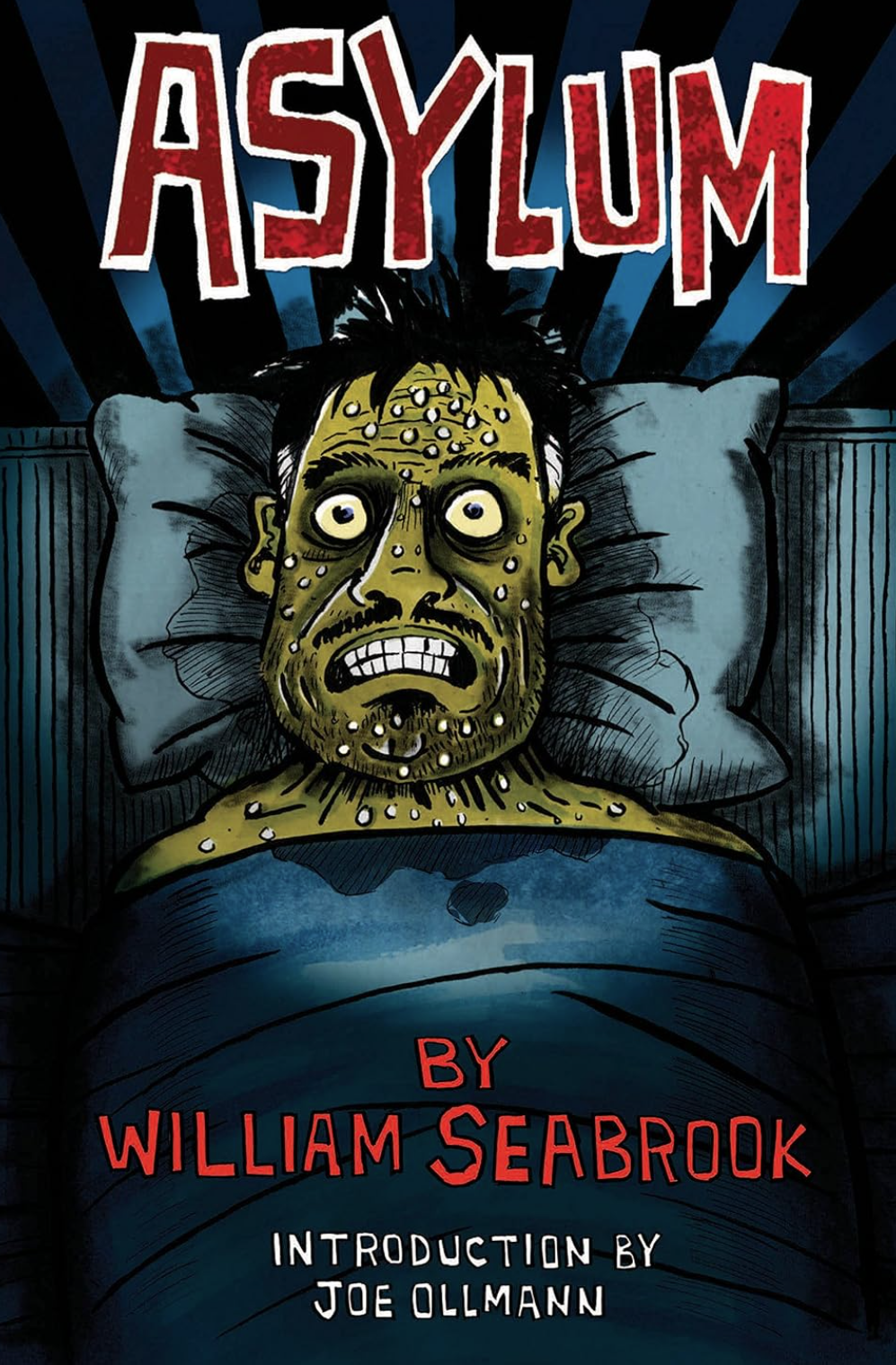
An interesting look at the mental health system in America in the 1930s. Lots of surprising things, namely less brutal and more chill than I expected. Namely the mental health system just put people in low-end resort type environment, really more of a county club prison, and waited out the mental illness. The author was a travel writer who managed to get himself committed a mental hospital to treat his alcoholism (that was not what they normally did.). This hospital would seem to be one of the nicer more prestigious hospitals and I’m assuming it was not representative of mental hospitals at the time.
This plan of treatment seemed to work for a while, until it didn’t. The author decided that after a while he was no longer addicted to alcohol so he could start drinking again and according to Wikipedia the outcome was predictable.
An interesting look at a different place in a different time.
I would read this only if you’re interested in period pieces of America in this time period. Usually I’m more into crime, and the general underworld of the 1910-1930s, but this is a different side of life in that era.
Summary + Notes
I had already slipped past the point where any sanitarium, hospital, treatment or environment which depended on my volitional coöperation, could hold out any hope. I knew that I had lost my will with relation to alcohol.
there was only left to me the wish—which is entirely different from the will—to be saved from my own weakness.
that I knew I was drinking myself to death, that I couldn’t stop—and that I wanted to be stopped—by force.
There is no law anyway—and of course there shouldn’t be any—to stop a man from drinking himself to death if he doesn’t disturb the public peace. And it seems that it is against the criminal law for private individuals, even family or doctors, to lock up or chain up an individual without due legal process—even though the individual invites it. Fortunately I found one friend who was capable enough, influential enough and hard-boiled enough to “call” what might have been a hysterical bluff and hand me the big-league works tied up with a piece of strong red tape and signed by a judge who had never heard of me.
I am sure there must be innumerable families who feel like doing something fairly desperate to save Uncle John or Brother Charlie from the well-known “drunkard’s grave,” but who would actually rather “see him in his grave” than shut up in a “madhouse.”
But since I intend to be honest, I may as well admit that such motives are incidental. I am not a reformer of public opinion, or a propagandist. I am an adventure writer of sorts, and I write this mainly as the story of a strange adventure in a strange place.
Too dangerous, I figured, to be allowed to come to the dining room. As a matter of fact, he was a Magyar from the Carpathian mountains where they hunt bears with short daggers.
It appeared that none of my organs was corroded, that I was just a plain drunk with the jitters and a reasonable chance of being cured, if there is any chance of a drunkard ever being cured, which the French and Spanish do not believe. The old Spanish proverb says, “There is no cure for a drunkard but death,”
They fixed the bed so it wouldn’t soak through to the mattress, then laid me straight and naked on the bed with my arms pressed along my sides like a soldier lying at attention and began swathing me, rolling me on one side and then the other, in tight wet sheets, so that the weight of my body rolling back would pull them smoother and tighter, over and over again, until they stood off to smooth any wrinkles out of the job and look at it and see if it was all right. I was flat on my back. Except that my head stuck out and lay comfortably on a pillow, I was the mummy of Rameses. I couldn’t bend my elbows or knees. I couldn’t even double my fists. My hands were pressed flat. I couldn’t move a muscle except by telegraphing a deliberate local order to it as oriental dancers do. This was the famous “pack.”
As a matter of fact, while they accept patients in this category and sometimes cure them, they are not very keen on taking them. They don’t like to take cases which they may not be able to cure, and, contrary to some impressions, the whiskey habit is harder to cure than the general run of ordinary mental derangements.
He had an authentic Boston Back Bay accent which made even Miss Pine and the doctors feel inferior, and the manners of Lord Godalmighty.
His unpopularity—to use a mild word for it—in the outside world had become as super as his superciliousness. He had been asked to leave a succession of banks and brokerage offices in which his influential family had placed him; his fiancée had thrown him over in disgust; servants, waiters, taxi drivers, clerks in stores invariably wanted to kill him, and no young women, or men either, of his own set could abide him.
It isn’t drinking that makes a drunkard. I had drunk for years, enthusiastically, and with pleasure, when I wanted to. Then something snapped in me, and I lost control. I began to have to have it when I didn’t want it. I couldn’t stop when I wanted to. Instead of being a pleasure any more, it was just too bad. I wasn’t here because I drank a lot … or too much. I was here, just like the rest, because I had lost control.
So here I was, an inmate of this extraordinary locked-and-barred kindergarten, for the same good reason as the rest. We were a bunch of grown men, most of us mature, who had lost control of ourselves in one way or another and who had to be controlled by others … that is, treated like a bunch of children … that is, put back in the nursery.
For years I’d been dining at nearer eight, with supper, if any, toward midnight or one o’clock in the morning.
We were sent to bed at nine o’clock. Ten hours’ sleep, instead of seven or eight, was supposed to be good for what ailed us.
So that he was more manager, more supervising boss than doctor, and the nature of his job was such that he would perhaps inevitably have been unpopular. He was, as a matter of fact, pretty generally unpopular, but the mutual antipathy which arose and grew between him and me was a personal matter, and everything I tell about him will be, of course, prejudiced. I am writing about a man whom I didn’t like, and who didn’t like me. It is consequently impossible to expect me to be fair.
Guessing was absolutely useless. I became convinced, and still am, that functional mental derangement, generally speaking, has no physiological, facial or cranial stigma. Congenital idiots, hydrocephalics, born imbeciles, of course have. But we had none such in our asylum. We were all cases who had gone off our trolleys, as it were, or had broken an axle, or had a monkey-wrench thrown in our gears, or had lost control, or had gone haywire, not been born so. And I assure you that we were indistinguishable to the naked eye from our keepers and attendants or from any average crowd on the outside,
it had to be in the afternoon because they hired a regular preacher and small choir from outside—and we mostly attended to look at the women patients, as the women patients attended to look at us.
The Russian Jew remembered that he had spent a Christmas Eve in jail, and Mr. Barnes remembered sitting all night in a cold Wisconsin railway station, waiting for a snow-delayed train. Comparing our Christmas Eve memories, I found that, being a sort of professional traveler, I could beat them all except the Russian.
God forbid that any of this record be or become a temperance lecture. I still think whiskey is a grand thing. I still believe that no man has ever become a victim of whiskey—but only of some weakness within himself.
I know a good deal more now than I did then, and I am inclined to believe that perhaps the only thing these doctors or anybody can now do for a certain type of drunkard is precisely to lock him up where he can’t get it. The method is beautifully pragmatic. … It is 100 per cent efficient. “Papa is killing himself drinking! How can we make him stop?” “The dog runs away. How can we make it stay at home?” Well, there may be many ways, through kindness, love, scolding, various sorts of treatment, moral or immoral suasion, by which you may or might be able to make the dog stop running away and papa stop drinking himself to death. But chain up the dog, by God, and he won’t run away. Lock papa up where he can’t get a drink, can’t bribe, can’t break out, can’t distill or ferment it himself, and, Q.E.D., papa will stop drinking. He’ll stop as long as he’s locked up, anyway, and if you keep him locked up long enough, he may get out of the habit.
“Everything,” says Epictetus, “has two handles; one by which it can be carried, and one by which it cannot.”
He was afraid I was turning chameleon, becoming institutionalized, too grateful and dependent on imprisonment, afraid I was still in love with the womb or the grave, and loved being locked up as a substitute for being dead—that is being afraid to face life.
“All fear,” he said, “all based on fear. You probably drank because you were afraid of something. You probably became a drunkard because there was something you were afraid to face sober.”
Presently, not suddenly, but slowly, not liking it, I knew: I was afraid I wasn’t good enough. Always had been afraid, but maybe in youth believed age would remedy it. Now I was middle-aged and afraid I’d never be good enough.
I am not ashamed to admit it, for it was not too pretentious. It did not involve wanting to be Shakespeare or Joyce. What I wanted more than anything was simply to be a good writer, and what I was afraid of was that I would never be anything at most but a good reporter.
There had been no loophole for subsequent alibis, no place to run away to, because I was already where I wanted to be—and instead of doing my best I took to drink and did practically nothing. I had been afraid to do my best for fear my best would not be good enough. A man stalls, loafs, procrastinates, sits in cafés, fails to throw all his best energy into a piece of work. He cannot bring himself to put “everything” into it, to “do his damnedest,” as the saying goes. Accused or self-accused of being lazy, he confesses—to laziness. But he doesn’t confess that he is afraid of destroying forever the illusion that he may some day ring the bell.
When I spilled all this, and more, to Paschall, he agreed that we’d probably arrived at the reason behind my prolonged heavy drinking and smash-up. Knowing it, he warned me, didn’t necessarily mean I was cured of it or free of it. He said the popular notion that twists, complexes, neurasthenic quirks could be got rid of by merely trotting them out into the daylight was all poppycock, psychoanalytic superstition. He hoped I might be happier now that I knew and admitted what was basically the matter with me, but said the main thing they hoped to do was simply to break me permanently from the habit of using alcohol as a psychic-pain-killer, as an anesthetic, as a coward’s-refuge, and that he hoped to goodness I’d reconcile myself to remaining locked up long enough to do that, for he believed they could do it, and remarked that even if it didn’t make me any happier it would, at any rate, be something.
The doctors knew what was the matter with him, if not the why of it. He had a horrid, pathological case of self-hatred, self-condemnation, self-loathing. He had never committed any shameful crime—he was the victim of some insane hallucination—but his state was similar to that which a sane man’s might be if he had murdered babies and kittens, or had cut his mother’s head off and thrown it to the pigs.
We often tried, but it would have been easier to cheer a deaf, dumb and blind man suffering from cancer. He was pretty bad.
The unpredictable nature of the happening through which the cleansing flame might descend made me wonder sometimes whether a major element in psychiatry might not be simply a matter of supplying the patient with safe, pleasant surroundings, and then waiting for something to happen.
Spike and I, for instance, were sometimes mildly amused by the delicatessen merchant who believed he was Napoleon Bonaparte, but the man who found it uproariously funny was the one who was sure he was Napoleon himself.
A “humming bird” in the argot of the attendants, is a patient addicted to screaming, crying, howling when not in discomfort or pain.
This being true, I may add that a good deal of the stuff that goes on in such an institution is funny, de facto, whether it ought to be or not, and that any picture which leaves it out would be sentimental buncombe.
That is, Clark was trying to tell me, but he said that it was hard to remember. It is always similarly hard to remember, he said, precisely what intense physical agony is like after the pain is over. An impacted wisdom tooth or a thumb caught in a slammed automobile door. You remember it, he said, but not really.
The only thing they agreed on was that it was a million times worse than being “haywire,” which was the local slang for hallucinated and violent.
I sometimes thought that he would inevitably have been canonized if he’d been shut up in an eleventh century monastery instead of a twentieth century mental hospital.
Charlie was “possessed,” he was a crazy man, but apparently possessed by gnomes or angels rather than by demons. I
It distressed me that certain mean, irritable crazy men on the back halls were still mean and irritable when they moved, cured, to the villas. It made me know I would always be a neurasthenic man, a frequently unhappy man, afraid of life, whether they cured me of being a drunken man or not.
His quarrel with fate, however, antedated Hollywood and the movies. He believed he was Pontius Pilate, and was always telling us about the dirty trick that had been played on him when he was Procurator of Judea. There had been the real Jesus, but there had also been a double, a man masquerading as Jesus who was a homosexual degenerate and criminal of the worst sort. So that he, Pontius Pilate, had convicted the real Jesus of all the things the false Jesus was guilty of. “Everybody was fooled as well as I,” he would shout, “yet I got all the blame.”
Of course, I got mad, lost my temper, and began to be unhappy again. I realized that by general rule, by blanket rule, by rule-of-thumb, his ruling was defensible. But I hated general rules. I saw myself, as every individual does, as an exception. I saw myself caught in Quigley’s damned red-taped cogs again. And, of course, on top of it, disliking him, I naturally belived, and still do, that he took a smug, sadistic pleasure in refusing to let me do what I wanted.
I had run away ineffectually at six to be a pirate as all children do, and instead of getting maturer powers of adjustment as I grew older, I had been running away ever since. At twenty I had run away to be a tramp. Later, with no better motive, I had run away to war. I had run away to the East and West Indies, to the Arabian desert, the Kurdistan mountains, the jungles of Africa. I had run as far as Timbuctoo, and had stumped my toe, and had hurt it so badly that I ran away once more with a bottle, to be a drunkard and forget it. I had said on all these occasions, sometimes proudly, that I had been running to some place or some thing, had invented plausible reasons and produced by-products. Now I knew that all the time I had been running away from something, and that the thing had always been myself.
I was locked up where I couldn’t run away, either by boat or bottle. I had to stay with myself and look at myself and it wasn’t pleasant. I saw, for one thing, that I had nothing to blame on whiskey, nor even on intoxication, which may sometimes be divine. Whiskey was a gift of the gods—dangerous, like fire and all gifts from heaven—to be used by the strong man with pleasure for joy, to solace and stimulate the imagination, to clothe reality in rosy light, evoke elusive happiness. I had misused it as a stupefying poison, to deaden consciousness—as an escape.
But most of all, I enjoyed my now familiar present friends, my fellow-inmates, so much that I sometimes wondered whether I’d find my sane friends as congenial.
The Armenian was still an Armenian. There was nothing anybody could do about that.