-
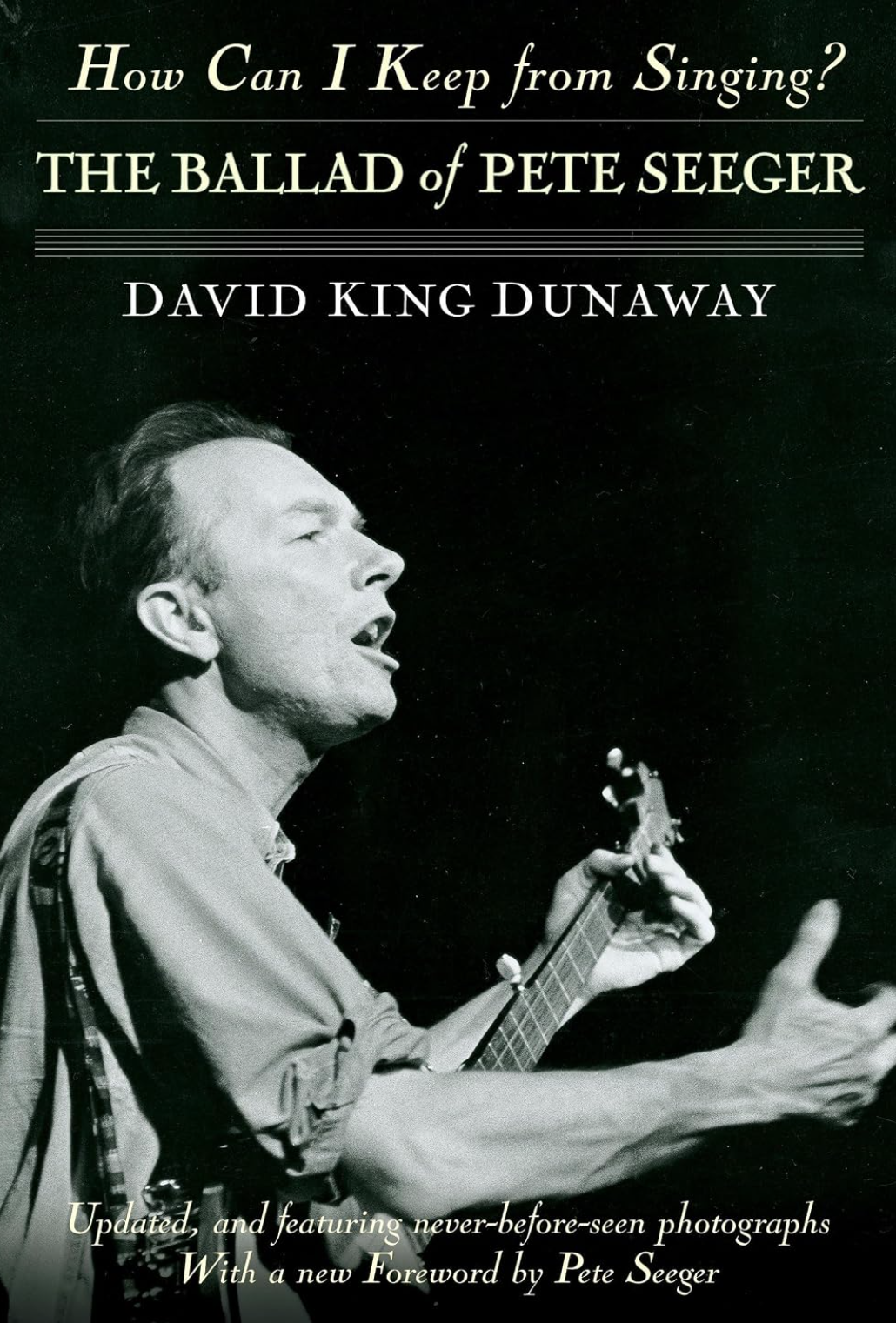
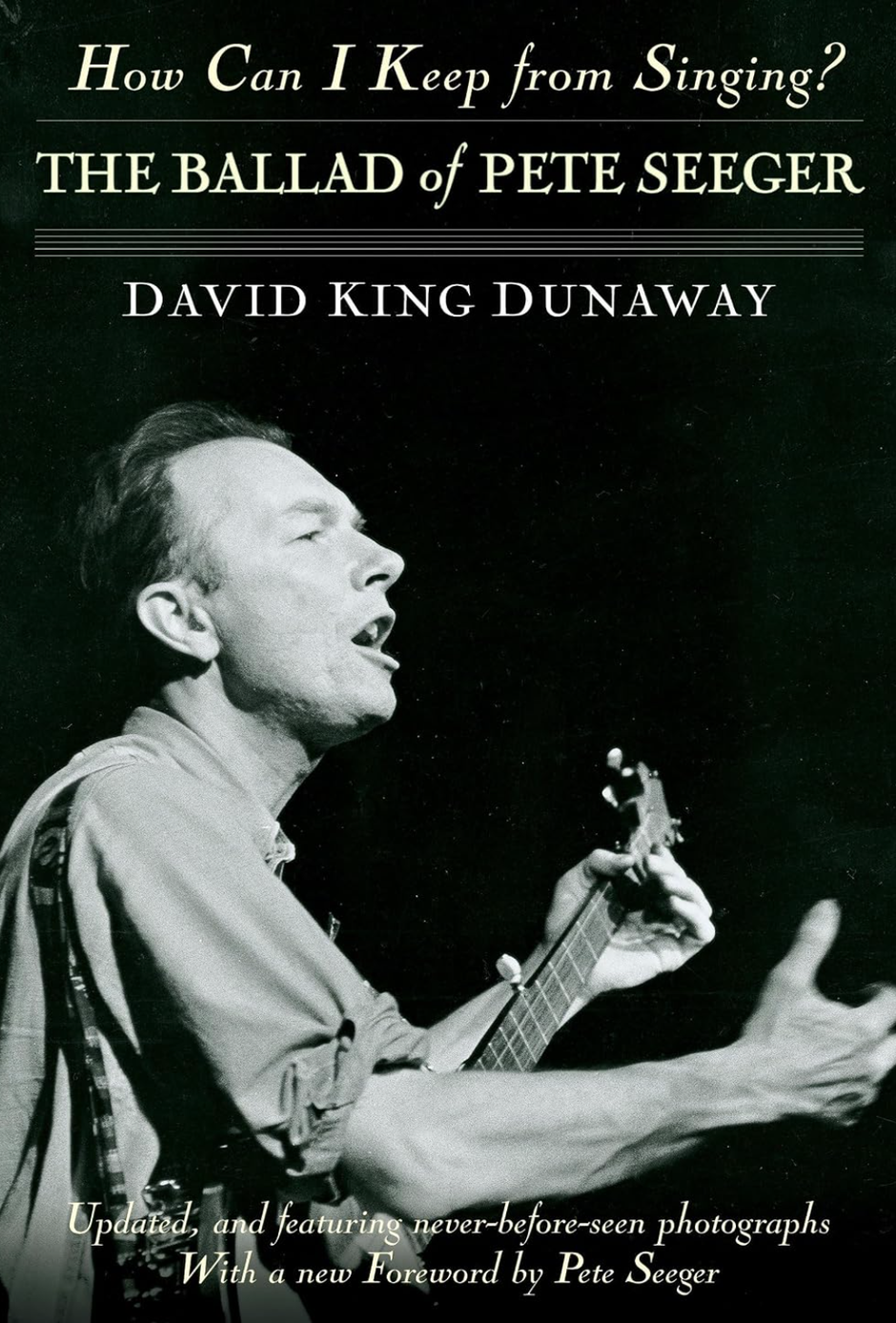
How can I keep from singing? The ballad of Pete Seeger
The Book in 3 Sentences
I am long overdue in posting this review (I finished it over a year ago!).
This is one of the last books I read from my “read everything about American folk music phase”. This is the story of Pete Seeger, one of the more foundational people in the folk music movement. The Bob Dylan movie that came out recently was much more accurate than I would have thought regarding Seeger. Seeger influenced nearly everything in some way for many decades in folk music.
The quotes do a decent job of summarizing the book. Seeger was very much a man of his time and era. He was born a sweater wearing grandfather type with oppositional (I don’t really give that much credence to any of his particulars, he was not an idealogue in that way. That is my conclusion, not the books) politics, heavily ingrained though not expressed old world religion, deep craftsmanship and a natural aptitude for caretaking whatever he was interested in. The book describes him as “hard to like but easy to admire” which would have made a better title for the took.
How I Discovered It
My recent obsession with American folk music.
Who Should Read It?
It is one of the top 3 I would read if I could only read 3 books on the topic. I would recommend it to anyone looking into the topic. It fills in many gaps, both with the music and the times it was written in and performed.
Summary + Notes
His niche has so far lasted seven decades of performing.
Family members tell of his immense reserve, insisting they’ve never been close. Despite his warmth on stage, there’s not much left to meet humanity one-on-one.
Her ancestor chart goes back further than mine. Mine just goes back to the seventeenth century, hers goes back to the sixteenth century with members of Parliament. She does not talk about it.”
Another entry reveals Seeger’s precocious interest in radical politics. At thirteen, he already had a subscription to the Communist literary magazine New Masses; he was a “red diaper” baby a generation before Dr. Spock. Just as he’d follow in his father’s journey into American folk music, so he’d read Mike Gold in the ’30s, as his father wrote a column on music for the Daily Worker. “Fascism is the last stage of capitalism,” Seeger scribed with the orthodoxy of adolescence. “The greatest danger [to revolutionaries] is the Greenwich Village type, the bohemian.” Stern words from someone who’d eventually spend four years living in the Village.
The entertainer’s reply shows a selfprotective irony. It was a shame, he wrote the Society, to cave in to a few threats. Not only had he and his parents lived in New York for years, but a great-uncle had been the mayor, the man who christened the Brooklyn Bridge.
A harbinger of problems to come. Seeger’s characteristic stance—head lifted high, forward of the body—leaves his vocal chords unsupported. In time, it will rob him of his voice.
His words carry unselfconscious modesty, mixed with the antipsychology, anti-individual canon of historical materialism: One life doesn’t count; only the many matter. “If Seeger ever wrote his autobiography,” fellow songwriter “Country” Joe McDonald mused, “he’d content himself with a half-dozen entries in the index.”
He was also influenced by the Anonymous movement, a fascinating group of artists in Paris in the 1920s, who refused to sign paintings. They insisted that works of art must stand on their own merits, not on the artist’s personality. Thus, talking with Seeger about his past is like starting a detective novel halfway through; you’re never sure whom to follow in the plot.
As the biographer Plutarch tells us, attention to small tasks characterizes people more truly than their heroic moments.
A well-known guitarist, Bob Gibson, later told Seeger, “You know, I was raised in Peekskill, and I know the whole story behind that riot. The Klan organized it.” “How?” Seeger asked. “I never knew for sure the Klan was up there.” “Oh, yes,” Gibson replied, “and they were in cahoots with the police. They had that place surrounded with walkie-talkies, just like a battlefield. You didn’t have a chance.” “How do you know?” “My father was on the Peekskill police force.”
Seeger’s character manifested itself in optimism and the stubbornness of principle that made him bring his children to a riot. He was a stubborn man, a tall skinny fellow who didn’t like to be pushed around. The stones thrown at Peekskill (and the pickets and blacklisters who followed later) couldn’t penetrate his shell of idealism. Peekskill only forced him toward those who throw the first stone, a passion that led him over and over to a cycle of confrontation and controversy and, eventually, to discontent.
“My ancestors came to this country because they didn’t want to answer questions put to them by the then un-English committees. One of them, Elder Brewster, was on the Mayflower with Governor Bradford, one of the leaders of the Plymouth Colony. His descendants that came my way were staunch upholders of independence among the colonists. Not one was a royalist.”
Seeger’s Puritan ancestors inhabited a world of callings and righteousness and moral uprightness, of Good Works to edify their brethren. Part of this doctrine was to bear witness, to oppose that “oppression which the Lord groaneth under,” and to condemn pride, worldliness, and want of truth. It was a social duty Seeger was ready to accept.
In 1919, when his third son, Peter, was born, Charles Seeger had become as much of an outcast as the radicals in Peekskill. Yet Charles was brought up not as a radical, but as a gentleman scholar: erect and precise. Growing up on Staten Island, Charles traced his ancestors back to Gebhard von Seeg of the Crusades and divided the world into three categories of worth: “the Seegers, friends of the Seegers, and everyone else.” The Seegers had four servants and a plot of land large enough for twenty houses. Pete Seeger’s grandfather had made a small fortune in sugar refining in Mexico, and he lived in semiretirement, writing his memoirs and playing Wagner by ear. The family took pride in being Yankee: Probity, self-control, and strict table manners were expected.
In 1911 they’d married and soon afterward set up their household in what seemed another continent: Berkeley, California.
The fellow who said this probably belonged to the Industrial Workers of the World (IWW), then organizing in California’s fields. This union of bindle stiffs, miners, loggers, and rebels had an enthusiastic (and musical) membership out west; when songs wouldn’t get them better working conditions, they weren’t shy about sabotage.
By 1917, though, the university community was becoming solidly pro-Ally—except for the Music Department, which revered Germans from Bach to Wagner. Not one to shy away from controversy, Charles told his dean (an Englishman) that Germany and England were both imperialist powers, and as far as he was concerned, they could fight each other to a stalemate. Rather than sounding principled, his stance came off as imperious.
Adding a primitive camper with a hammock, Charles, Constance, and their two boys traveled the open wilderness that was prewar California, up the dirt roads and canyons to the waterfalls of Yosemite. The trailer bumped along back roads to cross the Sierras at Tioga Pass, two miles above sea level. Below stood a forest of sequoias, the oldest in the nation: dark, leafy giants, tall as skyscrapers. The hostilities of Charles’s life in Berkeley fell away among the rivers and snowy mountains.
Like Siegfried Sassoon or Rupert Brooke, Alan Seeger saw WWI as a chance for a generation to prove itself.
On a hot September afternoon in 1918, the Seegers left their house keys with a tenant and headed east. Charles’s “sabbatical” from the university would last forty years.
Charles and Constance settled into separate bedrooms, and on May 3, 1919, a month before the treaty ending World War I, Peter Seeger was born.
After settling in, the Seegers hiked through the fragrant hills of North Carolina, inviting local residents to free classical music concerts. Amazingly, the mountain folk came out, and went away in awe: imagine a fiddle making sounds like that!
The radio also brought lesser known tunes, particularly at night, when its waves bounced off distant clouds and the fiddle tunes of John Carson and Eck Roberts drifted up from southern stations. Soon the Carter Family and Jimmie Rodgers would be heard—but not at the Seegers’, where only classical music was welcome.
After their fight, Charles put the three boys in the car and took them to his parents’ house. Divorce split the allegiances of the Seeger boys: John and Charles hewed to mother. To them, Charles had walked out, or Constance had thrown him out for good reason. But nothing was discussed. At one point Peter burst out, “We’re having such a nice time—where’s mother?” No one told him his parents had separated. In Peter’s case, neither really had custody; he was always off at school. The closest he came to a home was the barn in Patterson.
Peter had been sent off to boarding school at four, an unusually early age. Like many children of divorce, Peter was caught between parents and developed an aversion to family quarrels. Constance felt wronged by Charles, who still hadn’t found a full-time job. She had her smooth, milky complexion, but ever since Charles had been fired in Berkeley, the pressure of supporting a family had soured her inside. The couple also had radically different ideas about music; Peter’s musical education was “the last big fight” the couple had. Was Peter to be trained properly, Constance demanded, or was he going to grow up a musical illiterate?
Of the three sons, Peter was the only one who refused piano or voice lessons. Yet he wasn’t unmusical, just undisciplined: “Whistles, anything that made music I banged on. I didn’t want to study, I was just having fun… The idea of reading notes was as boring to me as painting by numbers.” Another problem was Peter’s foot. According to the way Constance taught, the whole body was kept motionless, so that the energy would pour out in the music. But no matter what he did, Peter couldn’t keep his foot from tapping. In his eighth year, his parents gave him a ukulele. The uke seemed daring, with its light, unelaborated sound. Peter played it constantly, till his brothers lost their patience; then he would sneak up on them from behind the sofa and start again.
Seton—a founder of the Boy Scouts—thought boys should pattern their ideal on the American tradition: self-reliant, strong, moral, and clean. Whatever you had you shared.”
Seton’s teachings offered Seeger dual ideals: the independent axman, who survived outside society by his strength, and a tribal communism of uncompromising moral purity. In time Peter became both: the woodsy, self-sufficient craftsman and a communalist, looking for his tribe.
Between this medieval chivalry and Seton’s Indians, Peter steeped himself in absolutes.
Part of his isolation came from his isolation from his family. From his seventh till his seventeenth year, he saw his family only at Christmas, Easter, and summers.
Charles had finally found a way to mix music and activism. He belonged to a group within the Degeyter Club, the Composers Collective, which tried to write songs for picket lines and unemployment demonstrations. As devotees of the new dissonance, however, the musicians sought to uplift workers’ musical tastes while stirring up revolution. The Composers Collective was probably the first group in the world to attempt a twelve-tone protest song.
Resistance was part of the New England nature; his great-grandfather, a Huguenot preacher, would have been proud. Peter could look back on the generations of predecessors who viewed the world as a thing to be reformed.
He didn’t notice that a few blocks away, another contingent paraded separately from the Communists—the Socialists. The “family” Peter had joined was not on speaking terms with its relatives.
Avon trained boys to take their place in the company of men, to preserve “the elite of the well-ordered mind,” as their brochure promised. Peter was going as a scholarship student, but Avon’s dress code—Brooks Brothers suits with starched wing collars and bow ties—were required for supper.
Unfortunately the magazine publishing Dreiser, Anderson, and Dos Passos was once censored by the Party for, in a wonderfully arcane phrase, “a lack of political intransigence.”
As Sherwood Anderson commented, on being asked the difference between Socialists and Communists, “I guess the Communists mean it.”
To others he seemed a goody-goody; he thought himself a rebel.
Older, betterread, Alan Lomax became a concerned older brother to Seeger.
Seeger was meeting Party members debating the new slogan “Communism is twentieth-century Americanism”; Paine and Jefferson were resurrected as American radicals. The Seeger boy fit right in to this new patriotism, with his all-American stock and wholesome habits. He came of age in one of the rare moments when American radicals succeeded by working in coalitions rather than in sects. He never forgot this convergence: Folk song, radicalism, and patriotism blended in his mind.
No raja’s son could have had better access to America’s musical treasury, a privilege he later shared with Ruth’s children, Mike and Peggy Seeger.
Ironically, the year Pete Seeger joined the Party was the year his father quit: “When I was fourteen, I remember asking him, ‘What are the bad things about Communism? Aren’t there good and bad things about everything in the world?’ He took all of ten or fifteen seconds away from his work and said, ‘No, it’s all good.’ Then he went back to his desk. “In 1937, he backed away from the Party when he read a manuscript of the Moscow trials: ‘They’re obviously tortured confessions!’ He wasn’t going to become a Trotskyist or an anarchist. He wasn’t going to be a dutiful, loyal member anymore. But I think he wanted to let me find my own way.
He took leave of the Charles River and his few friends. One afternoon before he left, he passed John F. Kennedy bustling across the yard with his personal secretary. If JFK became the most famous graduate of the Class of ’40, Pete Seeger was its best-known dropout.
Toshi—the name means “beginning of a new era”—had luxuriant jet-black hair and an adventuresome streak inherited from her mother, the radical in an old Virginia family that included Jim Bowie of the Bowie knife. Peter shyly asked her about herself. She told him how, over her grandparents’ wishes, her mother had married a Japanese exile and then went to Europe, to bear her baby in peace. Because of the Oriental Exclusion Act (which prevented children of 50 percent or more Oriental blood from entering the United States), she would not have been allowed in the country had not her mother smuggled her in, lying to the customs officer that the vivacious baby was 100 percent Caucasian.
Despite his gentle side and a tenderness for children, a reputation for violence followed Ledbetter onstage like a sessionman no one paid.
Painting remained his ambition until one day when an art teacher, Arthur Stern, casually asked him what else he did. “Well, I play the banjo,” Peter answered brightly. “I’ve never heard you play the banjo,” the instructor said, “but I’d suggest you stick to that.”
Yet the widespread public association of folk music and social causes dates from the mid-1930s Popular Front era. Wobblies
Woodrow Wilson Guthrie was born on Bastille Day, July 14, 1912, in Okemah, Oklahoma, later moving to Pampa, Texas, before making the dust bowl migration to California. He came from a more middle-class family than many imagine; his maternal grandmother was a schoolteacher. Despite a hard childhood, with his mother in an asylum, his sister burned in an explosion, and his father bankrupt, Woody had an optimistic, come-what-may spirit. Yet a hard loner sound colored his voice; he could never really belly laugh.
If Seeger was disappointed, Alan Lomax thought it a momentous occasion: “Go back to that night when Pete first met Woody Guthrie. You can date the renaissance of American folk song from that night. Pete knew it was his kind of music, and he began working to make it everybody’s kind of music.…It was a pure, genuine fervor, the kind that saves souls.”
ALL THIS SINGING made a musician of Seeger. From 1939 to 1941 he learned his basic musicianship from Guthrie and Lead Belly. Lead taught him bass runs for the 12-string’s doubled bass notes tuned an octave apart; Lead patterned them after the piano breaks in Louisiana boogie-woogie. From him Seeger also learned the importance of rhythm. Woody taught him to play simple and straight, sometimes playing a ten-verse song with just two chords. Seeger and Guthrie differed in vocal color and tone, the qualities that distinguish two voices singing the same notes together.
He eventually paid Woody back for his teaching by exposing millions to Guthrie’s music. Woody was awfully rich ore, but without the miner and the mill, many would never have seen the gold.
Music was not all Guthrie taught Seeger. He absorbed Woody’s healthy disinterest in commercial success, from episodes like Woody’s contract with the Model Tobacco Company, which had paid him a princely two hundred dollars a week to sing on a radio show, on condition he keep his radicalism off the air. Woody decided he liked freedom better than Model Tobacco, and the two parted ways. Guthrie wasn’t above commercial work, so long as it didn’t disturb his lifestyle. Seeger, more of a moralist than his friend, made a credo out of noncommercialism.
Woody had grown up on country music and Seeger on pop tunes, two distinct musical cultures. (When the same company had both pop and country releases, it issued them on different labels, in different areas.) From this union of Seeger and Guthrie came a new music: citybilly meets hillbilly—a blend of politics, country music, and ballads.
“Finally in Rapid City, South Dakota, I did it. I’d had to pawn my camera—worth sixteen dollars and hocked for five—to get a cheap guitar, because I’d broken my banjo. There I was, a thousand miles from home. I had to earn some money right away, so I hit the saloons. The first night I made five dollars and got the camera back with the song ‘Makes No Difference Now.’
Travel had toughened him, and he knew he’d never go hungry if he held on to his banjo. He came back bubbling with Americana: Folk music was patriotic. But New York City radicals, many of them Eastern European immigrants, couldn’t share his enthusiasm. When a friend applied for a job as a music director in New York, radicals criticized him for being “too American” in his music, “just like Pete Seeger.”
He shared his problems with Lead Belly, who, despite his enormous talents, eked out a bare living in New York. While Guthrie and Seeger had traveled Route 66, Huddie had been in prison on Rikers Island on an assault charge, an embittering experience.
It upset Seeger to realize that, with less experience, he could get more work than Lead Belly—because he was white and talked the “right” English.
SEEGER’S APPETITE FOR TRAVEL approached gluttony. In October 1940, he took off again to visit Alabama. He was all legs in those days, full of Yankee stiffness and working-class affectations, such as refusing to wash. “I was worried about my beds, he was so dirty,” recalled his host, Mrs. Joe Gelders. To get him to clean up, the family had to promise washing would help the purplish-red acne that persisted in patches on his face.
Seeger’s association of folk music and antimaterialism may have come from mistaken notions of country living, but he nonetheless made it his life.
The Almanacs had done a good job for “the only group that rehearses on stage,” as Woody called them.
He had inherited money from one of the Boston Houghtons and enjoyed discussing the proletarian dictatorship out on a sundeck with a tall drink in hand.
Pete Seeger was the disciplined musician of the group, the central element that the others needed to function. “When Woody and I were together,” Lee said, “nothing much happened; we drank wine and talked a lot, had a great time, but no sparks flew.”
He came up with a moral, something he was always good at: “Take it easy, but take it.”
“He wasn’t the greatest banjo player, he didn’t have the greatest voice, but there was something catchy about him.…It was a time when the left wing was very romantic about America; in literature, these were the days of Carl Sandburg, Archibald MacLeish, and Stephen Benet. Then suddenly it was as if the music of America had arrived,” carried on the shimmering strings of a young Yankee banjoist.
Yet as a profession, songwriting was on the rise; technological advances in record production had lessened the music industry’s dependence on sheet sales; and while formulaic, Tin Pan Alley–style songwriting still dominated the industry (20th Century Fox alone employed twenty-five songwriters for its films). Records had become less expensive to produce, thus opening opportunities for independent songwriters. “Anyone could write a popular song,” said Irving Caesar (who, with George Gershwin, wrote “Swanee”). “That’s no great shakes. But to be able to write a song any time of day and night, that’s what a pro had to be able to do. I wrote my songs any time, on a bet.”
Even friends such as Dorothy Millstone, progressive journalist for the New York Post, grew uneasy. “After hearing that Russia had been invaded, I hung up the phone, and the first thing I did was break my Almanac records.”
Glenn Miller could play the same sweet tunes no matter what happened to the world, but Pete Seeger faced the occupational hazard of political singers: song obsolescence.
“Woody was also continually frustrated (and amused) by the curves of history which were wiping out our repertoire,” said Bess Lomax. “He really wanted to write songs that would last. To express this, he parodied a song he knew… and called it ‘On Account of That New Situation’”: I started to sing a song To the entire population, But I ain’t a’ doing a thing tonight, On account of this new situation.
On nights they had bookings the group raced through what they called “the subway circuit.” Around nine, they went off to their first booking (worth perhaps ten dollars for a twenty-minute set); then they rode the subway to the next one, returning home at 3 or 4 A.M., after as many as five appearances. The Almanacs learned to tune fast; if they overstayed, they lost the next booking.
To pay the ninety-five-dollar rent for their three-story house, the group held “hootenannies,” named after the ones Seeger and Guthrie had attended in Seattle.
They worked with folk songs because they loved them—particularly Seeger, who had become so absorbed in the banjo that even simple conversations grew difficult. He played for hours at a stretch, his back against the living room wall and his long legs jackknifed across the floor. Coming home from a night of bookings, he would play a few more tunes before bed.
“The idea of plucking up on a note and then brushing down on the strings is much rarer, as it were, than the style of plucking up on a note and then brushing up on the strings with the same finger. Bascom Lamar Lunsford was just the first person Pete saw play in that way, and Pete assumed it was universal. It’s still not a widespread banjo style. Commonly, it’s either frailing and brushing down or brushing up when you’re plucking.”
Pete Seeger was out of his depth. He could sing, play, and make up songs that pleased urban audiences, but because Garland’s political songs came from his experience as a coal miner, they had a solid feel; Seeger’s attempts resembled furniture made of plywood with a folk veneer. He was a citybilly, destined to be a middleman between rural singers and city audiences accustomed to crooners like Bing Crosby.
“Fellow travelers” supported the Party but didn’t join up; that was like standing outside a Students for a Democratic Society meeting in the 1960s, while the insiders targeted the next demonstration. Being approached about membership carried a feeling of being chosen, of becoming a tough, sacrificing comrade; not everyone was invited.
On his part, Seeger viewed the Party the way suburban mothers sometimes regard the PTA: an organization worthy of support, but not great fun—in a word, duty.
Whether urging them to clean up or cut down on their drinking, Seeger was the kind of roommate whose vacations are occasionally welcome.
Even the Party agreed on preventive detention for Japanese Americans.
because her father, Takashi Ohta, was not one to hide his background. An adventuresome exile from a highly respected family in Japan, Takashi had traveled the world as a soldier of fortune, fighting under Sun Yat-sen, hiking the Gobi Desert, and serving in the British Merchant Marine. He fascinated Peter; his life was the stuff of romance. If Toshi’s father had been on the West Coast, he would have been rounded up and put in a camp; in New York, the FBI came and took his binoculars, camera, and bread knife.
Popular outrage at Japan and their own hatred for Hitler led the Almanacs to write war songs in earnest. The most successful of these was “Reuben James,” the story of the ninety-five people drowned in the first American ship torpedoed in World War II. On first try, Woody had turned the passenger list into an impossibly long ballad, listing everyone who went down. Seeger doubted anyone would listen to the end. The Almanacs discussed it in a circle in the living room. Woody was adamant and ready to spend a week memorizing the verses. Finally someone asked, “What were their names?” and that became the chorus. This was Almanac songwriting at its best: direct, nonrhetorical, focused on people instead of statistics.
The more insulting they became, the more the owners laughed. It was a devastating experience: “I don’t think Woody ever got over it. He’d finally gotten to a territory where he couldn’t be outrageous enough,” said Bess.
While the FBI hunted the Almanacs’ past, reporters in New York had done their own research, which soon hit the front pages. Seeger’s insistence on keeping the Almanac name turned out to be a disaster. Three days after the This Is War show, Seeger picked up the New York Post and read PEACE CHOIR CHANGES TUNE. The World-Telegram proclaimed: SINGERS ON NEW MORALE SHOW ALSO WARBLED FOR COMMUNISTS. The stories rehashed the Atlantic article “Poison in Our System,” published before the Nazi attack on Russia.
The inequality of talent within the group reemerged: Only Seeger and Guthrie had solo bookings. In February, they were about equal. By June and July, dates marked “Pete” took up half the Almanacs’ bookings.
the Almanacs’ publisher. “Gordon,” Miller had said, “do you realize Pete’s the second best banjo player in the country?” Gordon smiled. “Seriously,” Miller continued, “there’s only one better—Uncle Dave Macon of the Grand Ole Opry. And Macon’s seventy-one.”
Seeger used his father’s Washington contacts to transfer into the Special Services Division (for performers). A
These songs held an important lesson for Seeger, though perhaps he was slow to learn it. Propaganda becomes unnecessary when inequality is obvious; no one had to write a song, for instance, to motivate GIs to break into the officers’ beer. This distinction— between songs created by people instead of for them—would prove crucial to his continuing hopes of inspiring singing in unions.
He made friends through music and discovered the side effects of community singing: the trust between song leader and singers, the chesty warmth that comes from strangers resonating in harmony. All this only made him ambitious for a larger organization than the Almanacs. “After the war,” he wrote Toshi, “I want to organize a very large chorus of untrained voices.”
Now I know [my profession] won’t spring from intuition and unschooled genius, but take hard study and perseverance and concentration.”
At twenty-six, with four albums, a national tour, and appearances on coast-to-coast radio, Seeger felt like a failure. No worldly success could satisfy his ambitions. As William Perkins wrote in 1612, “A vocation or calling is a certain kind of life ordained and imposed on Man by God, for the common good.” Seeger might not have chosen these words to characterize himself, but they’re apt. He also suffered from the emotion his Puritan ancestors called humility: the modest pride that let a John Brown rouse a congregation against slavery, then weep quietly at his own unworthiness.
Asked about his purpose in life in January 1946, he answered, “Make a singing labor movement. Period.…I was hoping to have hundreds, thousands, tens of thousands of union choruses. Just as every church has a choir, why not every union?”
New York’s ethnic audiences knew jazz, Yiddish, or Slovak tunes better than Appalachian ones. Still, Seeger was a musician first, and a politician second.
The couple lived traditionally; Toshi took care of the children and filled a salad bowl the size of a horse trough for hungry guests, while Seeger came and went “like a boarder.”
An interesting and handy device. Puritans in colonial America believed in something similar, a “reprover,” which kept a lookout for wayward impulses and pride. Seeger’s “little eraser” let him float over office politics, trusting that the good cause would keep people working together.
The FBI took People’s Songs more seriously than the Communist Party did.
In its humdrum way, the Bureau was an accurate critic: Its analysts realized (more fully than Seeger did) the limits of song in producing change without a mass social movement. They understood that Seeger sang for “red intellectuals” rather than any sector of the working class. Yet the FBI concluded that PS threatened national security, for songs nourished the radical community.
“I remember a courthouse in Mississippi, where an absolutely livid white southerner stood in front of me and said, ‘Bet you can’t sing Dixie!’ I said, ‘Sure I can, if you’ll sing it with me.’” The Dixiecrat stood there furious, unsure whether to sing or not, while Seeger sang not one, but three verses he had learned in the army.
Seeger and Wallace shared a vision of an America of rustic virtue, where people helped strangers and their union brothers, where black and white sang in church together and sat down to Sunday dinner afterward. In a land of honest woodsmen, confrontations like this were foreign. “Am I in America?” Wallace had to ask, waves of hatred roiling around him.
PS ended so fast board members on the West Coast never even had a chance to vote.
It was a time of business unionism, as the labor movement evolved from the IWW’s One Big Union for All to the AFL’s “We represent our members.” Industrial workers wanted refrigerators and washers, not labor conflict.
He told the FBI of his alarm “at the efforts of Communists and Communist sympathizers to infiltrate and gain control of Folksinging.” Emrich worried that these singers “might be unpatriotic”; he eventually wrote Seeger “regretting” that he had no resources to spare.
Seeger decided to build a log cabin. In the spring of 1949, he and Toshi borrowed $1,700 from family and friends for a down payment on seventeen hardy acres overlooking the Hudson River.
To Seeger’s delight, the two versions of “Hammer” harmonized. At his concerts people would sing in unplanned harmony; he couldn’t stop talking about this, insisting politicians could learn from it.
The Weavers sang their left-wing repertoire and songs made up for the occasion. From a nearby window, tomatoes started splattering the unprotected truck. Seeger looked up anxiously: “What do we do now?” “Be glad they’re not bricks,” Gordon answered with a grim smile.
“We’d like to sing a song from South Africa by Solomon Lindy—about the lost king of the Zulus, Chaka the Lion. The legend arose that he didn’t die, he simply went to sleep. Someday he would wake up and lead his people again. The African people, slaves in their own land, sing that the lion is not dead but sleeping. Well, all you lions out there.…” Seeger strummed the banjo and started a musical chant: “Way-up boy, Wimoweh, Wimoweh,” repeated by the audience. Against this rhythm, Seeger’s falsetto rose and bounced off the ceiling.
They interpreted the Lead Bellys and Guthries, who were too foreign for mass tastes.”
Seeger hoped to do better this time, telling Lee, “Performing commercially is something that makes you want to see if you can do it as well as the next fellow.” It might sound strange for Seeger to champion freedom of the marketplace, but deep down, he believed in very American symbols: log cabins, the nuclear family, the Bill of Rights. By venturing into the music industry’s arena, Seeger was saying, let the best song win, just as folk songs are themselves products of a musical Darwinism.
As the Weavers grew more popular, some former friends attacked them. This was the period of the Communist Party’s “white chauvinism” campaign against racial prejudice, and Irwin Silber took the Weavers to task in a column entitled “Can an AllWhite Group Sing Songs from Negro Culture?” The Weavers were now “‘chasing the bitch goddess Success, falling into a rut with their music to please their upper-class nightclub audiences.’ Pete
All these factors—combined with the paucity of Party members in the Beacon area and the Party’s halfhearted support of People’s Songs—caused Seeger to drift away, though friends remained in the Party. There was no dramatic break, no denunciation. He just stopped going.
ON JUNE 25, 1950, just as the Weavers’ first records appeared in the shops, the Korean War erupted. The casualty lists made Communists into America’s mortal enemies and jeopardized the tenuous East-West division of Europe. Julius Rosenberg was about to be arrested for allegedly selling atomic secrets to the Soviet Union. And at the end of June, Red Channels: Communist Influence on Radio and Television appeared from the publishers of Counterattack. Bound in red with no authors listed, Red Channels destroyed hundreds of careers in a single edition. On the cover, below the title, a microphone leaned left as a crimson hand seized control. In phrases like “Where there’s red smoke there’s usually Communist fire,” the book listed artists and entertainers with alleged “Communist-front” associations:
She hadn’t meant to be a road manager, but no one would let her stop. Throughout the trip she worried: Six months is a long time for a four-year-old. “We drove back to Beacon and there, by the road, was Toshi’s father and the two babies. Her father said, ‘There they are!’ We stopped the car and got out and Danny says, ‘Ta-papa said, “These are your mother and father,” but you know, I didn’t recognize you when you got out.’” Toshi never quite forgave her husband. This was the last tour she made with the Weavers.
Harvey Matusow, an ambitious informer.
Harvey had just won a twelve-day trip to Puerto Rico for selling Daily Worker subscriptions; many were later found to be duplicates.
A folklorist might complain that once Seeger “filtered” a song,
In his later autobiography, False Witness, Matusow recanted; in gritty detail, he admitted committing perjury and conspiring with U.S. attorneys to give false testimony. His conscience had caught up with him, but the price was that no one, Right or Left, trusted him. For his scruples, Harvey the ex-ex-Communist received five years in Lewisburg Federal Penitentiary.
At Harvard, he (like Seeger) was moved by the Swedish writer Swedenborg’s antimaterialism. He earned his living by an invented profession: supplying farmers with apple seeds. Chapman would trade seeds for a night’s lodging, just as Seeger had traded his paintings—though Chapman, unlike Seeger, had a head for business. “Many thought him eccentric, thousands loved him,” Seeger wrote, “but all recognized the practicality of his system.”
In the 1950s, an underground did exist in the United States, including Seeger’s former comrades. The Communist Party, expecting its leaders to be assassinated in an armed fascist uprising, had set up a clandestine network of cadres “in deep freeze.” These tactics unfortunately reinforced the impression created by anti-Communist “I Spy” films and television programs. In June 1954, a Harvard poll found that 52 percent of Americans favored imprisonment for Party members.
FORTUNATELY, SEEGER FOUND a patron in Folkways Records and his old friend Moses Asch, son of Yiddish writer Sholem Asch and visionary of the folk song set. Despite mikes falling off rickety stands and people opening the studio door and spoiling his recordings, Moe Asch and his assistant, Marian Distler, documented an American folk song revival long before anyone cared to buy the records.
By 1955 Folkways had released twenty-nine Seeger albums, including two excellent ten-inch records, Darling Corey and The Goofing Off Suite, both of which show his mastery of traditional Appalachian banjo and his experiments in fusing classical and folk styles.
Someone joked that the committee was hunting musicians overthrowing the government by “force and violins.”
His life had fallen into a pattern: initial success, attacks, and censorship.
Locked out of the clubs, he went into the recording studio, turning out discs at the astonishing rate of six per year from 1954 to 1958. (This level of production was due to Folkways’ complete disregard for normal recording procedures. Moe Asch never even kept a list of Seeger’s sessions.)
Many of the records were for children, and they introduced songs Americans now take for granted: “Frog Went A-Courtin’,” “This Old Man.” Probably a few hundred thousand children first heard American folk music through these recordings.
The board stopped short of lodging charges, but the irony of the situation was not lost on Seeger: The man who had done the most to spread labor songs in the United States was asked by his own union if he was loyal enough to be a musician.
Underlying these battles (and hundreds more that followed) was one critical factor his defenders rarely knew: that Seeger had been a member of the Party. Though his participation was insignificant—over the years he had attended a few dozen meetings—at the point when his membership became a public issue he did not step forward.
He did not criticize the Party publicly, however. Criticizing automatically made one a renegade, for the organization refused to distinguish the exfrom the anti-Communist. Members either followed Party discipline or they were out in the cold, isolated from friends, and suspect.
Seeger wouldn’t publicly criticized Stalinism for a half century.
For four or five years, Seeger had carried a musical phrase in his head, like an man saving string: “long time passing.” He had been struck by its melodic beauty: the four vowel sounds are sequential, opening up the mouth as they are sung. “All I knew was that those were three words I wanted to use in a song; I wasn’t quite sure how, where, or when. Suddenly it fit with this ‘Where have all the flowers gone—long time passing.’ And, five minutes later, I had ‘Long time ago.’
“I am glad to report partial success in my campaign to lead the younger generation astray,” Seeger wrote in Sing Out!, “by persuading them to spend their college vacations hitch-hiking around the country, learning about people and regions.”
Around the age of eighteen (some say earlier), Mike came down with shingles in his eyes. He had to lie in darkness for six weeks. Pete had just sent Peggy and Mike a copy of his banjo manual, and Mike hooted, “You can’t teach the banjo by a book!” “Prove it,” his mother Ruth said cagily. “You try it and see if you can.” “So there was Mike on his back,” his sister Peggy recalled. “This banjo appeared. I’d sit up there and read the passage, ‘You’ve got to go plunk—di-de, plunk—di-de,’ and Mike practiced in the dark. That’s how he started playing banjo, and he never looked back after that. Once he discovered he could do ‘plunk—di-de,’ he went on to ‘bump—ditty, bump—ditty.’
To him, folk songs had always had a patriotic undercurrent; the music had been carved from the rhythm of daily lives, the curves of the American land, the outline of its architecture, and its climate. For generations, the stream of folk music had flowed underground, beneath America’s pop and high culture: Indian dance tunes, Irish airs, Afro-American shouts and blues. Seeger wanted to bring these traditions close to the musical surface, so Americans could reclaim their riches.
At a single 1954 concert in Palo Alto, for instance, Seeger had inspired the careers of both Joan Baez and Dave Guard (of the Kingston Trio). All
Television could be a new beginning for him. Singers had begun telling audiences, “Here’s a song I learned off an old Pete Seeger record.” Seeger was only forty-one, but thanks to the blacklist, he might have been dead and buried.
DANGEROUS MINSTREL NABBED HERE wrote the New York Post on March 31, 1961: “Amid our larger tribulations, the Justice Department has moved fearlessly and decisively against ballad singer Pete Seeger.… That the combined powers of the House committee and the Justice Department should be rallied to imprison him is a bitter burlesque. Some jail will be a more joyous place if he lands there, and things will be bleaker on the outside.”
Commercialism in folk music wasn’t new, but the contradictions of copyright had sharpened as “Tom Dooley” made thirty thousand dollars a week for the Kingston Trio, while Frank Warner, the song’s collector, and Frank Profitt, the singer, barely earned gas money. A particularly painful copyright problem had emerged in the early fifties, when Alan Lomax had asked Seeger to acknowledge him as the owner of folk songs Alan and his father collected—many unearthed in an effort underwritten by the federal government. Seeger had been upset. How could Alan, who ought to know better, claim royalties from songs that belonged to the public domain? “Everybody was being so fucking opportunistic,” Irwin Silber fumed. “I didn’t see how Lomax’s position could be justified, since the collecting was financed by the Library of Congress.”
ON MAY 18, 1962, the Court of Appeals ruled that Seeger’s indictment was faulty and dismissed his case. It was over. The judges disappointed him by sidestepping questions of his freedom to sing when and where he pleased. Instead, the court found that HUAC’s authority hadn’t been clearly explained. Seeger thought this absurd; he’d hoped to attack the whole edifice of un-Americanism, but all he won was an instruction for the government to draft better documents.
Folkways calculated that they had sold a million of Seeger’s records since World War II.
The boom in folk music was now so prominent that Time placed photogenic Joan Baez on their 1962 Thanksgiving cover:
Look printed a column on what to wear to a hoot: “Bulky knits and…a vaguely beat but neat look. Fashion is stylishly singing along.”
“What a mistake I made in not trademarking the term ‘hootenanny,’” Seeger later reflected. “To think that a nice word which Woody and I had found out in Seattle was being used for a cheap TV show. If there was anytime I was bitter, I guess that would be it.”
Seeger made a few key alterations: “I changed it to ‘We shall.’ Toshi kids me that it was my Harvard grammar, but I think I liked a more open sound; ‘We will’ has alliteration to it, but ‘We shall’ opens the mouth wider; the ‘i’ in ‘will’ is not an easy vowel to sing well.”
Bernice is one of those holding Bob Dylan’s hand and singing “We Shall Overcome” in one of the most publicized pictures of the era, taken a month before the Seegers’ departure at the 1963 Newport Folk Festival, where entertainers planned the bill and everybody, at Seeger’s insistence, received the same fee. Forty thousand attended that year for the all-star team at Newport: Peter, Paul and Mary; Dylan and Baez.
Dylan had made a profound impression on Seeger and Sis and Gordon at Broadside: “As soon as he got to New York, they were madly in love with him,” Dave Van Ronk recalled. Dylan and Seeger had performed together in Greenwood, Mississippi, to support voter registration drives. At Newport, they sang their only recorded duet, “You Playboys and Playgirls, You Ain’t Gonna Run My World.”
On AllIndia Radio, his listening audience was estimated to be as large as the entire population of the United States.
Yet one commentator wrote, “The myth of Dylan’s 1965 Newport performance has never borne scrutiny well.”
Before the Butterfield Band played, the Newport Board had met to debate amplified instruments. Seeger and Alan Lomax opposed them, making them “folk music’s stodgy right wing.” Seeger, whom Lomax called “folk music’s holy man,” was outvoted.
He left Newport’s stage forever, taking with him most of the folk revival’s audience.
The incident in Newport shook Seeger profoundly. Yet if not for the implied rejection, he might have seen himself in Dylan’s rebelliousness. After all, Seeger’s decision to experiment with pop music and bring the Weavers into nightclubs had met similar criticisms—especially from Irwin Silber, who had the Jeremiahlike distinction of denouncing both.
Though a crowd pleaser, he’d rarely attracted sexual propositions; his persona was more grandfatherly than rakish.
Bess Lomax Hawes reflected. “In performance, you can pour out your emotion on the stage. Another way is by finding ways to keep yourself very cool in normal human interaction. I’ve seen Pete just walk away and then put his fist through something.”
The network received more publicity for breaking its blacklist than they did for maintaining it for seventeen years. Among
Pete never thought that was true,” Bess said. “There was a line from Engels we discussed: ‘Art is the spume of history,’ what flies off the top. Pete was convinced songs had helped start the civil rights and union movements; Butch felt songs appeared only when events provided the material.”
He’d started singing to organize unions—and wound up isolated from selfserving institutions that had no place for him or their radical heritage (with some exceptions). He’d restocked America’s repertoire with songs from the reservoir of folk tradition—and others had created Hootenanny, which also had no place for him. “Maybe I felt I’d shot my wad, and there wasn’t much more to do.”
Julius Lester again tore holes in liberal ideals: “Yet while black anger increases, whites remain only concerned and deeply disturbed.… This is why the black radical reserves his greatest anger for the white who, to all appearances, is most sympathetic to him.”
“They had been attacked about this; with the sloop they were evading the issues of the day. That’s what I said. But he was going to find a movement that no one could take him out of because that was his movement.”
Having an enemy had made it easier to keep going.
Her husband’s domestic consciousness-raising had now progressed to where he wrote, with that uneasy humor men often adopt in answering feminist challenges, “Most men only chain their wives to a sink. I’ve chained mine to a desk as well.” Because Toshi was a woman, and because she disliked spotlights, she never received her due.
“I used to be snobbish about TV; I am no longer. Anyone who says, ‘Slobs can watch the boob tube, I prefer to read books,’ is like someone who says, ‘I don’t care who swims in the polluted river; after all, I have a swimming pool.’”
Pete Seeger always had a blind spot to the excesses of socialism-in-the-making. In the 1970s, he refrained from criticizing the Soviet Union even when groups of musicians, such as the Czech Plastic People ensemble, were tried and jailed under Russian pressure. About the only thing Seeger objected to in the USSR at this point was polluted lakes. Criticisms were for renegades and right-wingers. (This would change.)
Before he left, a documentary about him premiered at a New York cinema, Pete Seeger: A Song and a Stone, directed by Robert Elfstrom. (The stone was the one he carried in his banjo case since the 1968 incident at Duke.) The film turned out to be a minor disaster: Seeger was disappointed at its hero worship, and the New York Times called it “perfectly dreadful, ranging from merely inept…to openly offensive.” While Cue and New York were mildly impressed, the Times’s comparison with Leni Riefenstahl’s pro-Hitler documentary Triumph of the Will sank the film. (Here was the “unthinking adulation” he’d hoped his biographers would avoid.)
Afterward, a Vietnamese novelist and war veteran came up. “When you sing songs of the Hudson Valley, where you live, that was when I decided I could believe you. Only when Americans realize that they too must stay home and fight to free their corner of the world—as we are fighting for ours—can the world live with America.”
The Clearwater also hadn’t caught on with local unions, who feared the loss of jobs and industry from environmental regulation. This effectively put Seeger on the opposite side from labor. Environmentalism already had a reputation—often ill-deserved— as a middle-class, white cause; if union organizers had written topical songs in the seventies, they might have satirized environmentalists. Sympathizing with both sides threw Seeger into a mild political paralysis.
Without a movement for change, Seeger resembled the pagan gods who became mortal once their last follower disappeared.
Arlo Guthrie, who’s known Toshi all his life, commented, “I can tell you that in my life it takes about twelve people for me to be me. It takes hundreds of people for Pete to be Pete. Toshi does that well. She’s the fulcrum. Pete is on one side; she is in the middle; and there are hundreds of people on the other side.
“It happens to every singer, sooner or later. The vocal chords tire and stretch after a lifetime of singing and performing. Many great singers lose their voice at forty. They can no longer hit the high notes and they don’t have the volume or control. “I can’t hit the high notes, and I can’t hit the low notes. When my voice is warmed up I can squeak by. But when it’s not warmed up it’s almost pitiful it’s so bad.” And it would get worse.
One specialist isolated the problem. Besides singing too many times in the same day, and singing too loudly to drown out traffic on a picket line, Seeger’s head-up style had abused his vocal chords. By singing with his face lifted to the sky, Adam’s apple pointing straight ahead, over the years he had torqued and overstretched his vocal cords. It was hard to face, but he was going to have to give up solo performances.
Some will conclude that Seeger was a hypocrite. Here he was, nostalgic for the Soviet Union following Khrushchev’s denunciation of Stalin and following the repression of Hungarian democracy. But which Communist Party had Seeger treasured? Not the “shreds of mind and body” he noted in 1958, but a vital, patriotic movement of the Popular Front thirties.
Surprisingly, Seeger and his right-wing critics actually agree. He sees the problem with Communism as systemic: Not the ideology of Marxism, but the structure for sharing power and wealth was wrong; the withering away of the organs of the state never took place. Now he advocated an E. F. Schumacher, small-isbeautiful approach. “Big things tend to attract power-hungry people. What makes me optimistic now is that there are not thousands but millions of little organizations springing up all over the place. They don’t all agree with each other, but at least they agree it’s better not to shoot each other.”
In the end, Seeger’s contradictions are pretty much like our own. As Walt Whitman, nineteenth-century poet and patriot, wrote, “Do I contradict myself? Very well then, I contradict myself. (I am large, I contain multitudes.)”
‘I am done with great things and big success and I am for those tiny, invisible, molecular, moral forces that work from individual to individual, creeping through the crannies of the world like so many rootlets or like the capillary oozing of water. Yet which, if you give them time, will rend the hardest monuments of man’s pride. William James.’”
Perhaps Seeger’s ultimate message is not political, but cultural: he urged Americans to make their own home-grown music.
Pete has a Daniel or Jeremiah view of the world, hammering out a warning. He was a prophet and a scold who could sing and write songs.
-
Asylum by William Seabrook
For my Notion template
The Book in 3 Sentences

An interesting look at the mental health system in America in the 1930s. Lots of surprising things, namely less brutal and more chill than I expected. Namely the mental health system just put people in low-end resort type environment, really more of a county club prison, and waited out the mental illness. The author was a travel writer who managed to get himself committed a mental hospital to treat his alcoholism (that was not what they normally did.). This hospital would seem to be one of the nicer more prestigious hospitals and I’m assuming it was not representative of mental hospitals at the time.
This plan of treatment seemed to work for a while, until it didn’t. The author decided that after a while he was no longer addicted to alcohol so he could start drinking again and according to Wikipedia the outcome was predictable.
An interesting look at a different place in a different time.
I would read this only if you’re interested in period pieces of America in this time period. Usually I’m more into crime, and the general underworld of the 1910-1930s, but this is a different side of life in that era.
Summary + Notes
I had already slipped past the point where any sanitarium, hospital, treatment or environment which depended on my volitional coöperation, could hold out any hope. I knew that I had lost my will with relation to alcohol.
there was only left to me the wish—which is entirely different from the will—to be saved from my own weakness.
that I knew I was drinking myself to death, that I couldn’t stop—and that I wanted to be stopped—by force.
There is no law anyway—and of course there shouldn’t be any—to stop a man from drinking himself to death if he doesn’t disturb the public peace. And it seems that it is against the criminal law for private individuals, even family or doctors, to lock up or chain up an individual without due legal process—even though the individual invites it. Fortunately I found one friend who was capable enough, influential enough and hard-boiled enough to “call” what might have been a hysterical bluff and hand me the big-league works tied up with a piece of strong red tape and signed by a judge who had never heard of me.
I am sure there must be innumerable families who feel like doing something fairly desperate to save Uncle John or Brother Charlie from the well-known “drunkard’s grave,” but who would actually rather “see him in his grave” than shut up in a “madhouse.”
But since I intend to be honest, I may as well admit that such motives are incidental. I am not a reformer of public opinion, or a propagandist. I am an adventure writer of sorts, and I write this mainly as the story of a strange adventure in a strange place.
Too dangerous, I figured, to be allowed to come to the dining room. As a matter of fact, he was a Magyar from the Carpathian mountains where they hunt bears with short daggers.
It appeared that none of my organs was corroded, that I was just a plain drunk with the jitters and a reasonable chance of being cured, if there is any chance of a drunkard ever being cured, which the French and Spanish do not believe. The old Spanish proverb says, “There is no cure for a drunkard but death,”
They fixed the bed so it wouldn’t soak through to the mattress, then laid me straight and naked on the bed with my arms pressed along my sides like a soldier lying at attention and began swathing me, rolling me on one side and then the other, in tight wet sheets, so that the weight of my body rolling back would pull them smoother and tighter, over and over again, until they stood off to smooth any wrinkles out of the job and look at it and see if it was all right. I was flat on my back. Except that my head stuck out and lay comfortably on a pillow, I was the mummy of Rameses. I couldn’t bend my elbows or knees. I couldn’t even double my fists. My hands were pressed flat. I couldn’t move a muscle except by telegraphing a deliberate local order to it as oriental dancers do. This was the famous “pack.”
As a matter of fact, while they accept patients in this category and sometimes cure them, they are not very keen on taking them. They don’t like to take cases which they may not be able to cure, and, contrary to some impressions, the whiskey habit is harder to cure than the general run of ordinary mental derangements.
He had an authentic Boston Back Bay accent which made even Miss Pine and the doctors feel inferior, and the manners of Lord Godalmighty.
His unpopularity—to use a mild word for it—in the outside world had become as super as his superciliousness. He had been asked to leave a succession of banks and brokerage offices in which his influential family had placed him; his fiancée had thrown him over in disgust; servants, waiters, taxi drivers, clerks in stores invariably wanted to kill him, and no young women, or men either, of his own set could abide him.
It isn’t drinking that makes a drunkard. I had drunk for years, enthusiastically, and with pleasure, when I wanted to. Then something snapped in me, and I lost control. I began to have to have it when I didn’t want it. I couldn’t stop when I wanted to. Instead of being a pleasure any more, it was just too bad. I wasn’t here because I drank a lot … or too much. I was here, just like the rest, because I had lost control.
So here I was, an inmate of this extraordinary locked-and-barred kindergarten, for the same good reason as the rest. We were a bunch of grown men, most of us mature, who had lost control of ourselves in one way or another and who had to be controlled by others … that is, treated like a bunch of children … that is, put back in the nursery.
For years I’d been dining at nearer eight, with supper, if any, toward midnight or one o’clock in the morning.
We were sent to bed at nine o’clock. Ten hours’ sleep, instead of seven or eight, was supposed to be good for what ailed us.
So that he was more manager, more supervising boss than doctor, and the nature of his job was such that he would perhaps inevitably have been unpopular. He was, as a matter of fact, pretty generally unpopular, but the mutual antipathy which arose and grew between him and me was a personal matter, and everything I tell about him will be, of course, prejudiced. I am writing about a man whom I didn’t like, and who didn’t like me. It is consequently impossible to expect me to be fair.
Guessing was absolutely useless. I became convinced, and still am, that functional mental derangement, generally speaking, has no physiological, facial or cranial stigma. Congenital idiots, hydrocephalics, born imbeciles, of course have. But we had none such in our asylum. We were all cases who had gone off our trolleys, as it were, or had broken an axle, or had a monkey-wrench thrown in our gears, or had lost control, or had gone haywire, not been born so. And I assure you that we were indistinguishable to the naked eye from our keepers and attendants or from any average crowd on the outside,
it had to be in the afternoon because they hired a regular preacher and small choir from outside—and we mostly attended to look at the women patients, as the women patients attended to look at us.
The Russian Jew remembered that he had spent a Christmas Eve in jail, and Mr. Barnes remembered sitting all night in a cold Wisconsin railway station, waiting for a snow-delayed train. Comparing our Christmas Eve memories, I found that, being a sort of professional traveler, I could beat them all except the Russian.
God forbid that any of this record be or become a temperance lecture. I still think whiskey is a grand thing. I still believe that no man has ever become a victim of whiskey—but only of some weakness within himself.
I know a good deal more now than I did then, and I am inclined to believe that perhaps the only thing these doctors or anybody can now do for a certain type of drunkard is precisely to lock him up where he can’t get it. The method is beautifully pragmatic. … It is 100 per cent efficient. “Papa is killing himself drinking! How can we make him stop?” “The dog runs away. How can we make it stay at home?” Well, there may be many ways, through kindness, love, scolding, various sorts of treatment, moral or immoral suasion, by which you may or might be able to make the dog stop running away and papa stop drinking himself to death. But chain up the dog, by God, and he won’t run away. Lock papa up where he can’t get a drink, can’t bribe, can’t break out, can’t distill or ferment it himself, and, Q.E.D., papa will stop drinking. He’ll stop as long as he’s locked up, anyway, and if you keep him locked up long enough, he may get out of the habit.
“Everything,” says Epictetus, “has two handles; one by which it can be carried, and one by which it cannot.”
He was afraid I was turning chameleon, becoming institutionalized, too grateful and dependent on imprisonment, afraid I was still in love with the womb or the grave, and loved being locked up as a substitute for being dead—that is being afraid to face life.
“All fear,” he said, “all based on fear. You probably drank because you were afraid of something. You probably became a drunkard because there was something you were afraid to face sober.”
Presently, not suddenly, but slowly, not liking it, I knew: I was afraid I wasn’t good enough. Always had been afraid, but maybe in youth believed age would remedy it. Now I was middle-aged and afraid I’d never be good enough.
I am not ashamed to admit it, for it was not too pretentious. It did not involve wanting to be Shakespeare or Joyce. What I wanted more than anything was simply to be a good writer, and what I was afraid of was that I would never be anything at most but a good reporter.
There had been no loophole for subsequent alibis, no place to run away to, because I was already where I wanted to be—and instead of doing my best I took to drink and did practically nothing. I had been afraid to do my best for fear my best would not be good enough. A man stalls, loafs, procrastinates, sits in cafés, fails to throw all his best energy into a piece of work. He cannot bring himself to put “everything” into it, to “do his damnedest,” as the saying goes. Accused or self-accused of being lazy, he confesses—to laziness. But he doesn’t confess that he is afraid of destroying forever the illusion that he may some day ring the bell.
When I spilled all this, and more, to Paschall, he agreed that we’d probably arrived at the reason behind my prolonged heavy drinking and smash-up. Knowing it, he warned me, didn’t necessarily mean I was cured of it or free of it. He said the popular notion that twists, complexes, neurasthenic quirks could be got rid of by merely trotting them out into the daylight was all poppycock, psychoanalytic superstition. He hoped I might be happier now that I knew and admitted what was basically the matter with me, but said the main thing they hoped to do was simply to break me permanently from the habit of using alcohol as a psychic-pain-killer, as an anesthetic, as a coward’s-refuge, and that he hoped to goodness I’d reconcile myself to remaining locked up long enough to do that, for he believed they could do it, and remarked that even if it didn’t make me any happier it would, at any rate, be something.
The doctors knew what was the matter with him, if not the why of it. He had a horrid, pathological case of self-hatred, self-condemnation, self-loathing. He had never committed any shameful crime—he was the victim of some insane hallucination—but his state was similar to that which a sane man’s might be if he had murdered babies and kittens, or had cut his mother’s head off and thrown it to the pigs.
We often tried, but it would have been easier to cheer a deaf, dumb and blind man suffering from cancer. He was pretty bad.
The unpredictable nature of the happening through which the cleansing flame might descend made me wonder sometimes whether a major element in psychiatry might not be simply a matter of supplying the patient with safe, pleasant surroundings, and then waiting for something to happen.
Spike and I, for instance, were sometimes mildly amused by the delicatessen merchant who believed he was Napoleon Bonaparte, but the man who found it uproariously funny was the one who was sure he was Napoleon himself.
A “humming bird” in the argot of the attendants, is a patient addicted to screaming, crying, howling when not in discomfort or pain.
This being true, I may add that a good deal of the stuff that goes on in such an institution is funny, de facto, whether it ought to be or not, and that any picture which leaves it out would be sentimental buncombe.
That is, Clark was trying to tell me, but he said that it was hard to remember. It is always similarly hard to remember, he said, precisely what intense physical agony is like after the pain is over. An impacted wisdom tooth or a thumb caught in a slammed automobile door. You remember it, he said, but not really.
The only thing they agreed on was that it was a million times worse than being “haywire,” which was the local slang for hallucinated and violent.
I sometimes thought that he would inevitably have been canonized if he’d been shut up in an eleventh century monastery instead of a twentieth century mental hospital.
Charlie was “possessed,” he was a crazy man, but apparently possessed by gnomes or angels rather than by demons. I
It distressed me that certain mean, irritable crazy men on the back halls were still mean and irritable when they moved, cured, to the villas. It made me know I would always be a neurasthenic man, a frequently unhappy man, afraid of life, whether they cured me of being a drunken man or not.
His quarrel with fate, however, antedated Hollywood and the movies. He believed he was Pontius Pilate, and was always telling us about the dirty trick that had been played on him when he was Procurator of Judea. There had been the real Jesus, but there had also been a double, a man masquerading as Jesus who was a homosexual degenerate and criminal of the worst sort. So that he, Pontius Pilate, had convicted the real Jesus of all the things the false Jesus was guilty of. “Everybody was fooled as well as I,” he would shout, “yet I got all the blame.”
Of course, I got mad, lost my temper, and began to be unhappy again. I realized that by general rule, by blanket rule, by rule-of-thumb, his ruling was defensible. But I hated general rules. I saw myself, as every individual does, as an exception. I saw myself caught in Quigley’s damned red-taped cogs again. And, of course, on top of it, disliking him, I naturally belived, and still do, that he took a smug, sadistic pleasure in refusing to let me do what I wanted.
I had run away ineffectually at six to be a pirate as all children do, and instead of getting maturer powers of adjustment as I grew older, I had been running away ever since. At twenty I had run away to be a tramp. Later, with no better motive, I had run away to war. I had run away to the East and West Indies, to the Arabian desert, the Kurdistan mountains, the jungles of Africa. I had run as far as Timbuctoo, and had stumped my toe, and had hurt it so badly that I ran away once more with a bottle, to be a drunkard and forget it. I had said on all these occasions, sometimes proudly, that I had been running to some place or some thing, had invented plausible reasons and produced by-products. Now I knew that all the time I had been running away from something, and that the thing had always been myself.
I was locked up where I couldn’t run away, either by boat or bottle. I had to stay with myself and look at myself and it wasn’t pleasant. I saw, for one thing, that I had nothing to blame on whiskey, nor even on intoxication, which may sometimes be divine. Whiskey was a gift of the gods—dangerous, like fire and all gifts from heaven—to be used by the strong man with pleasure for joy, to solace and stimulate the imagination, to clothe reality in rosy light, evoke elusive happiness. I had misused it as a stupefying poison, to deaden consciousness—as an escape.
But most of all, I enjoyed my now familiar present friends, my fellow-inmates, so much that I sometimes wondered whether I’d find my sane friends as congenial.
The Armenian was still an Armenian. There was nothing anybody could do about that.
-
Benjamin Tod and Lost Dog Street Band – an excellent show!
All 3 of us saw them last night at the Variety Playhouse. I wasn’t sure how well the material would translate to a six piece band but it did quite well. The show was not quite sold out (the balcony was not open) but the crowd was good. They did all of the songs I was wanting them to do (“Using Again”, “Wyoming”, “September Doves”, “Sorry For The Things”) and a great number of others.

-
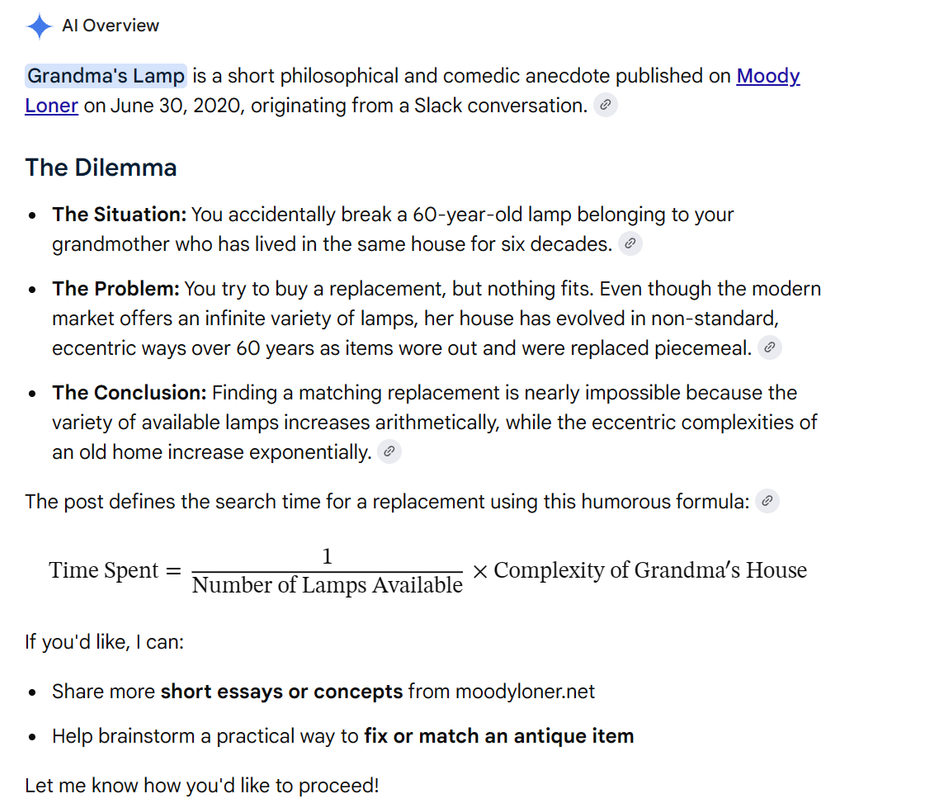
Another bit of internet stardom
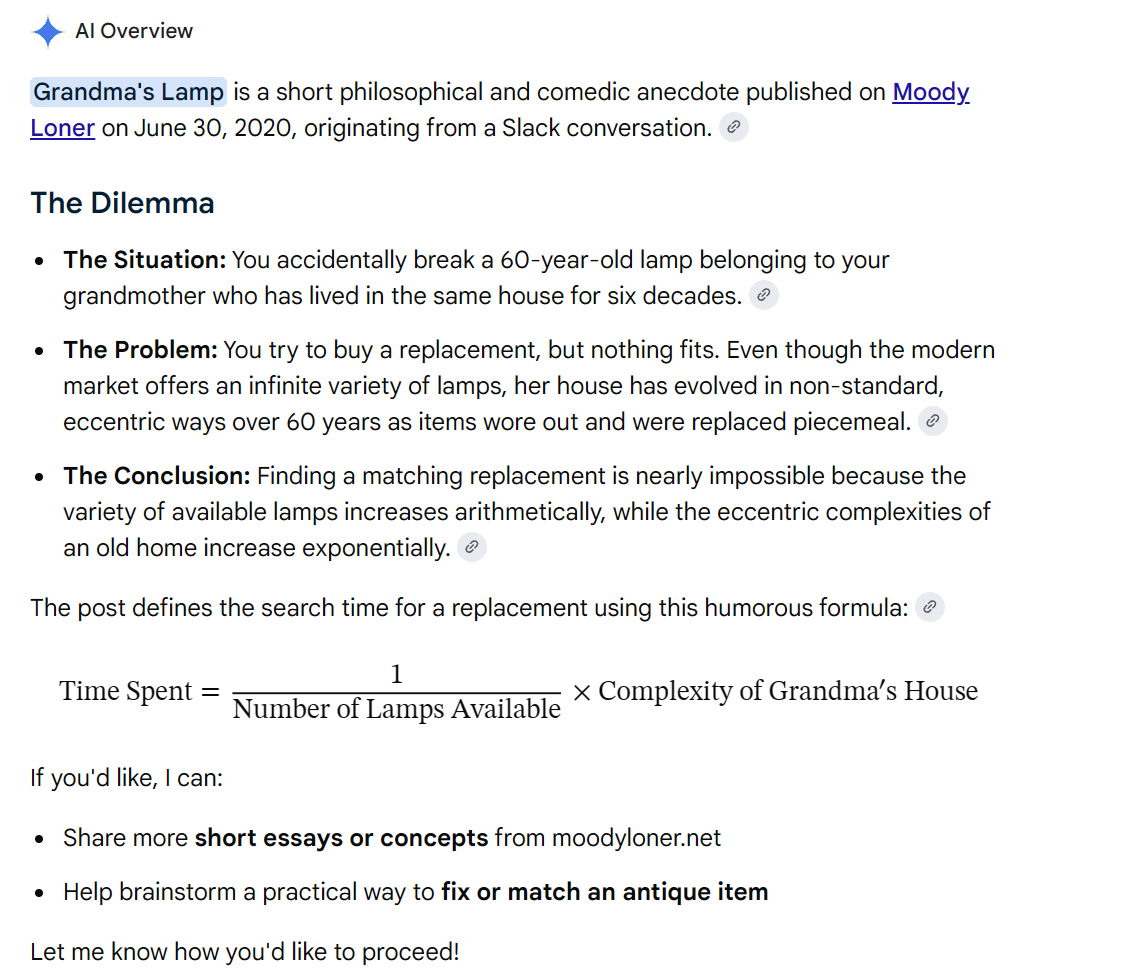
First Claude answers a questions by quoting my blog, and now this
-
New Favorite Shadow Portrait

-
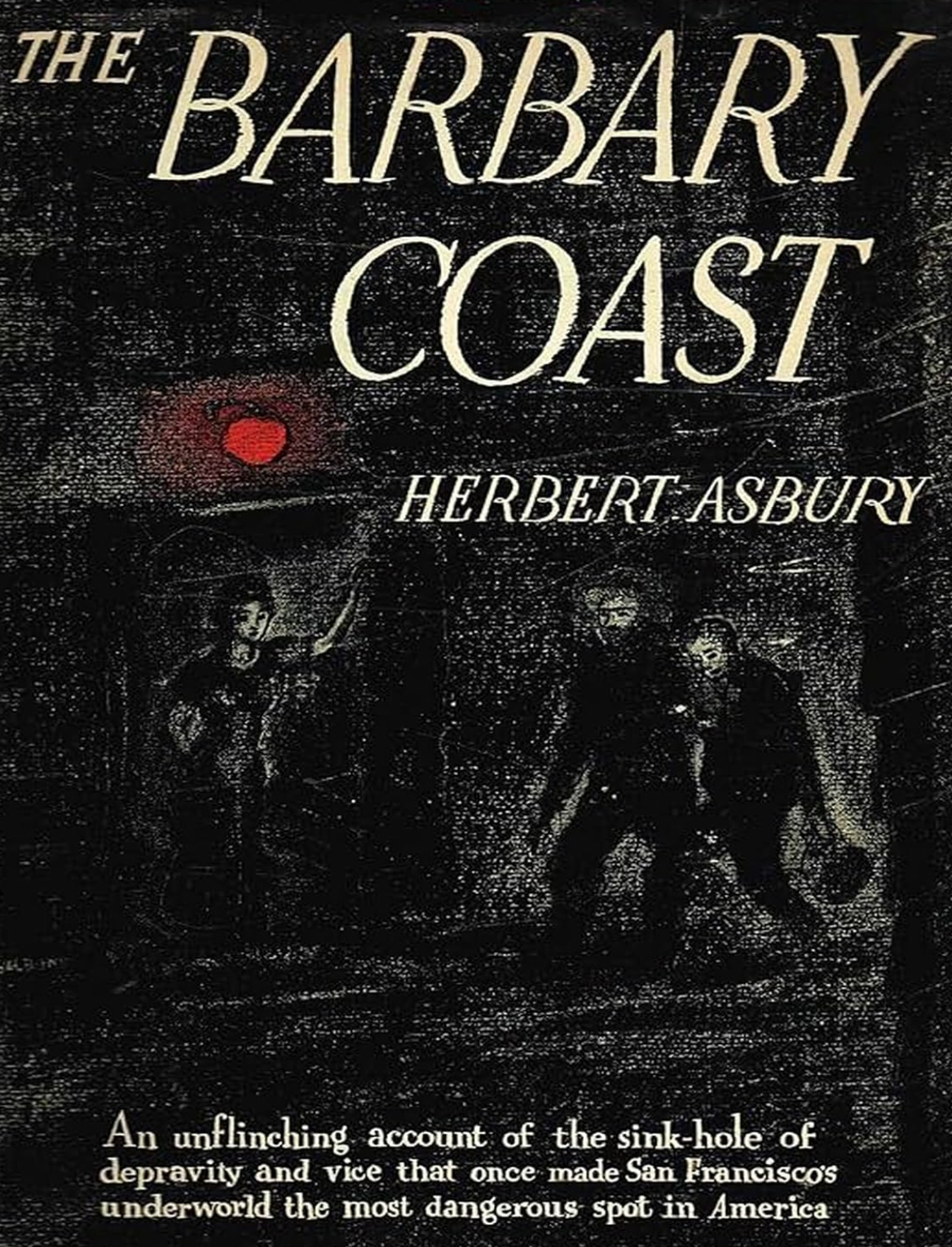
The Barbary Coast by Herbert Asbury
The Book in 3 Sentences
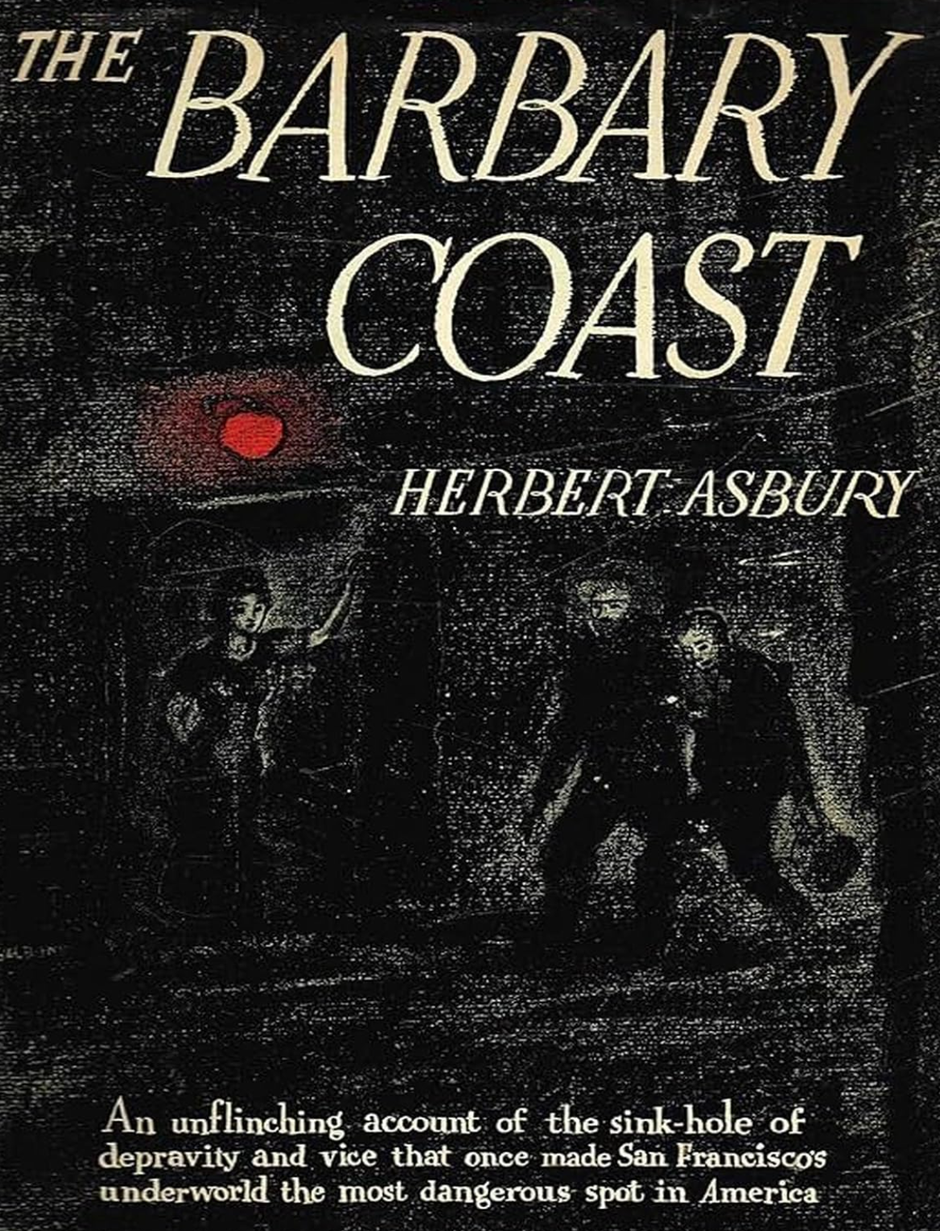
- A lovely history of the San Francisco underworld from approximately 1845-1910 or so. I’m a sucker for this time period. Asbury includes a bit too much detail but that has it’s own charm as well.
How I Discovered It
The lovely Amazon auto suggest feature. Also – I read Asbury’s “Gangs of New York” decades ago and knew what I was getting into.
Who Should Read It?
Fans of the city and the genre.
Highlights
Brannan hurried overland to meet Brigham Young. He tried unsuccessfully to induce the Mormon leader to abandon his plan of settling in the valley of the Great Salt Lake and urged him to lead the whole body of Mormons into California and build up a strong Mormon state in the territory surrounding the Bay of San Francisco, which he represented as possessing an incomparable climate and soil of extraordinary fertility.
None of this money was ever remitted to the Church at Salt Lake City, and when Brigham Young made formal demand for “the Lord’s share,” and also for a share of Brannan’s personal earnings, Brannan retorted that he would pay upon a written order signed by the Lord, and not otherwise.
Brigham Young several times dispatched his holy gunmen, better known as Destroying Angels, to San Francisco to deal with Brannan and collect the money by force. But the Angels were invariably met in the desert, and their wings clipped, by Brannan’s “exterminators,” fighting men whom he is said to have employed as a bodyguard for half a dozen years.[3]
During the height of the gold excitement, there were at least five hundred ships stranded in the harbor, some without even a watchman on board, and none with a crew sufficiently large to work her. Many of these vessels never sailed again.
By the beginning of 1850 the city had a permanent population of at least twenty-five thousand, most of whom were adult males under forty, and had become the foremost American port on the Pacific, a distinction which it retained until the phenomenal rise of Los Angeles. Several
Many of these repulsive rodents attained such size and ferocity that they were more than a match for a terrier, and they often attacked sleeping men, biting large chunks from ears, noses, and cheeks.
The exact number of gambling places in early San Francisco was never determined, but there were at least several hundred; perhaps as many as a thousand.
The most popular games were monte, faro, rondo, roulette, rouge et noir, and vingt-et-un. Poker was comparatively unknown, for the restive San Franciscans, and the miners who regularly risked the proceeds of their back-breaking toil, considered this prince of gambling games too slow. They
the amazingly high cost of living and the extraordinary opportunities for frittering away money, everyone in early San Francisco was supremely confident that he would soon be able to return home with an incalculable amount of gold. Everything was conceived on a vast scale, and there was always plenty of cash available for any scheme that might be proposed, no matter how impossible or bizarre it seemed. No one hesitated to borrow money, although for several years the prevailing rates of interest ranged from eight to fifteen per cent a month, payable in advance, and even higher unless gilt-edged security was provided.
Many, at a loss how else to exhibit their prosperity, employed dentists to put their own gold into their teeth. If they had no teeth that required attention, they had good ones dug out and gold ones substituted.
Together with male natives of these and other Central and South American countries, they were known in San Francisco by the generic name of Chilenos, or, contemptuously, “greasers.”[18]
Moreover, it was at least as cosmopolitan as the remainder of the population; it has been said that by the end of 1852 there was no country in the world that was not represented in San Francisco by at least one prostitute.
If anyone protested that he carried no weapon, the statement was considered so preposterous that he was promptly searched. Almost invariably a knife or a fire-arm was found secreted in some unusual part of his clothing.
When the mob seized her, there was a great roar of “Give her a fair trial and hang her!” which aptly expressed the sentiment that prevailed throughout California.
Particularly susceptible to this sort of jingoism were the fifty or sixty young thugs who comprised an organization known at first as the Hounds and later as the San Francisco Society of Regulators. Despite this highsounding title, they were never anything more than an aggregation of thieves and ruffians, whose principal occupation was maltreating the SpanishAmericans. Under pretense of a fervent and belligerent patriotism, the Hounds beat, stabbed, and shot the helpless Chilenos whenever opportunity offered; systematically extorted gold and jewelry from the few who had acquired wealth; burned and otherwise destroyed their tents and cabins; and made frequent forays against the colony of harlots at Clark’s Point and on the slopes of Telegraph Hill, where they raped the women, tore down their shelters, and carried off their meager belongings.
None of these penalties was actually inflicted, however, for the politicians did not fail the Hounds in their hour of peril. Within a few days all of the young thugs had been released. But they were so frightened that they made no effort to reorganize, and soon afterwards most of them left San Francisco.
No man dared touch him, for all knew that if he was molested, or even angered, he would return with his desperadoes and torture and kill every soul in the place.
Murieta threw down his rifle, raised his hands, and called to Captain Love: “Shoot no more. The work is done.”
The head of the outlaw chieftain, and the mutilated hand of Three-Fingered Jack, were severed from their bodies, placed in large bottles of spirits, and brought to San Francisco.
Because the hair on the head continued to grow, it attracted much attention for several years, particularly among the superstitious Mexicans. Eventually it found its way into Dr. Jordon’s Museum of Horrors, in Montgomery Street, on the outskirts of the Barbary Coast. It was destroyed in the earthquake and fire of 1906.
There, in particular, gathered the ruffianly larrikins from the frontier towns of Australia, and the escaped convicts and ticket-ofleave men from the British penal settlements at Sydney, in New South Wales, and on the island of Tasmania, then called Van Diemen’s Land. This wave of undesirable immigration, which to all intents and purposes was one hundred per cent criminal, began to wash against the shores of California about the middle of 1849, in direct and open violation of an old Mexican statute which forbade the entry into the territory of persons who had been convicted of crime in other countries.
Every grog shop is provided with a fiddle, from which some half-drunken creature tortures execrable sounds, called by way of compliment, music.
But too often this dignitary was of the type of an early Alcalde named Meade, who knew little law, but who had a violent antipathy toward Mexicans and cigarette-smokers. To admit being either or both was tantamount to conviction in his court.
During the half-dozen years that followed Alcalde Geary’s first attempt to form a reputable municipal government, an average of almost two murders a day were committed in San Francisco—and at no time in that period did the city have a population of more than forty thousand.
Three-fourths of San Francisco lay in ruins when the fire finally burned itself out, but the task of rebuilding was begun with characteristic energy and dispatch. Within ten days the wreckage had been cleared away and three hundred buildings erected, while hundreds more were under construction. By June 1 business and life in general were proceeding almost as usual.
This witness was heard, but, under questioning, at length admitted that he had not seen Jenkins for several days. He was, it appeared later, a professional alibi witness for a large group of Sydney Ducks.
By far the most powerful politician in early San Francisco was David C. Broderick, a New York saloon-keeper and Tammany henchman who became a United States Senator and was at length killed in a duel by Judge David S. Terry of the California Supreme Court.
From the middle of 1851 to his death, in 1859, Broderick was, for all practical purposes, in absolute control of San Francisco’s political machinery.
Under the protection of the politicians the dives, bagnios, and hide-aways of Sydney-Town began to reopen, and the Sydney Ducks and other criminals who had been deported or frightened away by the Vigilantes of 1851 gradually returned. By the middle of 1855 San Francisco was again a hell-roaring swirl of crime and debauchery; once more the city swarmed with murderers, thieves, burglars, gamblers, prostitutes, and swindlers of every degree. And within another six months conditions were at least as bad as they had ever been at any time during the early days of the gold rush. “Assassinations, murders, and hangings constitute the leading materials of the budget of news in San Francisco,” said a New York newspaper in January 1856.
while a considerable number of respectable citizens sincerely believed that such an illegal usurpation of authority was a greater source of danger than a continuation of the corruption under which San Francisco was laboring. Among the latter was William T. Sherman, then engaged in the banking business, who later became General in the United States Army.
The Governor’s proclamation had appointed William T. Sherman, who had gained considerable fame as a soldier during the Mexican War, as Major-General of militia and had commanded the members of all volunteer companies, and all other persons subject to military duty, to report to General Sherman and assist in subduing the insurgents. Fewer than a hundred men answered the summons.
King was born in Georgetown, Maryland, and was the son of William King. As a youth he worked in Washington, where he found thirteen other James Kings. To avoid confusion he called himself James King the son of William, which he soon shortened to James King of William.
In later times the Barbary Coast meant only the single block on Pacific Street between Kearney and Montgomery streets, a short stretch of dangerous and disreputable thoroughfare, which was also widely known, after the middle eighteen-nineties, as Terrific Street.
Every variety of vice and crime was almost constantly on display. For many years, and especially during the eighteensixties and eighteen-seventies, it is doubtful if a night passed in which the Barbary Coast was not the scene of at least one murder and of innumerable robberies.
Occasionally a girl earned as much as fifty dollars a week, practically all of which she gave to her pimp, who promptly spent it on another woman, as has been the custom of his kind from time immemorial.
The Morgue was also headquarters for the many drug addicts, better known in those days as hoppies, who lived in the alleys of Chinatown and the Barbary Coast.
Occasionally they earned a few pennies by showing the holes in their arms to tourists. Few of the hoppies could afford a hypodermic needle; instead, they used an ordinary medicine dropper, filling it with cocaine or morphine and forcing the point into their flesh. They obtained most of their supplies of narcotics at an all-night drug-store in Grant Avenue, where enough cocaine or morphine for an injection cost from ten to fifteen cents.
In that year the city granted the right to sell beer, whisky and other intoxicating beverages to 3,117 places, or one for every ninety-six inhabitants. And there were at least two thousand blind pigs, or blind tigers, as speakeasies were called in those days, which operated without licenses. The
when the United States census showed a total of 71,328 scattered throughout the state. More than half, however, were in San Francisco. The number began to decline immediately after the passage of the Ten-year Exclusion Act in the spring of 1882, and the influx from the Flowery Kingdom was definitely stopped by the Scott Exclusion Act of 1888, which specifically forbade the importation of Chinese laborers.[41]
The Chinese settlement has always been confined within a small sliver of territory some seven blocks long and three blocks wide, and although for almost thirty years thousands of Orientals arrived in San Francisco every year, nearly all of them managed to find both lodging and business opportunity in this restricted area.
Four years later, in 1889, another official investigation placed the number of Chinese in San Francisco at 45,000, of whom about one-third were women and children, including slaves.
Despite the activities of the steamship and railroad companies, the constitutional convention of 1878 was overwhelmingly antiChinese, and the state constitution as ratified by the voters of California in the spring of 1879 reflected the prevailing attitude. It forbade the employment of Chinese by corporations, debarred them from the suffrage, annulled all contracts for coolie labor, directed the Legislature to provide for the punishment of any company which imported Chinese, and imposed severe restrictions upon their residence in the state. The popularity of these stringent provisions was further attested in September 1879, when a secret ballot was taken at the regular election on the question of permitting the entry of the Chinese. Only 833 votes, out of a total of 155,471, were cast in favor of unlimited settlement by the Orientals.
Still another imposed a fine of from ten to fifty dollars upon “any person found sleeping in a room containing less than five hundred cubic feet of space for each person.” This law made the slumbers of practically every Chinaman in San Francisco illegal.
Its first appearance as a common noun was probably in 1872, when the Sacramento Weekly Union of February 24 asked editorially if the boys of that city were to be “trained as polite loafers, street hounds, hoodlums, or bummers?” Within five years the word was in general use throughout the United States and had taken its proper place in the American language as the peculiarly apt designation of a young rowdy of criminal tendencies. The exact derivation of “hoodlum” is unknown, and probably always will be, in common with many other words and phrases of journalistic parentage.
All of these hoodlums, of whatever age, possessed a violent antipathy to the Chinese and tormented them at every opportunity and in every conceivable way.
Such effective repartee by the police, however, was rare; usually the hoodlum was accorded comparatively gentle treatment. Not until about 1890 did the San Francisco police learn what the New York police had already known for more than fifty years—that the best cure for hoodlumism is the frequent application of locust or hickory to the hoodlum’s skull. Once the police had acquired this knowledge, the power of the rowdies rapidly declined.
some five years after his encounter with the carriage-painter he was caught committing a robbery. He was convicted and sent to San Quentin Prison for fifteen years, and the reign of this human billy-goat as King of the Hoodlums and pet of the prostitutes was ended.
By the latter part of 1854, when the yellow population of San Francisco numbered only a few thousand, the upper end of Sacramento Street and the eastern side of Grant Avenue were lined with gambling houses. They were crowded both day and night, for the Chinaman is probably the most persistent and reckless gamester on earth; he will, ordinarily, bet on either side of any proposition, no matter how fantastic. Most of the Celestial gambling resorts of the early days were small and poorly furnished; in few was there room for more than three to six tables.
most spectacular and at the same time the most powerful agencies in the underworld of Chinatown were the tongs, which were always deeply involved in every evil scheme concocted in the quarter. The complete history of these extraordinary associations probably never will be written. It is extremely doubtful if any white man has ever thoroughly understood the innumerable ramifications of tong influence or been privy to the intricacies of their organization and methods, despite the fact that they are as American as chop suey. Like that celebrated dish, they are unknown in China.[53]
The boo how doy, popularly known as hatchetmen or highbinders, received regular salaries, with extra pay for exceptional bravery in battle, and bonuses based on the number of men they killed.
But from the ranks of the boo how doy came many killers of great renown, whose exploits entitle them to rank beside the best of the gunmen produced by the white man’s gangland.
Many murder mysteries in early San Francisco were never solved because of this practice of shipping the corpus delicti to sea as a live sailor; many crimps did a flourishing business in so disposing of the victims of criminals who had found that the easiest way to rob a man was to kill him first.
All of Miss Piggott’s regular customers knew the exact location of the trapdoor and kept away from it, for it was an unwritten law of the establishment that any man who stood upon the fatal spot was fair game.
A frequent visitor to the Cobweb Palace was William Walker, the famous Central American filibuster who, with his long, black cloak and big, floppy hat, was a familiar figure in San Francisco for several years. Once when Walker poked with his cane at a cobweb, Warner remarked: “That cobweb will be growing long after you’ve been cut down from the gibbet.” It was only about three years later that Walker was shot by a firing squad in Honduras.
The origin of the custom of putting a dime in a pocket of the rifled raiment is unknown in present-day San Francisco, although the coin was obviously meant for car-fare home.
In common with most reformers, however, he was not long content to confine his activities to the special field in which the value of his work was unquestioned and in which he had the support of every right-thinking citizen; he was soon heavily engaged in what might best be described as a general denouncing business. Scarcely a week passed in which the newspapers did not contain at least one statement of violent protest signed by him, and scarcely a sermon did he deliver in which something or someone was not denounced in language which left no doubt as to his meaning. He inveighed against public dancing as vicious and immoral and against the nickelodeons as possessing the same undesirable attributes; he condemned most of San Francisco’s trolley cars, and especially those which traversed Kearny Street, as “dance halls on wheels . . . full of lewd women and beastly men”; and during his latter years he fell into the habit of fulminating against practically every public amusement and pastime which threatened to obtain a foothold in San Francisco.
After a Saturday-night inspection of the brothel, when he found the hallways swarming with drunken men and saw things which he had supposed went out of fashion with the destruction of Sodom and Gomorrah, Father Caraher immediately launched a vigorous offensive. He found the heads of the police department and other city officials in a somewhat sympathetic mood, for the blatant depravity on exhibition at the Nymphia had caused considerable talk even among the hardened debauchees of the Barbary Coast.
If there were no women on the trolleys, the conductors usually shouted: “All out for the whore house!”
For many years the reform element, particularly the clergy, successfully advanced the curious argument that since the brothels could not be abolished, fear of disease would keep men from frequenting them; they never seemed capable of realizing that vice regulated, even to a slight extent, is vice in retreat. They ignored the frequent warnings of reputable physicians and medical societies that venereal diseases were becoming alarmingly prevalent in all classes of San Francisco’s population.
Within a few minutes after the earth had ceased to rock, sixteen fires were throwing their menacing glare against the morning sky from as many sections of the city south of Market Street.
For two days the holocaust raged unchecked, while the trains and ferries, and the roads throughout the countryside, were crowded with frightened and unhappy refugees. The fire finally burned itself out, but not until it had destroyed 28,188 buildings in 522 blocks, covering an area of more than four square miles, or 2,593 acres, of which 1,088 acres were north of Market Street. The property loss was estimated at about four hundred million dollars, while 315 persons were known to have lost their lives, and 352 had been reported to the police as missing. Only a few were ever found.
periodic crusades against Judge Carroll Cook, revealed that they were two officers of Judge Cook’s branch of the Superior Court. Harrington and his associates changed the name of the resort to the Dash, and remodeled the interior, installing a row of curtained booths on either side of the dance-floor. They also discharged most of the dancing girls and in their places employed male degenerates who wore women’s clothing.
By the middle of October the Barbary Coast lay, as the San Francisco Bulletin said, “harmless as a serpent bereft of its fangs.”
The backbone of the Barbary Coast had been broken by the Examiner’s crusade and the action of the Police Commission in the autumn of 1913. In the language of the prize-ring, the Coast was punchdrunk; it could do nothing but wait hopelessly for the knock-out blow.
-
Addendum to Imperium
I finally got around to publishing my notes on Imperium, and then Tyler Cowen publishes this better description of the Russian national psyche
To begin with, each Eurasian ruler conceived of himself as the sovereign of a universal, not national, empire. Such a ruler was non plus ultra; confident in his superiority over other religious or political bodies, he was destined to rule the world, if not politically, at least rhetorically, an autocrat whose subjects’ servile condition was a natural state.
Seen through the prism of a universal monarchy, the Eurasian imperial vision blurred the separation between metropolis and periphery, between the peoples within and outside the empire’s boundaries, between servitude and slavery. Whether they were elites or commoners, all were considered to be in personal servitude to an emperor and often referred to by a term interchangeable with slave.
Consequently, Eurasian societies did not develop either the notions or the institutions that could enshrine the idea of freedom…
The concept of universal monarchy allowed for little differentiation between internal and external territories. -
Imperium by Ryszard Kapuscinski
From my Notion template
This Book – in 3 Sentences

I somehow stumbled across this book in my kindle recommendations, or perhaps it was a blog (Kevin Kelly perhaps?) somewhere but I’m glad I read it. The author is a Polish journalist from the Iron curtain era who traveled quite widely in the Soviet Union at it’s peak and decline, in particular the outer republics, not so much in Russia proper. It’s a pure travelogue, mostly of the “I went here and saw this” variety (i.e. the good kind). The highlights do a much better job of summarizing it than I would. A few notable thoughts after reading this book (mostly vibe based, my observations, not the author’s).
- It occurred to me that both Russia and it’s former imperial territories and the United States are outliers in how people view nationality. Russia assumes that everything is a natural empire and anything that isn’t currently an empire will become part of one at some point . America thinks that America is at the forefront of the natural progression of things and everything will be America at some point. The world becomes one eventual empire vs becoming one eventual country. I now think that a comparison of views of nationality involving either country is of limited value due to the viewpoints being such outliers. That is my observation, not the author’s.
- Scott Alexander’s definition of communism as mostly “taking every bad idea in the world and doing them all at once” seems much more accurate to the real Soviet world result than anything involving Marxism seems very apt.
Highlights
How many victims, how much blood and suffering, are connected with this business of borders! There is no end to the cemeteries of those who have been killed the world over in the defense of borders. Equally boundless are the cemeteries of the audacious who attempted to expand their borders. It is safe to assume that half of those who have ever walked upon our planet and lost their lives in the field of glory gave up the ghost in battles begun over a question of borders.
In short, the total surveillance clearly plays the same persuasive role as those one-story-high, thick billows of barbed wire: it is simply a silent but emphatic warning, lest some preposterous idea accidentally enter your head!
Worst of all are the books. What a curse to be traveling with a book! You could be carrying a suitcase of cocaine and keep a book on top of it. The cocaine wouldn’t arouse the least bit of interest; all the customs inspectors would throw themselves upon the book. And what—God forbid!—if you’re carrying a book in English? Then the real running, checking, paging through, reading would begin.
The second group will observe the Soviet people and imitate their way of thinking and acting. The essence of this posture is resigning oneself to the existing reality, and even being able to derive from it a certain satisfaction. There is a saying that is very helpful in this, and which it behooves one to repeat to oneself and to others every evening, regardless of how terrible the day that has just ended: “Rejoice in this day, for things will never again be as good as they were today!”
It wasn’t really possible to imagine Siberia. One of my friends finally showed me a drawing in a book: in a heavy snowstorm walked a column of tattered and hunched-over men. Heavy chains with iron balls at the end were attached to their hands and legs, and they dragged these balls behind them over the ground. Siberia, in its sinister, cruel form, is a freezing, icy space…plus dictatorship.
And yet it doesn’t occur to anyone to frighten children with: “Wash your hands or they’ll send you to Canada!” Or “Play nicely with that little girl or they’ll deport you to America!” In those countries, quite simply, there is no dictatorship, nobody puts anyone in chains, nobody imprisons anyone in camps, dispatches him to work in hellish frost, to a certain death. In those frozen lands, man has one antagonist—the cold. Here, as many as three—the cold, hunger, and armed force.
Despite being transported in a wagon-coffin, the general is aware of being in a certain way privileged—they are driving him; others they force to march for years on foot.
This wandering of the deportee is not only a displacement in space and in time. It is accompanied by a process of dehumanization: the one who reaches the end (if he doesn’t die along the way) has already been stripped of everything that is human. He has no surname; he does not know where he is; he does not know what they will do with him. His language has been taken away: no one will speak with him. He is a consignment; he is a thing; he is a trifle.
Whiteness is often associated with finality, with the end, with death. In those cultures in which people live with the fear of death, mourners dress in black, to scare death away from themselves, isolate it, confine it to the deceased. But here, where death is regarded as another form, another shape of existence, mourners dress in white and dress the deceased in white: whiteness is here the color of acceptance, consent, of a surrender to fate.
It is Europe. European civilization is the only one that has ever had global ambitions and (almost) realized them. Other civilizations either couldn’t satisfy such ambitions for technical reasons (for instance, the Maya), or simply didn’t have such interests (for instance, China), convinced that they themselves were the entire world. Only European civilization proved capable of overcoming its ethnocentrism. Within it arose the desire to know other civilizations, as well as the theory (formulated by Bronislaw Malinowski) that global culture is created by a constellation of parallel cultures.
If there exists such a thing as the genius of a nation, then the genius of the Russian nation is expressed in, among other things, just this saying: “Well, that’s life!”
One of the pillars upon which the system rests is isolation from the world, and a foreigner, by the mere fact that he exists, undermines this pillar.
I read Bierdayev’s old book in which he reflected upon how the great expanses of the Imperium had influenced the Russian soul. What does a Russian think about, somewhere on the shore of the Yenisey, or deep in the Amur taiga? Every road that he takes seems to have no end. He can walk along it for days and months, and always Russia will surround him. The plains have no end, nor the forests, nor the rivers. To rule over such boundless expanses, says Bierdayev, one had to create a boundless state. And behold, the Russian fell into a contradiction—to maintain the great expanses, the Russian must maintain a great state; on the maintenance of this great state he expends his energy, of which not enough remains for anything else—for organization, for husbandry, and so on. He expends his energy on a state that then enthralls and oppresses him. Bierdayev believes that this immensity, this limitlessness of Russia, has a negative influence on its inhabitants’ way of thinking. For it does not demand of them concentration, tension, an intensification of energy, or the creation of a dynamic, vigorous culture. Everything falls apart, is diluted, drowned in this ungraspable formlessness. Russia—an expanse, on the one hand, endless, broad, and yet, on the other hand, so crushing that it takes one’s breath away, and there is nothing left to breathe.
And then I traveled to the non-Russian republics of what was then the Imperium. What caught my eye? That despite the stiff, rigorous corset of Soviet power, the local, small, yet very ancient, nations had succeeded in preserving something of their tradition, of their history, of their, albeit, concealed pride and dignity.
Painting did not bring him happiness. He had a girl called Margerita. No one knows what sort of girl she was. Niko loved her and painted her portrait. Margerita’s face is done according to the conventions of the great naives, by which everything is too big and out of proportion. Oversized lips, bulging eyeballs, enormous ears. Niko gave this portrait to Margerita. The girl shrieked in indignation. Enraged, full of hatred, she left him. His talent condemned him to solitude. From then on he lived in lonely abandonment.
A nation that does not have a state seeks salvation in symbols. The protection of the symbol is as important to it as the protection of borders is to other states. The cult of the symbol becomes a form of the cult of country. Protection of the symbol is an act of patriotism.
But there is also the matter of religion. In the year 301, during the reign of the emperor of the Armenians Tiridates III Arashakuni, Armenia adopts Christianity. It is the first country in the world in which Christianity attains the rank of a state religion.
way. Many works of ancient literature survived owing entirely to the fact that they were preserved in Armenian translations.
Baku always made a career of oil. As far back as the tenth century Arab writers refer to Baku as the place from which oil is brought.
We are standing over a relief map of Central Asia, and she wants to show me how great Azerbaijan once was (this is what she regards as a bit of nationalism). I tell her that her desire to present to me the Great Yesterday is a universal impulse in today’s world.
Today expansion is difficult and risky, as a rule broadening ends in narrowing, and that is why nations must satisfy the instinct for breadth with a feeling of depth, which means reaching into the depths of history to demonstrate their strength and significance.
After the Revolution, Valery tells me, they started giving girls’ names that celebrate the modern inventions now making their way to the countryside. So there are girls with the names Tractor, Chauffeur. One father, apparently counting on tax reductions, called his daughter Finotdiel, which is an abbreviation of the name of the Office of Finance (Finansovyj Otdiel).
The disciples of this martyr, the Hurufites—mystics of the numeral, cabalists, and diviners—believed that the origins of the universe could be comprehended in terms of the figures 28 and 32. Using these numerals one can explain the mystery of each thing. It was the Hurufites’ belief that God expressed himself through beauty: the more beautiful something was, the more God manifested himself in it. Beauty was their criterion for valuating the phenomenal world.
An underwater mountain range connects the eastern and western shores of the Caspian Sea. The mountains stretch from Baku to Krasnovodsk in Turkmenistan.
The transition to a sedentary life was for the nomad always a last resort, a sign of failure in life, a degradation. One can settle a nomad only by force, by economic or political coercion. For him, the freedom that the desert gives has no price.
The people of the Uzboj worshiped sacred stones. This is typical of inhabitants of deserts, who revere everything they have at hand—stones, gorges, wells, and trees.
Particles of dust, these bits of near nothingness (they are stones ground to powder by wind and water), suspended in the air, grow warm in the sun, and thus comes into being a dry mist, the terror of all desert people, a dry and hot mist, clouds of powder as hot as burning coals; that is what the desert commands one to breathe in the hour of its fury.
During the feast they serve the guest the sheep’s boiled head on a plate. The guest must eat the brain. Then he must pluck out and eat one of the eyes. The host eats the other eye. In this way the knots of brotherhood are tied. It is an experience one does not quickly forget.
Erkin said that an Uzbek prefers to overpay and buy in the bazaar than to spend less in a store. The bazaar is tradition, the place of meetings and conversation, a second home.
He ordered his adversaries and opponents poisoned. He prepared the potions himself. He carried the standard of death, and this mission absorbed him for half the day. During the second half of the day, art absorbed him. Timur devoted himself to the dissemination of art with the same zeal he sustained for the spread of death.
Timur was sounding the limits of man’s possibilities. Timur demonstrated that which Dostoyevsky later described—that man is capable of everything.
Erkin showed me Timur’s grave in Samarkand, made of green nephrite. Before the entrance to the mausoleum there is an inscription, whose author is Timur: Happy Is He Who Renounced the World Before the World Renounced Him.
Just as Columbus lived in the epoch of great geographic discoveries, when every sailing expedition altered the picture of the world, so we live today in the epoch of great political discoveries in which ever newer and newer revelations continuously change the picture of our contemporaneity.
But doubts at once assailed me—was I really right to search for perestroika outside Moscow? I had just read a new book, published in early 1989, by the eminent historian Natan Eydelman, Revolution from the Top in Russia. The author regards perestroika as just one more in a series of turning points in Russian history and reminds us that all such turning points, revolutions, convulsions, and breakthroughs in this country came about because they were the will of the czar, the will of the secretary-general, or the will of the Kremlin (or of Petersburg). The energy of the Russian nation, says Eydelman, has always been spent not on independent grass-roots initiatives, but on carrying out the will of the ruling elite.
Nicholas I: “The Czar is surprised—the inhabitants of Petersburg tremble with fear, / The Czar is angry—his courtiers die of fear; armies are marching, whose God and faith / is the Czar. The Czar is angry: let us die, we will cheer up the Czar!”) The czar has been considered a god, literally, for centuries, for Russia’s entire history. Not until the nineteenth century was there a czarist decree to remove the portraits of the czar from the Orthodox churches. A czarist decree! Without it no one would have been so bold as to touch such a portrait, or rather, icon. Even Bakunin, that anarchist and subversive, Jacobin and dynamiter, calls the czar “the Russian Christ.” And just as the czars are the vicars of God, so Lenin and Stalin are the vicars of world communism. Only after Stalin’s death does the slow process of secularizing the rule of the Almighty begin. Secularization—and with it the gradual erosion of omnipotence.
This last notion was put forth in the sixteenth century by the Pskov sage and visionary, the monk Philotheus. “Two Romes have already fallen (Peter’s and Byzantium),” he writes in a letter to the contemporary Muscovite prince Vasily III. “The Third Rome (Moscow) stands. There will not be a fourth,” he categorically assures the prince. Moscow: it is the end of history, the end of mankind’s earthly wanderings, the open gateway to the heavens.
All dictators, irrespective of epoch or country, have one common trait: they know everything, are experts on everything. The thoughts of Qadaffi and Ceauşescu, Idi Amin and Alfredo Stroessner—there is no end to the profundities and wisdom. Stalin was expert on history, economics, poetry, and linguistics. As it turned out, he was also expert on architecture. In 1934—which means between one ghastly purge and the next, even more horrifying, one—he commissioned a plan for the rebuilding of Moscow. He devoted to it, as was piously written, much time and attention. The new Moscow was to manifest in its appearance the following traits of the epoch: triumph, power, monumentality, might, seriousness, massiveness, invincibility
In any case, the greatest ambition and fondest dream of Stalin was precisely the same as the greatest ambition and fondest dream of all Soviet leaders—namely, to catch up with and surpass the United States!
After all, there are countless churches in Moscow; there are even churches in the Kremlin, and yet the Leader’s finger came to rest on just this one place, where there towered the spectacular silhouette of the temple built by the czars of Greater Russia to thank God for forcing Napoleon to retreat and saving their Imperium.
Only he who maintains (and has somehow proven) that his authority has a human and divine nature can rule here, can lead the people and count on their obedience and devotion. Hence the preponderance in Russian history of pretender czars, false prophets, haunted and fanatical holy men—they claim the power to rule souls and that they are touched by the hand of God. The hand of God is in this case the sole legitimation of power.
In short, the background scenery changes, but the main principle of history, which continues to operate in the foreground, remains unchanged—the principle of the cult.
unaware that as he does so he becomes for a second time communism’s victim: the first time he was a victim by force, imprisoned by the system, and now he has become a victim voluntarily, for he has allowed himself to be imprisoned in the web of communism’s problems. For such is the demonic nature of great evil—that without our knowledge and consent, it manages to blind us and force us into its strait-jacket.
Armenians! They must be together. They search for one another the world over, and—the tragic paradox of their fate—the more their diaspora expands and dissipates away, the greater their mutual longing for one another, their desire and need to be together. Only
can one appreciate how painful a thorn for them is the matter of Nagorno-Karabakh—to live a dozen or so kilometers from one another and yet not to be able to be together! An eternal splinter, an eternal wound, an eternal stigma.
that we do not resolve difficulties, we only displace them. “The art of clarification,” says Cournot, “like the art of negotiation, is often simply the art of displacing difficulties. There is, one might say, a kind of untouchable reserve of incomprehensibility in certain things that the calculations of human intelligence are capable neither of removing nor of diminishing, but only of arranging this way or that, sometimes leaving everything in a half-light, at another time illuminating certain points at the expense of others, which are then submerged by a darkness even deeper than before.“
(They say “comrade” more and more infrequently here, but they also aren’t able to say “mister,” for that still sounds too bourgeois, and the form “you,” toward a person whom one doesn’t know well, is impolite. So they address each other as “woman,” “man.”)
Like peasants the world over who begin each conversation with reflections on the subject of crops, and Englishmen who start every exchange with a discussion of the weather, so in the Imperium the first step in establishing contact between people is a mutual determination of one’s nationality. For much will depend on this.
At the same time, behind these front lines, Beria directs the deportation of Poles and Greeks, Germans and Kalmuks, into the depths of the Caucasus and to Siberia. As a result, entire nations find themselves in lands foreign to them, in unfamiliar surroundings, in poverty and hunger. One of the goals of these operations is to create the uprooted man, wrenched from his culture, from his environment and landscape, and therefore more defenseless and obedient vis-à-vis the dictates of the regime.
A single czarist official drives an entire column of Tuvinians (a Siberian tribe) to a hard-labor camp, and not one of these unfortunate vassals will revolt. After all, they could easily kill this official and vanish into the forest. But no, they walk on obediently, meekly execute his commands, endure his verbal abuse in silence. The reason, Mickiewicz explains, is that, in the eyes of the enslaved Tuvinians, this official personifies the might of the all-powerful state, which arouses their fright, terror, dread. To raise a hand against the official is to raise a hand against the superpower, and none of them can bring himself to do that.
One need only see cities over which a wave of ethnic conflict has recently rolled—even Fergane or Osh. Among the burned and devastated houses of Uzbeks, Karakalpaks, or Tajiks are visible the untouched houses of Russians. For who stands behind a poor Karachi, attacked by an infuriated Turk? At most—another Karachi. And behind a Russian? A kalashnikov, a tank, a nuclear bomb.
Not everyone knows that the Turkish language is the second most dominant language of the Imperium. About sixty million people speak it. An Azerbaijani can communicate not only in Ankara, but also in Tashkent and Yakutsk. His Turkish-speaking brethren live everywhere. In a certain sense, the former USSR is a Slavic-Turkish superpower. Solzhenitsyn’s idea was to get rid of the Turkish element so that only a Slavic superpower would remain.
After seventy-three years of bolshevism, people do not know what freedom of thought is, and so in its place they practice freedom of action. And here freedom of action means freedom to kill.
They stole what they could. Stalin locked them up in boarding schools. There they learned hatred, and when they grew up, they were dressed in the uniforms of the NKVD. The NKVD held the nation in the grip of a bestial fear. And there’s communism for you.
I have flown maybe one hundred thousand kilometers in this country on airplanes. Two observations from those trips: The airplanes are always full—at each airport, for every destination, mobs of people are waiting, sometimes for weeks, so that finding an empty seat somewhere is quite out of the question. Second, during the entire flight there is complete silence in the cabin. The passengers sit motionless; no one speaks. If one hears a buzz somewhere, bursts of laughter, and the clink of glasses, it means that a group of Poles is on board: who knows why, but travel puts them into a state of boundless euphoria, into a near frenzy.
It is true that a bit of time has elapsed since the epoch of Stalinism, but its memory is alive, and the lessons, traditions, and habits of that period remain, are fixed in consciousness, and will long influence people’s behavior. How many of them (or their families, acquaintances, and so on) went to the camps because during a meeting, or even in a private conversation, they asked about this or that? How many in so doing ruined their careers? How many lost their jobs? How many lost their lives?
A wise sentence from Ecclesiastes: “Who gathers knowledge, gathers pain.” Developing this bitter thought, Karl Popper once wrote (I am quoting from memory) that ignorance is not a simple and passive lack of knowledge, but is an active stance; it is the refusal to accept knowledge, a reluctance to possess it; it is its rejection. (Or, in a word, antiknowledge.)
A civilization that does not ask questions, one that banishes from within its compass the entire world of anxiety, criticism, and exploration—the world that expresses itself precisely through questions—is a civilization standing in place, paralyzed, immobile. And that is what the people in the Kremlin were after, because it is easiest to reign over a motionless and mute world.
No Louvre, no castles on the Loire, can offer so many pleasant and unforgettable sensations as the gloomy and humble interior of the Hotel Vorkuta. At work here is the immemorial law of relativity. Entering the Louvre from the sidewalks of Paris is not a passage from earth to heaven, whereas entering the lobby of the Hotel Vorkuta from the street is. The lobby saves our life, for it is warm, and warmth in this town is the most priceless thing.
Genady Nikolayevich, a miner, just turned fifty and retired. Such an early retirement is one of the perks one receives for work in such dreadful, polar conditions. Although it is a rather dubious perk—only twenty percent of miners live to be fifty.
Genady Nikolayevich is rather inclined toward the opinion of Ivan Solonievich, one of the few inmates who in 1934 succeeded in escaping to the West: all of Russia is a camp.
In small and medium-sized countries there is no equivalent of this class of which we speak here. In such countries, the elite are busy with their own internal affairs, their local intrigues, their own closed backyard. But in the Imperium, the ruling class (and often the common people as well) are preoccupied with the imperial scale of thinking, and, even more, the global scale, the scale of large numbers, large spaces, of continents and oceans, of geographic meridians and parallels, of the atmosphere and the stratosphere, why, of the cosmos. In Western Europe they were surprised to see on television that poor old women in Moscow abandoned the breadlines they had been standing in, gave up buying bread, to march down the street shouting the slogan “We will not give back the Kuril Islands!” But why be surprised? The Kuril Islands are a part of the Imperium, and the Imperium was built at the cost of the feeding and clothing of these women, at the cost of their leaking shoes and cold apartments, and, what is most sad, at the cost of the blood and lives of their husbands and sons. And so they should give this back now? Never. Never ever.
Nationalism cannot exist in a conflict-free condition; it cannot exist as a thing devoid of grudges and claims. Wherever the nationalism of one group rears its head, immediately, as if from beneath the ground, this group’s enemies will spring up.
In Irkutsk I spot a poster advertising a theatrical production entitled A Word about Russia. I buy a ticket and go. The show takes place in a church that was formerly called the Museum of Atheism.
“Russia,” he calls, “must remain a great world power! They want us to become like the Indians on an American reservation. They are trying to make us drunk, they are trying to poison us. But we will not become Indians. We will not be a banana republic!”
Fiodorov speaks about terrible things. When criminals escaped, they would persuade one of the political prisoners—naive and unsavvy—to go with them. This they did as insurance against death from hunger, which was always a threat. At a certain point they would kill the victim and divide up his flesh.
So let us stop getting excited and thrashing about, let us stop tormenting the stewardesses with questions for which they have no answers, and, following the example of our brothers and sisters from the sleepy village of San Juan near Valdivia, from the settlements on the Gobi desert crushed by the heat, and from the littered outskirts of Shiraz, let us sit motionless, staring off into space, and every hour sinking deeper and deeper into a state of mental numbness.
“Caucasian mafia” was how the taxi driver characterized those detained. The word “mafia” is enjoying a tremendous popularity these days. It is increasingly replacing the word “nation.” Here where one hundred nations once lived “in harmony and brotherhood,” one hundred mafias have now appeared. The nations have vanished, have ceased to exist. Three large mafias have taken their place—the Russian mafia, the Caucasian mafia, and the Asiatic mafia. These large mafias are divided into an infinite number of smaller ones. There are Chechen and Georgian mafias, Tatar and Uzbek, Chelyabinsk and Odessian. The smaller mafias are divided into even smaller ones, and these in turn into utterly small ones.
In today’s post-Soviet society there exist not only individual criminals, not only criminal elements, but an entire criminal class possessing a genealogy and tradition different from the rest of society.
Magadan is the capital of the northeastern territory of Siberia called Kolyma, after the river that flows here.
In colloquial Russian, Kolyma was transformed, bizarrely, into a word denoting the consolation of relativism. That is, when things are truly bad, awful, frightful, one Russian consoles another: “Don’t despair, it was worse in Kolyma!”
There were 160 camps—or, as they are also called, Arctic death camps—in Magadan and Kolyma. The convicts changed over the years, but at any given moment there were around half a million residents. Of these, one-third died in the camps, and the rest, after serving years of hard labor, left as physical cripples or with permanent psychic injuries. Whoever survived Magadan and Kolyma was never again the person he or she once was.
Garanin shot several, a dozen, or sometimes several dozen people a day. Murdering, he laughed or sang cheerful ditties. Beria ordered him shot suddenly and for obscure reasons, ostensibly for being a Japanese spy.
Convinced that he is in an insane asylum, that he is in a ghastly land of madness and surreal paranoia, Weissberg does not break down; under the most horrifying conditions, in crowded, dirty prisons dripping with blood, his mind, the mind of a Western rationalist, works intensively—it searches for a rational, reasonable explanation for that which is happening around him. In each cell they throw him into, Weissberg strives to discuss, to question, to exchange opinions.
It is Shalamov’s mind that is rational and logical and Weissberg’s mind that is astray, lost in abstractions. “Each intervention in that which fate was bringing, in the will of the gods, was something unbecoming and contradictory to the code of camp conduct,” Shalamov recalls. And between the lines: whoever thinks that he can behave differently has never touched the true bottom of life; he has never had to breathe his last in “a world without heroes.”
That desire—for one’s voice to be heard somewhere—is characteristic of enslaved peoples, who cling to their belief in the possibility of justice in the world the way a drowning man clings to a plank, who are convinced that being heard is being understood and that by that means alone they can prove their argument and win the case.
He doesn’t want a conversation, but a declaration that you agree with him, admit that he is right, join the cause. Otherwise you have no significance in his eyes, you do not exist, for you count only if you are a tool, an instrument, a weapon. There are no people—there is only the cause.
Their world is small—several valleys and mountains. Their world is simple—on one side we, the good people, on the other they, our enemies. Their world is governed by an unambiguous law of exclusivity—us or them. And if another world exists nevertheless, what might they want of it? Only that it leave them in peace. They need to be left in peace so as to thrash each other all the more thoroughly.
We have a saying here: if you do not plant cotton, they will plant you [in prison], if
It Is a Known fact that a dozen or so meters below the surface of every desert lie large deposits of concentrated salt. If water is conducted to it, the salt, together with the moisture, will begin to rise to the surface. And that is exactly what happened now in Uzbekistan. The concealed, crushed, deeply secreted salt started to move upward, to regain its liberty. The golden land of Uzbekistan, which was first cloaked in the white of cotton, was now glazed over with a lustrous crust of white salt.
Siberia is called the largest prison on earth. The czar deported hundreds of thousands of his subjects here; here the Bolsheviks imprisoned millions of innocent people. But our Siberian, Claudia Mironova, considers Siberia a place of sanctuary, an island of liberty. The immeasurable distances, the enormous taiga, and the lack of roads facilitated isolation, provided refuge, enabled one to vanish from view. Entire communities of dissenters, says Claudia Mironova, were able to survive here. They survived the czar and the Bolsheviks—no one knew where they were.
And she herself, Claudia Mironova? When they were herding everyone into the kolkhoz, one night she and her husband, taking with them a cow and two pigs, fled deep into the taiga. They settled there, built a shed, and later even a little house with an enclosure. During the entire Stalinist era, she says with pride, they did not see a single stranger. She posits as the key to their survival her knack for canning lard. Lard—therein lies the secret of life. The secret of life and the prerequisite for liberty. If you do not have lard—meaning, if you do not possess this basic, elementary wealth—you will not be free. That is what Claudia Mironova says, sharing with us the most important lesson of her life.
The so-called Soviet man is first and foremost an utterly exhausted man, and one shouldn’t be surprised if he doesn’t have the strength to rejoice in his newly won freedom. He is a long-distance runner who reached the finish line and collapsed, dead tired, incapable even of raising his arm in a gesture of victory.
Simplifying greatly, one can say that there are two Ukraines: the western and the eastern. The western (the former Galicia, territories that belonged to Poland before the war) is more “Ukrainian” than the eastern. Its inhabitants speak Ukrainian, feel themselves to be one hundred percent Ukrainian, and are proud of this. It is here that the soul of the nation survived, its personality, its culture. Things look different in the eastern Ukraine, which covers a territory larger than the western. Thirteen million native Russians live here and at least as many half Russians; here Russification was more intense and brutal; here Stalin murdered almost the entire intelligentsia. In 1932 and 1933, he had several million Ukrainian peasants starved to death and ordered tens of thousands of Ukrainian intellectuals shot. Only those who fled abroad were saved. Ukrainian culture was better preserved in Toronto and Vancouver than in Donetsk or Kharkov.
And they were all talking about one thing—the fact that on January 21, on the anniversary of the proclamation of the short-lived Ukrainian independence of 1918, hundreds of thousands had joined hands and formed a chain stretching more than five hundred kilometers between Kiev, Lvov, and Ivano-Frankovsk.
the Parliament passes a declaration of the sovereignty of the Ukrainian Soviet Socialist Republic. The declaration proclaims the primacy of the laws of the Republic over those of the USSR and also the right of the Republic to possess its own army and to mint its own currency. The declaration states that the Ukraine will be a neutral and nonatomic state. (This has great importance, since enormous stocks of the weapons of mass destruction are located in the territories of the Republic.) Yet
Rudzkoy, Yeltsin’s deputy, and Sobchak, the mayor of Petersburg, depart at the head of the delegation. Both had played leading roles in the defeat of the neo-Stalinist putsch, but both are Russians and thus they understand what Russia is without the Ukraine. “Without the Ukraine,” the Polish historian J. Waswicz wrote back in the thirties, “Moscow is relegated to a northern wilderness.”
Ukrainian patriotism has a peasant quality: it is firmly rooted in the native soil.
Even the Pioneers were sent in to help, but were later pulled out, for these were children, and children died in the greatest numbers—not only from hunger, but also because cannibals carried them off.
Stalin’s goal was to save the Imperium: the Imperium cannot exist without the Ukraine. Yet the twenties witness a renascence of Ukrainian nationalistic ambition, which develops under the slogan “Far from Moscow!” The main repository of the Ukrainian spirit is the peasantry. To break that spirit, Stalin must destroy the peasantry. At the time, there were around thirty million Ukrainian peasants. Technically, one could have annihilated a significant portion of them by building a network of gas chambers. But that is an error Stalin did not commit. He who builds gas chambers bears all the blame, brings the disgrace of being a murderer down upon himself.
Novgorod was a famous city in the Middle Ages, something along the lines of a Florence or an Amsterdam of the north—a dynamic concentration of commerce and craftsmanship, a long-flowering center of various arts, especially of sacred architecture and icon painting. A unique political system existed here. For hundreds of years (from the eleventh to the fifteenth century) Novgorod was a kind of independent, self-governing feudal republic in which the highest authority rested with a council composed of different elements of the city’s population and the neighboring free peasantry. The people elected a prince who ruled in their name and could be recalled at any moment. For those times and in that part of the world, these were unheard-of practices. The symbol of the freedom and independence of this city-state was a great bell with which the residents were summoned to the council.
the local kremlin. (A kremlin is a type of ecclesiastical citadel, a gathering of churches, cloisters, and service buildings surrounded by walls and, once, the seat of princely power.)
Moscow was anxious that Belorussia be inhabited by a Russian-speaking population—not even necessarily ethnic Russians, just Russian speakers.
I am all ears as one of the delegates ponders: Which domination is more dangerous for Belorussia—the Russian or the Polish? And he concludes that it is the Polish, because Poland is more attractive.
History In this country is an active volcano, continually churning, and there is no sign of its wanting to calm down, to be dormant.
The Russian Writer Yurii Boriev compared the history of the USSR to a train in motion: The train is speeding into a luminous future. Lenin is at the controls. Suddenly—stop, the tracks come to an end. Lenin calls on the people for additional, Saturday work, tracks are laid down, and the train moves on. Now Stalin is driving it. Again the tracks end. Stalin orders half the conductors and passengers shot, and the rest he forces to lay down new tracks. The train starts again. Khrushchev replaces Stalin, and when the tracks come to an end, he orders that the ones over which the train has already passed be dismantled and laid down before the locomotive. Brezhnev takes Khrushchev’s place. When the tracks end again, Brezhnev decides to pull down the window blinds and rock the cars in such a way that the passengers will think the train is still moving forward.
The Third World was born and a great demographic explosion began—the population of poorly developed countries began to increase at a rate three times greater than that of wealthy countries. A dozen problems result from this, which will be the worry of the twenty-first century.
Gorbachev’s enemies claim that he assumed the leadership of a flourishing USSR and brought about its breakup. It was just the opposite—the USSR was disintegrating for a long time, and Gorbachev extended its life for as long as it was possible to do so.
It is interesting that today blood flows only where blind nationalism enters the fray, or zoological racism, or religious fundamentalism—in other words, the three black clouds that can darken the sky of the twenty-first century.
Despite these difficulties, one can assume that three processes will come to predominate in Russian life. The first is the battle between the forces of integration and disintegration. Nationalism. Russians will want to maintain a large and strong state, an imperial superpower, whereas various non-Russian minorities will pursue more and more explicitly their own, autonomous goals.
The Russian land, its characteristics and resources, favor the power of the state. The soil of native Russia is poor, the climate cold, the day, for the greater part of the year, short. Under such natural conditions, the earth yields meager harvests, there is recurrent famine, the peasant is poor, too poor to become independent. The master or the state has always had enormous power over him. The peasant, drowning in debts, has nothing to eat, is a slave. Simultaneously, it is a land rich in natural resources—in oil, in gas, in iron ore. But these are natural resources whose exploitation and profits are easy to monopolize, particularly by a strong bureaucratic-authoritarian state. In this way both the soil’s poverty and its riches undermine the people and bolster the regime. It is one of the great paradoxes of Russia.
-
HikerTrash: Sordid tales from a dirty hiker
From my notion template
The Book in 3 Sentences

A lovely relaxing memoir written by a good friend of mine. I’ve known the author for decades now and our personalities and tastes have always contrasted and complimented each other quite well. In the past I’ve mentioned to him that he is using his “singlehood” (for lack of a better term) the best of anyone I know. This is his memoir of leaving compressed modern life and walking the continent. He remains the friend who always has the best answer to “So, what have you been up to since we last saw each other?”
How I Discovered It
The author told me, more authors should do that.
Who Should Read It?
People who spend too much time contemplating their compressed modern lives and wonder what something different would look like.
Highlights
It is not death that a man should fear, but he should fear never beginning to live.” M. Aurelius.
Technically, this was a safer choice than biking solo across the country. But to call it safe would be a stretch. This is far more involved and tedious. Yeah, it was just a walk through nature, but it was still fraught with peril.
Ever consider how much time is actually invested in just owning shit?
One I surely would not survive if not for the Whippet. A hybrid trekking pole/ice axe that I carry. (a tool I recommend every hiker carry)
Named the “Lost Coast” after depopulation in the 1930s, its name remains due to its inaccessibility, sparse population and rugged geographical features. The first night we spent there was in a little town called Shelter Cove.
The Redwood Forest is an extraordinary place. Thousands of 350 ft trees towering over you, blocking out much of the daylight.
For the following hour and a half, I’d attempt, successfully, to capture this indescribable spectacle in a photograph.
Snow is just frozen water why not use that? Why? 1. Because it doesn’t melt as quickly as you’d think. Nor does it provide much water. What looks like a lot of snow, once melted produces very little water. You could use your stove to melt it but then you’re wasting gas. Good in an emergency but only as a last resort. 2. Snow is just frozen, naturally distilled; water and distilled water is bereft of the minerals needed to absorb said water. It’s better than nothing but melted snow alone does not hydrate you sufficiently.
At an average of 18 inches wide it is quite difficult to find once separated from it.
As matter of fact, after only 6 months of meeting Karen I was able to quit my job cooking and make a living off the band income alone.
Previously, as a musician, most of my life I just played the drums. Contributing very little in the creative process. It wasn’t till I had hiked 1000 miles that I had the confidence to do what I did with Karen and the others. I managed, directed, created, wrote music and played the drums. All these things I found came very naturally. This was the first time I voluntarily took the leadership role in a creative endeavor. Then for it turn out highly successful made losing it quite painful.
Megadens, was a television show that remodeled private residences for the DIY network. One I had the privilege of working on from 2011 till 2016.
My theory is this. We as humans were born with an inherent ability to perceive multiple dimensions. And over time lose it. Perhaps because of diet or vaccines, air pollution, chemicals in the water or even television programming. Maybe radio waves or radar waves, microwaves, LED lights, WIFI, Bluetooth, 4g, 5g. Take your pick. It’s well documented that many children seem to be able to see spirits, apparitions or they have invisible friends. Watch or read any true stories about the paranormal and see for yourself. Animals sense them as well. You can see this in countless videos and testimonies. Cats, dogs, horses, even deer.
We’re not necessarily gifted the virtue of patience only opportunities to practice it.
Within days she was gone. Sept 11th 2021. She experienced no pain or fear. Which I am thankful for. She didn’t suffer like dad. We were told it was C19.
Meditation is mandatory. Quiet the mind. And then creative ideas rise to the top. Like wax in a lava lamp.
“It is the creative potential itself, in human beings, that is the image of God” Mary Daly
I don’t believe in coincidences anymore. I believe in omens. I call such curious encounters “landmarks” on a spiritual journey.
It seems the more one sheds the need for material possessions and desires, the more life’s journey plays out more on a spiritual level and less a physical one. And often it is rife with oddly synchronistic events.
The higher you climb in elevation, the cooler the air gets. About 5.4 degrees Fahrenheit every 1000 ft of elevation. But the air also gets thinner (less oxygen). Effecting your pace negatively. So, there’s some give and take.
In early 2010, prior to my divorce, I came down with a thing called diverticulitis. A potentially lethal condition. Small pockets in the digestive tract called diverticula become enflamed when eating certain foods or too much food in my case. These can potentially burst, leading to sepsis and a slow torturous decoupling from this plane of existence.
Practically harmless to humans, there are a variety of species of tarantulas native to Arizona.
I’ve yet to encounter a place with forests so dense. As beautiful as it is here, it feels prehistoric. Almost supernatural. The forests seem to be a separate world from the surrounding area. Once you set foot in them, under their thick dense canopy, It’s like entering another dimension.
You could spend your life thinking it’s all just a series of problems and curses. Brought on to you by society or your mom or dad or religion, government, gen x, gen z, or boomers. But it is you who is responsible for how your life unfolds. The mainstream media will have you convinced otherwise. They are wrong.
After months of hiking through the mountains and desert I’m learning more and more to be present in the moment.
-
My Inventions: The Autobiography of Nikola Tesla

The Book in 3 Sentences
- I actually finished this book ten or fifteen years ago – I was looking through my highlights trying to find some bits about his prodigious imagination and ability to visualize objects and concepts. I did not find that, I guess I did not highlight it. The book is interesting throughout. I will probably reread it at some point in the future – putting this review into existens for the sake of completeness. A good, honest autobiography, as these things go. These days he would totally be diagnosed with several spectrum disorders, probably accurately. His descriptions of his imagination and visualization is what stands out. I will probably reread purely for that part. It’s always interesting to hear genius describe itself.
How I Discovered It
The Kindle auto discover feature.
Who Should Read It?
People interested in that era. I think the original impetus was hearing The Handsome Families “Tesla’s Hotel Room” from their “Last Days of Wonder” album. I’ve always found the phrase captivating – such a pleasant way to hint at a since of an earlier time of insight and beauty. To “bask in the light of an older heaven” as Stapledon would say.
How the Book Changed Me
I suppose the bits about Tesla’s imagination had an impact – some people really have “spikey” talents in some or fashion and that is why we hear about them a century later. It’s also odd – he was all engineering, no science.Highlights
Genius is its own passport, and has always been ready to change habitats until the natural one is found. Thus it is, perchance, that while some of our artists are impelled to set up their easels in Paris or Rome, many Europeans of mark in the fields of science and research are no less apt to adopt our nationality, of free choice. They are, indeed, Americans born in exile, and seek this country instinctively as their home, needing in reality no papers of naturalization.
give us, through ripening years, of many deep problems; but when a man springs from a people who have a hundred words for knife and only one for bread, it is a little unreasonable to urge him to be careful even of his own
Government Telegraph Engineering Department at BudaPest. His salary was small enough to please those who hold that the best endowment of genius is poverty,
Emerson has said that steam is half an Englishman; may we not, in view of what such men as Edison have done, add that electricity is half an American?
The progressive development of man is vitally dependent on invention. It is the most important product of his creative brain. Its ultimate purpose is the complete mastery of mind over the material world, the harnessing of the forces of nature to human needs.
Speaking for myself, I have already had more than my full measure of this exquisite enjoyment, so much that for many years my life was little short of continuous rapture. I am credited with being one of the hardest workers and perhaps I am,
for I have devoted to it almost all of my waking hours. But if work is interpreted to be a definite performance in a specified time according to a rigid rule, then I may be the worst of idlers. Every effort under compulsion demands a sacrifice of life-energy. I never paid such a price. On the contrary, I have thrived on my thoughts.
Altho I must trace to my mother’s influence whatever inventiveness I possess, the training he gave me must have been helpful. It comprised all sorts of exercises–as, guessing one another’s thoughts, discovering the defects of some form or expression, repeating long sentences or performing mental calculations. These daily lessons were intended to strengthen memory and reason and especially to develop the critical sense, and were undoubtedly very beneficial.
and make it visible. Such an advance would revolutionize all human relations. I am convinced that this wonder can and will be accomplished in time to come; I may add that I have devoted much thought to the solution of the problem.
This I did constantly until I was about seventeen when my thoughts turned seriously to invention. Then I observed to my delight that I could visualize with the greatest facility. I needed no models, drawings or experiments. I could picture them all as real in my mind. Thus I have been led unconsciously to evolve what I consider a new method of materializing inventive concepts and ideas, which is radically opposite to the purely experimental and is in my opinion ever so much more expeditious and efficient. The moment one constructs a device to carry into practise a crude idea he finds himself unavoidably engrost with the details and defects of the apparatus. As he goes on improving and reconstructing, his force of concentration diminishes and he loses sight of the great underlying principle. Results
at the sacrifice of quality. My method is different. I do not rush into actual work. When I get an idea I start at once building it up in my imagination. I change the construction, make improvements and operate the device in my mind. It is absolutely immaterial to me whether I run my turbine in thought or test it in my shop. I even note if it is out of balance. There is no difference whatever, the results are the same. In this way I am able to rapidly develop and perfect a conception without touching anything.
During that period I contracted many strange likes, dislikes and habits, some of which I can trace to external impressions while others are unaccountable. I had a violent aversion against the earrings of women but other ornaments, as bracelets, pleased me more or less according to design. The sight of a pearl would almost give me a fit but I was fascinated with the glitter of crystals or objects with sharp edges and plane surfaces. I would not touch the hair of other people except, perhaps, at the point of a revolver. I would get a fever by looking at a peach and if a piece of camphor was anywhere in the house it caused me the keenest discomfort. Even now I am not insensible to some of these upsetting impulses. When I drop little squares of paper in a dish filled with liquid, I always sense a peculiar and awful taste in my mouth. I counted the steps in my walks and calculated the cubical contents of soup plates, coffee cups and pieces of food—otherwise my meal was unenjoyable. All repeated acts or operations I performed had to be divisible by three and if I mist I felt impelled to do it all over again, even if it took hours. Up to the age of eight years, my character
knowledge make modern existence hazardous in many ways. Most persons are so absorbed in the contemplation of the outside world that they are wholly oblivious to what is passing on within themselves.
taken in as whiskey or produced in the stomach from sugar. But it should not be overlooked that all these are great eliminators assisting Nature, as they do, in upholding her stern but just law of the survival of the fittest. Eager reformers should also be mindful of the eternal perversity of mankind which makes the indifferent “laissez-faire” by far preferable to enforced restraint.
me. I was fascinated by a description of Niagara Falls I had perused, and pictured in my imagination a big wheel run by the Falls. I told my uncle that I would go to America and carry out this scheme. Thirty years later I saw my ideas carried out at Niagara and marveled at the unfathomable mystery of the mind.
I had a veritable rnania for finishing whatever I began, which often got me into difficulties.
But instinct is something which transcends knowledge. We have, undoubtedly, certain finer fibers that enable us to perceive truths when logical deduction, or any other willful effort of the brain, is futile.
When natural inclination develops into a passionate desire, one advances towards his goal in seven-league boots. In
less than two months I evolved virtually all the types of motors and modifications of the system which are now identified with my name. It
machines, I determined to try my fortunes in the Land of Golden Promise. But the chance was nearly mist. I liquefied my modest
“Is this America?” I asked myself in painful surprise. “It is a century behind Europe in civilization.” When I went abroad in 1889 – five years having elapsed since my arrival here – I became convinced that it was more than one hundred years AHEAD of Europe and nothing has happened to this day to change my opinion.
time. We crave for new sensations but soon become indifferent to them. The wonders of yesterday are today common occurrences. When
My project was retarded by laws of nature. The world was not prepared for it. It was too far ahead of time. But the same laws will prevail in the end and make it a triumphal success.
not less menacing than those born from want and suffering. If we were to release the energy of atoms or discover some other way of developing cheap and unlimited power at any point of the globe this accomplishment, instead of being a blessing, might bring disaster to mankind in giving rise to dissension and anarchy which would ultimately result in the enthronement of the hated regime of force. The greatest good will comes from technical improvements tending to unification and harmony, and my wireless transmitter is preeminently such.
because of the directional character of the circuit. This was perfectly self-evident, but came as a revelation to some simple-minded wireless folks whose experience was confined to forms of apparatus that could have been improved with an axe, and they have been disposing of the bear’s skin before killing him. If
This invention is a logical outcome of observations begun in my boyhood and continued thruout my life. When
Peace can only come as a natural consequence of universal enlightenment and merging of races, and we are still far from this blissful realization.
As I view the world of today, in the light of the gigantic struggle we have witnest, I am filled with conviction that the interests of humanity would be best served if the United States remained true to its traditions and kept out of “entangling alliances.” Situated as it is, geographically, remote from the theaters of impending conflicts, without incentive to territorial aggrandizement, with inexhaustible resources and immense population thoroly imbued with the spirit of liberty and right, this country is placed in a unique and privileged position. It is thus able to exert, independently, its colossal strength and moral force to the benefit of all, more judiciously and effectively, than as member of a league.
The proposed League is not a remedy but on the contrary, in the opinion of a number of competent men, may bring about results just the opposite. It is particularly regrettable that a punitive policy was adopted in framing the terms of peace, because a few years hence it will be possible for nations to fight without armies, ships or guns, by weapons far more terrible, to the destructive action and range of which there is virtually no limit.