How can I keep from singing? The ballad of Pete Seeger
The Book in 3 Sentences
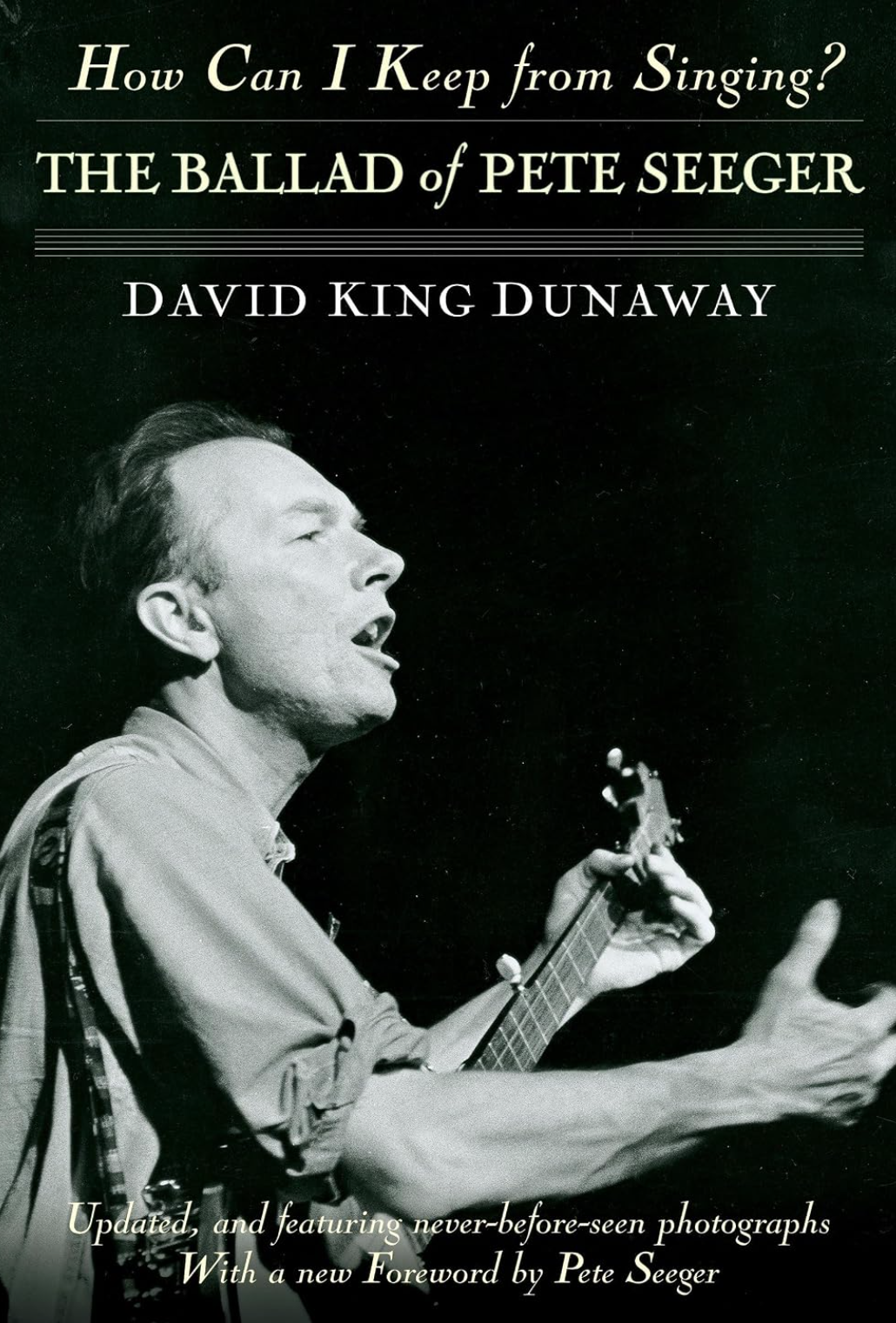
I am long overdue in posting this review (I finished it over a year ago!).
This is one of the last books I read from my “read everything about American folk music phase”. This is the story of Pete Seeger, one of the more foundational people in the folk music movement. The Bob Dylan movie that came out recently was much more accurate than I would have thought regarding Seeger. Seeger influenced nearly everything in some way for many decades in folk music.
The quotes do a decent job of summarizing the book. Seeger was very much a man of his time and era. He was born a sweater wearing grandfather type with oppositional (I don’t really give that much credence to any of his particulars, he was not an idealogue in that way. That is my conclusion, not the books) politics, heavily ingrained though not expressed old world religion, deep craftsmanship and a natural aptitude for caretaking whatever he was interested in. The book describes him as “hard to like but easy to admire” which would have made a better title for the took.
How I Discovered It
My recent obsession with American folk music.
Who Should Read It?
It is one of the top 3 I would read if I could only read 3 books on the topic. I would recommend it to anyone looking into the topic. It fills in many gaps, both with the music and the times it was written in and performed.
Summary + Notes
His niche has so far lasted seven decades of performing.
Family members tell of his immense reserve, insisting they’ve never been close. Despite his warmth on stage, there’s not much left to meet humanity one-on-one.
Her ancestor chart goes back further than mine. Mine just goes back to the seventeenth century, hers goes back to the sixteenth century with members of Parliament. She does not talk about it.”
Another entry reveals Seeger’s precocious interest in radical politics. At thirteen, he already had a subscription to the Communist literary magazine New Masses; he was a “red diaper” baby a generation before Dr. Spock. Just as he’d follow in his father’s journey into American folk music, so he’d read Mike Gold in the ’30s, as his father wrote a column on music for the Daily Worker. “Fascism is the last stage of capitalism,” Seeger scribed with the orthodoxy of adolescence. “The greatest danger [to revolutionaries] is the Greenwich Village type, the bohemian.” Stern words from someone who’d eventually spend four years living in the Village.
The entertainer’s reply shows a selfprotective irony. It was a shame, he wrote the Society, to cave in to a few threats. Not only had he and his parents lived in New York for years, but a great-uncle had been the mayor, the man who christened the Brooklyn Bridge.
A harbinger of problems to come. Seeger’s characteristic stance—head lifted high, forward of the body—leaves his vocal chords unsupported. In time, it will rob him of his voice.
His words carry unselfconscious modesty, mixed with the antipsychology, anti-individual canon of historical materialism: One life doesn’t count; only the many matter. “If Seeger ever wrote his autobiography,” fellow songwriter “Country” Joe McDonald mused, “he’d content himself with a half-dozen entries in the index.”
He was also influenced by the Anonymous movement, a fascinating group of artists in Paris in the 1920s, who refused to sign paintings. They insisted that works of art must stand on their own merits, not on the artist’s personality. Thus, talking with Seeger about his past is like starting a detective novel halfway through; you’re never sure whom to follow in the plot.
As the biographer Plutarch tells us, attention to small tasks characterizes people more truly than their heroic moments.
A well-known guitarist, Bob Gibson, later told Seeger, “You know, I was raised in Peekskill, and I know the whole story behind that riot. The Klan organized it.” “How?” Seeger asked. “I never knew for sure the Klan was up there.” “Oh, yes,” Gibson replied, “and they were in cahoots with the police. They had that place surrounded with walkie-talkies, just like a battlefield. You didn’t have a chance.” “How do you know?” “My father was on the Peekskill police force.”
Seeger’s character manifested itself in optimism and the stubbornness of principle that made him bring his children to a riot. He was a stubborn man, a tall skinny fellow who didn’t like to be pushed around. The stones thrown at Peekskill (and the pickets and blacklisters who followed later) couldn’t penetrate his shell of idealism. Peekskill only forced him toward those who throw the first stone, a passion that led him over and over to a cycle of confrontation and controversy and, eventually, to discontent.
“My ancestors came to this country because they didn’t want to answer questions put to them by the then un-English committees. One of them, Elder Brewster, was on the Mayflower with Governor Bradford, one of the leaders of the Plymouth Colony. His descendants that came my way were staunch upholders of independence among the colonists. Not one was a royalist.”
Seeger’s Puritan ancestors inhabited a world of callings and righteousness and moral uprightness, of Good Works to edify their brethren. Part of this doctrine was to bear witness, to oppose that “oppression which the Lord groaneth under,” and to condemn pride, worldliness, and want of truth. It was a social duty Seeger was ready to accept.
In 1919, when his third son, Peter, was born, Charles Seeger had become as much of an outcast as the radicals in Peekskill. Yet Charles was brought up not as a radical, but as a gentleman scholar: erect and precise. Growing up on Staten Island, Charles traced his ancestors back to Gebhard von Seeg of the Crusades and divided the world into three categories of worth: “the Seegers, friends of the Seegers, and everyone else.” The Seegers had four servants and a plot of land large enough for twenty houses. Pete Seeger’s grandfather had made a small fortune in sugar refining in Mexico, and he lived in semiretirement, writing his memoirs and playing Wagner by ear. The family took pride in being Yankee: Probity, self-control, and strict table manners were expected.
In 1911 they’d married and soon afterward set up their household in what seemed another continent: Berkeley, California.
The fellow who said this probably belonged to the Industrial Workers of the World (IWW), then organizing in California’s fields. This union of bindle stiffs, miners, loggers, and rebels had an enthusiastic (and musical) membership out west; when songs wouldn’t get them better working conditions, they weren’t shy about sabotage.
By 1917, though, the university community was becoming solidly pro-Ally—except for the Music Department, which revered Germans from Bach to Wagner. Not one to shy away from controversy, Charles told his dean (an Englishman) that Germany and England were both imperialist powers, and as far as he was concerned, they could fight each other to a stalemate. Rather than sounding principled, his stance came off as imperious.
Adding a primitive camper with a hammock, Charles, Constance, and their two boys traveled the open wilderness that was prewar California, up the dirt roads and canyons to the waterfalls of Yosemite. The trailer bumped along back roads to cross the Sierras at Tioga Pass, two miles above sea level. Below stood a forest of sequoias, the oldest in the nation: dark, leafy giants, tall as skyscrapers. The hostilities of Charles’s life in Berkeley fell away among the rivers and snowy mountains.
Like Siegfried Sassoon or Rupert Brooke, Alan Seeger saw WWI as a chance for a generation to prove itself.
On a hot September afternoon in 1918, the Seegers left their house keys with a tenant and headed east. Charles’s “sabbatical” from the university would last forty years.
Charles and Constance settled into separate bedrooms, and on May 3, 1919, a month before the treaty ending World War I, Peter Seeger was born.
After settling in, the Seegers hiked through the fragrant hills of North Carolina, inviting local residents to free classical music concerts. Amazingly, the mountain folk came out, and went away in awe: imagine a fiddle making sounds like that!
The radio also brought lesser known tunes, particularly at night, when its waves bounced off distant clouds and the fiddle tunes of John Carson and Eck Roberts drifted up from southern stations. Soon the Carter Family and Jimmie Rodgers would be heard—but not at the Seegers’, where only classical music was welcome.
After their fight, Charles put the three boys in the car and took them to his parents’ house. Divorce split the allegiances of the Seeger boys: John and Charles hewed to mother. To them, Charles had walked out, or Constance had thrown him out for good reason. But nothing was discussed. At one point Peter burst out, “We’re having such a nice time—where’s mother?” No one told him his parents had separated. In Peter’s case, neither really had custody; he was always off at school. The closest he came to a home was the barn in Patterson.
Peter had been sent off to boarding school at four, an unusually early age. Like many children of divorce, Peter was caught between parents and developed an aversion to family quarrels. Constance felt wronged by Charles, who still hadn’t found a full-time job. She had her smooth, milky complexion, but ever since Charles had been fired in Berkeley, the pressure of supporting a family had soured her inside. The couple also had radically different ideas about music; Peter’s musical education was “the last big fight” the couple had. Was Peter to be trained properly, Constance demanded, or was he going to grow up a musical illiterate?
Of the three sons, Peter was the only one who refused piano or voice lessons. Yet he wasn’t unmusical, just undisciplined: “Whistles, anything that made music I banged on. I didn’t want to study, I was just having fun… The idea of reading notes was as boring to me as painting by numbers.” Another problem was Peter’s foot. According to the way Constance taught, the whole body was kept motionless, so that the energy would pour out in the music. But no matter what he did, Peter couldn’t keep his foot from tapping. In his eighth year, his parents gave him a ukulele. The uke seemed daring, with its light, unelaborated sound. Peter played it constantly, till his brothers lost their patience; then he would sneak up on them from behind the sofa and start again.
Seton—a founder of the Boy Scouts—thought boys should pattern their ideal on the American tradition: self-reliant, strong, moral, and clean. Whatever you had you shared.”
Seton’s teachings offered Seeger dual ideals: the independent axman, who survived outside society by his strength, and a tribal communism of uncompromising moral purity. In time Peter became both: the woodsy, self-sufficient craftsman and a communalist, looking for his tribe.
Between this medieval chivalry and Seton’s Indians, Peter steeped himself in absolutes.
Part of his isolation came from his isolation from his family. From his seventh till his seventeenth year, he saw his family only at Christmas, Easter, and summers.
Charles had finally found a way to mix music and activism. He belonged to a group within the Degeyter Club, the Composers Collective, which tried to write songs for picket lines and unemployment demonstrations. As devotees of the new dissonance, however, the musicians sought to uplift workers’ musical tastes while stirring up revolution. The Composers Collective was probably the first group in the world to attempt a twelve-tone protest song.
Resistance was part of the New England nature; his great-grandfather, a Huguenot preacher, would have been proud. Peter could look back on the generations of predecessors who viewed the world as a thing to be reformed.
He didn’t notice that a few blocks away, another contingent paraded separately from the Communists—the Socialists. The “family” Peter had joined was not on speaking terms with its relatives.
Avon trained boys to take their place in the company of men, to preserve “the elite of the well-ordered mind,” as their brochure promised. Peter was going as a scholarship student, but Avon’s dress code—Brooks Brothers suits with starched wing collars and bow ties—were required for supper.
Unfortunately the magazine publishing Dreiser, Anderson, and Dos Passos was once censored by the Party for, in a wonderfully arcane phrase, “a lack of political intransigence.”
As Sherwood Anderson commented, on being asked the difference between Socialists and Communists, “I guess the Communists mean it.”
To others he seemed a goody-goody; he thought himself a rebel.
Older, betterread, Alan Lomax became a concerned older brother to Seeger.
Seeger was meeting Party members debating the new slogan “Communism is twentieth-century Americanism”; Paine and Jefferson were resurrected as American radicals. The Seeger boy fit right in to this new patriotism, with his all-American stock and wholesome habits. He came of age in one of the rare moments when American radicals succeeded by working in coalitions rather than in sects. He never forgot this convergence: Folk song, radicalism, and patriotism blended in his mind.
No raja’s son could have had better access to America’s musical treasury, a privilege he later shared with Ruth’s children, Mike and Peggy Seeger.
Ironically, the year Pete Seeger joined the Party was the year his father quit: “When I was fourteen, I remember asking him, ‘What are the bad things about Communism? Aren’t there good and bad things about everything in the world?’ He took all of ten or fifteen seconds away from his work and said, ‘No, it’s all good.’ Then he went back to his desk. “In 1937, he backed away from the Party when he read a manuscript of the Moscow trials: ‘They’re obviously tortured confessions!’ He wasn’t going to become a Trotskyist or an anarchist. He wasn’t going to be a dutiful, loyal member anymore. But I think he wanted to let me find my own way.
He took leave of the Charles River and his few friends. One afternoon before he left, he passed John F. Kennedy bustling across the yard with his personal secretary. If JFK became the most famous graduate of the Class of ’40, Pete Seeger was its best-known dropout.
Toshi—the name means “beginning of a new era”—had luxuriant jet-black hair and an adventuresome streak inherited from her mother, the radical in an old Virginia family that included Jim Bowie of the Bowie knife. Peter shyly asked her about herself. She told him how, over her grandparents’ wishes, her mother had married a Japanese exile and then went to Europe, to bear her baby in peace. Because of the Oriental Exclusion Act (which prevented children of 50 percent or more Oriental blood from entering the United States), she would not have been allowed in the country had not her mother smuggled her in, lying to the customs officer that the vivacious baby was 100 percent Caucasian.
Despite his gentle side and a tenderness for children, a reputation for violence followed Ledbetter onstage like a sessionman no one paid.
Painting remained his ambition until one day when an art teacher, Arthur Stern, casually asked him what else he did. “Well, I play the banjo,” Peter answered brightly. “I’ve never heard you play the banjo,” the instructor said, “but I’d suggest you stick to that.”
Yet the widespread public association of folk music and social causes dates from the mid-1930s Popular Front era. Wobblies
Woodrow Wilson Guthrie was born on Bastille Day, July 14, 1912, in Okemah, Oklahoma, later moving to Pampa, Texas, before making the dust bowl migration to California. He came from a more middle-class family than many imagine; his maternal grandmother was a schoolteacher. Despite a hard childhood, with his mother in an asylum, his sister burned in an explosion, and his father bankrupt, Woody had an optimistic, come-what-may spirit. Yet a hard loner sound colored his voice; he could never really belly laugh.
If Seeger was disappointed, Alan Lomax thought it a momentous occasion: “Go back to that night when Pete first met Woody Guthrie. You can date the renaissance of American folk song from that night. Pete knew it was his kind of music, and he began working to make it everybody’s kind of music.…It was a pure, genuine fervor, the kind that saves souls.”
ALL THIS SINGING made a musician of Seeger. From 1939 to 1941 he learned his basic musicianship from Guthrie and Lead Belly. Lead taught him bass runs for the 12-string’s doubled bass notes tuned an octave apart; Lead patterned them after the piano breaks in Louisiana boogie-woogie. From him Seeger also learned the importance of rhythm. Woody taught him to play simple and straight, sometimes playing a ten-verse song with just two chords. Seeger and Guthrie differed in vocal color and tone, the qualities that distinguish two voices singing the same notes together.
He eventually paid Woody back for his teaching by exposing millions to Guthrie’s music. Woody was awfully rich ore, but without the miner and the mill, many would never have seen the gold.
Music was not all Guthrie taught Seeger. He absorbed Woody’s healthy disinterest in commercial success, from episodes like Woody’s contract with the Model Tobacco Company, which had paid him a princely two hundred dollars a week to sing on a radio show, on condition he keep his radicalism off the air. Woody decided he liked freedom better than Model Tobacco, and the two parted ways. Guthrie wasn’t above commercial work, so long as it didn’t disturb his lifestyle. Seeger, more of a moralist than his friend, made a credo out of noncommercialism.
Woody had grown up on country music and Seeger on pop tunes, two distinct musical cultures. (When the same company had both pop and country releases, it issued them on different labels, in different areas.) From this union of Seeger and Guthrie came a new music: citybilly meets hillbilly—a blend of politics, country music, and ballads.
“Finally in Rapid City, South Dakota, I did it. I’d had to pawn my camera—worth sixteen dollars and hocked for five—to get a cheap guitar, because I’d broken my banjo. There I was, a thousand miles from home. I had to earn some money right away, so I hit the saloons. The first night I made five dollars and got the camera back with the song ‘Makes No Difference Now.’
Travel had toughened him, and he knew he’d never go hungry if he held on to his banjo. He came back bubbling with Americana: Folk music was patriotic. But New York City radicals, many of them Eastern European immigrants, couldn’t share his enthusiasm. When a friend applied for a job as a music director in New York, radicals criticized him for being “too American” in his music, “just like Pete Seeger.”
He shared his problems with Lead Belly, who, despite his enormous talents, eked out a bare living in New York. While Guthrie and Seeger had traveled Route 66, Huddie had been in prison on Rikers Island on an assault charge, an embittering experience.
It upset Seeger to realize that, with less experience, he could get more work than Lead Belly—because he was white and talked the “right” English.
SEEGER’S APPETITE FOR TRAVEL approached gluttony. In October 1940, he took off again to visit Alabama. He was all legs in those days, full of Yankee stiffness and working-class affectations, such as refusing to wash. “I was worried about my beds, he was so dirty,” recalled his host, Mrs. Joe Gelders. To get him to clean up, the family had to promise washing would help the purplish-red acne that persisted in patches on his face.
Seeger’s association of folk music and antimaterialism may have come from mistaken notions of country living, but he nonetheless made it his life.
The Almanacs had done a good job for “the only group that rehearses on stage,” as Woody called them.
He had inherited money from one of the Boston Houghtons and enjoyed discussing the proletarian dictatorship out on a sundeck with a tall drink in hand.
Pete Seeger was the disciplined musician of the group, the central element that the others needed to function. “When Woody and I were together,” Lee said, “nothing much happened; we drank wine and talked a lot, had a great time, but no sparks flew.”
He came up with a moral, something he was always good at: “Take it easy, but take it.”
“He wasn’t the greatest banjo player, he didn’t have the greatest voice, but there was something catchy about him.…It was a time when the left wing was very romantic about America; in literature, these were the days of Carl Sandburg, Archibald MacLeish, and Stephen Benet. Then suddenly it was as if the music of America had arrived,” carried on the shimmering strings of a young Yankee banjoist.
Yet as a profession, songwriting was on the rise; technological advances in record production had lessened the music industry’s dependence on sheet sales; and while formulaic, Tin Pan Alley–style songwriting still dominated the industry (20th Century Fox alone employed twenty-five songwriters for its films). Records had become less expensive to produce, thus opening opportunities for independent songwriters. “Anyone could write a popular song,” said Irving Caesar (who, with George Gershwin, wrote “Swanee”). “That’s no great shakes. But to be able to write a song any time of day and night, that’s what a pro had to be able to do. I wrote my songs any time, on a bet.”
Even friends such as Dorothy Millstone, progressive journalist for the New York Post, grew uneasy. “After hearing that Russia had been invaded, I hung up the phone, and the first thing I did was break my Almanac records.”
Glenn Miller could play the same sweet tunes no matter what happened to the world, but Pete Seeger faced the occupational hazard of political singers: song obsolescence.
“Woody was also continually frustrated (and amused) by the curves of history which were wiping out our repertoire,” said Bess Lomax. “He really wanted to write songs that would last. To express this, he parodied a song he knew… and called it ‘On Account of That New Situation’”: I started to sing a song To the entire population, But I ain’t a’ doing a thing tonight, On account of this new situation.
On nights they had bookings the group raced through what they called “the subway circuit.” Around nine, they went off to their first booking (worth perhaps ten dollars for a twenty-minute set); then they rode the subway to the next one, returning home at 3 or 4 A.M., after as many as five appearances. The Almanacs learned to tune fast; if they overstayed, they lost the next booking.
To pay the ninety-five-dollar rent for their three-story house, the group held “hootenannies,” named after the ones Seeger and Guthrie had attended in Seattle.
They worked with folk songs because they loved them—particularly Seeger, who had become so absorbed in the banjo that even simple conversations grew difficult. He played for hours at a stretch, his back against the living room wall and his long legs jackknifed across the floor. Coming home from a night of bookings, he would play a few more tunes before bed.
“The idea of plucking up on a note and then brushing down on the strings is much rarer, as it were, than the style of plucking up on a note and then brushing up on the strings with the same finger. Bascom Lamar Lunsford was just the first person Pete saw play in that way, and Pete assumed it was universal. It’s still not a widespread banjo style. Commonly, it’s either frailing and brushing down or brushing up when you’re plucking.”
Pete Seeger was out of his depth. He could sing, play, and make up songs that pleased urban audiences, but because Garland’s political songs came from his experience as a coal miner, they had a solid feel; Seeger’s attempts resembled furniture made of plywood with a folk veneer. He was a citybilly, destined to be a middleman between rural singers and city audiences accustomed to crooners like Bing Crosby.
“Fellow travelers” supported the Party but didn’t join up; that was like standing outside a Students for a Democratic Society meeting in the 1960s, while the insiders targeted the next demonstration. Being approached about membership carried a feeling of being chosen, of becoming a tough, sacrificing comrade; not everyone was invited.
On his part, Seeger viewed the Party the way suburban mothers sometimes regard the PTA: an organization worthy of support, but not great fun—in a word, duty.
Whether urging them to clean up or cut down on their drinking, Seeger was the kind of roommate whose vacations are occasionally welcome.
Even the Party agreed on preventive detention for Japanese Americans.
because her father, Takashi Ohta, was not one to hide his background. An adventuresome exile from a highly respected family in Japan, Takashi had traveled the world as a soldier of fortune, fighting under Sun Yat-sen, hiking the Gobi Desert, and serving in the British Merchant Marine. He fascinated Peter; his life was the stuff of romance. If Toshi’s father had been on the West Coast, he would have been rounded up and put in a camp; in New York, the FBI came and took his binoculars, camera, and bread knife.
Popular outrage at Japan and their own hatred for Hitler led the Almanacs to write war songs in earnest. The most successful of these was “Reuben James,” the story of the ninety-five people drowned in the first American ship torpedoed in World War II. On first try, Woody had turned the passenger list into an impossibly long ballad, listing everyone who went down. Seeger doubted anyone would listen to the end. The Almanacs discussed it in a circle in the living room. Woody was adamant and ready to spend a week memorizing the verses. Finally someone asked, “What were their names?” and that became the chorus. This was Almanac songwriting at its best: direct, nonrhetorical, focused on people instead of statistics.
The more insulting they became, the more the owners laughed. It was a devastating experience: “I don’t think Woody ever got over it. He’d finally gotten to a territory where he couldn’t be outrageous enough,” said Bess.
While the FBI hunted the Almanacs’ past, reporters in New York had done their own research, which soon hit the front pages. Seeger’s insistence on keeping the Almanac name turned out to be a disaster. Three days after the This Is War show, Seeger picked up the New York Post and read PEACE CHOIR CHANGES TUNE. The World-Telegram proclaimed: SINGERS ON NEW MORALE SHOW ALSO WARBLED FOR COMMUNISTS. The stories rehashed the Atlantic article “Poison in Our System,” published before the Nazi attack on Russia.
The inequality of talent within the group reemerged: Only Seeger and Guthrie had solo bookings. In February, they were about equal. By June and July, dates marked “Pete” took up half the Almanacs’ bookings.
the Almanacs’ publisher. “Gordon,” Miller had said, “do you realize Pete’s the second best banjo player in the country?” Gordon smiled. “Seriously,” Miller continued, “there’s only one better—Uncle Dave Macon of the Grand Ole Opry. And Macon’s seventy-one.”
Seeger used his father’s Washington contacts to transfer into the Special Services Division (for performers). A
These songs held an important lesson for Seeger, though perhaps he was slow to learn it. Propaganda becomes unnecessary when inequality is obvious; no one had to write a song, for instance, to motivate GIs to break into the officers’ beer. This distinction— between songs created by people instead of for them—would prove crucial to his continuing hopes of inspiring singing in unions.
He made friends through music and discovered the side effects of community singing: the trust between song leader and singers, the chesty warmth that comes from strangers resonating in harmony. All this only made him ambitious for a larger organization than the Almanacs. “After the war,” he wrote Toshi, “I want to organize a very large chorus of untrained voices.”
Now I know [my profession] won’t spring from intuition and unschooled genius, but take hard study and perseverance and concentration.”
At twenty-six, with four albums, a national tour, and appearances on coast-to-coast radio, Seeger felt like a failure. No worldly success could satisfy his ambitions. As William Perkins wrote in 1612, “A vocation or calling is a certain kind of life ordained and imposed on Man by God, for the common good.” Seeger might not have chosen these words to characterize himself, but they’re apt. He also suffered from the emotion his Puritan ancestors called humility: the modest pride that let a John Brown rouse a congregation against slavery, then weep quietly at his own unworthiness.
Asked about his purpose in life in January 1946, he answered, “Make a singing labor movement. Period.…I was hoping to have hundreds, thousands, tens of thousands of union choruses. Just as every church has a choir, why not every union?”
New York’s ethnic audiences knew jazz, Yiddish, or Slovak tunes better than Appalachian ones. Still, Seeger was a musician first, and a politician second.
The couple lived traditionally; Toshi took care of the children and filled a salad bowl the size of a horse trough for hungry guests, while Seeger came and went “like a boarder.”
An interesting and handy device. Puritans in colonial America believed in something similar, a “reprover,” which kept a lookout for wayward impulses and pride. Seeger’s “little eraser” let him float over office politics, trusting that the good cause would keep people working together.
The FBI took People’s Songs more seriously than the Communist Party did.
In its humdrum way, the Bureau was an accurate critic: Its analysts realized (more fully than Seeger did) the limits of song in producing change without a mass social movement. They understood that Seeger sang for “red intellectuals” rather than any sector of the working class. Yet the FBI concluded that PS threatened national security, for songs nourished the radical community.
“I remember a courthouse in Mississippi, where an absolutely livid white southerner stood in front of me and said, ‘Bet you can’t sing Dixie!’ I said, ‘Sure I can, if you’ll sing it with me.’” The Dixiecrat stood there furious, unsure whether to sing or not, while Seeger sang not one, but three verses he had learned in the army.
Seeger and Wallace shared a vision of an America of rustic virtue, where people helped strangers and their union brothers, where black and white sang in church together and sat down to Sunday dinner afterward. In a land of honest woodsmen, confrontations like this were foreign. “Am I in America?” Wallace had to ask, waves of hatred roiling around him.
PS ended so fast board members on the West Coast never even had a chance to vote.
It was a time of business unionism, as the labor movement evolved from the IWW’s One Big Union for All to the AFL’s “We represent our members.” Industrial workers wanted refrigerators and washers, not labor conflict.
He told the FBI of his alarm “at the efforts of Communists and Communist sympathizers to infiltrate and gain control of Folksinging.” Emrich worried that these singers “might be unpatriotic”; he eventually wrote Seeger “regretting” that he had no resources to spare.
Seeger decided to build a log cabin. In the spring of 1949, he and Toshi borrowed $1,700 from family and friends for a down payment on seventeen hardy acres overlooking the Hudson River.
To Seeger’s delight, the two versions of “Hammer” harmonized. At his concerts people would sing in unplanned harmony; he couldn’t stop talking about this, insisting politicians could learn from it.
The Weavers sang their left-wing repertoire and songs made up for the occasion. From a nearby window, tomatoes started splattering the unprotected truck. Seeger looked up anxiously: “What do we do now?” “Be glad they’re not bricks,” Gordon answered with a grim smile.
“We’d like to sing a song from South Africa by Solomon Lindy—about the lost king of the Zulus, Chaka the Lion. The legend arose that he didn’t die, he simply went to sleep. Someday he would wake up and lead his people again. The African people, slaves in their own land, sing that the lion is not dead but sleeping. Well, all you lions out there.…” Seeger strummed the banjo and started a musical chant: “Way-up boy, Wimoweh, Wimoweh,” repeated by the audience. Against this rhythm, Seeger’s falsetto rose and bounced off the ceiling.
They interpreted the Lead Bellys and Guthries, who were too foreign for mass tastes.”
Seeger hoped to do better this time, telling Lee, “Performing commercially is something that makes you want to see if you can do it as well as the next fellow.” It might sound strange for Seeger to champion freedom of the marketplace, but deep down, he believed in very American symbols: log cabins, the nuclear family, the Bill of Rights. By venturing into the music industry’s arena, Seeger was saying, let the best song win, just as folk songs are themselves products of a musical Darwinism.
As the Weavers grew more popular, some former friends attacked them. This was the period of the Communist Party’s “white chauvinism” campaign against racial prejudice, and Irwin Silber took the Weavers to task in a column entitled “Can an AllWhite Group Sing Songs from Negro Culture?” The Weavers were now “‘chasing the bitch goddess Success, falling into a rut with their music to please their upper-class nightclub audiences.’ Pete
All these factors—combined with the paucity of Party members in the Beacon area and the Party’s halfhearted support of People’s Songs—caused Seeger to drift away, though friends remained in the Party. There was no dramatic break, no denunciation. He just stopped going.
ON JUNE 25, 1950, just as the Weavers’ first records appeared in the shops, the Korean War erupted. The casualty lists made Communists into America’s mortal enemies and jeopardized the tenuous East-West division of Europe. Julius Rosenberg was about to be arrested for allegedly selling atomic secrets to the Soviet Union. And at the end of June, Red Channels: Communist Influence on Radio and Television appeared from the publishers of Counterattack. Bound in red with no authors listed, Red Channels destroyed hundreds of careers in a single edition. On the cover, below the title, a microphone leaned left as a crimson hand seized control. In phrases like “Where there’s red smoke there’s usually Communist fire,” the book listed artists and entertainers with alleged “Communist-front” associations:
She hadn’t meant to be a road manager, but no one would let her stop. Throughout the trip she worried: Six months is a long time for a four-year-old. “We drove back to Beacon and there, by the road, was Toshi’s father and the two babies. Her father said, ‘There they are!’ We stopped the car and got out and Danny says, ‘Ta-papa said, “These are your mother and father,” but you know, I didn’t recognize you when you got out.’” Toshi never quite forgave her husband. This was the last tour she made with the Weavers.
Harvey Matusow, an ambitious informer.
Harvey had just won a twelve-day trip to Puerto Rico for selling Daily Worker subscriptions; many were later found to be duplicates.
A folklorist might complain that once Seeger “filtered” a song,
In his later autobiography, False Witness, Matusow recanted; in gritty detail, he admitted committing perjury and conspiring with U.S. attorneys to give false testimony. His conscience had caught up with him, but the price was that no one, Right or Left, trusted him. For his scruples, Harvey the ex-ex-Communist received five years in Lewisburg Federal Penitentiary.
At Harvard, he (like Seeger) was moved by the Swedish writer Swedenborg’s antimaterialism. He earned his living by an invented profession: supplying farmers with apple seeds. Chapman would trade seeds for a night’s lodging, just as Seeger had traded his paintings—though Chapman, unlike Seeger, had a head for business. “Many thought him eccentric, thousands loved him,” Seeger wrote, “but all recognized the practicality of his system.”
In the 1950s, an underground did exist in the United States, including Seeger’s former comrades. The Communist Party, expecting its leaders to be assassinated in an armed fascist uprising, had set up a clandestine network of cadres “in deep freeze.” These tactics unfortunately reinforced the impression created by anti-Communist “I Spy” films and television programs. In June 1954, a Harvard poll found that 52 percent of Americans favored imprisonment for Party members.
FORTUNATELY, SEEGER FOUND a patron in Folkways Records and his old friend Moses Asch, son of Yiddish writer Sholem Asch and visionary of the folk song set. Despite mikes falling off rickety stands and people opening the studio door and spoiling his recordings, Moe Asch and his assistant, Marian Distler, documented an American folk song revival long before anyone cared to buy the records.
By 1955 Folkways had released twenty-nine Seeger albums, including two excellent ten-inch records, Darling Corey and The Goofing Off Suite, both of which show his mastery of traditional Appalachian banjo and his experiments in fusing classical and folk styles.
Someone joked that the committee was hunting musicians overthrowing the government by “force and violins.”
His life had fallen into a pattern: initial success, attacks, and censorship.
Locked out of the clubs, he went into the recording studio, turning out discs at the astonishing rate of six per year from 1954 to 1958. (This level of production was due to Folkways’ complete disregard for normal recording procedures. Moe Asch never even kept a list of Seeger’s sessions.)
Many of the records were for children, and they introduced songs Americans now take for granted: “Frog Went A-Courtin’,” “This Old Man.” Probably a few hundred thousand children first heard American folk music through these recordings.
The board stopped short of lodging charges, but the irony of the situation was not lost on Seeger: The man who had done the most to spread labor songs in the United States was asked by his own union if he was loyal enough to be a musician.
Underlying these battles (and hundreds more that followed) was one critical factor his defenders rarely knew: that Seeger had been a member of the Party. Though his participation was insignificant—over the years he had attended a few dozen meetings—at the point when his membership became a public issue he did not step forward.
He did not criticize the Party publicly, however. Criticizing automatically made one a renegade, for the organization refused to distinguish the exfrom the anti-Communist. Members either followed Party discipline or they were out in the cold, isolated from friends, and suspect.
Seeger wouldn’t publicly criticized Stalinism for a half century.
For four or five years, Seeger had carried a musical phrase in his head, like an man saving string: “long time passing.” He had been struck by its melodic beauty: the four vowel sounds are sequential, opening up the mouth as they are sung. “All I knew was that those were three words I wanted to use in a song; I wasn’t quite sure how, where, or when. Suddenly it fit with this ‘Where have all the flowers gone—long time passing.’ And, five minutes later, I had ‘Long time ago.’
“I am glad to report partial success in my campaign to lead the younger generation astray,” Seeger wrote in Sing Out!, “by persuading them to spend their college vacations hitch-hiking around the country, learning about people and regions.”
Around the age of eighteen (some say earlier), Mike came down with shingles in his eyes. He had to lie in darkness for six weeks. Pete had just sent Peggy and Mike a copy of his banjo manual, and Mike hooted, “You can’t teach the banjo by a book!” “Prove it,” his mother Ruth said cagily. “You try it and see if you can.” “So there was Mike on his back,” his sister Peggy recalled. “This banjo appeared. I’d sit up there and read the passage, ‘You’ve got to go plunk—di-de, plunk—di-de,’ and Mike practiced in the dark. That’s how he started playing banjo, and he never looked back after that. Once he discovered he could do ‘plunk—di-de,’ he went on to ‘bump—ditty, bump—ditty.’
To him, folk songs had always had a patriotic undercurrent; the music had been carved from the rhythm of daily lives, the curves of the American land, the outline of its architecture, and its climate. For generations, the stream of folk music had flowed underground, beneath America’s pop and high culture: Indian dance tunes, Irish airs, Afro-American shouts and blues. Seeger wanted to bring these traditions close to the musical surface, so Americans could reclaim their riches.
At a single 1954 concert in Palo Alto, for instance, Seeger had inspired the careers of both Joan Baez and Dave Guard (of the Kingston Trio). All
Television could be a new beginning for him. Singers had begun telling audiences, “Here’s a song I learned off an old Pete Seeger record.” Seeger was only forty-one, but thanks to the blacklist, he might have been dead and buried.
DANGEROUS MINSTREL NABBED HERE wrote the New York Post on March 31, 1961: “Amid our larger tribulations, the Justice Department has moved fearlessly and decisively against ballad singer Pete Seeger.… That the combined powers of the House committee and the Justice Department should be rallied to imprison him is a bitter burlesque. Some jail will be a more joyous place if he lands there, and things will be bleaker on the outside.”
Commercialism in folk music wasn’t new, but the contradictions of copyright had sharpened as “Tom Dooley” made thirty thousand dollars a week for the Kingston Trio, while Frank Warner, the song’s collector, and Frank Profitt, the singer, barely earned gas money. A particularly painful copyright problem had emerged in the early fifties, when Alan Lomax had asked Seeger to acknowledge him as the owner of folk songs Alan and his father collected—many unearthed in an effort underwritten by the federal government. Seeger had been upset. How could Alan, who ought to know better, claim royalties from songs that belonged to the public domain? “Everybody was being so fucking opportunistic,” Irwin Silber fumed. “I didn’t see how Lomax’s position could be justified, since the collecting was financed by the Library of Congress.”
ON MAY 18, 1962, the Court of Appeals ruled that Seeger’s indictment was faulty and dismissed his case. It was over. The judges disappointed him by sidestepping questions of his freedom to sing when and where he pleased. Instead, the court found that HUAC’s authority hadn’t been clearly explained. Seeger thought this absurd; he’d hoped to attack the whole edifice of un-Americanism, but all he won was an instruction for the government to draft better documents.
Folkways calculated that they had sold a million of Seeger’s records since World War II.
The boom in folk music was now so prominent that Time placed photogenic Joan Baez on their 1962 Thanksgiving cover:
Look printed a column on what to wear to a hoot: “Bulky knits and…a vaguely beat but neat look. Fashion is stylishly singing along.”
“What a mistake I made in not trademarking the term ‘hootenanny,’” Seeger later reflected. “To think that a nice word which Woody and I had found out in Seattle was being used for a cheap TV show. If there was anytime I was bitter, I guess that would be it.”
Seeger made a few key alterations: “I changed it to ‘We shall.’ Toshi kids me that it was my Harvard grammar, but I think I liked a more open sound; ‘We will’ has alliteration to it, but ‘We shall’ opens the mouth wider; the ‘i’ in ‘will’ is not an easy vowel to sing well.”
Bernice is one of those holding Bob Dylan’s hand and singing “We Shall Overcome” in one of the most publicized pictures of the era, taken a month before the Seegers’ departure at the 1963 Newport Folk Festival, where entertainers planned the bill and everybody, at Seeger’s insistence, received the same fee. Forty thousand attended that year for the all-star team at Newport: Peter, Paul and Mary; Dylan and Baez.
Dylan had made a profound impression on Seeger and Sis and Gordon at Broadside: “As soon as he got to New York, they were madly in love with him,” Dave Van Ronk recalled. Dylan and Seeger had performed together in Greenwood, Mississippi, to support voter registration drives. At Newport, they sang their only recorded duet, “You Playboys and Playgirls, You Ain’t Gonna Run My World.”
On AllIndia Radio, his listening audience was estimated to be as large as the entire population of the United States.
Yet one commentator wrote, “The myth of Dylan’s 1965 Newport performance has never borne scrutiny well.”
Before the Butterfield Band played, the Newport Board had met to debate amplified instruments. Seeger and Alan Lomax opposed them, making them “folk music’s stodgy right wing.” Seeger, whom Lomax called “folk music’s holy man,” was outvoted.
He left Newport’s stage forever, taking with him most of the folk revival’s audience.
The incident in Newport shook Seeger profoundly. Yet if not for the implied rejection, he might have seen himself in Dylan’s rebelliousness. After all, Seeger’s decision to experiment with pop music and bring the Weavers into nightclubs had met similar criticisms—especially from Irwin Silber, who had the Jeremiahlike distinction of denouncing both.
Though a crowd pleaser, he’d rarely attracted sexual propositions; his persona was more grandfatherly than rakish.
Bess Lomax Hawes reflected. “In performance, you can pour out your emotion on the stage. Another way is by finding ways to keep yourself very cool in normal human interaction. I’ve seen Pete just walk away and then put his fist through something.”
The network received more publicity for breaking its blacklist than they did for maintaining it for seventeen years. Among
Pete never thought that was true,” Bess said. “There was a line from Engels we discussed: ‘Art is the spume of history,’ what flies off the top. Pete was convinced songs had helped start the civil rights and union movements; Butch felt songs appeared only when events provided the material.”
He’d started singing to organize unions—and wound up isolated from selfserving institutions that had no place for him or their radical heritage (with some exceptions). He’d restocked America’s repertoire with songs from the reservoir of folk tradition—and others had created Hootenanny, which also had no place for him. “Maybe I felt I’d shot my wad, and there wasn’t much more to do.”
Julius Lester again tore holes in liberal ideals: “Yet while black anger increases, whites remain only concerned and deeply disturbed.… This is why the black radical reserves his greatest anger for the white who, to all appearances, is most sympathetic to him.”
“They had been attacked about this; with the sloop they were evading the issues of the day. That’s what I said. But he was going to find a movement that no one could take him out of because that was his movement.”
Having an enemy had made it easier to keep going.
Her husband’s domestic consciousness-raising had now progressed to where he wrote, with that uneasy humor men often adopt in answering feminist challenges, “Most men only chain their wives to a sink. I’ve chained mine to a desk as well.” Because Toshi was a woman, and because she disliked spotlights, she never received her due.
“I used to be snobbish about TV; I am no longer. Anyone who says, ‘Slobs can watch the boob tube, I prefer to read books,’ is like someone who says, ‘I don’t care who swims in the polluted river; after all, I have a swimming pool.’”
Pete Seeger always had a blind spot to the excesses of socialism-in-the-making. In the 1970s, he refrained from criticizing the Soviet Union even when groups of musicians, such as the Czech Plastic People ensemble, were tried and jailed under Russian pressure. About the only thing Seeger objected to in the USSR at this point was polluted lakes. Criticisms were for renegades and right-wingers. (This would change.)
Before he left, a documentary about him premiered at a New York cinema, Pete Seeger: A Song and a Stone, directed by Robert Elfstrom. (The stone was the one he carried in his banjo case since the 1968 incident at Duke.) The film turned out to be a minor disaster: Seeger was disappointed at its hero worship, and the New York Times called it “perfectly dreadful, ranging from merely inept…to openly offensive.” While Cue and New York were mildly impressed, the Times’s comparison with Leni Riefenstahl’s pro-Hitler documentary Triumph of the Will sank the film. (Here was the “unthinking adulation” he’d hoped his biographers would avoid.)
Afterward, a Vietnamese novelist and war veteran came up. “When you sing songs of the Hudson Valley, where you live, that was when I decided I could believe you. Only when Americans realize that they too must stay home and fight to free their corner of the world—as we are fighting for ours—can the world live with America.”
The Clearwater also hadn’t caught on with local unions, who feared the loss of jobs and industry from environmental regulation. This effectively put Seeger on the opposite side from labor. Environmentalism already had a reputation—often ill-deserved— as a middle-class, white cause; if union organizers had written topical songs in the seventies, they might have satirized environmentalists. Sympathizing with both sides threw Seeger into a mild political paralysis.
Without a movement for change, Seeger resembled the pagan gods who became mortal once their last follower disappeared.
Arlo Guthrie, who’s known Toshi all his life, commented, “I can tell you that in my life it takes about twelve people for me to be me. It takes hundreds of people for Pete to be Pete. Toshi does that well. She’s the fulcrum. Pete is on one side; she is in the middle; and there are hundreds of people on the other side.
“It happens to every singer, sooner or later. The vocal chords tire and stretch after a lifetime of singing and performing. Many great singers lose their voice at forty. They can no longer hit the high notes and they don’t have the volume or control. “I can’t hit the high notes, and I can’t hit the low notes. When my voice is warmed up I can squeak by. But when it’s not warmed up it’s almost pitiful it’s so bad.” And it would get worse.
One specialist isolated the problem. Besides singing too many times in the same day, and singing too loudly to drown out traffic on a picket line, Seeger’s head-up style had abused his vocal chords. By singing with his face lifted to the sky, Adam’s apple pointing straight ahead, over the years he had torqued and overstretched his vocal cords. It was hard to face, but he was going to have to give up solo performances.
Some will conclude that Seeger was a hypocrite. Here he was, nostalgic for the Soviet Union following Khrushchev’s denunciation of Stalin and following the repression of Hungarian democracy. But which Communist Party had Seeger treasured? Not the “shreds of mind and body” he noted in 1958, but a vital, patriotic movement of the Popular Front thirties.
Surprisingly, Seeger and his right-wing critics actually agree. He sees the problem with Communism as systemic: Not the ideology of Marxism, but the structure for sharing power and wealth was wrong; the withering away of the organs of the state never took place. Now he advocated an E. F. Schumacher, small-isbeautiful approach. “Big things tend to attract power-hungry people. What makes me optimistic now is that there are not thousands but millions of little organizations springing up all over the place. They don’t all agree with each other, but at least they agree it’s better not to shoot each other.”
In the end, Seeger’s contradictions are pretty much like our own. As Walt Whitman, nineteenth-century poet and patriot, wrote, “Do I contradict myself? Very well then, I contradict myself. (I am large, I contain multitudes.)”
‘I am done with great things and big success and I am for those tiny, invisible, molecular, moral forces that work from individual to individual, creeping through the crannies of the world like so many rootlets or like the capillary oozing of water. Yet which, if you give them time, will rend the hardest monuments of man’s pride. William James.’”
Perhaps Seeger’s ultimate message is not political, but cultural: he urged Americans to make their own home-grown music.
Pete has a Daniel or Jeremiah view of the world, hammering out a warning. He was a prophet and a scold who could sing and write songs.