Music
-
Papaw O’Dells in Cleveland TN is a magnificent guitar store
PaPaw O’Dells in Cleveland TN. Well worth the drive. They paid top dollar for trades, specialize in bluegrass instruments (mostly) and had a wonderful selection, including the (only three for sale in the US) guitar I was looking for at a reasonable price, which actually was less than what I was trading in. They also throw in the setup/final customization too, which most places charge for. Absolutely wonderful people too. I spent an hour or so just chatting with the owners. An impromptu jam developed while I was there on Saturday – apparently the local players just show up on Saturday afternoons.
If you’re ever in the market, or know someone who is then definitely check them out – highly recomended.
-
Joan Baez: The Last Leaf by Elizabeth Thompson
The Book in 5 Sentences
- On the whole a pretty sub par biography in general. There were some details that were unknown to me at the time, but all of the important ones were largely covered in the Dylan biographies. On the whole I was unimpressed. It did not delve into her guitar work very much (she is a guitarist of some renown, why not?) and spent too much time on the mundane aspects of her life. The direct Pete Seeger influence was interesting, as well as the fact that she was a national figure in this (rapidly growing) niche at 19 and 20 was mentioned, but largely underdocumented.
Summary + Notes
At his death in 1951, The New York Times reported that he had been a professor of English and drama at Hunter College in Manhattan, and in 1933 established a fellowship center in Mount Kisco, New York State, “an educational project for the promotion of peace.”
Back home, his wife saw his anxiety and suggested they seek guidance from the Quaker community. They went as a family, the girls staying for twenty minutes before being dispatched next door with all the other kids to Quaker Sunday school. Not surprisingly, Joanie found it tiresome, as would any child forced to sit in silence, but the Baezes attended regularly from then on. Joanie has never entirely left the ritual of Quaker Meeting behind and it’s clear from her own lifelong commitment to pacifism and nonviolence that, young as she was, the experience was a formative one.
The protest cemented her friendship with Ira Sandperl, a self-taught Gandhian scholar and advocate of nonviolent social change whom she’d met at the Quaker Meeting her father insisted “the girls” continue to attend. By day he worked at Kepler’s, the radical and intellectual bookshop that was to Menlo Park what Cody’s was to Berkeley, and City Lights to San Francisco. A Stanford dropout, he was often on campus, talking about peace and disarmament, and Joanie found in him a mentor and friend. In 1965, they would co-found the Institute for the Study of Nonviolence.
And it took, and I loved the music and I discovered that this man did what my family, in a sense, had done for many years which was, having become Quakers, fused everything with their politics. This was music and politics in a way I’d never known it but it was so natural to me, his music and what he did with his life, and I understood that very quickly. There was Harry Belafonte, Odetta and Pete. I listened to Pete’s music endlessly and heard the stories about him, and learned the songs, and followed him.
how the Baez women felt about upping and moving yet again is unknown. The lifestyle probably took its toll on Albert and Joan’s marriage, for by the end of the 1970s they were living apart and would divorce, though they remade their vows some thirty years later because Albert wanted to die a married man. Free-spirited and creative, Joanie might have been less anxious and insecure if she’d been able to settle in one place and make lasting friends, but she has said she was eventually afraid to make friends because she knew they’d be lost in the next move. She appears to have had no idea why she was enrolled at Boston University’s School of Fine and Applied Arts, only that no other school would take her.
Any drama was strictly personal, and pretty soon Joanie had flunked college.
Club 47, the coffeehouse with which Baez is forever associated, had opened its doors in January 1958, founded by Brandeis graduates Paula Kelly and Joyce Kalina and built from scratch, their aim to replicate a Paris café “where people would go listen to jazz, smoke cigarettes and talk a mile a minute,” explained Siggins.
What’s remarkable is just how fully formed the teenage Joan Baez was as a talent. Film footage discovered in a fridge during 36the making of the PBS documentary How Sweet the Sound captures a Club 47 performance from 1958. She is perched on a stool, ramrod-straight, half in shadow, her hair long and wavy, wearing a patterned dress and playing a mahogany Martin. She is singing the English ballad “Barbara Allen” exactly as it would appear on her second album three years later.
As with Bob Dylan, there are those who claim that she “stole” songs and made them her own to such an extent that it sounded as though other people were copying her. Such is the folk process, everyone learning from everyone else, yet there are some who claim that Baez stole not only Debbie Green’s songs but her identity. Green herself has firmly refuted this.
Kalina have recalled Joanie as being difficult to befriend, someone who could be “arrogant, rude, hysterical—she had stage fright half the time.” It would be decades before she attained a sense of inner peace, the result of “serious work,” and only in the second half of her career did she become truly comfortable onstage.
39Folksingers ’Round Harvard Square featured Baez with Bill Wood and Ted Alevizos, both of whom she has also cited as major influences. It was made in May 1959 at Fassett Recordings, located in a Beacon Hill brownstone.
Joanie descended the stage to “an exorbitant amount of fuss.” Wein thought her gift “immediately apparent. She was an exceedingly talented vocalist, the Sarah Vaughan of folk-singing,” he wrote in his memoir Myself Among Others. “Instantly she became not only the great discovery, but also the living symbol, of the first Newport Folk Festival.”
Grossman returned. He was just getting into artist management and he saw folk music as the next big thing, telling Shelton that “the American public is like Sleeping Beauty, waiting to be kissed awake by the prince of folk music,” a metaphor that Baez, whom Gibson thought “puritanical,” might not have appreciated.
Martin guitars, once available cheap in yard sales, were now much sought-after.
She was comfortable with Vanguard, who as it happened had the rights to record the Newport Folk Festival from its inception in 1959. Helped in large part by the success of Joan Baez, who at one point had three albums in the Top 10, the label would become pre-eminent in the field of what’s now called Americana.
Her decision made, Joanie returned home to Belmont, singing Tuesdays and Fridays at Club 47 for $25 a night, a princely sum in those days. By day she worked as a housemother in the kindergarten at Perkins School for the Blind, where Amelia Earhart had been a volunteer reader and Helen Keller a student.
Folksingers ’Round Harvard Square was released in January 1960 on Veritas Records.
The nineteen songs were laid down over three days, with “Mary Hamilton,” the long Scottish Child Ballad—from the nineteenth-century anthology of English and Scottish ballads identified by Francis James Child, a Boston-born polymath who became Harvard’s first Professor of English—that would become a staple of her repertoire, captured in one take.
Working with her was always delightful, on the road as well as in the studio or concert hall set-ups. Her voice, in all registers, was extremely microphone-friendly and did not require any electronic manipulations such as limiters or equalization. Joan required minimal editing, as most of her output was one-take versions.”
Joan Baez was released in time for Christmas 1960 and would spend sixty-four weeks on the Billboard chart, peaking at No. 20 and eventually being certified Gold. The singer was not yet twenty but her performance is remarkably assured.
But the folk revival was overwhelmingly white—and, despite a small group of high-profile older women, overwhelmingly male. As
There were more concerts with Pete Seeger, whose consummate ease as a performer was in stark contrast to her own anxieties.
Dylan’s first break came on April 11, 1961, when he was booked for his first professional gig, playing support to bluesman John 51Lee Hooker at Gerde’s. Baez had already heard his name which is presumably why she headed to West 4th Street that night. She noted that he carried “an undignified amount of baby fat,” wore a too-small jacket and seemed dwarfed by his guitar. His own songs were “original and refreshing if blunt and jagged” and she thought him “exceptional.” He finished his set and was brought to the table where she was seated with Michael. “The historic event of our meeting was under way,” she wrote a quarter-century later.
Nat Hentoff, who, writing in The Reporter of folk’s renaissance, suggested that, until Baez, “no one had appeared who could hold an audience by musical excellence alone.”
Scarcely four years had passed since her Club 47 debut, yet May 1962 found Baez giving a solo concert at Carnegie Hall.
The signing of the Civil Rights Act was two years away and Baez was one of the first major artists to embrace the black cause.
Time recommended three “other newcomers”: Bonnie Dobson, Judy Collins, and Carolyn Hester—all of them still active.
of detached madrigal singers performing calmly at court, and of saddened gypsies trying to charm death into leaving their Spanish caves.
was “uniquely and profoundly” her own. Yet for some traditionalists and their followers who’d been ploughing the folk furrow long before the 1960s revival, the Baez voice was too polished for folk music, which, in her hands, became something akin to art song.
Pete Seeger would not be invited to appear because of his left-wing views, even though a seven-year battle with the House Un-American Activities Committee had seen him vindicated. As a result, Baez refused to appear, as would The Greenbriar Boys, Tom Paxton, Barbara Dane, and Ramblin’ Jack Elliott. Judy Collins and Theodore Bikel, having participated in earlier shows, refused future appearances.
“A Hard Rain’s a-Gonna Fall,” a song written with fierce urgency the previous October as the world held its breath during the Cuban Missile Crisis. Baez’s
the Pacific Ocean just a short drive away in the Jaguar XK-E she’d bought on a whim with cash and which the IRS would later seize and sell to offset the taxes she was withholding in protest against Vietnam. (She has always said Dylan was a terrible driver, so he may not have been allowed behind the wheel of the silver sports car, of which neighbor Hunter S. Thompson was envious.)
She would open each concert and then introduce Dylan, who would play a half-dozen songs, and then they would sing together. It’s easy to forget that in the old analog world, few people would have known what was coming, and it’s fair to say that not every audience was ecstatic. Nevertheless, Baez—always loyal to a cause—persisted, enabling Dylan quickly to acquire an audience.
Thus, she was “no longer supporting my portion of the arms race” and was 69withholding the sixty percent of her income tax used for defense spending.
Dylan’s thoughts on the subject, if any, are unknown, though Baez had yet to understand he was not an activist.
In her memoir, Baez described Dylan as “turning out songs like ticker tape, and I was stealing them as fast as he wrote them.”
“the rich fruits of their singing collaborations. Joan always seemed, onstage, the earnest, worshipful one, overly so, in the presence of the Boy Genius, and Bob would sometimes lightly mock that earnestness, as he did between songs at the Philharmonic. But when singing together they were quite a pair, their harmony lines adding depth to the melodies, their sheer pleasure in each other’s company showing in their voices.”
Nat Hentoff, writing in The New Yorker, reported him as saying: “Those records I’ve already made, I’ll stand behind them, but some of that was jumping into the scene to be heard and a lot of it was because I didn’t see anybody else doing that kind of thing. Now a lot of people are doing finger-pointing songs. You know—pointing to all the things that are wrong. Me, I don’t want to write for people anymore. You know—be a spokesman.” Lest there be any doubt, he volunteered that he wasn’t going down South to hold any picket signs and, besides, “The NAACP is a bunch of old guys.”
The album is simultaneously milestone and stepping stone, for the tracks include folk songs (among them “The Wild Mountain Thyme,” often sung in duet with Dylan) and country (“A Satisfied Mind,” a song she helped put on the map), as well as Donovan’s “Colours.” (At Newport ’65, perhaps to irritate Dylan, she had invited Donovan to join her for a duet.)
Enrolling students were given an extensive reading list, prepared by Sandperl (Thoreau, Tolstoy, Huxley, Gandhi, Malcolm X all featured), and were required to learn meditation and the benefits of Quaker-style daily silence. Baez described them as “regular-looking, college-age people. Flower children, thank God, aren’t interested.”
According to Hudson, both Merton and the nurse shared an enthusiasm for Baez’s music, agreeing they would each listen to her recording of “Silver Dagger,” a song of unrequited love from her debut album, every day at 1.30am.
Within a few weeks, and on his wife’s twenty-first birthday, Fariña would die in a motorcycle spill in Carmel following the launch party for his novel. Would
Only when she was back home in California did she learn that the CIA had pressured the interpreter to mistranslate her political remarks. “If you don’t cooperate, you will have trouble in your work in the future,” The New York Times reported his being told.
On March 26, Baez and Harris married at New York’s St. Clement’s Episcopal Church, speaking Quaker wedding vows. The groom wore a dark three-piece suit and tie, walrus moustache, and whiskers, the bride a Grecian-style floor-length dress. Judy Collins sang.
I had no idea what to expect from motherhood. It’s a bit like getting old. You don’t know what it’s like until you get there.
At an intensely political event reflecting her recent trip to Hanoi, she publicized Amnesty from the stage and with leaflets.
Inspiration for the task arrived quite out of the blue—a phone call from “a booth in the Midwest.” As she recollected to Arthur Levy, Bob Dylan rang and read to her the entire text of “Lily, Rosemary and the Jack of Hearts,” a lengthy and surreal song that would appear a few months later on Blood on the Tracks, still 104regarded as among his finest albums.
Dylan tried to persuade her to stay, talking already about a sort of never-ending tour on which they could all bring their kids. She
They would appear on the same stage in January 2010, as the newly elected President Obama and Michelle celebrated the music of the civil rights era at the White House. Not a word was exchanged.
In Washington, President Jimmy Carter promised to send the Seventh Fleet to rescue Boat People at sea.
Extraordinarily, Baez was not invited to participate in the making of “We Are the World.” When it came to 1985’s Live Aid, promoter Bill Graham, with whom she’d often worked, surely realized it would be rude not to include her, even if there had been fallout over the abortive Dylan and Santana tour. But she was granted only the 9am Philadelphia opening spot and given six minutes to perform. Introduced by Jack Nicholson, she declared: “Good morning, Children of the Eighties! This is your 119Woodstock, and it’s long overdue,” before singing “Amazing Grace” and (somewhat ironically) a couple of verses of “We Are the World.”
By 1979, Baez, too, was trying not to think about Vietnam. However, confronted with the evidence and two refugees who came to a study group at her California home to ask what had happened to all the Americans who had marched in solidarity with the Vietnamese, she could no longer stand aside. Her campaign for the Boat People brought opprobrium from the left, who felt she was letting the country off the hook over the war, and praise from the right, presidential candidate Ronald Reagan applauding her stand and noting that she’d finally “seen the light.”
As a teenager she made friends with members of the American Friends Service Committee, working with it down the years. Though she may now call it meditation, Baez routinely “keeps silence,” alert to “the still small voice” of God, whatever she may call him.
He wished to remind his fellow countrymen “that they are to be men first, and Americans only at a late and convenient hour.” Sentiments with which Joan Baez has always concurred.
Belafonte bankrolled the 1964 freedom summer, the year of Mississippi Burning, when three young activists were ambushed, tortured, and killed by the Ku Klux Klan, and in August that year flew into Greenwood, Mississippi with $70,000 in cash to support the Student Nonviolent Coordinating Committee (SNCC).
Reactionary violence or revolutionary violence—a rubber-hose beating felt the same whoever administered it, she explained, 134not for the first time. “I believe in people, not systems.” To her, all life is sacred.
Less seriously, 32% of women admitted to having ironed their hair to get “the look.”
Only Joan Baez appeared to see protest, in whatever form, as a vocation.
Vanguard released a three-CD box set, Rare, Live & Classic, one third of the tracks previously unreleased. They included family tapes and tracks from the Grateful Dead sessions of spring 1982, the album planned and recorded at drummer Mickey Hart’s Novato ranch but never released.
The break between chest voice and head voice, a problem overcome with lessons and daily exercises, is evident. She can sing in one or the other or make a leap for a high note or two, but melodies that require her to proceed seamlessly across the range are becoming a problem. The slightest cold or sore throat will of course exacerbate it, as will tiredness, all enemies of the singer.
Bob Dylan talked of her “heart-stopping soprano” and a guitar style he tried and failed to master, saying she was “at the forefront of a new dynamic in American music.”
Technique improves stamina but, as with the rest of the body, the years take their toll: The vocal cord fibers thin and stiffen and the larynx cartilage hardens, with the result that the voice becomes less stable, the top notes less reliable.
Her guitar playing has been taken for granted but it has always been rather sophisticated, a self-contained combination of rhythm and lead, Baez often picking out lines that either harmonized with her voice or were in counterpoint to it, while bass notes supported a song’s harmonic architecture.
Baez made one of her first New York City appearances with Earl Scruggs, and on The Earl Scruggs Revue Anniversary Special (CBS, 1975) she duets with Johnny Cash on “Gospel Ship,” and is joined by Leonard Cohen and Buffy Sainte-Marie on “Passing Through” (when she sings a verse in Dylan’s voice).
By the 1970s, her confidence as a speaker, and her eloquence, are rather remarkable. Discussing Vietnam, human rights, and nonviolence, she gives the combative arch-conservative William F Buckley a run for his money on Firing Line (1979).
NO DIRECTION HOME: BOB DYLAN (Martin Scorsese, 2005) Mesmerizing documentary of Dylan’s Greenwich Village years, 1961-65. Baez talks and sings from her California kitchen.
-
Ramblin’ Man: The Life and Times of Woody Guthrie by Ed Cray
The Book in Many Sentences
A tremendous, well written work that succeeds in the goal of every biography – the reader should have no unanswered questions after completing the book. In fact, this biography answered every question I had, raised some more questions and answered those too. I strongly recommend this book to anyone interested in American folk music or American political sentiment in the 20th century.
I’d read the Joe Klein biography sometime in the early 2000s and thought it did a good job of puncturing the Guthrie mystique, but after reading the Cray book I find the Klein book nearly a hagiography. No punches were pulled and both the good and the bad of Guthrie was unveiled. The good was mostly public and publicized, but the bad was hidden and much weirder than I anticipated.
Surprising Insights
- The bits about “Prairie Socialism” of the early 20th century was quite insightful. I had no idea about much of that. The teaching of American history does not lend itself to gradual increases and decreases. Guthrie makes much more sense in that light
- For all his talk of working people, Guthrie himself never held much in the way of a regular job. I knew this already, but this book came close to quantifying it. In my reading, outside of his late in the war military service, and “Let’s avoid the military” merchant marine service you could measure his working a steady job in days.
- At no point in his life did he care about money, or what money could bring. The marginal value of money over bare subsistence (for him and family) was essentially zero.
- His father was much more of a political insider than I would have thought. Very much a local apparatchik.
- Guthrie was much more of an alcoholic that I previously thought.
- His ability to attract people he could endlessly sponge off of, and steal from (including guitars!) was immense.
- He was definitely a CPUSA stooge
- Songs for John Doe! Which I knew about, but should be an eternal reminder that people are loyal to political parties, not political principles
- The Communist Party USA’s slogan “Communism is 20th Century Americanism” is a great slogan and I wander why no one has used that in modern times.
- Guthrie’s mom was much more violent than I would have thought.
- He spent far, far more time in New York and Los Angeles talking about ‘ramblin’ than I would have thought, and far less time actually ‘ramblin’ from place to place.
- I actually have a lot more thoughts than this, but will have to wait for another blog post
Highlights
Once prickly proud and fiercely independent, a figure larger than life, now he seemed shrunken, even emaciated, his wiry hair graying at forty-four, his face weathered by wind, sun, and tragedy. The voice was all but mute. Fire had seared his right arm, the angry skin drawn red and taut, the elbow cocked so he no longer could play an instrument or lift a pen.
They saw their father on weekends, sometimes visiting him at the state mental hospital in Montclair, New Jersey, occasionally taking him home to Brooklyn.
People across the country were singing the song now—at hoots and sing-a-longs and, better still, in public schools. Often the kids didn’t know who wrote it, didn’t care even. No matter, the skinny man in the oversized sport jacket sitting in the box at stage right had never bothered to copyright his thousand or more songs.
Restless Jerry P. had moved his family, including then-eighteen-year-old Charley, from the cattle and cotton country of Bell County north across the state to Indian Territory in 1897. The federal government was awarding land grants as large as 160 acres to anyone with Indian blood; Jerry P.’s second wife, Charley’s stepmother, was one-eighth Creek. It was enough to qualify.
They were Scots-Irish, MacGuthries in a distant past, more recently settled in Tennessee. The Guthries had migrated to Texas in covered wagons after the War Between the States, fervent Confederates still. It was no accident that Charley had a younger half-brother named Jefferson Davis Guthrie.
With statehood in the offing, Charley Guthrie, a solid Democrat, ran for election as district court clerk and won on September 18, 1907—after 395 votes from all-Negro and heavily Republican precincts were arbitrarily thrown out on the pretext that their ballot boxes had been stuffed.
The new district court clerk moved five miles from Castle to Okemah, a town “partly western in its optimism and quick acceptance of outsiders, and partly southern, in the soft accents of its inhabitants, its prejudice against blacks, and its tolerance of booze, sidewalk fights, and public drunkenness.”
More galling still, once-independent farmers found themselves renting back from speculators and banks the very acreage they had owned the year before.
His children as young as three might be drafted to pick cotton, and still it was never enough.
Their home was completed at a cost of $800, and the Guthries moved in during the fall of 1909.
There were, in fact, two forms of socialism. One was the orthodox dogma imported from Europe, atheist, rigidly Marxist in its demand that the land and engines of production be held in common. The other was a peculiarly American hybrid, one that blended the apocalyptic Protestant beliefs of small-town America with the Marxist principle of shared wealth.
The Socialist vote had steadily grown until Oklahoma had the largest membership of any state in the union. In Okfuskee County, the socialists had skimmed off 15 percent of the votes in the 1908 presidential election.
On July 2, 1912, after forty-six ballots, the Democrats nominated the governor of New Jersey, Woodrow Wilson, to be their presidential nominee. When, twelve days later, Nora delivered her third child and second son, Charley insisted the eight-pound boy be named after the Democratic candidate.
Nora favored the moralistic parlor ballads so popular in the last decades of the nineteenth century, “The Dream of a Miner’s Child,” “A Picture from Life’s Other Side,” and “A Story I Know Too Well”:
By World War I, Oklahoma was the nation’s largest oil-producing state. The huge Midcontinent field—with Okfuskee County sucking up its share—sprouted thirty thousand wooden derricks pumping easily refined “sweet” crude.
Mounting anger and the frustration of the state’s small farmers erupted in the wartime summer of 1917. Members of a small, radical tenant farmers’ organization, the Working Class Union, began an implausible, even absurd march to Washington. Once there, they intended to protest “Big Slick” Woodrow Wilson’s war and the newly adopted draft act. This was a “rich man’s war, poor man’s fight” and they wanted none of it.
Meanwhile, World War I doomed the Socialist Party. As patriotic fervor rose, buoyed by higher farm prices, the Socialist vote fell. From a peak in 1914 when some rural areas in Oklahoma delivered half of the vote to the Socialists, the party’s tally steadily dropped. Okfuskee County, which had given 31 percent of the vote to the Socialists in 1912, mustered a scant 3 percent six years later.
Real estate and insurance agent, Charley Guthrie was counted a successful businessman, holding as many as thirty pieces of rental property.
At least some of the neighbors thought the Guthries were too generous. Charley was easy with a dollar while Nora was sometimes so lost in her own thoughts she did not pay attention to the children. “The children always had expensive toys,” one sniffed, “but necessities were scarce.”
Return Barry to the state legislature, Charley thundered, and “he will want to amend that certain one of the Ten Commandments which says ‘Thou shalt not steal,’ so as to read ‘Thou shalt not steal on a small scale.’”
The election behind him, Charley had other things to worry about, in particular, his wife’s odd behavior. More and more she was acting like her older brother Jess, giving silly orders, behaving strangely or not paying attention, then finally just slipping off into a private world.
Woody found his own comfort. He would ever after deny that Clara had deliberately set herself on fire.
In the aftermath of the Great War, the solid citizens of Oklahoma had transformed militant patriotism into fervent self-righteousness. Once the Tulsa World had urged citizens to “Get Out the Hemp,” and “strangle the I.W.W.’s. Kill ’em just as you would kill any other snake.” Now American Legionnaires and a newly revived Ku Klux Klan, nothing less than “an extralegal arm of the business community,” took up vigilante enforcement of public morality. The Klan, particularly in boomtowns like Okemah, rallied support for Jim Crow and Prohibition, while decrying the new sexual freedom and those it deemed radicals, particularly union organizers.*
Crazy indeed. Even to an eight-, nine-, ten-year-old boy, who noted that before the oil boom, poor Indians could marry blacks but not whites, while after the boom, oil-rich Indians could marry whites but not blacks.*
But each tenant’s default compounded Charley’s mounting debt to the bank, and eventually he failed. “I’m the only man in this world that’s lost a farm a day for thirty days,” he groaned. In all, he tearfully told his sons, he had lost fifty thousand dollars.*
He was forty-three, a man scraping by while others skimmed the quick riches any boom proffered. For the first time he felt like an old man. Arthritis gripped his hands. Too many fistfights had broken too many bones.
The Cain house was on Okemah’s east end, where folks were “too poor to paint, too proud to whitewash.”
Nora alternated unpredictably between forgetfulness and blinding anger. She would stand in the yard, oblivious of the rain, staring at distant horizons. She failed to heat water for a bath, but forced George to bathe in the chilled tub anyway. Another time, she chased George around the house with a butcher knife, he later told his younger sister.
In a last gesture to preserve memories of the free-spirited girl he had courted, Charley hid the truth of just what happened on Saturday afternoon, June 25, 1927. He dismissed it as merely “an accident.” According to one account, he lay dozing, startled awake by the kerosene splashed across his chest, his shirt on fire and his wife standing over him, numbly watching the flames.* Charley dashed from the house, slapping at the flames and rolling on the ground. A neighbor helped to smother the fire, but too late. Charley had been severely burned, his torso a welter of blackened, peeling flesh from his collarbone to his navel.
Word quickly circulated around Okemah that Nora, seized by a fit of rage, had thrown a kerosene lamp at her husband. Even if the story was not true, she was plainly unhinged, Charley’s Masonic brothers decided. With the permission of Grandma Tanner and Nora’s half-brother Warren, they arranged for her immediate commitment to the Central State Hospital for the Insane in Norman on Monday, June 27.
the four of them drove the hard-packed roads of central Oklahoma to Norman and Central State Hospital for the Insane. There Nora sat in a locked ward, her limbs jerking spasmodically, a shrunken hulk who stared blankly at her visitors. Woody sought to talk to her, but she did not respond. Only at the end, as they were leaving, did she dredge a name from her memory. “You’re Woody, aren’t you?” she asked vaguely. She had markedly deteriorated in the past year, doctors told the young man. They held out little hope for either a recovery or her return home.
The young man effectively became a ward of Okemah’s more prosperous families. Because he was a burden to the Smiths, he shifted to the E. L. Price family home on Sixth Street. The
If he excelled in anything, it was ninth-grade typing; not only did he earn an A, but he became an accomplished typist in the process.
The vast sweep of the Staked Plain rose forty-seven hundred feet above sea level, so high that the cold winds blowing down the Great Plains from Canada had blasted the land bare of trees.
The young man stood a wiry five feet five inches tall, perhaps an inch shorter than his father, but at 120 pounds, stronger than the badly scarred and arthritic Charley.
If there was a problem with Guthrie, Harris said, it was that the young man “didn’t care if he had ten cents or ten dollars in his pocket.” Nor was he dependable.
He characteristically made light of the long hours he spent woodshedding, listening to others and copying what he heard played. “After a while, I was rattling around with [Jeff], playing my way at the ranch and farm house dances. We worked our way up to playing inside of the city limits.” In fact, he was to work at it harder than anything else he had taken up in his young life. Certainly harder than at school.
Meanwhile Woody was practicing guitar, Jennings said, trying to master “the Carter Family lick” shaped by Maybelle Carter on a series of RCA Victor shellac records. Because “he wanted to do all the runs,” Jennings explained, Guthrie listened to the records repeatedly in Shorty Harris’s drugstore, imitating what he heard. He listened, he imitated, he listened again, he imitated once more, learning by rote.
He read constantly, Matt Jennings recalled. “We’d go to the library together and check out two or three books, and he’d recap them for me before I got through one book.” Guthrie systematically worked his way through the shelves, concentrating on psychology, Western religions, and Eastern philosophies, what Jennings called “yogi stuff.” Guthrie read and reread the newly published mystical parables of Lebanese-American poet Kahlil Gibran, The Prophet. “He just wanted to know something about everything in the world,” Matt explained.
In time, young Guthrie felt confident enough to write in his tight longhand a book about the fundamentals of psychology, then to stuff his notebook pages inside a salvaged cover from another book, and donate the volume to the library. Mrs. Todd catalogued the manuscript under “Guthrie, Woodrow Wilson,” and put it on the shelves.*
“Had a letter last week that my mother’s dead.” Charley had gathered his three children together and read them the official notification; Nora Guthrie had died three months before in the state hospital at Norman.†
Woody’s prospects as either innkeeper or bartender hardly improved when Texas Rangers swept down on the town in July 1930, declared martial law, and rounded up those they deemed undesirable. Hundreds found themselves escorted to the edge of town, then summarily ordered to move on. The Rangers returned to the jail, arrested Sheriff E. S. Graves, and padlocked the cribs, jake joints, and remaining cothouses along South Cuyler that Graves had protected. For three days Pampa was quiet, until the Rangers left; the gamblers, bootleggers, and prostitutes crept back, more discreet now, but still offering the same pleasures.
In his music as well, Woody sought to simplify. Instead of learning the more difficult fingering that would allow him to play in all the keys, Guthrie became “a clamper fiend.” He used a capo, a spring-loaded clamp that enabled him to shorten the length of the strings, and thus raise the pitch, fret by fret, half-step by half-step.
With Jeff and Allene, Woody made his first unpaid radio broadcasts, on WDAG in Amarillo, then early in 1936 on tiny KPDN on the second floor of the Culbertson Building in Pampa. While the appearances on WDAG were sporadic, “two-by-four” KPDN offered Guthrie and the Corncob Trio more regular fifteen-minute bookings on “The Breakfast Club.”
People who knew the Guthries, particularly the men who performed with Woody, came to think the young man a “born natural” musician. “Give him a French harp and he was an artist on it,” Shorty Harris said of his on-again, off-again employee. Sooner or later Guthrie learned to play virtually anything with strings—guitar, mandolin, violin—anything
Some of Mary’s attraction for Woody came with his desire for a family life. Mary embodied that, and a stable, loving family. As his uncle noted, “The Jennings were fine people, very up-and-up nice people, all of them.”
Furthermore, Guthrie was virtually unemployed, with no prospects to speak of. How was he going to support a wife, a girl barely sixteen at that? And what about children? Despite their opposition, Mary was determined to follow her heart. Eventually she prevailed upon her mother to sign a consent form allowing the underage girl to be wed.
Sharecroppers, who only rented the land they farmed, received nothing; the effect was to drive them from their farms as landowners put their acreage into the land bank.
They—and tens of thousands of other sharecroppers throughout the South—raised cotton and lived off a vegetable garden and the hog they slaughtered. Each year they mortgaged their mule to buy seed and start over, always hoping for better weather, a bigger crop, and higher prices. But the good times never came.
By the end of the decade, only 35 percent of farm families owned their own homes; most farmers rented the land they worked.
A half-million farm families were turned from the land, to become itinerant “honk-honk hoboes” in the 1920s. Hundreds of thousands more followed as the Great Depression set in.
Mary was undemanding, “a good, easy girl,” Guthrie wrote in a notebook of random thoughts he began to keep. “She’s about the only person in circulation that knows just exactly how to handle me.” Handling Guthrie meant leaving him free to do whatever he wanted when whim overtook him. “She very seldom ever complained, and she worked hard all of the time. She could straighten up a house almost as fast as I could litter it up with scrap paper.”
Even with the birth of his daughter Gwendolyn in November 1935, Guthrie was an indifferent husband, “the least adapted to marriage of anyone who ever took the vow,” said Matt. Guthrie, who came and went as he pleased, seemed to think his daughter no more important than anyone else’s kids, Matt said. Guthrie played with Gwen, but left the hard task of child rearing to Mary.
Three years of drought had brought down upon the Panhandle two- and three-hour windstorms, furies that sucked fertile topsoil high into the air to sift down in a fine grit two or three inches deep on road and roof. If the winds were from the Southwest deserts, the dust was tan or gray; if they blew off the rich farmlands of Kansas to the north, the dust clouds were black. And all the while, the biggest storms flattened hundred-mile fronts.
The dust storm heaved up without warning late in the afternoon of Palm Sunday. From Amarillo on the southwest across a seventy-mile front to tiny Miami, Texas, on the northeast, it suddenly loomed, towering three, four, five thousand feet into the sky, rolling steadily onward. The sky turned black, black as night, so black, Pampans remembered, “you couldn’t see your hand in front of your face.” Nothing was more frightening than that first half hour of darkness. The cloud rolled in from the north, tumbling black earth swept up from the rich Kansas topsoil and the lighter red dust of the Texas Panhandle, “like the Red Sea closing in on the Israel children,” Woody Guthrie wrote later. He and Mary stuffed wet newspapers around doors and windows, then hunkered down in their shotgun shack on South Russell. They struggled to catch a good breath as the fine dust filtered through cracks until the naked electric light hanging on a cord from the ceiling glowed no brighter than a lighted cigarette.
John Gikas, hunting rabbits north of town, raced the black cloud to Pampa at sixty miles per hour. Overtaken by the storm, his car shorted out by static electricity, and Gikas groped his way the last block to home.
By 1935 he was copying portraits in oils; Abraham Lincoln and Jesus Christ were repeated subjects. His sister-in-law Ann remembered too copies of “Whistler’s Mother” and “A Boy and His Dog” (“Blue Boy”) in the house on South Russell.
In fact, his involvement in the superstition business was more deliberate, and Woody less passive than he later portrayed. In the first issue of “News Expose,” a mimeographed “newspaper” he wrote and edited for friends at the end of 1935, Guthrie announced “ALONZO M. ZILCH BECOMES PSYCHOLOGICAL READER.” Zilch, Guthrie’s alter ego, had “turned to a strange field of endeavor, that of psychology, philosophy, and things of the mental realm.” The white house on South Russell Street was now “The Guthrie Institute for Psychical [sic] Research.”
Guthrie spent some seven months in Pampa as a fortune-teller and sometime faith healer. In that time, he scraped out a precarious living for a man with a wife and a year-old daughter; too many of his visitors could pay him only in gratitude.
In the evenings, Guthrie often disappeared to stomp the railroad tracks, to swap songs with the men huddled in hobo jungles or listen to stories about a fearsome railroad detective known as East Texas Red.
Steady work made Pampa all the more confining and less attractive to Guthrie. Life with Mary, as much as he admired her, was stifling. Beyond frolicking with his daughter, he had little to do with Gwen.
The more Betty Jean contributed financially to their income, the more demanding she became. Once an accommodating stepmother, she now insisted that the children—George, Mary Jo, and the boy born Lee Roy Buzbee, now dubbed Fritz Guthrie—call her “mother.” When they refused, she whipped them.
As a boy in Okemah, he had occasionally attended the First Methodist Sunday school. In Pampa, he had gone along to tent revivals when those touring attractions came to town, but no one in his immediate family regularly attended church
Woody would also vote for Roosevelt; what else could he do in Pampa, where, as Matt Jennings put it, “Republicans were just about as powerful as the Vegetarians”?
Sometime in late February or early March 1937, Matt’s older brother Fred drove Guthrie in Jennings’s beer delivery truck the twenty-five miles to the federal highway south of Pampa. Just outside Groom, Texas, Guthrie climbed down from the cab, stuffed his paint brushes in a hip pocket, slung his guitar over his shoulder, and put up his thumb. Out there, at the end of Route 66, lay California and opportunity.
He kept moving, singing in honky-tonks for a beer and a sandwich, thumbing rides on the side of the highway by day, by night looking for a dead-headed freight or asking police to let him sleep in their warm jails if the boxcars rumbled through town without slowing. He was in a hurry. “You hate to just sleep all night and not get anywhere,” Guthrie wrote later.
A second housewife down the line packed four “great big juicy sandwiches” in a bag for him; he shared them with three other hoboes in the freight yard. “I felt like I had learnt the secret of all religion. To give away all of the stuff you can’t use. All other baloney is bull.”
“There is a stage of hard luck that turns into fun, and a stage of poverty that turns into pride, and a place in laughing that turns into fight,” Guthrie had discovered.
Turlock was a thriving town of more than 4,000, surrounded by hundreds of small farms. Nurtured by a sprawling irrigation system that siphoned the glacier-fed Merced River, the rich alluvial loam produced alfalfa, watermelons, row crops, peaches, and apricots nine months of the year.
The federal government was going to build a huge dam, the first step in a vast irrigation plan to water the central valley; there were said to be jobs for laborers there.
Guthrie was a few months shy of twenty-five, the father of one child, his wife pregnant with another. He sent occasional, small money orders to Mary, who depended on her concerned parents most of the time. “I know it upset my dad a lot—my mother too,” she said. “Woody wasn’t doing the manly thing.”
Most important, Jack Guthrie was as ambitious as his cousin Woody was directionless. And he had a suggestion. Why not team up and see if they could make a go of it in Los Angeles? The big city would offer lots of opportunities the small towns of the central valley lacked.
Publicity was everything; furthermore, the program would give them enough prestige to ask for a two-dollar guarantee for six hours of singing in saloons.
As editor of the air, Burke was caught up in the welter of California’s unusual politics. A leader in the state’s newly reborn Democratic Party, he presided over a clangorous array of retirees seeking twenty-five- or thirty-dollars-a-week pensions, old-line socialists grubbing for a utopian community in the desert, technocrats and Upton Sinclair’s End Poverty in California advocates with their rival schemes to end the hegemony of big business, the open shop, and the unchallenged sway of the Los Angeles Times in southern California.
Burke offered them a daily, fifteen-minute slot at 8:00 A.M. They could do the program and still make it to a construction site early enough to pick up at least a half-day’s work. They could begin next Monday.
BEFORE 8:00 on the morning of July 19, 1937, Woody Guthrie and his cousin Jack stepped up to the microphone in the cramped studio on the third floor of radio station KFVD. As the engineer’s finger snapped in their direction, they began singing the theme song of the first Oklahoma and Woody Show.
From the earliest days of silent films, former cowboys like Bronco Billy Anderson had turned out one—, two—, then four-reel flickers. Over the years, particularly after the invention of the talkie, the heroic cowboy of a legendary West gave way to singing cowboys in a West that existed only on Hollywood’s back lots.
By the time Woody Guthrie reached Los Angeles in 1937, the “horse operas” of Maynard and Gene Autry were Saturday matinee favorites.
Even in such urban areas as Philadelphia, New York, and Los Angeles, country or western music filled large blocks of airtime. The NBC network broadcast two country programs weekly, National Barn Dance from Chicago and Grand Ole Opry from Nashville.
Not only was the music popular with listeners, it was inexpensive. Station managers and program directors had no trouble finding musicians like the Guthrie cousins willing to perform for free in the hope of building a following.
Woody and Maxine were different from the cowboy singers who favored artificial “buckaroo ballads.” Rather than sing of a West that never was, Woody preferred to re-create in song a West that had vanished, with ballads like the gritty “Sam Bass,” learned in Pampa from his Uncle Jeff, or the hardbitten “Corinna, Corinna,” picked up somewhere between Pampa and California.
Just twenty-five, Woody’s singing style was evolving. The unusual two-part harmony with Maxine Crissman stemmed from the century-old church tradition of shape-note hymn books, with the male voice providing the tenor harmony above the alto carrying the melody. At the same time, he forsook the traditional, nasal, pinched-throat voice of the southern mountains; he sang with a harsh head tone, more of the West, a rasping voice at once old and new.
Despite his affable radio demeanor, Guthrie was still stiff with the prejudices of Okemah and Pampa. He casually referred to African-Americans as “niggers,” and once after an unpleasant clash with blacks on the beach at Santa Monica Bay,
His racism was unconscious and unexamined, a by-product of a boyhood spent not far from that part of Oklahoma known as “Little Dixie.” (Both Matt Jennings and Woody’s Uncle Jeff later remarked how they had to take pains not to use the word “nigger,” though Matt, practicing Catholic that he was, ignored racial differences.)
Guthrie was shaken. He apologized on the air, declined to play the harmonica showpiece again—under that title—and from then on spoke of “colored men.”
Maxine came to understand at least one source of the pressure. She and Woody were spending a considerable amount of time together, usually alone. While it was all innocent, whispers of a romance, a dalliance, something, got back to Mary in Pampa.
They were not only broadcasting locally, but because of the peculiarities of the frequency, KFVD’s signal reached far beyond California. When atmospheric conditions were right, the nighttime program bounced off the cooling ionosphere as far as Hawaii to the west, and well into the Great Plains to the east. In Pampa, at 1:00 A.M., Mary Guthrie tuned to 1000 kilocycles on the dial to listen for the code words of love Woody had promised in his letters.
Sponsors meant they had taken the first step to fame, if not fortune. Sponsors did not care how good you were, Crissman said. Instead, they asked, “How much mail do you get?”
(Woody had already worked out deals whereby he would periodically mention nearby Henry’s Service station in exchange for free repairs on Roy Crissman’s weary automobile, and Polly Gasoline for a full tank. Guthrie also received complimentary tickets when he plugged a touring rodeo.)
That evening, Guthrie called Mary in Pampa and asked her to bring their two daughters and join him in Glendale. He suggested that Matt drive them to California; Woody would send the ten-dollar gas money.
Woody was less pleased with the living arrangement. With Mary’s arrival, his plan to “sail the seas and walk foreign lands” was overtaken by her dream of owning a ceramic shop; she would run the business, and Woody would paint.
Such domesticity was beyond Woody. “He just wasn’t a nine-to-five man,” Maxine said. He liked to work through the night, do their morning show, then return home to sleep during the day. With five children running through the house, that schedule was difficult to keep. He loved his two daughters and Mary, Maxine concluded, “but he just wanted to get away from them.”
The oldest of the stations, XER, built its transmitter and antenna in Villa Acuña, Coahuila, in 1930, across the Rio Grande from Del Rio, Texas. Free of the wattage limitations imposed by the Yankees’ Federal Communications Commission, the signal of XER and its successor, XERA, blanketed the entire American Midwest well into Canada.
Broadcasting from Mexico also freed promoters from Federal Trade Commission restrictions. Consequently, patent medicine and snake oil salesmen prospered on these “border blasters,” selling cure-alls for feminine ailments and unlikely concoctions like J. R. Brinkly’s goat-gland extract for sexual impotence.
But not for long. Apparently at Horton’s instigation, a squad of six armed soldiers marched into the XELO building and ordered Guthrie and his friends from the country. An army officer informed them in English that their visas did not have the necessary work permits to continue broadcasting. They would be arrested if they returned to work in the morning.
After three weeks, the Mexican adventure was over. Horton ducked out without paying the group’s last two weeks’ salary. The tantalizing WLS offer also mysteriously vanished.*
Burke responded to the listeners’ mail—eventually, Maxine would estimate, they received ten thousand pieces in a ten-month period—by moving the Woody and Lefty Lou program
A foot of rain in the first week of March 1938 brought widespread flooding throughout Southern California. Streets became raging spillways, intersections flooded to cover wheel hubs. More than 130 people died in the floods; many of them were literally washed out to sea, their bodies never recovered.
Guthrie was paying more attention to the newspapers, and from them acquiring a broader vision of the world. On his copy of “Chinese-Japs” he jotted a reminder, “Rewrite with better slant on the chinamen.”
On Saturday, June 18, 1938, some ten months after they first went on the air together, Woody and Lefty Lou from Old Mizzou broadcast together for the last time.
On that last broadcast, Guthrie announced he would become the Light’s roving “hobo correspondent.” First he planned to ride freights five hundred miles north to Chico, California, where hungry migrant farmworkers anxiously waited for the almonds and peaches to come in. From there, well, they could read the Light to find out.
Guthrie hitchhiked to Sacramento with the idea of getting arrested. As he told the story to Maxine—it would be elaborated in later retellings—he walked into the capitol, unslung his guitar, and started singing in the marble rotunda. A crowd of secretaries and tourists applauded his impromptu serenade, and some good-naturedly threw coins for him. After a few songs, capitol police simply escorted Guthrie from the building—but not before he swept up and pocketed the change on the floor.
In this fifth year of Franklin D. Roosevelt’s New Deal, an older Woody Guthrie saw with a new understanding. These migrants were desperate amid plenty, proud folk trapped by the “crooked work and starvation going on all around.”
The constant dread of the wandering worker is to be arrested by some city officer, charged with idleness or vagrancy and sent in almost chain gang style to the bean patch to work without pay.
No hand at picking cotton himself, and not one to take another man’s job in any event, Guthrie watched from the edge of the road as the American Legion’s vigilantes in their “black sedans with hot searchlights” scattered picket lines with flailing axe handles.
The misery Guthrie saw that summer and fall struck him hard. For the first time, this man who masked his serious thoughts with deflecting humor spoke to his wife about what he had seen, “about people being hungry and not having a place to live.” The plight of the migrants, “dust bowl refugees” he now called them, was pathetic. “His main object in life from then on was to help the poor man.” Her husband still cared nothing for money for himself or his family, Mary Guthrie added with a faint tone of exasperation. He
Once again, he was not “doing the manly thing,” Mary complained. As her brother Matt put it, Guthrie loved his family, “but had this idea of equality [that] all children are equal. ‘Mine aren’t better than anyone else’s.’ ” Emotionally, the runny-nosed kids of the migrants playing in the fields were his children too.
They came, lured by handbills distributed from Oklahoma to Arizona by agricultural associations touting high wages in the Golden State. A labor surplus assured growers a supply of hungry people ready to work for a penny less than their neighbor.
The flow of migrants westward had steadily increased in inverse proportion to rainfall in the Great Plains. The drier the growing season “back home,” the poorer the crop, and the harder it became for sharecropping families to hold on. Compounding the problem was the fact that southern-grown short-staple cotton could not compete with the higher-quality long-staple imports from India and, particularly, Egypt.
Contrary to the myth, the great majority of the people on the roads were neither blown out by windstorms nor tractored out by farm mechanization. In eastern Oklahoma, untouched by the dust storms, landlords and bankers were evicting tenant farmers in order to turn patchworks of small farms into vast cattle ranges. “For every farmer who was dusted out or tractored out,” Guthrie came to understand, “another ten were chased out by bankers.”
When the seasons changed and the walnuts had been bagged, the last cotton, lettuce, and ’chokes shipped to market, the suddenly unemployable workers became “Okies.” Texan Buck Owens, later to become a major country music figure, remembered the signs, “No Okies Allowed in Store,” propped in the shop windows of his hometown Bakersfield. “Well, I knew I wasn’t from Oklahoma, but I knew who they was talking about.”
The migrants camped where they could. Guthrie ruefully joked he had relatives living under every bridge in California.
To supplement his dollar a day, Guthrie sang for tips in the bars along “The Nickel,” Los Angeles’s Fifth Street Skid Row.
A number of Ed’s friends were black, and only the Communists seemed truly concerned with the plight of the Negro in America.
Guthrie was cavalier about the fees. “If you’re afraid I wouldn’t go over in your lodge or party, you are possibly right. In such case, just mail me $15 and I won’t come. When I perform, I cut it down to $10. When for a good cause, $5. When for a better cause, I come free. If you can think of a still better one, I’ll give you my service, my guitar, my hat, and sixty-five cents cash money.”
“Woody was a great lover of humanity in the abstract, but was rough on people individually.”
He became outspoken in his opposition to international fascism, so prominent an antifascist that in May 1935, Geer was briefly kidnapped at a Hollywood theater, beaten by four Nazi sympathizers, and dumped, bruised and half-conscious, in the hills under the Hollywoodland sign.
Guthrie was to meet Burl Ives and Gilbert Houston there, the one a pudgy character actor who played a polished guitar and sang a few folk songs he had learned from his Illinois family, the other a black-browed, handsome youth whose acting career foundered on his extreme myopia.
Geer and Robbin, Guthrie also found men who shared his newborn dedication to the people of the dust bowl migration. Geer and Robbin provided an embracing, extended family while their Marxist views offered a political and social explanation for the poverty Guthrie saw all about him. Guthrie reveled in their acceptance and he borrowed what he thought useful of their politics.
Like the Socialists of pre-statehood Oklahoma, Guthrie remained a bedrock Christian, unchurched, undisciplined, but certain of his faith. “I seldom worship in or around churches, but always had a deep love for people who go there,” he explained.
For all his interest in communism, he remained his own man. When others praised the Soviet Union and the purported superiority of its economic system, Guthrie remained silent. According to brother George Guthrie, “He never did run the country down to me, or the way it was run, or anything like that.”
He also endorsed “Ham and Eggs,” a California-based pension movement that promised thirty dollars every Thursday to the poor and the elderly. The Communist Party officially sneered at the scheme.
Certainly, doctrine of any sort bored Guthrie; Ed Robbin remembered his new friend dropping off to sleep during meetings at the Robbin home as the interminable discussions of the nuances of Marxist thought ground on. Guthrie instead picked up the slogans, if not the dialectic of the Communist Party U.S.A.
For all his conviction, Guthrie did not join the Communist Party—despite his later claim that “the best thing that I did in 1936, though, was to sign up with the Communist Party.” But in 1936, Guthrie was living in Pampa, Texas. He had not yet visited Sacramento, where he claimed he purchased a copy of the Constitution of the Union of Soviet Socialist Republics and fell under its sway. His wife Mary insisted Guthrie did not join the Communist Party. They wouldn’t have him, she added.
Ed Robbin, the first party member to take Guthrie in tow, deemed his friend a poor recruit. He was not asked to join. Will Geer agreed. “Woody never was a party member, because he was always considered too eccentric by the party apparatus. . . . But he was a convinced socialist, positive that this country had to be socialist.” Guthrie instead served as what the party called a “fellow traveler,” a nonmember who generally agreed with the Communist Party’s platform but was not subject to party discipline.
Communism, ran the freshly minted party slogan, “is Twentieth Century Americanism.”
“Naturalization” was intended to submerge Moscow’s influence on the Communist Party U.S.A.’s daily affairs and to mask the “foreign” origins of the party. (Party members, at least those with identifiably ethnic names, even went so far as to adopt American noms de politique.)
Richmond took on the column despite his skepticism about Guthrie, the folksiness of his columns, and their deliberate misspellings.
As the summer of 1939 wore on, Guthrie’s reputation among Los Angeles’s leftists grew.
Forester decided to hire this new voice to write an opinion piece for his “independent weekly.” From now on, writing would take more of Guthrie’s time and energy.
War in Europe was no concern of theirs. Neither the United States nor the Soviet Union were involved—the one was too far away, the other had signed a nonaggression pact with Berlin just a week before. And just as suddenly, American communists were no longer speaking of “antifascist fronts.”
Even with his wife due to deliver their third child, Guthrie abruptly drove off with Will Geer to the Imperial Valley on a Friday night in October. Mary did not bother to protest; her husband did what he wanted.
It was one thing to allow a Communist airtime on KFVD when “antifascism” was the watchword among liberals everywhere. It was quite another when the Soviet Union not only signed a nonaggression pact with Germany, but also joined Hitler in carving up hapless Poland. The Burkes did not want lame excuses or strained explanations for Moscow’s land grab, for its escalating threats on neighboring Finland. Ed Robbin, spinning apologia for the Soviet Union, would have to go.
When Mary insisted that Guthrie take a steady job, he reluctantly worked a few days for Shorty Harris in the drugstore. “I hated this worst than anything in the world,” wrote the man who had boasted he was “born working, raised working.” To Guthrie, soda-jerking once more for Shorty Harris was an acknowledgment of how little he had achieved.
Guthrie was impressed, particularly when Geer told him the rent was $150. “I thought at first that was for a whole year.”
She had loaned it to him, with “no question I would get it back.” But when she asked Guthrie to put the guitar in its case because it was raining, he refused on the ground he never used a case. “I knew then I would never see that Martin again.”
He borrowed the tune from the Carter Family’s “Little Darling, Pal of Mine,” which had itself been inspired by a southern gospel hymn, “Oh, My Loving Brother.”
A classically trained composer, a lyricist, and performer in his own right, Robinson was struck by Guthrie’s sense of timing. “Woody was a performer, a natural performer,” Robinson continued. “It was terribly understated. It didn’t look like much. But he made you look twice.”
Alan had accompanied his father on lecture tours as early as age six. Later, father and son worked together, lugging a 350-pound Presto recording machine from schoolhouse to mountain cabin, eventually to amass some ten thousand songs and ballads on three thousand aluminum discs.
And he had picked the artists to perform for the Steinbeck Committee fund-raiser—all but Will Geer’s friend from California, this bushy-haired Okie with the exaggerated drawl.
In the meantime, Guthrie fit himself into New York’s radical circles—what Maxine Crissman, left behind in California, disdained as “the wrong crowd back there.” Guthrie resumed writing his “Woody Sez” column for the People’s World, periodically sending a sheaf of columns to Al Richmond in San Francisco. The Daily Worker picked up the short commentaries—giving Guthrie a certain cachet among New York City’s sectarian Left.
Once again, Guthrie played the country boy, remaking Okemah and his early life to appear an authentic proletarian.
Woody Guthrie was deliberately reshaping himself to the fantasies of the Communist Left: a voice of the people, unlettered yet intelligent, perceptive and droll. As Al Richmond described it, Woody “put on like he was less sophisticated than he really was. . . . He was not totally unsophisticated in terms of what might be called dogma.”
(Such sentiments did not prevent Guthrie from applauding the Soviet Union’s attack and victory in the Russo-Finnish War.)
In New York, Guthrie was to remake himself as an “untutored” spokesman for the underclass and an authentic voice of social protest. In a commentary he sent to Alan Lomax, the young man who had read his way through the Okemah and Pampa public libraries wrote, “I’ve not read so many books. I doubt if I’ve read a dozen from back to back.”
Early in his stay, Guthrie went to bed still wearing his muddy boots, provoking Lomax to scold his guest. He ought to behave himself and act like an adult, Lomax barked. From then on, Guthrie slept on the floor, his heavy jacket serving as a blanket. As if he were asserting his independence, he insisted upon eating while he stood at the sink.
It was an act, “and it was very annoying actually. Everybody knew it was an act,” Bess Lomax said. “It was perfectly obvious that he was quite a literate person, and he was writing up a storm all the time.” He played the primitive when he was unsure of himself, she added. It was a test of their trust in him.
Guthrie was a prize to be treasured, the one-in-ten-thousand informant who was close to his roots yet was supremely articulate. “Take care of Woody,” Alan advised his younger sister Bess.
“My father, mysteriously, for some reason caught fire,” Guthrie asserted, adding Charley’s was a failed suicide attempt prompted by financial reverses. Charley, living still in Oklahoma City with his half-brother Claude, was to take the blame for mother Nora, dead for more than a decade.
Lomax proposed to make a preliminary selection of the songs. Guthrie would write introductions to each while a young man Lomax had hired as an intern at the Archive of American Folk Song, Peter Seeger, would serve as the music editor.
Guthrie and Seeger, who would shoulder most of the burden of editing Lomax’s book, were an unlikely pairing. The Seegers were patrician New Englanders, people of “old money” and older lineage. It was a heritage that twenty-one-year-old Peter Seeger both honored and hid. Though Seeger’s father and mother were musicians, he a composer-conductor, she a concert violinist, their third son had declined formal musical training. A ukulele, a whistle, an Autoharp, anything would do for the boy—except the violin and compulsory lessons.
Though money was tight in the Seeger household, Peter spent most of his youth at boarding schools, drawing closer to his father, Charles, and eventually taking up his pacifist, leftist views. Together they attended meetings of the Pierre Degeyter Club in New York’s Greenwich Village to hear talks about music in a world cleansed by revolution.*
In father Charles Seeger, the patrician’s noblesse oblige toward those who were neither Seegers nor Seeger friends had grown to an embracing concern for the working class.
Guthrie and Seeger got on well together. “He must have liked my banjo picking, because everything else about me must have seemed strange,” Seeger said later. “Didn’t drink. Didn’t smoke. Didn’t chase girls.” Woodrow Wilson Guthrie certainly did all three.
The two albums gained only limited distribution and scattered sales; fewer than a thousand copies were sold—and those largely among college intellectuals and members of the political Left. When Guthrie eventually asked Wetherald to reissue the two sets, he was turned down. The fuming Guthrie finally concluded that RCA refused to re-release the albums for political reasons “in order to silence him.”
The dalliances came easily, according to Will Geer. At parties or fund-raisers, “Woody was a very sexy fellow and he wrote sexy ballads, the way he would sing them in a sexual manner. . . . He got a lot of the girls with charm.
Guthrie supported himself with well-paying radio appearances, earning as much as eighty-three dollars for a sustaining show and even more if the program was sponsored. He sang “Do-Re-Mi” on Corwin’s Pursuit of Happiness and earned fifty dollars for the one song, his best pay ever.
The trip with Guthrie through the Southeast was Seeger’s first brush with poverty and with racial bigotry.
Seeger was startled by the whitewashed house on the corner of Russell and Craven, “not much better than a shack, and not much bigger than a trailer.” Here was Guthrie, devoting himself to the plight of the unemployed and dispossessed, yet his own family hardly lived any better.
Seeger was taken aback only when Mary’s mother, deciding he was trustworthy, reached up to shake him by the shoulders. “You’ve got to make that man treat my daughter right,” she earnestly insisted.
Three days in Pampa playing with his children, now five, three, and fourteen months, were seemingly enough for the restless Guthrie.
When he was not broadcasting, Woody was making music in the fifth-floor apartment of Martha and Huddie Ledbetter on East 10th Street. Despite the obvious differences of race, age, and even size, Guthrie and the burly man known as “Leadbelly” were unusually close. Guthrie “just adored Leadbelly,” Yurchenko stressed, and “Leadbelly was just crazy about him.
On January 16, 1925, in one of his last acts as governor, Neff signed a full pardon for the songmaker. His was one of just five the governor granted during his entire term. Ledbetter, having sung his way to freedom, was now draped in legend.
If there was a “star” in the nascent folk song movement, it was Leadbelly.
Furthermore, for all his being on time, being prepared with his songs, Ledbetter could not read the lines Lomax wrote for him. Ray insisted Lomax not book Ledbetter again.
Pipe Smoking Time went on the air on November 25, 1940, with Guthrie singing a theme song set to “So Long, It’s Been Good to Know You”: Howdy, friend, well, it’s sure good to know you. Howdy, friend, well, it’s sure good to know you. Load up your pipe and take your life easy With Model Tobacco to light up your way. We’re glad to be with you today.
Mary chose to ignore the obvious evidence of her husband’s dalliances with young women. After all, she was responsible for three children. Besides, Texas girls knew that was a man’s way.
The array of food, the expansive bar, the expensive formal dress both attracted and angered Guthrie in his everyday work clothes. The fact that the women in their gowns had shaved under the arms intrigued Guthrie.
No matter her husband had finally found a job to support them. No matter they were left homeless. No matter three-and-a-half-year-old Sue, when Alan Lomax asked where she lived, replied, “In the car.”
Their alcohol-propelled adventure ended when Guthrie lost his car keys in the desert.
Robbin thought they would drive to Pasadena. Instead, Guthrie pried open a window in the empty house and promptly moved his family in. (Some two months later, Guthrie finally met his unsuspecting landlord, charmed her with his singing, and settled on ten-dollars-a-month rent for the dilapidated house. He would never pay it.)
Writing came easily to him, even with the three children clamoring to sit in his lap or crawling underfoot. It was nothing so much as “a conversation with yourself . . . just a quiet way of talking to yourself.” His prose was free-form, flowing and seamless, typed quickly, single-spaced and virtually without margins. “Its mighty seldom that I know what I’m a gonna . . . write till I read it back over to myself and the biggest part of the time its news to me.”
There they rented rear rooms behind a gift shop run by the state. Lacking electricity, Guthrie punched a hole in the wall separating the units, ran a drop cord through it, and bootlegged power.
Kaiser had constructed a gasoline-powered, five-mile-long beltline to move gravel to the construction site, where dozens of bulldozers and moveable cranes crawled like bugs far below their lookout point.
For two weeks he had hitchhiked his way across the country. He was still on the road on June 22, 1941, when he learned that Hitler had sent five great army columns eastward into the Soviet Union, a brazen stroke that sundered the Soviet-Axis Pact and drove the Red Armies into bloody retreat. Guthrie had a wry grin as the fifth-floor door opened and he shook Pete Seeger’s hand. “Well, I guess we’re not going to be singing any more of them peace songs,” he offered.
No group had been a more consistent foe of Franklin Roosevelt and his pro-British policies than the tenants in the fifth-floor flat. They had turned about with the Stalin-Axis agreement in August 1939; so they reversed themselves twenty-two months later.
“it became one war, instead of two, and there was some chance of beating fascism on its own ground, which everybody was for. But it sure knocked hell out of our repertoire.”
Guthrie was to have a profound influence on the Almanacs. The Oklahoman spanned the distance between rural and urban. “There was the heart of America personified in Woody. . . . And for a New York Left that was primarily Jewish, first or second generation American, and was desperately trying to get Americanized, I think a figure like Woody was of great, great importance,” said one man close to the group.
They sang folk songs Hays had learned from neighbors around Commonwealth College and hymns his father had boomed from the pulpit. They sang songs Seeger had plucked from the Library of Congress collections. But the majority of their songs were deliberately composed to protest any U.S. involvement in the threatening European war.
The Almanacs’ antiwar posture uncomfortably aligned them with the strutting fascists of the German-American Bund and the bitter Roosevelt haters gathered into America First. Bernay decided to release the three-record album as Songs for John Doe on an expedient “Almanac” label.
With the $250 fee they earned for the day’s work, Mill Lampell bought a 1932 midnight blue Buick from a New Jersey relative. Once owned by a thug nicknamed “Joey the Mouth,” the armor-plated car got seven miles a gallon and burned a quart of oil with each tank of gas. It had one advantage; it was big enough for the five of them, their instruments, and luggage.
Guthrie’s rage against the Interests could be petty, even “unpardonably rude,” as Alan Lomax’s gently reared sister Bess put it. Invited with Lampell to the expansive home of a friend of Lampell’s former girlfriend, Guthrie was uncomfortable and grew hostile. He brazenly tried to pocket a silver cigarette lighter, then silverware, and a cigarette box. Each time the hostess snatched them back. Guthrie finally went off—to the hostess’s relief—with a wedge of cheese and a bottle of brandy stuffed in his pockets.
They crossed the northern tier of states, first to Butte where they sang for mine workers, then on to Duluth and a lumber camp near the Canadian border, where fifty taciturn Scandinavian jacks listened to the men’s songs in utter silence and then asked for encores—which they also greeted with silence.
“He was so dominant because he was the authentic thing. For the rest of us, it was more or less something we adopted. For Woody, we assumed, it was authentic stuff,” Hawes added.
Behind on their rent, the electricity and gas bills unpaid, Seeger grumbled that Hays the hypochondriac was malingering. Contrary to all socialist doctrine, the Almanacs voted to ask him to leave the 10th Street house.
Their working-class background offered them an insight into Guthrie; it also left them with no illusions about the real estate agent’s son. “He pretended to be something else,” Cunningham explained years later. “He loved to have people think of him as a real working-class person and not as an intellectual. “Gordon told Woody once, when Woody was boasting about how he had gone to work with the migratory workers, ‘You never picked a grape in your life. You’re an intellectual. You’re a poet.’”
Guthrie was self-engrossed, she added. “He seemed to feel that it was perfectly all right for other people to support him, to see that he had whatever he wanted, and furthermore, he did not see why he in return should assume any responsibility towards others.”
Deferring musically only to his friend Huddie Ledbetter, Guthrie was the de facto featured performer at these hootenannies.
Guthrie, said his friend, Pete Seeger, “was really a writer more than a performer. He’d write a song, and restlessly go on to write another song, and restlessly go on to write another song, and restlessly go on to write another song.” He sang some of the songs a few times, “but more often than not, we wouldn’t even hear them. He’d write it, and go and write another.”
Assuming the pointed insults were part of their act, the booking agent laughed off the jibes at the Rockefellers and Standard Oil Corporation. With the right costumes and a few hay bales as props, these kids would be fine. He offered them a two-week engagement.
As many as 30 million people reportedly heard the Saturday-evening program broadcast over an unusual four-network hookup on February 14, 1942. No group of folk singers ever had a larger audience.
Then, as quickly as the Almanacs rocketed to national attention, they were to fall from grace. On Tuesday, February 17, the Scripps-Howard World-Telegram trumpeted “Singers on New Morale Show Also Warbled for Communists.” The article, which linked the Almanacs to the antiwar album Songs for John Doe, ignored the fact that Communist policy had changed in the year since its release. Once antiwar, the Almanacs were now militantly determined to beat the Axis. They were as “American” in their patriotism as any Legionnaire or Ku Kluxer.
His backlighted curls glowing, “this little boy turned around and looked at me, and I knew right then and there that I was going to marry him.” It was a stunning realization for the twenty-four-year-old woman born Marjorie Greenblatt in Atlantic City, New Jersey. She was already married, to Joseph Mazia, a metallurgist who worked on a classified job at the government’s Frankfort Arsenal.
Once again, as Cisco Houston admiringly put it, here was this scrawny guy who “was a little bit unwashed, but he always managed to get the beautiful women.”
Joe Mazia was alternately angry and disbelieving. He had just had a visit from two agents from the Federal Bureau of Investigation who were conducting a security check on him. The agents asked him if he knew his wife “was having an affair with a Communist.”
While he was now organized, his manuscript was not. According to Gordon Friesen, himself a published novelist, the twelve-hundred-page, single-spaced manuscript did not have an acceptable conclusion. “There was a beginning, a middle, but then the story just went on and on.”
Aware of the protective fictions he had crafted and the heroic yarns he spun, Guthrie invariably called his book “an autobiographical novel.” Others were to assume Guthrie’s fantasies were true; there lay the seeds of myth.
Leadbelly and his wife, Martha, looked on Guthrie in a parental way. Their apartment “was always a place where Woody could go and did go often for food and a place to sleep and probably gave Martha, Huddie’s wife, fits, . . . considering some of his personal habits, because Martha had one of the best kept houses I’ve ever seen,” Lee Hays commented.*
Still married to Mary and the ostensible supporter of three young children, Guthrie was exempt from the draft.
All the while Marjorie wavered between her duty to her faithful husband and her love for Guthrie. On December 20, 1942, she finally found a compromise, and a decision. She would stay in Philadelphia with Joseph until he received his security clearance from the FBI in April.
To Mary he inscribed, improbably, generously: “Anything good I ever do will be because of you, Mary.” In return, Mary mailed Guthrie a copy of the divorce papers she had signed in El Paso on March 23, 1943. She was doing well, working her way up from a three-dollars-a-day waitress to manager of the Welcome Inn, with a staff as large as thirty-five people.
Cisco Houston, when he was not at sea, chided him for growing soft, an Okie too comfortable in New York’s honeyed luxury. There was a war to be won, and Guthrie was not doing his part. If Houston’s comments were a goad, Guthrie’s draft board was a prod. He was divorced, and though the father of four—three legitimatized by marriage, the fourth acknowledged by birth certificate—he was legally single and therefore subject to induction.
Guthrie would mind Cathy while Marjorie taught dance lessons during the day. He pushed Cathy in her stroller along the boardwalk, prepared her bottle, and diapered her, all chores he had avoided with his first three children.
Despite Asch’s seeming indifference, these were the first of more than three hundred different songs, ballads, and fiddle and harmonica tunes Guthrie was to record for him over the next eight years.
Three days after recording the first two songs, Guthrie was back in the Asch studio with Cisco Houston. In a day-long session they recorded fifty-six songs and ballads. They returned the next day—probably with Sonny Terry—to cut seventeen more masters. On April 24 and 25, the pair recorded another fifty songs.
Proud holder of NMU Book No. 86716, Guthrie had remained draft-exempt so long as he served in the merchant marine. But as he told Jim Longhi, the FBI had lifted Guthrie’s seaman’s papers because of an article he had written for the Sunday Worker. He would regain his papers, he promised, and sail with Jim Longhi on the next voyage. Guthrie’s appeal failed. A self-important officer from Naval Intelligence now sat screening seamen in the NMU hiring hall off Eighth Avenue. Guthrie’s name was on a blacklist.
He was inducted, ironically enough, on May 7, 1945, the day the embattled Third Reich surrendered.
While he had written, and sometimes sent a few dollars or toys, Guthrie had not seen Gwen, Sue, and Billy in almost four years.
The marriage had not only bound Guthrie to Marjorie, but it served to free him from the service. As a married man, he could now claim Cathy as a dependent. The father of four children, Guthrie had enough points under the army’s complicated system to qualify for a discharge.
On December 21, 1945, two days later, Private First Class Guthrie was released from active duty. Like millions of other ex-GIs, he returned home to hang his dress uniform with its “ruptured duck” in the far corner of a dark closet; it had never fit his slender frame anyway. He was honorably discharged on January 13, 1946.
Guthrie seemed unable to concentrate. He wrote a great deal, but no two days’ work fit together coherently.
He hurt others as well. When one woman he impregnated asked him for money to help pay for an abortion, Guthrie refused. His seed, his “creation ore,” was too precious to be squandered; the woman found a cooperative doctor without his help, and ended their affair.*
During the war, Guthrie had no difficulty reconciling the two; American patriot and American communist were one and the same. But as the Red Army on the east and the Allied armies on the west closed on Hitler’s Germany, President Franklin D. Roosevelt died; in his place was Harry S. Truman, as reflexively anticommunist as Roosevelt was instinctively a negotiator. Truman was of no mind to compromise when the second in command of the French Communist Party fired the first shot of the Cold War.
By mid-June 1945, the transformation was complete. Loyal Communists across the country were hastily retracting support of Browder, of “Teheranism,” of what now was officially termed “revisionism.”
Almost as a refuge, Guthrie in mid-1946 spent days typing hundreds of pages of his wartime essays and songs, papers that had been damaged by sea spray and salt water.
There would be no funeral. Marjorie and Woody had the body cremated with the intention of scattering Cathy’s ashes along the Coney Island beach she loved. A day or two after Cathy’s death, Cisco Houston and Jim Longhi silently walked along that dark beach with Guthrie, the seamen three bonded in grief. Guthrie suddenly threw himself on the sand, his arms and legs in the air, raging into the dark sky. “He screamed for thirty seconds,” Longhi recalled. “And then he got up. And it was over.”
Guthrie’s drinking did not surprise Longhi; because of a shipboard confidence, Longhi knew of Guthrie’s fear of the madness that had swept away Nora in 1925. “The rum made him feel good.”
According to Guthrie, songs had to be about people to be interesting, to be art. “A song was a different kind of thing than a speech. . . . A song had to have some staying power.”
Guthrie surrendered on August 2, 1949, in New York City on an indictment that charged him with mailing three letters containing material so obscene they could not be spread upon the court records. He was freed on a thousand dollars bail posted by Marjorie and her brother David.
In a plea bargain arranged by Longhi, Guthrie pled guilty on October 5, 1949, to a single count of mailing “an obscene, lewd and lascivious letter.” Longhi spent the next seven weeks, with the aid of four continuances, getting Guthrie into a pioneering psychiatric counseling program—and keeping him there.
Longhi scrambled to free his former shipmate. “The sentence was long enough to go over Christmas, and I didn’t like that,” he explained. “I did a little talking around, and got him out before Christmas. The irony is that some of my right-wing friends got him out.”
While in the hospital, Guthrie was visited by a twenty-year-old college dropout who called himself “Buck” Elliott. Born Elliot Charles Adnopoz, the son of a successful Brooklyn surgeon, young Elliott was fascinated by horses, cowboys, and the mythical West. He had run away from home at fourteen to join a rodeo, changed his name to something more American, scraped through high school between journeys westward, and taken up the guitar as the suitable instrument for a would-be cowboy from Brooklyn.
“We started playing music, and one day led to another,” Elliott explained. “I ended up staying there for about a year and one-half.” There was never a formal invitation to move in, “but they didn’t kick me out and I became like a member of the family.”
The two men managed to play together daily, sometimes for hours on end, Nora recalled. Her father would sometimes spike the children’s morning orange juice with rum so they would be quiet while he and Elliott played guitar. (To save time, he also fed them hot dogs for breakfast and bribed them with candy during the day.)
Elliott was, as he put it, the “perfect mimic.” For years after, he “did Woody Guthrie songs exactly the way that Woody did.” He played guitar the same way; he sang in the same rusty voice so well that people often mistook one for the other.
Whether it was Matusow’s testimony, or Ives’s, or the earlier citations by the California senate’s Un-American Activities Committee, the blacklist snared Guthrie in early 1952. Decca dropped the Weavers, its number one act.
Guthrie was not to be placated. In a flash of anger, he struck Marjorie—“He beat the hell out of me,” she later acknowledged—cut the telephone cord, then threatened her with the scissors.
At the hospital, Guthrie told the doctors that he suffered dizzy spells and blackouts. The doctors responded with an unsurprising diagnosis of alcoholism.
Guthrie spent a month in Bellevue, first wringing the alcohol from his guts, then undergoing the repair of a hernia by Jack Elliott’s surgeon father, Abraham Adnopoz.
Eventually, Earl Robinson’s brother-in-law, a doctor, suggested Guthrie transfer to Brooklyn State Hospital. The staff there was experimenting with insulin shock therapy to treat alcoholism.
Huntington’s chorea—“chorea,” or dance, for the spontaneous muscular contractions that wracked the limbs—was an inherited degenerative disease. It struck most often when the victim was between thirty and fifty years old; the physical, emotional, and cognitive symptoms appeared gradually, but inexorably worsened. There was no cure.
In the end the helpless victim died, limbs twitching or grown rigid and unmoving. As often as not, death came from choking, or infection, or starvation, not from the disease itself. Huntington’s chorea was a sentence of death by slow degrees. Later they all would wonder just when the disease began. Guthrie himself stated it was shortly after he got out of the Army Air Force. Marjorie attributed the onset to Cathy’s death, convinced there was a psychological trigger. However it began, alcohol seemed to exaggerate, if not exacerbate, Guthrie’s condition.
Will and Herta Geer had come the year before to join a clutch of liberal friends already established in the sparsely settled town. Herta had found the tract with its rustic house in Topanga Canyon and insisted they buy it. Will, blacklisted for his politics, could not appear in films, on radio, or the disdained medium of television. Instead they would build a hillside amphitheater with help from other blacklisted actors and writers, and present plays. They would get by, Herta insisted.
“She was a nice person—generous, talented, open,” said Bob DeWitt, who had sold the house to the Marshalls. “She was the first hippie that I ever knew . . . a free-spirited person in 1952 and that was unheard of at the time.”
For her part, Anneke wrote later, “I didn’t stop to think how jealous my husband would be in this strange set-up. As a matter of fact, I really didn’t care what he felt. I just wished he would go away, and leave me alone.”
(In reality, Hamilton realized, Guthrie was an intellectual. “I didn’t get the feeling that he was really a laborer in the proletarian sense of the word.”)
Gerlach played a twelve-string guitar in the style of Leadbelly, which irritated Guthrie. “Guthrie didn’t like imitators. He didn’t like people imitating him. He was not much for fans,” Gerlach noted. Guthrie advised Gerlach to find his own way of playing the unwieldy twelve-string.
Within a week the triangular relationship became strained, Elliott said. “Woody seemed to be a little uncomfortable with young me around. See, I was twenty-one, and Anneke was twenty-one, and Woody was forty-one.”
“Woody was more of an emotional burden than anybody else would have been,” she added with a laughing snort. “It was too much emotion in one small house.” Finally, they asked Guthrie and Anneke to leave.
He tried to write those kinds of stories for Geer, who was presenting blacklisted actors and singers under the omnibus title of “Folksay.” Guthrie’s scripts were unpresentable, Geer said, the writing both cumbersome and pornographic.
Topanga did not seem as welcoming. Elliott suggested Guthrie “might have been aware of the fact that people there were not real in love with him on account of the way he took off with Anneke.”
“I got up the next morning, and Woody was gone and so was our silverware. I imagine he pawned it for a bottle.”
Guthrie left El Paso by Greyhound bus for Tulsa on August 9, 1954, FBI agents trailing after him.
He had been arrested for trespassing in the freight yards, nabbed while sleeping. “Before the officer hauled me off, the brakeman slipped me a dollar. Something like that always happens just when you get to starving. I can safely say that Americans will let you get awful hungry but they never quite let you starve.”
On Thursday, September 16, 1954, Guthrie put a pad of writing paper, a shirt, and the manuscript for “Seeds of Man” into a paper bag. Bag in hand, he checked himself into Brooklyn State Hospital, surrendering finally to the doctors’ diagnosis.
Marjorie made it clear Guthrie was a member of her family when she linked with a new suitor, Al Addeo. She was frank, Nora noted. “She said that he was marrying both of them, and that she came with a ‘husband,’ that she came with Woody.”
As the applause ran on, the legend of Woody Guthrie—the banty, brilliant songmaker who had stood for the underdog and downtrodden—crystallized, Silber decided.
Guthrie, hospitalized but alert, reviewed the agreement that turned over to the trust all rights to his songs and publications. Any future income was to be used to pay medical and educational expenses for Arlo, Joady Ben, and Nora. (Creation of the trust also served to prevent state authorities from seizing the income from royalties to pay for Guthrie’s hospitalization.)*
Dr. George Comeau determined that Guthrie needed to be restrained “for the welfare of patient and safety of others.” Judge Nelson K. Mintz committed Guthrie to the New Jersey State Hospital at Greystone Park.
I’m worried about how you boys are doing. Out there, if you guys say you’re communists, they’ll put you in jail. “But in here, I can get up there and say I’m a communist and all they say is ‘Ah, he’s crazy.’ You know, this is the last free place in America.”
There were increasingly more of these acolytes, including a nineteen-year-old dropout from the University of Minnesota, Robert Zimmerman, who arrived amid a New York City snowstorm almost twenty years to the day after Guthrie. In late January or early February 1961, Bob Dylan, as Zimmerman had taken to calling himself, knocked on the door of the home Marjorie had bought in Howard Beach. One of Marjorie’s teenage dance students, hired to keep watch over the children, took one look at the young man’s work boots and mismatched attire, then politely suggested he come back another time.
In later visits to the Gleason home, Dylan fastened on Jack Elliott, who had returned from a six-year stay in Great Britain, where he had introduced Guthrie’s songs to a host of young musicians. Elliott, as he acknowledged in a newspaper interview, “did Woody Guthrie songs exactly the way that Woody did,” and was criticized for “being a perfect mimic, aping Woody Guthrie down to the very last movement and gesture and facial expression.” Years before, Guthrie had drawled, “Jack sounds more like me than I do.” Now, watching Elliott—whose two made-in-Britain recordings Dylan had repeatedly listened to in Minneapolis—Dylan copied appearance, manner, and gesture.
John Cohen had known Guthrie for as long as eight years and had seen the creeping pace of Huntington’s chorea. Later, watching Dylan sing in a Greenwich Village club, “jerking around, tilting his head this way, and making these moves—I’d never seen anything like that except in Woody. When I first saw him, I said, ‘Oh, my God, he’s mimicking Woody’s disease.’”*
Guthrie had spent four years, ten months, and five days at Greystone. In that span, his third wife had put their daughter up for adoption, had divorced him, remarried, and fled the country. Greystone dentists had removed eight of his teeth. Surgeons had repaired hernias on both his left and right sides and performed a hemorrhoidectomy on him.
By early 1966, Guthrie weighed no more than 100 pounds, down from the 125 pounds he had weighed when he was confined to Greystone nine years earlier.
Guthrie died at 7:20 A.M. the next morning, Tuesday, October 3, 1967. He was fifty-five years old. He had spent the last thirteen years and seventeen days in state mental hospitals, essentially untreated, wasting away slowly.
Marjorie would ask resisting secretaries how old they were. “If they’re under thirty, I say I’m Arlo’s mother. If they’re over thirty, I say I’m Woody’s wife.”)
Tragedy stalked the children of Woody Guthrie. Cathy, the child he had nicknamed “Stackabones,” was dead, fatally burned in a fire twenty years earlier. Her death had seemingly drained her father of creative energy; certainly there were few notable works from him after that.
Perhaps it is in the nature of performers to adopt a stage persona; Jack Elliott, Bob Dylan, and Guthrie’s son Arlo—born like Elliott “on a 5,000-acre cattle ranch” in Brooklyn, later given speech lessons to lose the local accent, bar mitzvahed on the Lower East Side of Manhattan—all would end up on stage with a generic Western drawl.
While he was less disciplined than members of the party, he nonetheless followed the party line, even to the extent of endorsing Communist North Korea’s invasion of autocratic South Korea.
That might describe Peter Seeger, who, blacklisted, spent more than a decade playing before growing audiences at colleges, churches, and gatherings of 1960s activists. He encouraged the notion that anyone could play an instrument and sing songs for their own enjoyment without regard to professional standards. In doing so, he transformed tens, perhaps hundreds of thousands of music consumers into music makers. Seeger is aware of that achievement; he himself described it as his most important work in an interview in 1998.
novelist John Steinbeck erroneously attributed to drought and dust storm the migration of his fictional Joads and the hundreds of thousands of other Oklahomans who fled the eastern part of the state looking for work. (In the main, these “Okies” were victims of poor farming practices and low farm prices.
Marjorie was furious when Elliott, Dylan, and others imitated Guthrie after the disease had set in. “They heard Huntington’s, the slur when singing, talking. In Elliott, Dylan, you hear early Huntington’s. Dylan didn’t even know the real person. Woody was mythology in his own mind.”
At the first annual Woody Guthrie Festival in Okemah on July 18, 1998, Arlo, by then a long-experienced performer, commented on the release two weeks before of a postage stamp honoring Guthrie: “For a man who fought all his life against being respectable, this comes as a stunning defeat.”
-
The Mayor of MacDougal Street by Dave van Ronk and Elijah Wald
From My Notion Template
The Book in 3 Sentences
- A wonderful memoir by legitimate legend Dave van Ronk – this book is a perfect long term view of the Greenwich village music phenomenon of the late 1950s and early 1960s written by it’s central participant. Van Ronk wasn’t it’s most well known participant, but he was the most connected and well situated for every event that took place. He provided context and perspective to every other history every written and every anecdote every spun about that time and place.
- Musically he was concerned with “mastery” in the modern use of the term (which expressed itself as professionalism) and was enough of a stand up guy to build and maintain the community that helped him, eventually becoming something of a father figure to the newcomers. The book also provided some wonderful time with an interesting musician and observer (which is a wonderful attribute of any biography). Very insightful about the human condition.
- The movie “Inside Llewyn Davis” was sort of based on the atmosphere described in the book though Dave van Ronk was the inverse in terms of personality and stature. For those who haven’t seen the movie the main character is a self absorbed musician who is an odd combination of unfriendly, dependent, charismatic, despised and admired (musically and as a musician). Van Ronk in real life was quite gregarious, charismatic, often providing for others (Bob Dylan crashed at his place for months apparently), a bit more mature than the other folk singers, while being admired both musically and as a musician (he could, and did, teach).
- After listening to a lot of van Ronk’s music most other folk finger pickers sound quite a bit like him, i.e. most players wind up copying him, whether they want to or not.
How I Discovered It
One of the authors of Dylan Goes Electric co wrote this book.
Who Should Read It?
Anyone, and I mean anyone interested in the music or the time period. It’s a nice way to spend time with an engaging personality
Highlights
“Why should I go anywhere?” Dave said of the Village. “I’m already here.”
Whenever you got here, it was better ten years earlier. That’s what people say now, complaining about gentrification. It’s what they said twenty years ago, complaining about tourists. It’s what they said forty years ago, complaining about hippie kids.
Once, back in the early sixties, I decided to leave New York. I told Dave I was going to return to Buffalo. He was incredulous and asked why, a question I was somehow unable to answer. “Well,” I managed, “that’s my hometown. That’s where I’m from.” He thought about it, then looked off into the middle distance. “I know a woman,” he said, “who was born in Buchenwald.”
It was not particularly interesting, and by that time I had decided I was going to be a musician or, barring that, some other sort of colorful ne’er-do-well.
My mother had decided that I should learn to play the piano, so I used to have to go to the local Sisters of St. Joseph convent for my lessons, and then every afternoon I had to go to the same convent and practice for an hour after school. I leave it to the reader to imagine how much I hated that. It was the first time I learned how to read music, and I detested the whole experience with such a purple passion that until I was in my thirties, I had no desire to read standard notation or play the piano. At that point I began to notice how much better the piano would have suited my musical tastes, but by then I had been playing guitar for twenty years and had managed to make it into a serviceable substitute.
For the rest of my life I continued to use those big fat barbershop chords, especially when I was working out voicings for guitar arrangements.
We only had one gig, a Christmas party at a German fraternal hall in Ridgewood, Brooklyn. Our pay was all the beer we could drink—I suppose they figured, How much beer can a fourteen-year-old kid drink? I do not recall the answer to that, but I am told that they carried me home like a Yule log.
Then, with the help of a Mel Bay instruction book, I set out to prove Segovia’s dictum that the guitar is the easiest instrument in the world to play badly.
Jack showed me some of the fingerings I would continue to use for the rest of my life. He was of the old orchestral jazz school, the musicians who played nonamplified rhythm guitar in the big bands: “Six notes to a chord, four chords to the bar, no cheating,” as Freddie Green used to say. And he also would sometimes use wraparound thumb bar chords and things like that, which had dropped out of the jazz world when more classical guitar techniques came in.
Though he never put it in those terms, it was ear training. He was making us listen, and after a while, if you really paid attention, you got so you could at least make a pretty good guess as to who was playing every instrument. There are people you can’t fool, people who can tell you, “No, that’s not Ben Webster, that’s Coleman Hawkins,” or “That’s not Pres, that’s Paul Quinichette,” and be right every time, and to do that, you can’t just groove with the music. You have to listen with a focus and an intensity that normal people never use. But we weren’t normal people, we were musicians. To be a musician requires a qualitatively different kind of listening, and that is what he was teaching us.
Never use two notes when one will do. Never use one note when silence will do. The essence of music is punctuated silence.
By this time I had heard and read a good deal about Greenwich Village. The phrase “quaint, old-world charm” kept cropping up, and I had a vivid mental picture of a village of half-timbered Tudor cottages with mullioned windows and thatched roofs, inhabited by bearded, bomb-throwing anarchists, poets, painters, and nymphomaniacs whose ideology was slightly to the left of “whoopee!” Emerging from the subway at the West 4th Street station, I looked around in a state of shock. “Jesus Christ,” I muttered. “It looks just like fucking Brooklyn.”
There is no way I can sort out an exact chronology for this hegira, but it started around 1951 and continued in stages over the course of the next few years. I never officially left home, but I would go over to Manhattan and end up crashing on somebody’s floor overnight, and then it got to be two nights, then three, until eventually I was spending most of my time in Manhattan—though every few days I would make the trek back to Queens to change my underwear and see if I could mooch some money. Gradually these visits grew less frequent, and by the time I was about seventeen, I was living in Manhattan full-time.
In hindsight, both sides had their merits and both took their positions to ridiculous extremes. The modernists were aesthetic Darwinists, arguing that jazz had to progress and that later forms must necessarily be superior to earlier ones. The traditionalists were Platonists, insisting that early jazz was “pure” and that all subsequent developments were dilutions and degenerations. This comic donnybrook dominated jazz criticism for ten or fifteen years, with neither side capable of seeing the strengths of the other, until it finally subsided and died, probably from sheer boredom.
Being an adolescent, I was naturally an absolutist, so as soon as I became aware that this titanic tempest in a teapot was going down, I had to jump one way or the other. As a result, I turned my back on a lot of good music. When I was twelve or thirteen, Charlie Christian was my favorite guitarist, I had amassed a huge collection of the Benny Goodman sextet, and I listened to bebop and modern jazz. By the time I was fifteen or sixteen, I had come to regard all of that music as a sorry devolution from the pure New Orleans style. I was convinced, intellectually and ideologically, that the traditionalists had the better of it, and that led me to a lot of good music, but it also led me away from a lot of good music and toward a lot of truly terrible music. It was an ideological judgment rather than a musical one, and it was stupid.
So I switched over and quickly became one of the worst tenor banjo players on the trad scene. And to be the worst at tenor banjo, you’re really competing, because that’s a fast track.
Thus, with my Vega in hand, I set out to be a professional jazzman. By that time I was already six foot two and weighed about 220 pounds. Six or seven months later, thanks to my devotion to jazz, I weighed 170.
I had never starved before, and I had no idea of the great range of possibilities out there in the world—one of them being starvation.
Those were the waning days of the trad-Dixieland revival. I was “just in time to be too late,” as the song says,
The joke in the early 1960s was that I was the only folksinger in New York who knew how to play a diminished chord, and while that was not quite true, it does indicate what set me apart from a lot of the other people.
Eddie Condon once remarked that when you are a musician, a dozen people might offer to buy you a drink in the course of an evening but nobody ever walks up and says, “Hey, let me stand you to a ham sandwich.” Between starvation and inebriation, it’s a miracle that any of us survived, much less actually learned anything.
My acquaintance with the demon weed dates to around 1954, a halcyon year for vipers.*
As I was rapidly discovering, it is hard work surviving without a steady job. I could usually come up with a floor or a couch to crash on, but food was always a problem. We would have boosting expeditions—I never actually did this myself, but I was certainly party to the proceeds—where a group would go into a supermarket and secrete some small, high-value items such as caviar and potted shrimp about their persons. Then we would go out and shop these things off to our more affluent friends for bags of rice and bulk items that were too big to shoplift.
The sight and sound of all those happily howling petit bourgeois Stalinists offended my assiduously nurtured self-image as a hipster, not to mention my political sensibilities, which had become vehemently IWW-anarchist. They were childish, and nothing bothers a serious-minded eighteen-year-old as much as childishness.
I immediately buttonholed him and asked him to show me what he was doing. That was Tom Paley, who later became a founding member of the New Lost City Ramblers.
Gradually, I improved—we all did, actually. When one of us figured something out, the knowledge would be shared, and our general level of skill rose. It was a combined process of experimentation and theft: you would come up with an idea, and the next thing you knew, all your friends would be playing it, but that was fine because when they came up with an idea, you would be playing it. As Machiavelli used to say, “Things proceed in a circle, and thus the empire is maintained.”
So I cast off my carefully cultivated jazz snobbery and set out to reinvent myself as a fingerpicking guitarist and singer. Like the man said, “Sometimes you have to forget your principles and do what’s right.”
In the 1950s, as for at least the previous two hundred years, we used the word “folk” to describe a process rather than a style. By this definition—to which I still subscribe—folk songs are the musical expression of preliterate or illiterate communities and necessarily pass directly from singer to singer. Flamenco is folk music; Bulgarian vocal ensembles are folk music; African drumming is folk music; and “Barbara Allen” is folk music. Clearly, there is little stylistic similarity here, but all these musics developed through a process of oral repetition that is akin to the game we used to call “whisper.” In whisper, one person writes down a sentence, then whispers it to another, who whispers it to a third, and so on around the room until the last person hears it and again writes it down; and then the two messages are compared, and often turn out to be wildly disparate.
And yet, self-announced folk revivals keep surfacing, just as they have at least since the days of Sir Walter Scott. The impulse behind them is generally romantic and anti-industrial—and, a bit surprisingly, among Anglophones in recent times it has almost always come from politically left of center. (Elsewhere, interest in folkloric traditions has often been found in combination with extreme nationalism of the most right-wing and fascist variety.)
a lot of both the middle-class left-wingers and the workers back in the 1930s were first- or second-generation immigrants, and the folk revival served as a way for them to establish American roots. This was especially true for the Jews. The folk revivalists were at least 50 percent Jewish, and they adopted the music as part of a process of assimilation to the Anglo-American tradition—which itself was largely an artificial construct but nonetheless provided some common ground. (Of course, that rush to assimilate was not limited to Jews, but I think they were more conscious of what they were doing than a lot of other people were.)
(The Industrial Workers of the World—IWW, or “Wobblies”—had done something similar back in the teens, but with the difference that singers like Joe Hill and T-Bone Slim were of the folk and generally set their lyrics to pop melodies or church hymns rather than to anything self-consciously rural or working-class.) It was part of the birth of “proletarian chic”—think about that the next time you slip into your designer jeans.
By 1939 this movement had its nexus in a sort of commune on West 10th Street in Greenwich Village called Almanac House. The residents included at one time or another, Pete Seeger, Alan and Bess Lomax, Woody Guthrie, Lee Hays, Millard Lampell . . . the list is long and impressive. All were songwriters to one degree or another (many collaborations and collective efforts here), but Guthrie was by far the most talented and influential of the lot. Taking pains to conceal his considerable erudition behind a folksy facade, he became a kind of proletarian oracle in the eyes of his singer-song-writer associates, who were, of course, incurable romantics. With Guthrie exercising a very loose artistic hegemony (Seeger and Lampell seem to have done most of the actual work), Almanac House became a kind of song factory, churning out topical, occasional, and protest songs at an unbelievable clip, as well as hosting regular “hootenannies.”
the blacklist damn near killed the folk revival in its tracks. The full extent of the witch hunt is rarely acknowledged even today. Most people believe it affected only public figures—people in government and the entertainment world—but that is completely wrong. Trade unions and the professions in the private sector were all profoundly affected, and for a while no one to the left of Genghis Khan could feel entirely safe. Thousands of people lost their jobs and were harassed by the FBI and threatened by vigilante anti-Communist crusaders. I had to sign a loyalty oath to get a job as a messenger, for chrissake, and I have already mentioned Lenny Glaser being fired from his job as a waiter after the FBI came around and asked the restaurant manager some pointed questions about his political affiliations. The right-wing press—which is to say, almost all of it—was running stories like “How the Reds Control Our Schools,” and the whole country was in a paranoid panic that lasted almost two decades. Leftists and intellectuals were terrorized, many essentially unemployable, not a few in prison, and a couple (the Rosenbergs) executed pour encourager les autres. Thus the cheery atmosphere of the Golden Fifties.
The young CP-ers, called the Labor Youth League or LYL, would be spread out all across the park, five-string banjos and nylon-string guitars in hand, singing what they called “people’s songs.” They were very serious, very innocent, and very young, and except for talking (and singing) a lot about “peace,” their political opinions were generally indistinguishable from those of liberal Democrats. They all seemed to go to Music and Art High School, and their parents all seemed to be dentists.
few of the CP’s older and more politically conscious people were usually on hand as well, and these I found evasive, dishonest, and ignorant. After listening to them recite their catechism, I concluded that however loathsome and psychotic the Red-baiters were, they had got one thing right: the CP was the American arm of Soviet foreign policy, no more, no less. They were stolid organization men, and a revolutionary looking for a home might as well have checked out the Kiwanis or the Boy Scouts.
This was the first I had heard that you had to read anything to be an anarchist. It sounded distinctly unanarchistic.
(In those prelapsarian days, the word “libertarian” was still in the hands of its rightful owners: anarchists, syndicalists, council communists, and suchlike. The mean-spirited, reactionary assholes who are currently dragging it through the mud were not even a blot on the horizon. We should have taken out a copyright.)
He had fought in Spain as well, and came out of that experience an extremely bitter anti-Communist. He was convinced that he had returned alive only because he had been taken prisoner by the Fascists—that otherwise he would have been purged by his more orthodox comrades. (Tom Condit, one of my young cohorts in the league, recalls meeting a couple of people who felt this way, and if we knew two, there must have been quite a few others.)
(At the time we knew Sam as Sam Weiner, which was his alias in the movement. Esther went by their married name, but they pretended that they were just living together, because they were very hard-line anarchists and ashamed to have gone through an official marriage ceremony.)
did very little political material. It did not suit my style, and I never felt that I did it convincingly. I just did not have that kind of voice or that kind of presence. Also, although I am a singer and have always had strong political views, I felt that my politics were no more relevant to my music than they would have been to the work of any other craftsman. Just because you are a cabinetmaker and a leftist, are you supposed to make left-wing cabinets?
in that three-year period from the time of the Berlin uprising through to the time of the Hungarian Revolution, more and more of the dirt from the Kremlin was being exposed. In a way, I almost sympathized with them. I mean, put yourself in their shoes: here you are, you’ve spent thirty or forty years of your life peddling poison that you thought was candy—think what that can do to somebody’s head. On the other hand, we could see what was happening in Eastern Europe, and many of us had also had our share of run-ins with authoritarian, Stalinist die-hards in one group or another, and we knew them for the assholes they were. We of the non-Communist left, whether we were revolutionary socialists or anarchists or whatever the hell we were calling ourselves that week, felt that, as Trotsky once said, between ourselves and the Stalinists there was a river of blood. So even though we had a certain admiration for the singers who had stood up to the Red hunters, when you got right down to it we wanted very little to do with them.*
So in a sense, the justifiable paranoia that was common in some sectors of the folk music field in the 1950s left us pretty much untouched.
Naturally, a lot of us despised the idea of needing an official permit, but it did have one advantage: the rule was that everyone was allowed to sing and play from two until five as long as they had no drums, and that kept out the bongo players. The Village had bongo players up the wazoo, and they would have loved to sit in, and we hated them. So that was some consolation.
As a general thing, there would be six or seven different groups of musicians, most of them over near the arch and the fountain. The Zionists were the most visible, because they had to stake out a large enough area for the dancers, and they would be over by the Sullivan Street side of the square, singing “Hava Nagilah.”* Then there would be the LYL-ers, the Stalinists: someone like Jerry Silverman would be playing guitar, surrounded by all these summer camp kids of the People’s Songs persuasion, and they would be singing old union songs and things they had picked up from Sing Out! Sometimes they would have a hundred people, all singing “Hold the Fort,” and quite a lot of them knew how to sing harmony, so it actually could sound pretty good.
The bluegrassers would be off in another area, led by Roger Sprung, the original citybilly. As far as I know, Roger single-handedly brought Scruggs picking to the city—not just to New York but to any city.
Which is not to say that the greensleevers did not have politics—some did, some did not—but there was a consensus among us that using folk music for political ends was distasteful and insulting to the music.
We were all hanging out together, and if you were any kind of musician, you couldn’t find enough hands to pick all the pockets that were available. So I ended up with a very broad musical base, without even thinking about it, simply because of the range of people I was associating with.
Later on, when the scene got bigger, the niches became more specialized and the different groups didn’t mix as much, which was a real pity. The musical world became segregated, and today people no longer get that broad range of influences.
whether it’s me or Dylan or a jazz trumpeter. You have to start somewhere, and the broader your base, the more options you have.
Of course, to a great extent, it was a generational thing: we thought of them as the old wave and conceived of ourselves as an opposition, as is the way of young Turks in every time and place.*
We were severely limited, however, because much as we might consider ourselves devotees of the true, pure folk styles, there was very little of that music available. Then a marvelous thing happened. Around 1953 Folkways Records put out a six-LP set called the Anthology of American Folk Music, culled from commercial recordings of traditional rural musicians that had been made in the South during the 1920s and ’30s. The Anthology was created by a man named Harry Smith, who was a beatnik eccentric artist, an experimental filmmaker, and a disciple of Aleister Crowley. (When he died in the 1990s, his fellow Satanists held a memorial black mass for him, complete with a virgin on the altar.) Harry had a fantastic collection of 78s, and his idea was to provide an overview of the range of styles being played in rural America at the dawn of recording. That set became our bible.
They say that in the nineteenth-century British Parliament, when a member would begin to quote a classical author in Latin, the entire House would rise in a body and finish the quote along with him. It was like that. The Anthology provided us with a classical education that we all shared in common, whatever our personal differences.
they were trying to recreate the music of the teens and twenties, but what actually happened was that they unwittingly created a new kind of music.
Even when I tried to sound exactly like Leadbelly, I could not do it, so I ended up sounding like Dave Van Ronk.
That kind of passionate attention pays off, in terms of being able to learn songs, play, sing, or whatever one needs to do. I was learning more music, and learning it faster, than I have ever done before or since.
He knew theory, knew how all the chords worked and how to build an arrangement, and he was only too happy to show me or anyone else who asked. I latched onto him, and it was like having coffee with Einstein a few times a week.
The rooms were small and ill lit, very crowded, and insufferably stuffy, and the music would go on until four or five o’clock in the morning. Those Spring Street parties led directly to the opening of the first Village folk music venue, and the beginning of my professional career,
have always had the card luck of Wild Bill Hickok, so in self-defense I started up a small blackjack game in the crew mess room—the point being that if you play by Las Vegas rules and have enough capital to ride out the occasional bad night, the dealer simply cannot lose. On the home journey, I made out like a bandit, and I paid off the S.S. Texan with $1,500 and a six-ounce jar of Dexedrine pills provided in lieu of a gambling debt, not to mention a half kilo of reefer scored off a Panamanian donkey-man for $20 while trundling through the Canal. In short, I was loaded for bear.
In concept and design, it was a tourist trap, selling the clydes (customers) a Greenwich Village that had never existed except in the film Bell, Book and Candle.
The Bizarre opened to the public on August 18, 1957, and the entertainment was no slapdash affair.
Hitching to Chicago was easy. You just stuck out your thumb near the entrance of the Holland Tunnel, headed west, and switched to public transportation when you got to the Illinois suburbs. The main problem was sleep. It was about 900 miles and took roughly 24 hours, depending on how many rides you needed to get there. There were some rest stops on the recently completed Ohio Turnpike, but if the cops caught you sleeping, they would roust you, and when they found that you had no car, they would run you in. You could get thirty days for vagrancy, so it was a good idea to stay awake.
His face had the studied impassiveness of a very bad poker player with a very good hand.
By the mid- to late 1960s, there were folklore centers all over America, and every single one was inspired by Izzy Young.
Not a great living, but those were easier times—otherwise, none of us would have made it through. I knew people who were paying $25 or $30 a month for a two-person apartment. Not a good apartment, but it could be done.
What is more, I always thought Pete was a much better musician than most people appreciated—including most of his fans. He phrases like a sonofabitch, he never overplays, and he dug up so much wonderful material. Whatever our disagreements over the years, I learned a hell of a lot from him.
His masterpiece was “The Ballad of Pete Seeger,” a viciously funny reworking of “The Wreck of the Old 97” that began “They gave him his orders at Party headquarters, / Saying, ‘Pete, you’re way behind the times. / This is not ’38, it is 1957, / There’s a change in that old Party Line.’” It had a couple more verses, ending with a quip about how the People’s Artists were going on with “their noble mission of teaching folksongs to the folk.”
Dick was a friend from the Libertarian League and a fellow sci-fi addict (he was one of a group of sci-fi-reading lefties who called themselves the Fanarchists).
He was quite an unprincipled man, and he did not pay the performers; he would make an exception for someone like Odetta or Josh White, but whoever else was on the bill was doing it for the “exposure” (which, as Utah Phillips points out, is something people die of).
we were the cutting edge of the folk revival—though bear in mind, we were in our late teens and early twenties, and if you do not feel you are the cutting edge at that age, there is something wrong with you. Of course we were the wave of the future—we were twenty-one!
As a general rule, I tried to avoid getting mixed up in this kind of convoluted skullduggery, but ever since I was a teenager, I had been reading about Lautrec and absinthe, Modigliani and absinthe, Swinburne and absinthe—naturally I was dying to find out about Van Ronk and absinthe. Also, there was the sheer joy of conspiracy for its own sake. What can I say? I have always been a hopeless romantic.
As for the folk scene, it was beginning to look as if it might have a future, and me with it. Admittedly, a great deal of my concertizing was still at benefits, a clear case of the famished aiding the starving.
And he had found a song called “Who’ll Buy Your Chickens When I’m Gone,” which he changed to “Who’ll Buy You Ribbons”—not a masterpiece, but it got to be a great point of contention later on when Dylan copped the melody and a couple of lines for “Don’t Think Twice, It’s All Right.”
He had put his own name on a good many of his arrangements of older songs, and began saying that his motto was “If you can’t write, rewrite. If you can’t rewrite, copyright.”
For a while there, every time he needed a few bucks, he would go to the library and thumb through some obscure folklore collection, then go up to Moe Asch at Folkways Records and say, “You know, Moe, I was just looking through your catalog, and I noticed that you don’t have a single album of Maine lumberjack ballads.”
All of which said, I was right as well: having a record out made an immediate difference in terms of getting jobs, and the fact that it appeared on the Folkways label gave me the equivalent of the Good Folksinging Seal of Approval.
(Incidentally, further research has confirmed that if you must have a disaster, have it happen in the Midwest. Whatever their cultural quirks, those folks can be really nice.)
In any case, what were the odds on getting popped the same way twice in one night? Lightning doesn’t strike etc., etc. Well, just ask any lightning rod about that old saw.
All of this was done to the tune of a strident crusade against “beatniks”—the word had only recently been minted by Herb Caen of the Chronicle, bless him—in the gutter press. Until that damned word came along, nobody noticed us, or if they did it was just “those kids.” We had all the freedom anonymity could bestow—a lovely state of affairs.
Frisco was a place where lefties could really feel at home. In those days, it was still a working-class town and, since the general strike of 1934 (which I heard a lot about), a union town to boot. The joint was fully outfitted with hot and cold running Reds of every imaginable persuasion.
To be working seven nights a week was incredible to me. In a sense it was the first real test of my career plans, of whether I truly wanted to be a professional, full-time musician. And the answer was yes, without question or reservation. It also provided a lot of incentive to develop my music, build up my repertoire, all that kind of thing.
It was an absolutely essential education, because you can practice playing guitar in your living room, and you can practice singing in your living room, but the only place you can practice performing is in front of an audience. Those old coffeehouses did not have to shut down early like the bars did, so they would stay open as long as there were paying customers, and you would wind up working four or five sets a night. I think that is one of the things that set the folksingers of my generation apart from the performers coming up today. There are some very good young musicians on the folk scene, but they will get to be fifty years old without having as much stage experience as I had by the time I was twenty-five.
By the time I came on the scene, though, he was long gone from the Village. For most of the 1950s he was either on the West Coast or wandering around Europe with a banjo player named Derroll Adams,
The next evening Bob Gibson, who was riding very high in those days, gave half of his stage time to an unknown young singer named Joan Baez. That was Joanie’s big break, and anyone who was there could tell that it was the beginning of something big for all of us.
On the other hand, there were the beatniks, who were much the same sort of self-conscious young bores who twenty years later were dying their hair green and putting safety pins in their cheeks. We despised them, and even more than that we despised all the tourists who were coming down to the Village because they had heard about them.
In 1959 the poets still had very much the upper hand. I sometimes say, and there is more than a little truth to it, that the only reason they had folksingers in those coffeehouses at all was to turn the house. The Gaslight seated only 110 customers, and on weekend nights, there would often be a line of people waiting to get in. To maximize profits, Mitchell needed a way to clear out the current crowd after they had finished their cup of over-priced coffee, since no one would have bought a second cup of that slop. This presented a logistical problem to which the folksingers were the solution: you would get up and sing three songs, and if at the end of those three songs anybody was still left in the room, you were fired.
Basically, it turned out that we could draw larger crowds and keep them coming back more regularly. This was not because folk music is inherently more interesting than poetry, but singing is inherently theatrical, and poetry is not. Even a very good poet is not necessarily any kind of a performer, since poetry is by its nature introspective—“In my craft or sullen art / Exercised in the still night,” as Dylan Thomas put it. A mediocre singer can still choose good material and make decent music, while a mediocre poet is just a bore.
As in LA, we worked hard for the money, because being a coffeehouse it did not have to shut down when the bars shut down, so after “last call” at 4:00 A.M., we would get our second straight rush and that would sometimes keep us working until 7:00, 8:00, 9:00 in the morning. I loved walking up 6th Avenue on my way home to bed, watching all the poor wage slaves schlepping off to work.
He also used to preach sometimes in a storefront church, and his sermons were really remarkable. He would set up a riff on his guitar, and then he would chant his sermon in counterpoint to the riff, and when he made a little change in what he was saying, he would make a little change on the guitar. There was this constant interplay and interweaving of voice and guitar, and these fantastic polyrhythms would come out of that—I have never heard anything quite like it, before or since.
We used to hang around for hours, and we would talk and I would ask him how to play one thing or another. He used to say, “Well, playing guitar ain’t nothing but a bag of tricks”—which I suppose is true in a way, but he had a very, very big bag.
You can listen to the records I did for Folkways, and then my first recordings for Prestige, and you will hear a huge difference in the guitar playing, and Gary is largely responsible for that change.
Being blind, he was a target for people who would grab his guitar and run off, so as a result he never let it out of his hands. He used to take it with him into the bathroom—and he would play there. He also had concluded that he needed to be able to defend himself, so he used to carry this big .38 that he called “Miss Ready.” He would pull out this gun and show it to me, and one time, as diffidently as I could, I said, “You know, Gary, you are blind. Don’t you think maybe it’s not such a good idea . . .” He said, “If I can hear it, I can shoot it.”
he turned those books over to the press. That made a lot of noise, and at one point some lieutenant came down and informed John that if he kept stirring up trouble, he was going to be shot while resisting arrest.
And there was this weird rule that no applause was permitted, because all these old Italians lived on the upper floors and they would be bothered by the noise and retaliate by hurling stuff down the airshaft. So instead of clapping, if people liked a performance they were supposed to snap their fingers. Of course, along with solving the noise problem, that also had some beatnik cachet.
For a couple of years after that, the streets were pretty cool, but around 1961–62 it got nasty again, this time with the focus on blacks and especially interracial couples. In a way, the real issue was neither homosexuality nor race; it was that this had been the old residents’ turf and they were losing it. The rents were going up and the locals were feeling threatened, so the kids were taking it out on the most obvious outsiders.
Basically, what I think happened was that the New York singers simply were not as competitive as the newcomers. You do not stick it out in this line of work unless you are fiercely driven, and most of the New Yorkers, while they might have had the talent, did not have that competitive drive. It was simple economic determinism: they were going to college, getting money from their parents, and however much they might have told themselves that their real focus was the music, when push came to shove, they found they had an easier time doing whatever they were learning to do in school.
Even the people who got to be very, very good were not necessarily that way when they arrived. Phil Ochs was not a better performer than Roy Berkeley when he started working in the Village; he just needed it more. I was one of the few New Yorkers to stick it out, and that was because I was stuck with it.
During Milos’s tenure I started running the Tuesday night hootenannies (what would now be called “open mikes”), which I continued through the early 1960s.
That man had more capacity for enjoyment than anyone I have ever known; he could have found something amusing about Hell.
After the set, Fred introduced us. Bob Dylan, spelled D-Y-L-A-N. “As in Thomas?” I asked, innocently. Right. I may have rolled my eyes heavenward. On the other hand, all of us were reinventing ourselves to some extent, and if this guy wanted to carry it a step or two further, who were we to quibble? I made my first acquaintance with his famous dead-fish handshake, and we all trooped back to the Kettle for another drink. The Coffeehouse Mafia had a new recruit.**
The first thing you noticed about Bobby in those days was that he was full of nervous energy. We played quite a bit of chess, and his knees would always be bouncing against the table so much that it was like being at a séance. He was herky-jerky, jiggling, sitting on the edge of his chair. And you never could pin him down on anything. He had a lot of stories about who he was and where he came from, and he never seemed to be able to keep them straight.
What he said at the time, and what I believe, is that he came because he had to meet Woody. Woody was already in very bad shape with Huntington’s chorea, and Bobby went out to the hospital and, by dint of some jiving and tap dancing, managed to get himself into his presence, and he sang for Woody, and he really did manage to develop a rapport with him. For a while, he was going out to the hospital quite often, and he would take his guitar and sit there and play for Woody.
We all admired Woody and considered him a legend, but none of us was trucking out to see him and play for him. In that regard, Dylan was as stand-up a cat as I have ever known, and it was a very decent and impressive beginning for anybody’s career.
Bobby was doing guest sets wherever he could and backing people up on harmonica and suchlike, but there was no real work for him. He was cadging meals and sleeping on couches, pretty frequently mine.
and Peter Stampfel, who became the guiding light of the Holy Modal Rounders and later one of the Fugs. We didn’t socialize as much with them, except for Peter, who has always been one of my favorite people and is undoubtedly some kind of genius—though so far, no one has ever figured out what kind.
Back then, he always seemed to be winging it, free-associating, and he was one of the funniest people I have ever seen onstage—although offstage no one ever thought of him as a great wit.
And his repertoire changed all the time; he’d find something he loved and sing it to death and drop it and go on to something else. Basically, he was in search of his own musical style, and it was developing very rapidly. So there was a freshness about him that was very exciting, very effective, and he acquired some very devoted fans among the other musicians before he had written his first song, or at least before we were aware that he was writing.
Now, Jack’s mother and father were very prominent people in Brooklyn; I understand that his father was chief of surgery in a hospital, and the family had been in medicine for several generations. So the fact that Jack had turned into a bum was a great source of grief. However, he had been away for a long time, and now he was home, and they were making some attempt at a reconciliation, so Dr. and Mrs. Adnopoz came down to see the kid. I was sitting at a front table with them and the cowboy artist Harry Jackson, and Jack was onstage, and he was having some trouble tuning his guitar. The audience was utterly hushed—a very rare occurrence in that room—and Mrs. Adnopoz was staring at Jack raptly, and then she lets out with a stage whisper: “Look at those fingers . . . Such a surgeon he could have been!”
But there was a sort of Village cabal that had a certain amount of influence within our small world, and among other things, we pushed Mike Porco to book Bobby. Terri had been helping Mike by doing this, that, and the other thing, but she really had to call in every favor to get Bobby that gig. In the end, Mike put him on opening for John Lee Hooker, and it went OK. Then a few months later he opened for the Greenbriar Boys, and Bob Shelton wrote him up in the Times, and that was really what got Bobby started.
Still, there was a definite groundswell of interest, and he soon had a small but fanatical claque of fans who would show up anywhere he was playing; if he dropped by to do a guest set at the Gaslight or one of the other clubs, they would appear by the second song.
Baez was a completely different kind of artist. With her, it was all about the beauty of her voice. That voice really was astonishing—the first time I heard her she electrified me, just as she electrified everybody else. She was not a great performer, and she was not a great singer, but God she had an instrument. And she had that vibrato, which added a remarkable amount of tone color. I think that I was a technically better singer than she was even then, but she had a couple of tricks that were damn useful, and I learned a few things from her.
The thing about Baez, though, was that like almost all the women on that scene, she was still singing in the style of the generation before us. It was a cultural lag: the boys had discovered Dock Boggs and Mississippi John Hurt, and the girls were still listening to Cynthia and Susan Reed. It was not just Joan. There was Carolyn Hester, Judy Collins, and people like Molly Scott and Ellen Adler, who for a while were also contenders. All of them were essentially singing bel canto—bad bel canto, by classical standards, but still bel canto. So whereas the boys were intentionally roughing up their voices, the girls were trying to sound prettier and prettier and more and more virginal.
When Dylan met Grossman, it was truly a match made in heaven, because those were two extraordinarily secretive people who loved to mystify and conspire and who played their cards extremely close to their vests. You never knew what scheme Albert was cooking up behind that blank stare, and he actually took a sort of perverse pleasure in being utterly unscrupulous.
It also introduced the piece that some people continue to regard as my signature song, “Cocaine Blues.”
In a lot of ways the difference was economic. By that time, the scene in New York was relatively professional, made up of all these people who were coming into town and needed to make a living from their music just to pay the rent. We were playing five sets a night in rooms full of drunken tourists, and even if we didn’t necessarily think of ourselves that way, we were professional entertainers. Cambridge was a college town, and the scene—not necessarily the performers but the fans and the hangers-on—was a bunch of middle- and upper-middle-class kids cutting a dash on papa’s cash.
People started asking me to do “that Dylan song—the one about New Orleans.” This became more frequent as Bobby’s popularity took off, and with a combination of annoyance and chagrin, I decided to drop the song until the whole thing blew over. Then, sometime in 1964, Eric Burdon and the Animals made a number-one chart hit out of the damn thing. Same arrangement. I would have loved to sue for royalties, but I found that it is impossible to defend the copyright on an arrangement. Wormwood and gall. I also heard that Bobby had dropped the tune from his repertoire because he was sick of being asked to do “that Animals song—the one about New Orleans.”
There is one final footnote to that story. Like everybody else, I had always assumed that the “house” was a brothel. But a while ago I was in New Orleans to do the Jazz and Heritage Festival, and my wife Andrea and I were having a few drinks with Odetta in a gin mill in the Vieux Carré, when up comes a guy with a sheaf of old photographs—shots of the city from the turn of the century. There, along with the French Market, Lulu White’s Mahogany Hall, the Custom House, and suchlike, was a picture of a forbidding stone doorway with a carving on the lintel of a stylized rising sun. Intrigued, I asked him, “What’s that building?” It was the Orleans Parish women’s prison.
What had happened, as it turned out, was that Jack Elliott, who had been on before us, had finished his set by throwing his hat in the air, and he chose that moment to come out and retrieve it. He was goofing around behind us, waving at the crowd, and I had no idea what was going on, and was simply dying. I later learned that as Jack walked off, Terri met him at the side of the stage and coldcocked him, knocked him flat on his ass. Small consolation.
One of the odd things about him was that he did not like beds; he preferred a good, comfortable armchair. He was the easiest man to put up overnight: “Here John, we have a couch.” “Oh, I don’t need a couch. Say, that looks like a great chair
He started watching my right hand, and he said, “You’ve got those basses backward.” And he played me a few measures of it the way he did it. It was just like on the record, and by God, he was right. I said, “Oh, shit, back to the old drawing board.” And he says, “No, no, no. You really ought to keep it that way. I like that.” That’s the folk process for you: some people call it creativity, but them as knows calls it mistakes.
By now that man has been dead for almost forty years, and he’s probably still in better shape than I am.
There will undoubtedly be times when there is a heightened interest in folk music, but we simply do not have the deep sources of talent that we had in the 1960s. Unless we can hatch another generation like Gary, Skip, and John, or John Lee and Muddy Waters, the quality will be sadly second-rate—and the world that produced those people is long gone.
That was one of the most important things about their music, and why they had become famous in the first place: because they played and sang like people who knew who they were. So they were not people who could be overawed all that easily. It doesn’t much matter if you are a sharecropper from Texas or a Harvard grad; if you don’t know who you are, you are lost wherever the hell you find yourself, and if you do, you do not have much of a problem.
As for Joni Mitchell or Leonard Cohen, they have as much to do with folk music as Schubert or Baudelaire.
In an attempt to avoid the migraines brought on by serious thought, most of the critics and music marketers have relied on a simple formula: if the accompaniment to this music is acoustic, it’s folk music. With amplified backup, it’s rock ’n’ roll, except in those instances where a pedal steel guitar is added, in which case it’s country. To be fair to the critics—which is no fun at all—the performers themselves have rarely been more perceptive when it comes to labeling their work.
“OK, if I’m gonna be a songwriter, I’d better be serious about it.” So he set himself a training regimen of deliberately writing one song every day, and he kept that up for about a year. The songs could be good, bad, or indifferent; the important thing was that it forced him to get into the discipline of sitting down and writing.
think people like Joni Mitchell and Leonard Cohen felt toward Dylan sort of the way Ezra Pound felt toward Walt Whitman: “You cut the wood; now it’s time for carving.”
I was working down at the Gaslight, and I opened my set with “This Land Is Your Land” and closed it with “The International,” including the verse that goes, “We want no condescending saviors.”
The core problem with the New Left was that it wasn’t an ideology, it was a mood—and if you are susceptible to one mood, you are susceptible to another.
Phil’s chord sense was quite advanced, and he was the only person around aside from Gibson who used the relative minor and secondary keys. He was also one of the few songwriters on that scene who knew how to write a bridge.
As a lyricist, there was nobody like Phil before and there has not been anybody since. That is not to say that I liked everything he wrote, but he had a touch that was so distinctive that it just could not be anybody else.
Like a lot of people on that scene, Phil was essentially a Jeffersonian democrat who had been pushed to the left by what was happening around him. Two consecutive Democratic presidents had turned out to be such disappointments that it forced a lot of liberals into a sort of artificial left-wing stance, and Phil was of that stripe. That may seem a surprising thing to say about the man who wrote “Love Me, I’m a Liberal,” but I think it is accurate. He had believed in the liberal tradition, and it had betrayed him, and naturally he had a special contempt for the people who espoused lukewarm liberal views but were supporting the Cold War, the war in Vietnam, the crackdown on the student movement.
Dylan was never as devoted to politics as Phil was, but I think that if you could have managed to pin him down, his views were roughly similar. He was a populist and was very tuned in to what was going on—and, much more than most of the Village crowd, he was tuned in not just to what was going on around the campuses but also to what was going on around the roadhouses. But it was a case of sharing the same mood, not of having an organized political point of view. Bobby was very sensitive to mood, and he probably expressed that better than anyone else. Certainly, that was Phil’s opinion. Phil felt that Bobby was the true zeitgeist, the voice of their generation.
One of the great myths of that period is that Bobby was only using the political songs as a stepping stone, a way to attract attention before moving on to other things. I have often heard that charge leveled against him, and at times he has foolishly encouraged it. The fact is, no one—and certainly not Bobby—would have been stupid enough to try to use political music as a stepping stone, because it was a stepping stone to oblivion. Bobby’s model was Woody Guthrie, and Woody had written a lot of political songs but also songs about all sorts of other subjects, and Bobby was doing the same thing.
In a way, the whole question of who influenced whom is bullshit. Theft is the first law of art, and like any group of intelligent musicians, we all lived with our hands in each other’s pockets. Bobby picked up material from a lot of people, myself included, but we all picked up things from him as well.
Within a couple of years, Bobby changed the whole direction of the folk movement. The big breakthrough was when he wrote “A Hard Rain’s A-Gonna Fall,” because in that song he fused folk music with modernist poetry. The tune was borrowed from an old English ballad called “Lord Randall,” and it was in the same question-and-response form, but the imagery was right out of the symbolist school.
Somewhere in my bookcases I probably still have a paperback collection of modern French poetry with Bobby’s underlinings in it. I have never traced any of the underlinings to anything he actually used in a song, but he was reading that stuff very carefully.
Blues is like a kielbasa, those long Polish sausages: you don’t sing a whole blues, you just cut off a section.
am absolutely ruthless about this, because I have no incentive to pad my repertoire with second-rate material of my own when I could just as easily add some first-rate material by someone else.
Poetry is automatically suspect to me, because if you are a good enough poet, you can make bullshit sound so beautiful that people don’t notice that it’s bullshit. I used to hear Dylan Thomas over at the old White Horse Tavern back in the 1950s, and when he had had enough to drink—which was frequently—he would recite his poetry, and my jaw would drop. It was beautiful, gorgeous stuff, and he recited it marvelously. But when I would go back and look at it on the page, a lot of it was bullshit. Not all of it, by any means, but I would challenge anyone to explain what some of those things were about.
I think it was a good thing that, back in the Renaissance, people like Michelangelo were treated like interior decorators. A well-written song is a craft item. Take care of the craft, and the art will take care of itself.
Leonard Cohen used to point out that the greatest problem for a writer is that your critical faculties develop faster than your creative faculties, and it is very easy to get so wrapped up in what is wrong with your songs that you quit writing entirely.
- Personally, I did not have to worry about this. I showed my draft card to a guy I knew over at the War Resisters League, to find out what my classification meant in terms of getting hauled off by the Feds, and he glanced at it and drawled: “Well, what it means is that when the Red Army is marching down 5th Avenue, you’ll be told, ‘Don’t call us, we’ll call you.’”
Most of the songwriters were writing well below their abilities, and people who were capable of learning and employing more complicated harmonies and chord structures confined themselves to 1-4-5 changes. Some of them were enormously talented, but they were like an enormously talented boxer who insists on fighting with one hand behind his back. The result was that we produced a Bob Dylan, a Tom Paxton, a Phil Ochs, a bit later a Joni Mitchell—but we did not produce a Johann Sebastian Bach or a Duke Ellington.
For me, one of the great things about that period was that I could make a living without leaving the Village. I was working weeks and weeks on end in clubs that I could walk to, so my living room was my dressing room, and I could even go home between sets. I was listening to music that interested me, and making music that interested my friends, and I felt that I belonged to a community of singers, songwriters, performers who were really cooking.
And I knew perfectly well that none of us was a true “folk” artist. We were professional performers, and while we liked a lot of folk music, we all liked a lot of other things as well. Working musicians are very rarely purists. The purists are out in the audience kibitzing, not onstage trying to make a living. And Bobby was absolutely right to ignore them.
The other reaction, which was even more damaging, was “I’m gonna be next. All I have to do is find the right agent, the right record company, the right connections, and I can be another Bob Dylan!” Yeah, sure you could. All you had to do was write “A Hard Rain’s A-Gonna Fall”—for the first time. That was what Bobby had done, and none of the rest of us did that. Bobby is not the greatest songwriter in history, but he was far and away the best on our scene, and whether we admitted it or not, we all knew that.
so when the scene shut down, I felt the satisfaction of a Seventh Day Adventist on the day the world really does come to an end.
liked the Village, and I still like it, and I would not like to live anywhere else. The country is a city for birds.
Dave was the most voracious reader I have known, and he would send me home with thick volumes of history or slim paperbacks of his favorite science fiction—“It’s mind rot, but good mind rot,” he would say.
I was with him when Sunday Street came out, the first solo album he had done in years.
“but if I start bloviating about how wonderful it was, what I say and what you hear will not be the same thing. It has been my observation that when you ask some alter kocker about the old days, his answer—however he may phrase it—will always be, ‘Of course, everything was much better then, because I could take a flight of stairs three at a time.’
-
Dylan Goes Electric by Elijah Wald
The book in 3 sentences
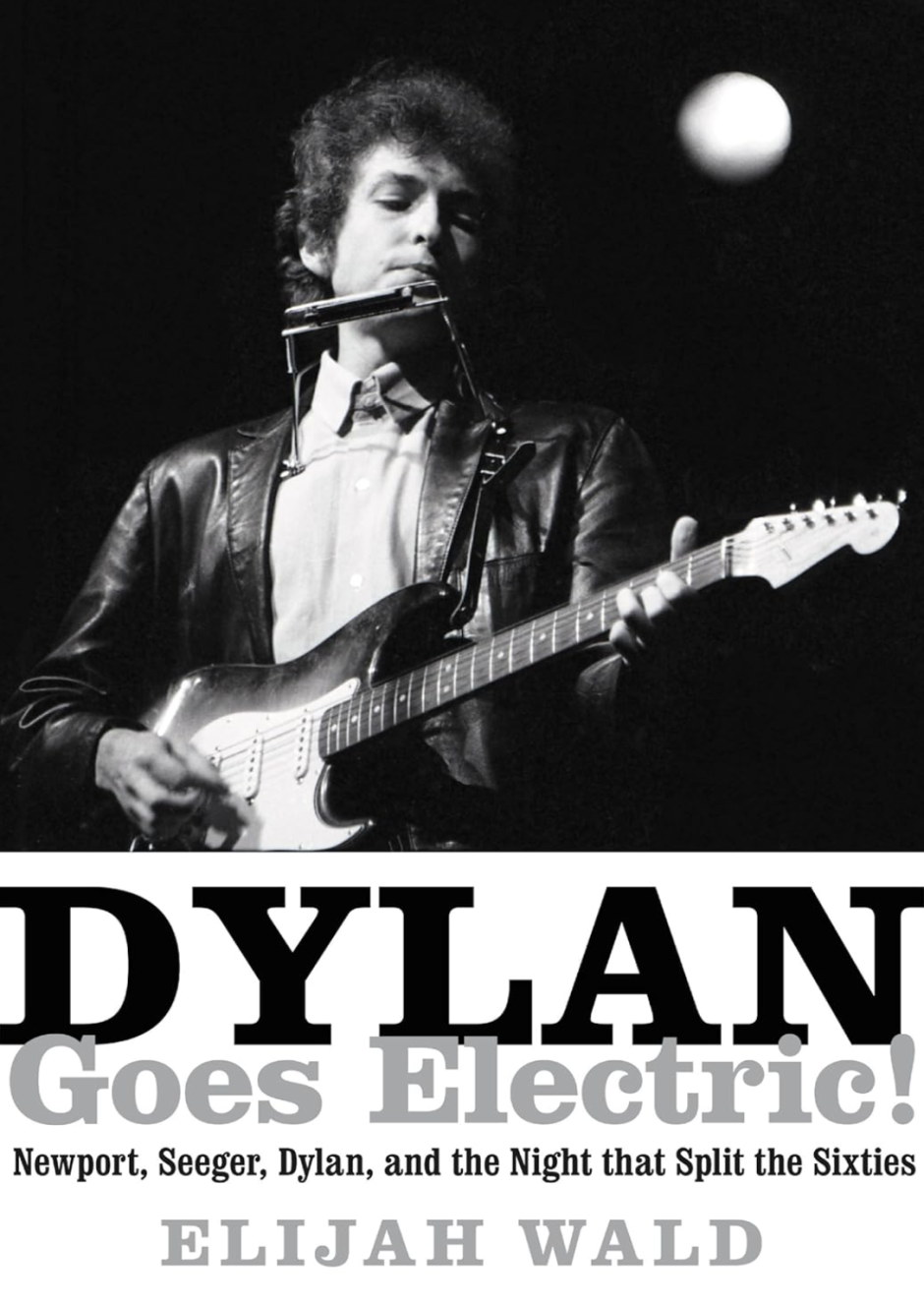
An excellent history of the Greenwich Village folk scene in the late 1950s and early 1960s, American folk music in general and early Dylan in particular. It filled in a lot of gaps in my understanding of the music, the people and the time period. How so much musical genius could coalesce and enhance each other is a marvel to behold. It’s easy to forget how hard music was to come by in that time. These days you can just say something into the air and a song will start to play, but in the 1950s if you wanted to hear Appalachian ballads you had to actually go to Appalachia, listen to radio stations you probably could not get, or luck into a friend with an improbably rare record collection.
Greenwich Village being a nexus of folk music talent meant that the folk singers from all over America could just come and swap songs – basically switching from intellectual and musical high latency and low bandwidth musical environment to a low latency and high bandwidth musical environment.
There was also a buildup of talent in Greenwich Village, and then for whatever (not really that related) reason tastes and styles went in the folk music direction and there was a wealth of talent to choose from. The amount of folk music in the highest selling records of the time period surprised me quite a bit.
How I Discovered It
I watched the movie “A Complete Unknown”
Who Should Read It?
Anyone interested in the music or the time period.
How the Book Changed Me
- The primary changes were the ones mentioned above, the main one not mentioned so far is the role of Pete Seeger. I started the book thinking that the movie exaggerated his importance and probably combined several people into one character, but after reading the book, if anything the movie minimized his role in American folk music. He did a staggering amount of work for a staggering number of years just keeping folk music as folk music a going concern. Before it appears in the comments (ha!) yes – the Stalin’s Songbird title is appropriate but meaningless. Folk singer political opinions do not count.
Highlights
Seeger was a hard man to know and sometimes a hard man to like, but he was an easy man to admire, and he backed up his words and beliefs with his actions. Some people might think it was hokey to build that house with his own hands, the Harvard boy homesteading on a patch of prairie an hour and a half north of Manhattan.
In retrospect that legend often overshadowed his work, and it is easy to forget what the work was. This is particularly true because Seeger was first and foremost a live performer, and only a shadow of his art survives on recordings. That was fine with him—he always felt the recordings were just another way of getting songs and music out into the world. If you complimented him, he would suggest you listen to the people who inspired him, and a lot of us did and discovered Woody Guthrie, Lead Belly, Uncle Dave Macon, Bob Dylan, and hundreds of other artists whose music we often liked more than his.
Pete would quote his father, Charles Seeger: “The truth is a rabbit in a bramble patch. One can rarely put one’s hand upon it. One can only circle around and point, saying, ‘It’s somewhere in there.’”
There were myriad views and conceptions of the folk revival, but in general they can be divided into four basic strains: the encouragement of community music-making (amateurs picking up guitars and banjos and singing together with their friends); the preservation of songs and styles associated with particular regional or ethnic communities (the music of rural Appalachia, the Mississippi Delta, the western plains, the Louisiana Cajun country, the British Isles, Congo, or anywhere else with a vibrant vernacular culture); the celebration of “people’s music” and “folk culture” as an expression of a broader concept of the people or folk (linking peasant and proletarian musical traditions with progressive and populist political movements); and the growth of a professional performance scene in which a broad variety of artists were marketed as folksingers. People committed to one of those strains often tried to distance themselves from people identified with another—purists criticized popularizers, popularizers mocked purists—but they all overlapped and intertwined, and all flowed directly from Pete Seeger.
Seeger’s name was inherited from a German great-great-grandfather who immigrated to the United States in 1787, but most of his ancestors had come over from England in the early Colonial period. His parents were classical musicians, his mother a violinist and his father a pianist and musicologist. A photo from 1921 shows two-year-old Pete seated on his father’s lap as his parents play music in a dirt clearing between their homemade wooden trailer and a makeshift tent. They were trying to bring culture to the common people, touring in support of socialism and the populist dissemination of “good” music.
He was briefly home from one of a series of boarding schools, which led to Harvard, which he dropped out of at nineteen, moving to New York City to be a newspaper reporter.
He was acting on Woody’s exhortation to “vaccinate yourself right into the big streams and blood of the people,” and recalled that trip as an essential part of his education, later advising young fans to spend their summer vacations hitchhiking around the country, meeting ordinary folks and learning how to fend for themselves in unfamiliar territory.
That would always be Pete’s unique talent: no matter the audience, no matter the situation, he could get people singing.
explaining that in country cabins the only books you’d find were a Bible and an almanac, one to get you to the next world and the other to see you through this one.
Seeger had always been shy, and the philosophy of anonymous participation suited his nature as well as his political beliefs—though it caused some friction in the Almanac Singers, since he and most of the others felt their songs should be presented as anonymous, communal creations, while Guthrie wanted to be properly credited for his work.
Though often attacked as a “Communist front,” People’s Songs received little encouragement from the Party, which did not think folk songs were likely to appeal to urban proletarians and preferred to cultivate artists like Duke Ellington—Seeger recalled a Communist functionary telling him, “If you are going to work with the workers of New York City, you should be in the jazz field. Maybe you should play a clarinet.”
Mostly, though, he worked on the Bulletin, presented educational programs about folk music, and played at benefits, square dances, and community events like the Saturday morning “wing-dings” he held for kids in his Greenwich Village apartment.
He and Toshi were living in the basement of her parents’ house on MacDougal Street—her Japanese father and Virginian mother were committed radicals, so he fit right in—and Pete seems to have been happy with this situation, earning minimal pay, serving progressive causes, and, in his words, “congratulating myself on not going commercial.”
“On Top of Old Smoky” (on which Pete created a model for future sing-along leaders by speaking each line before the group sang, like a preacher “lining out” a hymn),
The Trio added a new, young, collegiate flavor and became the defining pop-folk group of the early 1960s. In 1961 the Highwaymen followed with “Michael, Row the Boat Ashore,” and the Tokens topped the charts by adding jungle drums and new lyrics to “Wimoweh” and retitling it “The Lion Sleeps Tonight.” The next year the Trio reached the Top 40 with Seeger’s “Where Have All the Flowers Gone”; Peter, Paul, and Mary got their first Top 10 hit with his “Hammer Song” (retitled “If I Had a Hammer”); and by 1965 the Byrds were at number one with his “Turn, Turn, Turn.”
Alan Lomax grumbled, “Peter looked at folk music as something to bring everybody in, whether they could sing or play in tune or anything like that.” Lomax, by contrast, wanted to focus attention on authentic proletarian artists and music. He was happy when a well-known entertainer was willing to help with that mission, whether it was the Weavers or a pop-jazz singer like Jo Stafford, but was annoyed that Pete encouraged urban amateurs to think they were carrying on folk traditions.
Pankake’s article underscored an essential fact: as the folk scene grew through the 1950s, it split into cliques that often bickered bitterly, but all came through Seeger, and while his recordings with the Weavers parented the pop-folk style, he was simultaneously parenting its traditionalist opponents.
As a result, although he was by far the most prolific recording artist on the folk scene, issuing six albums a year from 1954 through 1958, his playing and singing were often more workmanlike than thrilling, and it is easy to underestimate both his skills and his influence on other players.
To Seeger, everything was political. His belief in folk music fitted with his beliefs in democracy and communism, and if he was often troubled by the fruits of those beliefs, he remained undaunted, repeating, “All you can do in this world is try.” During the 1950s he did not record many explicitly political songs, in part due to Cold War paranoia but also because his years with the Almanac Singers and People’s Songs had made him aware of the limitations of that approach. He had hoped to support a singing labor movement, but found that “most union leaders could not see any connection between music and pork chops” and ruefully noted that by the late 1940s, “‘Which Side Are You On?’ was known in Greenwich Village but not in a single miner’s union local.” In the formulation of his biographer David Dunaway, he concluded that the most effective way to connect his music to his politics was by singing songs by the working class rather than writing songs for it.
But it was not the kind of music Pete wanted to be playing, and when the Weavers were hired to do a cigarette commercial a month and a half later, it was the final straw. As the group’s sole nonsmoker, he bowed to the democratic process and did the session, but quit immediately afterward, noting “the job was pure prostitution . . . [and] prostitution may be all right for professionals—but it’s a risky business for amateurs.”
By March 27, 1961, when Seeger’s case finally went to trial, the Kingston Trio’s “Tom Dooley” had kicked off a full-scale folk boom and the week’s top five albums included discs by the Trio, the Brothers Four, and the Limeliters. Folk ensembles accounted for ten of the thirteen best-selling albums by duos or groups, the Seegerless Weavers among them. Smoothly polished trios and quartets were still by far the most popular folk acts; although Joan Baez had released her first album in January and Billboard tipped it as a disc to watch, it was still just reaching the cognoscenti.
“Some jail will be a more joyous place if he lands there, and things will be bleaker on the outside.”
Seeger came of age in the Depression and never lost the sense that economic inequality was the root of humanity’s problems, that a vast majority of working people was threatened and subjugated by a tiny minority of rapacious capitalists, and that the only solution was to organize mass movements that would harness the people’s numbers to combat the oppressors’ wealth. Twenty years later, Dylan grew up in the most economically equitable era in American history. World War II had jump-started the US economy, and New Deal reforms meant that wealth was spread more evenly than ever before. When he wanted a car or a motorcycle, his father bought one for him, and a lot of his friends had cars or motorcycles too.
The battles of his youth were not organized political struggles; they were individual gestures of protest against the placid conformity of his elders and his less imaginative peers.
For a teenager bursting with unfocused energy, the country and western style was too restrained and also too widely available. He needed music that not only captured his imagination but set him apart, and found it in the R & B broadcasts he picked up on his bedside radio after the staid local programming had gone off the air. KTHS,
In the 1930s and 1940s radio had been dominated by national networks that beamed The Kraft Music Hall, Your Hit Parade, Amos ’n’ Andy, and The Lone Ranger into every home with electricity, but in the 1950s that role was taken over by television, and radio became a haven for local programming, ethnic programming, niche markets, and small sponsors.
In the 1930s Seeger had to travel to the Asheville Folk Festival to find the raw southern sounds that changed his life, but Dylan made the same journey without leaving his bedroom. To some extent that meant they had different relationships to the music: for Seeger it was inextricable from the communities that created it and the historical processes that shaped those communities, while for Dylan it was a private world of the imagination.
“Trying to make life special in Hibbing was a challenge. . . . Rock ’n’ roll made Bob and me feel special because we knew about something nobody else in Hibbing knew about. . . . We started losing interest in Elvis after he started becoming popular.”
In the right circles, obscure musical knowledge was social currency.
Kegan was a city boy whose regular singing partners included several African American teenagers, and they may have been the first black people Dylan met.
One way or another, he kept performing through his high school years.
Bob’s main instrument in this period seems to have been piano,
Aside from music, his other passion was movies—his uncle owned the local theater, so he could go as often as he wanted—and friends recalled him being particularly fascinated by Rebel Without a Cause, watching it over and over and buying a red jacket like James Dean’s character wore.
Not only was Dandy playing the right kind of records, when Bob and Bucklen inquired about him it turned out that he was African American—in Bucklen’s estimate “the only black guy within fifty miles.” That alone would have been enough to fascinate Bob.
Like many grown-ups in the R & B business, he regarded what he played on the radio as a compromise with the crude tastes of a mass public and preferred the intricate explorations of cool jazz and hard bop: Bucklen remembers him saying, “I like blues. I like rock music. But there’s no depth to it like jazz.”
an uncle—gave him an album of Lead Belly 78s. The next day he called Bucklen: “Bob almost shouted over the phone: ‘I’ve discovered something great! You got to come over here!’”
A teenager who disdained Elvis Presley as a pale imitation of Clyde McPhatter and got excited about Lead Belly was not going to have his world changed by the Kingston Trio.
Belafonte had originally modeled himself on Josh White, the black guitarist and singer from South Carolina who made rural blues palatable to New York cabaret audiences, then branched out into left-wing topical songs and Anglo-American ballads.
For a young musician who had trouble keeping bands together, there was an obvious appeal to music that could be played solo,
Odetta’s rich blend of bel canto and blues provided a connection to the artists Dylan already loved. If his voice sounded nothing like hers, that was hardly a barrier for someone who had previously modeled himself on Little Richard, and he arrived in Minneapolis with a repertoire largely drawn from her records: “Santy Anno,” “Muleskinner Blues,” “Jack o’ Diamonds,” “’Buked and Scorned,” “Payday at Coal Creek,” “Water Boy,” “Saro Jane,” and his first Woody Guthrie songs, “Pastures of Plenty” and “This Land Is Your Land”—the two Odetta had recorded.
judging by what survives on early tapes his second-strongest influence was yet another classically trained black folksinger, Leon Bibb,
Dylan was also thinking more professionally than most people on the scene.
He was naturally shy, but performing brought something out in him: “I could never sit in a room and just play all by myself,” he wrote. “I needed to play for people and all the time.” It was a way of relating to his new acquaintances, but also in some respects a way of shutting them out, and not everyone was supportive. “You’d go to a party and Bob would get a chair and move right into the center of the room and start singing,” Weber recalled. “If you didn’t want to listen, you got the hell out of the room, and I resented it.”
He stopped going to classes in his first semester and instead hung out in coffeehouses, bars, and friends’ apartments, soaking up conversation, music, books, and the Bohemian culture that had been so lacking in Hibbing.
They had mistaken commercial pap for authentic folk art, and it was their duty to rescue other innocents who had been similarly beguiled.
But Dylan was enthralled and inspired: when Pankake went out of town for a couple of weeks he helped himself to a bundle of records, and his current girlfriend, Bonnie Beecher, recalled him playing the Elliott albums, one after another, insisting that she recognize their brilliance: “Literally, you are in this room until you’ve heard them all, and you get it.”
Guthrie exerted a strong influence on both men, but they were also linked in other ways—both Jewish, middle-class, introverted loners who reinvented themselves as mythic wandering minstrels. Woody was an inspiration as much for his anarchic independence as for his specific musical skills, and although they sang dozens of Guthrie’s songs, that was almost an afterthought.
The Guthrie of Bound for Glory is a drifting hobo folksinger, picking up songs wherever he goes, sometimes improvising a lyric to suit a particular situation, but in general singing the familiar songs of ordinary working people. The real Guthrie spent a lot of time at a typewriter but sang a similar range of material, and on records, radio, and stage performances he showed no preference for his own compositions. For Dylan, Guthrie was exciting as a singer, player, and songwriter, but most of all as a man who lived life on his own terms. Given how large Guthrie has loomed in Dylan’s biographies, one of the most striking things about the surviving tapes of that year and a half in Minneapolis is how little Guthrie material is on them: a scant five songs, at least four of which Dylan had learned from other people’s recordings.
Nelson remembered Dylan changing instantly and dramatically after hearing those first Jack Elliott albums: “He came back in a day, or two at the most, and . . . from being a crooner basically, nothing special . . . he came back and sounded like he did on the first Columbia record.”
Little Richard and Odetta had been inspirational models, but Guthrie was more than just an exciting musician: he was a storyteller, a legend, and that fall he seems to have become a fixation.
a bunch of Woody’s letters from the hospital in New Jersey where he had been confined since the mid-1950s
Bob Dylan arrived in New York in January 1961 and headed to Greenwich Village, where he introduced himself to the local scene by playing a couple of songs at a coffeehouse on MacDougal Street.
in any case within that first week he met Guthrie, sang for him, and established himself as one of the few young performers who had a direct connection to Woody, not only as a legend but as a person.
More than that, he established himself with the New York folk crowd as a new incarnation of the Woody who had rambled out of the West twenty years earlier.
“There were detractors who accused Bob of being a Woody Guthrie imitator,” says Tom Paxton, a singer from Oklahoma who had arrived in the Village a year or so earlier. “But that was silly on the face of it, because Jack Elliott was a more conscious Woody clone than Bob ever was. When Bob sang Woody Guthrie songs it was very distinctive, but Bob sang like Bob right from the beginning.” Seeger agreed: “He didn’t mold himself upon Woody Guthrie. He was influenced by him. But he was influenced by a lot of people. He was his own man, always.”
Dylan loved Guthrie’s songs and cared about visiting him and singing for him, and some people close to Woody felt that Dylan established a stronger connection than any of the other young singers who made the pilgrimage.
Anyone hoping to understand the cultural upheavals of the 1960s has to recognize the speed with which antiestablishment, avant-garde, and grass-roots movements were coopted, cloned, and packaged into saleable products and how unexpected, confusing, and threatening that was for people who were sincerely trying to find new ways to understand the world or to make it a better place.
In terms of folk music in the early 1960s, it seemed pretty clear what kind of far-out was selling. “Rockless, roll-less and rich, the Kingston Trio by themselves now bring in 12% of Capitol’s annual sales, have surpassed Capitol’s onetime Top Pop Banana Frank Sinatra,”
In 1961 the Trio was the best-selling group in the United States, accounting for seven of Billboard magazine’s hundred top LPs. Harry Belafonte had three, the Limeliters had one,
Normal people might find it amusing to visit the Café Bizarre or the Wha? and see the weirdos in their native habitat, but the Kingston Trio was not only more polished and entertaining; they were also more honest: as Dave Guard said, “Why should we try to imitate Leadbelly’s inflections when we have so little in common with his background and experience?” The Bohemians were a bunch of poseurs who dressed badly, listened to screechy music, and were at best ridiculous and often frankly annoying. Of course, the Bohemians saw the situation rather differently: to them, the Trio and its fans were a bunch of empty-headed conformists marching in lockstep to the drumbeat of Madison Avenue and the Cold War military-industrial complex, and any effort to succeed on the commercial folk scene represented a compromise with a corporate culture that was bland, retrograde, and evil—the culture of blacklisting, segregation, and nuclear annihilation.
In 1963, Dylan’s girlfriend Suze Rotolo was told that her cousin’s husband, a career army officer, had lost a promotion that required security clearance because she was pictured with Dylan on the cover of his Freewheelin’ album,
Through most of the 1950s serious fans drew a distinction between authentic folksingers, who played the traditional music of their communities, and “singers of folk songs” like Seeger, Burl Ives, Richard Dyer-Bennett, and Odetta, who performed material collected in those communities but had not grown up in the culture.
Van Ronk, a leading figure in this group, later dubbed them the “neo-ethnics.” Some played old-time hillbilly music, some played blues, some sang medieval ballads, and there were lots of other flavors in the mix:
Music was permitted in the park from noon till five, and if you weren’t sated by then there would be a hootenanny and concert that evening at the American Youth Hostels building on Eighth Street. Then serious pickers and singers would convene at 190 Spring Street, where several musicians had apartments, or in various other lofts, basements, and walk-ups around the Village or Bowery, and the playing would continue till dawn. In terms of hearing new songs and styles, meeting other musicians, and building skills and repertoire, the parties were at least as important as the clubs and coffeehouses. The Village musicians all learned from one another and were each other’s most important audience.
They reshaped songs and arrangements to fit their tastes and talents, but always within the musical languages of the rural South, and within three years had recorded six albums for Folkways and spawned imitators across the country.
But music was always at the heart of it, and soon Dylan was playing decent fingerstyle guitar and singing a lot more blues.
Eric Von Schmidt was a painter, guitarist, and the uproarious Bohemian godfather of the Harvard Square scene, combining Van Ronk’s devotion to old jazz and blues with Elliott’s anarchic enthusiasm.
“You heard records where you could, but mostly you heard other performers.”
He has sometimes been criticized for how much he borrowed from others, but that was not an issue until he became famous. At the time, as Van Ronk put it, “We all lived with our hands in each other’s pockets. You’d learn a new song or work out a new arrangement, and if it was any good you’d know because in a week or two everybody else would be doing it.”
In those first months a lot of people regarded Dylan as just another young folksinger with a particularly abrasive voice, and some are still baffled by his success. But others say he stood out immediately:
For Dylan, as for Pete Seeger, the attraction of folk music was that it was steeped in reality, in history, in profound experiences, ancient myths, and enduring dreams. It was not a particular sound or genre; it was a way of understanding the world and rooting the present in the past.
There was always a disconnect between the aesthetic of the hardcore folk scene and the marketing categories of the music business. Going
“I played all the folk songs with a rock ’n’ roll attitude,” Dylan recalled. “This is what made me different and allowed me to cut through all the mess and be heard.”
Among the neo-ethnic crowd, songwriting tended to be viewed with suspicion, in large part because it was associated with the Seeger-Weavers generation and pop-folk trends.
Within four months of arriving in New York he got a gig at the most prestigious showcase of the neo-ethnic scene, Gerdes Folk City, opening for the legendary John Lee Hooker, and a few months later his talents were recognized by another legend, the record producer John Hammond.
Shelton recalled that the Times piece was applauded by Van Ronk and Elliott, but “much of the Village music coterie reacted with jealousy, contempt, and ridicule.” When it was followed by a Columbia recording contract, “Dylan felt the sting of professional jealousy. He began to lose friends as fast as he had made them.”
Time magazine, in a cover story featuring Joan Baez, wrote: The tradition of Broonzy and Guthrie is being carried on by a large number of disciples, most notably a promising young hobo named Bob Dylan.
More to the point, neither Playboy nor Time would have been giving Dylan that kind of coverage if he had not been on a major national record label, and a lot of people couldn’t understand what he was doing there.
But Dylan’s problem was not that he had limited energies and needed to channel them; it was that he was exploding with ideas and needed opportunities to try them out.
He had been surrounded by leftists of various stripes since his Minneapolis days—there was no escaping that in urban Bohemia—and in August 1961 he met a seventeen-year-old named Suze Rotolo, who would be his companion, lover, and sometime muse for the next two years.
The melody was lilting and pretty, adapted from a nineteenth-century slave song that Odetta had recently recorded: “No More Auction Block for Me.”
They recognized the criticism as a badge of pride, proof that, rather than sounding like the callow college kids being marketed as folksingers, Dylan was in the same camp as Dave Van Ronk and the New Lost City Ramblers, evoking the authentic ethnic traditions of people like Lemon Jefferson and Roscoe Holcomb. But “Blowin’ in the Wind” was not the sort of song you might hear in a Texas juke joint or on a back porch in Kentucky. It was folksinger music.
The article continued: “Not since Charlie Chaplin piled up millions in the guise of a hapless hobo has there been a breed of entertainer to match today’s new professional folksingers in parlaying the laments of poverty into such sizable insurance against the experience of it.”
There were two distinctions that set him apart from previous folk stars: he was primarily a songwriter, and he had a lousy voice.
The review emphasized Dylan’s vocal deficiencies: “Sometimes he lapses into a scrawny Presleyan growl,” and “at its very best, his voice sounds as if it were drifting over the walls of a tuberculosis sanitarium—but that’s part of the charm.” He was the antithesis of a slick pop-folk warbler.
The image of Dylan as a songwriter who triumphed despite a lack of vocal and instrumental skills almost entirely supplanted his earlier reputation as a dynamic interpreter of rural roots music.
Baez was a dauntingly sincere artist, in Joan Didion’s phrase, “the Madonna of the disaffected.”
Grossman’s talents as a promoter were more than equaled by his backroom financial savvy, and a bedrock truth of the American music business is that performers reap the fame, but the money is in publishing. (In a holdover from the days of sheet music, a song’s publisher typically receives half of all royalty payments, though by 1960 the publisher’s sole contribution might have been to persuade the songwriter to sign a contract.)
Grossman had a unique deal with Witmark, receiving half the publisher’s royalties for any songwriter he brought to the company, and his management contract with Dylan—as with Odetta; Peter, Paul, and Mary; Ian and Sylvia; and the other acts he soon acquired—gave him 20 percent of the artist’s earnings, with an additional 5 percent for income from recordings. As a result he had a very strong interest in Dylan writing songs, recording them, and having them recorded by his other acts and anyone else who might care to join the party.
“Albert scared the shit out of people,” says Jonathan Taplin, who started as his assistant and went on to become a successful film producer. “He was the greatest negotiator in history.” Van Ronk recalled Grossman as an endlessly fascinating and amusing companion, but added, “He actually took a sort of perverse pleasure in being utterly unscrupulous.”
Dylan had a gut sense that the world was a mess and admired the idealism of Guthrie and Seeger, but his politics were a matter of feelings and personal observation rather than study or theory. “He was a populist,” Van Ronk said. “He was tuned in to what was going on—and much more than most of the Village crowd, he was tuned in not just to what was going on around the campuses, but also to what was going on around the roadhouses—but it was a case of sharing the same mood, not of having an organized political point of view.” Contrasting him with Phil Ochs, who had been a journalism major before taking up guitar, Rotolo noted, “Dylan was perceptive. He felt. He didn’t read or clip the papers. . . . It was all intuitive, on an emotional level.”
He was writing longer, more complex lyrics, and the British song forms provided useful patterns: “Girl from the North Country” and “Bob Dylan’s Dream” were based on Carthy’s versions of “Scarborough Fair” and “Lady Franklin’s Lament,” “With God on Our Side” on Dominic Behan’s “The Patriot Game,” and “Masters of War” on “Nottamun Town,” the Appalachian survival of a mysterious English song that retained echoes of ancient mummers’ rites. As
Dylan might recognize the value of that kind of self-abnegation and dedication, but he was repelled by the idea of anyone handing their mind over to any organization or ideology. He did not take part in rallies or marches and regularly denied that his songs expressed anything but his own experiences and feelings. When he presented himself as a little guy, one of the ordinary folk, his model was Woody, the quirky Okie bard who never really fit into any group and was rejected by the Communist Party as undisciplined and unreliable.
Dylan was more comfortable as a loner than as a spokesman, and when he made his strongest stand against censorship, in May 1963, it was right out of the pages of Bound for Glory. He had been booked to appear on the Ed Sullivan Show, America’s most popular variety program, but when they told him he couldn’t sing “Talkin’ John Birch Paranoid Blues,” he walked out, just as Woody had walked out of a showcase gig at Rockefeller Center’s Rainbow Room in the final scene of that book. In real life Woody was at the Rainbow Room as a member of the Almanac Singers, but when he reworked the story for his memoir he was by himself, one small guy standing up to a team of corporate bigwigs, and for anyone who loves that book it is a thrilling moment. Dylan re-created it in more public and significant circumstances, and his stand was hailed as a blow against the blacklist and cemented his reputation as Woody’s heir.
Though few reviews mentioned her, Wein recalled Baez as “not only the great discovery, but also the living symbol, of the first Newport Folk Festival.”
When critics attacked the Kingston Trio, the Brothers Four, or the New Christy Minstrels for having ordinary voices and instrumental skills and relying on a small repertoire of familiar songs, they were highlighting exactly what made those groups attractive to millions of kids across the United States: the idea that anyone could be part of the movement, not only as a spectator but as a participant.
That was what made Hootenanny so galling: it was simultaneously the most visible showcase for the folk revival and a prop of the conservative, conformist power structure the revivalists despised. Its
Tastes that a few years earlier had seemed esoteric were increasingly mainstream, which was great in some ways but disturbing in others—it was, of course, wonderful that the music had a larger audience, but it diluted the feeling of sharing something secret and precious, and there was every reason to fear that the mainstream would transform heartfelt art into mass-produced schlock.
One reason so many people cared so deeply about Seeger, Baez, and Dylan was that each managed to reach large audiences without seeming to compromise—and Dylan’s success was even more jarring than Seeger’s or Baez’s. They were both unique, committed artists, but also pleasant and reliable and, if they had been willing to relinquish their political commitments, could easily have joined the Hootenanny wave.
In musical terms, the contrast was striking. As Van Ronk put it, “Dylan, whatever he may have done as a writer, was very clearly in the neo-ethnic camp. He did not have a pretty voice, and he did his best to sing like Woody, or at least like somebody from Oklahoma or the rural South, and was always very rough and authentic-sounding.” With Baez, “it was all about the beauty of her voice,” and it was not just her: virtually all the female folk stars sang in styles influenced by classical bel canto. “Whereas the boys were intentionally roughing up their voices, the girls were trying to sound prettier and prettier, and more and more virginal . . . and that gave them a kind of crossover appeal to the people who were listening to Belafonte and the older singers, and to the clean-cut college groups.”
John Cohen argued that topical songs were actually less relevant than old ballads and fiddle tunes, since they “blind young people into believing they are accomplishing something . . . when, in fact, they are doing nothing but going to concerts, record stores, and parties.”
wrote that Bobby Zimmerman’s old acquaintances “chuckle at his back-country twang and attire and at the imaginative biographies they’ve been reading about him. They remember him as a fairly ordinary youth from a respectable family, perhaps a bit peculiar in his ways, but bearing little resemblance to the show business character he is today.” His parents told the reporter that Bobby had always written poems, but they were disturbed to see him acting like a hayseed, and his father provided an explanation his young fans could be expected to find particularly damning: “My son is a corporation and his public image is strictly an act.”
But—gotcha!—“A few blocks away, in one of New York’s motor inns, Mr. and Mrs. Abe Zimmerman of Hibbing, Minn., were looking forward to seeing their son sing at Carnegie Hall. Bobby had paid their way east and had sent them tickets.”
Baez and Dylan often irritated friends on the left with their unfocused politics, but in social terms they were solidly with the radicals.
It was a perfect revolution for young Americans raised on John Wayne and Marlon Brando movies, who dreamed of creating a new world through thrilling, heroic gestures.
in the summer of 1964 Dylan was still largely unknown to them. In a New Yorker profile later that year, Nat Hentoff indicated his “accelerating success” by noting that his first three LPs had cumulatively sold almost four hundred thousand copies. By comparison, Cash’s Ring of Fire LP, released shortly after Dylan’s second album, sold about five hundred thousand in its first year, which still didn’t come close to what Baez was selling, while Peter, Paul, and Mary were in a different league, regularly putting both albums and singles at the top of the charts.
the legendary Skip James, whose eerie falsetto and minor-keyed guitar style remain for many listeners the most profound blues on record.
It was the first time they had sung together, and Cash remembered it as the highlight of the festival. He had arrived a day late for his scheduled Friday appearances, almost blowing the gig, and was in the depths of his amphetamine addiction—Glover described him as “gaunt and twitchy, but real as hell”—and
To Seeger, folk music was defined by its relationship to communities and traditions: it was what nonprofessionals played in their homes or workplaces for their own amusement and the songs and music they handed down through that process to later generations. That did not mean it was better than the music of Beethoven or Gershwin, but it was different, and a big part of the difference was that it was shared, that no one owned or controlled it.
Buffy Sainte-Marie often repeated the story of singing “Universal Soldier” at the Gaslight Café and being complimented by a nice man who offered to help her by publishing the song, wrote a contract on a paper napkin, paid her a dollar, and acquired 50 percent of the fortune it made when it became an international hit—but
the singers shouted, “I get high! I get high! I get high!” Those were the days when dopers talked to each other in code, and Bob and his buddies were solid initiates, so they were thrilled to hear these merry limeys sneaking a hidden kick into a teen-pop chart hit. It was not until August, when Dylan met the Beatles in New York and suggested getting stoned together, that they explained they were actually singing “I can’t hide!”
In Paris he hung out with Hugues Aufray, who was translating his songs into French; drank good wines; ate in nice restaurants; and had a fling with Nico, the German fashion model and singer who would later join the Velvet Underground. From there he went to Berlin, then on to Greece with Nico in tow.
Unlike them, unlike the Kingston Trio, unlike Elvis or Duke Ellington or Hank Williams or Leopold Stokowski, Dylan and Seeger and Baez all walked onstage looking the same way they looked when they were walking down the street or hanging out with their friends—a conscious and striking departure not only from previous stage wear but from the suits, makeup, and neatly coifed hair that were still the norm for much of their audience.
Jagger recalled Dylan telling Keith Richards, “I could have written ‘Satisfaction’ but you couldn’t have written ‘Tambourine Man,’” and when the interviewer seemed shocked, he added, “That was just funny. It was great. . . . It’s true.”
The Byrds’ sound was a logical fusion of the Beatles and Peter, Paul, and Mary, and from the point of view of mainstream pop prognosticators it made the same sense as Chubby Checker recording a calypso twist. Hardcore folk fans were equally quick to make that connection, with a different implication: these people weren’t innovators, they were opportunists.
Most of the drugs had been around for a while—my father smoked marijuana with a group of medical students in 1933, taking careful notes on their revelations—but the elevation of drug use into a drug culture, and the equation of that culture with youth, music, and social change, was something new.
The song was “Like a Rolling Stone,” and though the version Dylan took into the studio on June 15 was a moody, seven-minute waltz, the next day they shifted to a 4/4 rock beat and, with the addition of Al Kooper on organ, cut the definitive version.
They recognized Dylan’s Sunday night set, when he “electrified one half of his audience and electrocuted the other,” as the “journalistic happening” of the 1965 Newport Festival.
Because this is folk music, however, one can only surmise that the quintet, electric guitars and all, are simple researchers dedicated to preserving the sound of the Beatles.”
In terms of record sales and name recognition, Dylan was still behind Peter, Paul, and Mary and roughly on a par with Baez, but in terms of current trends he was in another class. He had originally been scheduled for Thursday night, but there were so many complaints from fans who could not make that first show that he and Baez were switched, with her on Thursday and him on the final Sunday program.
In the legend of Newport 1965, Dylan’s Sunday night set was the culmination of a three-day battle between electric rebels and hidebound folk purists, and the opening volley was fired on Friday by the Paul Butterfield Blues Band.
To blues purists, the Chambers Brothers, Lightnin’ Hopkins—even, at a stretch, Bo Diddley and Chuck Berry—were authentic exponents of an ethnic folk culture, while Bloomfield, Butterfield, and Bishop, talented as they might be, were interpreters.
Lomax tried to push Grossman aside, or maybe it was Grossman who pushed Lomax. Either way, in seconds the portly prophet of tradition and the portly purveyor of mammon—“the two big bears,” in Maria Muldaur’s description—were throwing inept punches and rolling in the dust. “It was a perfect confrontation whose symbolism was lost on none of us,”
The audience has not heard their murmured interchange and waits quietly, then starts screaming and booing as Dylan unplugs his guitar and leaves the stage, followed by the other musicians. Yarrow steps to the microphone, still wearing his dark shades and looking tired and worried. The crowd is going wild. “Bobby was—” he begins, then pauses, summoning his resources: “Yes, he will do another tune, I’m sure, if you call him back.” Dylan’s set has lasted seventeen minutes, a bit over the normally allotted time, but included only three songs and a lot of dead space, and the crowd is full of people who came to Newport specifically to see him. There is no way they are going to let him get away that easily, and they meet Yarrow’s challenge with a frenzied mix of boos, applause, whistles, and shouts of “More!”
Whatever one’s opinion, the naysayers have some facts on their side: The band was underrehearsed, and even if one thinks the first two songs sound great, “Phantom Engineer” was a high-energy train wreck. Aside from the music, Dylan’s performance was halting and disorganized, and he made no attempt to engage with the audience, to excuse the problems, or to distract from the confusion. His set lasted roughly thirty-five minutes, longer than anyone else’s that night, but that included two minutes when he was offstage and eight when he was onstage tuning, waiting for the other guys to get ready, waiting for a new guitar, a capo, a harmonica, looking back over his shoulder, complaining, or simply strumming disjointedly and playing an occasional note on the harmonica.
Dylan told Anthony Scaduto, “I did not have tears in my eyes. I was just stunned and probably a little drunk.”
Phil Ochs gleefully suggested that the next year’s finale should “feature a Radio City Music Hall Rockette routine including janitors, drunken sailors, town prostitutes, clergy of all denominations, sanitation engineers, small time Rhode Island politicians, and a bewildered cab driver,” backed by “the beloved Mississippi John Hurt’s new electric band consisting of Skip James on bass, Son House on drums and Elizabeth Cotton on vibes being hissed and booed by the now neurotic ethnic enthusiasts.”
Seeger did not come to the party, but the following morning a young folk fan was eating breakfast at the Viking and noticed him sitting with his father, Charles, at the next table. “He was telling his father, who was hard of hearing, about what had happened and what he thought of Dylan, and he sort of leaned over, and these were his exact words: ‘I thought he had so much promise.’”
During the intermission that night, Theodore Bikel put it in a nutshell, telling a Broadside writer: “You don’t whistle in church—you don’t play rock and roll at a folk festival.” For that analogy to hold, Newport had to be the church: the quiet, respectable place where nice people knew how to act. Pete Seeger was the parson. The troubled fans were the decent, upstanding members of the community. And Dylan was the rebellious young man who whistled. Which was exactly what he had always been, and what Seeger had been, and what Newport had celebrated.
“The people” so loved by Pete Seeger are the mob so hated by Dylan. In the face of violence he has chosen to preserve himself alone. . . . And he defies everyone else to have the courage to be as alone, as unconnected, as unfeeling toward others, as he.
At the Philadelphia Folk Festival a few weeks later, Phil Ochs sang his attack on wishy-washy centrists, “Love Me, I’m a Liberal,” then pointed to a stream of water near the stage and said, “If Pete Seeger were here, he’d walk on it.” There was irony in these attacks, since Seeger remained a red-tainted pariah to conservatives and was barred from mainstream venues where Dylan and Ochs were welcome.
“Eve” was joined by dozens of discs with socially relevant themes, often set off with rudimentary harmonica fills.
Collins cut a Kooper-backed single of Dylan’s “I’ll Keep It with Mine”; Albert
Their caressing harmonies were a much easier sell than Dylan’s quirky rasp, and through the rest of the 1960s, while his albums sold in the mid-hundreds of thousands and the Rolling Stones only once cracked the million mark, each Simon and Garfunkel LP sold at least two or three million.
Some old-time Village regulars tried to hop the folk-rock train, but the main lesson most learned was that they were not Dylan.
The other reaction, which was even more damaging, was, “I’m gonna be next. All I have to do is find the right agent, the right record company, the right connections, and I can be another Bob Dylan!” Yeah, sure you could. All you had to do was write “A Hard Rain’s A-Gonna Fall”—for the first time. That was what Bobby did, and none of the rest of us did that. Even if everyone didn’t admit it, we all knew that he was the most talented of us.
Around the same time he told Robert Shelton, “My idea of a folk song is Jeannie Robertson or Dock Boggs. Call it historical-traditional music.” For him, folk songs were not mellow, feel-good music; they were a connection to a tangled, mythic past. “It comes about from legends, bibles, plagues,” he told Hentoff. “All these songs about roses growing out of people’s brains and lovers who are really geese and swans that turn into angels.” And, he added: “They’re not going to die.” Twenty years later he was still drawing that line: “Nowadays you go to see a folk singer—what’s the folk singer doin’? He’s singin’ all his own songs. That ain’t no folk singer. Folk singers sing those old folk songs, ballads.”
For northern liberals, Vietnam was a much more divisive issue than voting rights and integrated drinking fountains, and many supported Johnson’s effort to stem the spread of international Communism. Then,
On tour with Baez in 1963, he had been refused a hotel room because of his unkempt appearance and responded by composing “When the Ship Comes In.” The image was from Brecht’s “Pirate Jenny,” in which a hotel maid dreams of a ship of avenging pirates who will sweep ashore and slaughter the complacent, respectable bourgeoisie.
He released Bringing It All Back Home in the spring of 1965, Highway 61 Revisited that summer, and Blonde on Blonde a year later.
Dylan’s reception at Newport had so much resonance because he mattered to his audience in a way pop music had never mattered before, and the power of that message came not only from Dylan but from Newport, from the fact that he was booed at a beloved and respected musical gathering, by an audience of serious, committed young adults. The fans who booed him from Forest Hills to the Manchester Free Trade Hall over the next year were showing not only their anger at his capitulation to the mainstream but their solidarity with that first mythically angered cohort of true believers.
Inevitably, though, the technology made a difference: at Newport the audience was full of people with their own guitars and banjos, and when the official program was over the unofficial music-making continued, sounding very similar to what was happening onstage. Electric instruments, for better or worse, demanded amplifiers and electrical outlets and established a divide: players behind the amps, listeners in front. It was not impossible to sing along with a rock band, but it was irrelevant. As Dylan put it, Seeger made his listeners “feel like they matter and make sense to themselves and feel like they’re contributing to something,” while listening to a rock band “is like being a spectator at a football game. Pete is almost like a tribal medicine man, in the true sense of the word. Rock ’n’ roll performers aren’t. They’re just kind of working out other people’s fantasies.”
“Dylan is no apostle of the electronic age. Rather, he is a fifth-columnist from the past.”
-
Recalibrating thoughts on songwriting
Preamble
My Dylan and folk music obsession continues to progress. I was struck by the thought of how good something has to be to be “arranged”.
In his autobiography Dave van Ronk mentioned the sheer amount of creativity that goes into an arrangement of a well-known song. Related – I’ve been working on a bluegrass version of one of Leonard Cohen’s middle period songs.
The Gist
Then I listened to a bunch of Dylan outtakes and was struck by how much a song needed to be refined before it could be arranged. A lot of the earlier versions were good, but not much more than that. The final versions were instant classics that benefit the world.
-
I’m Your Man: The Life of Leonard Cohen
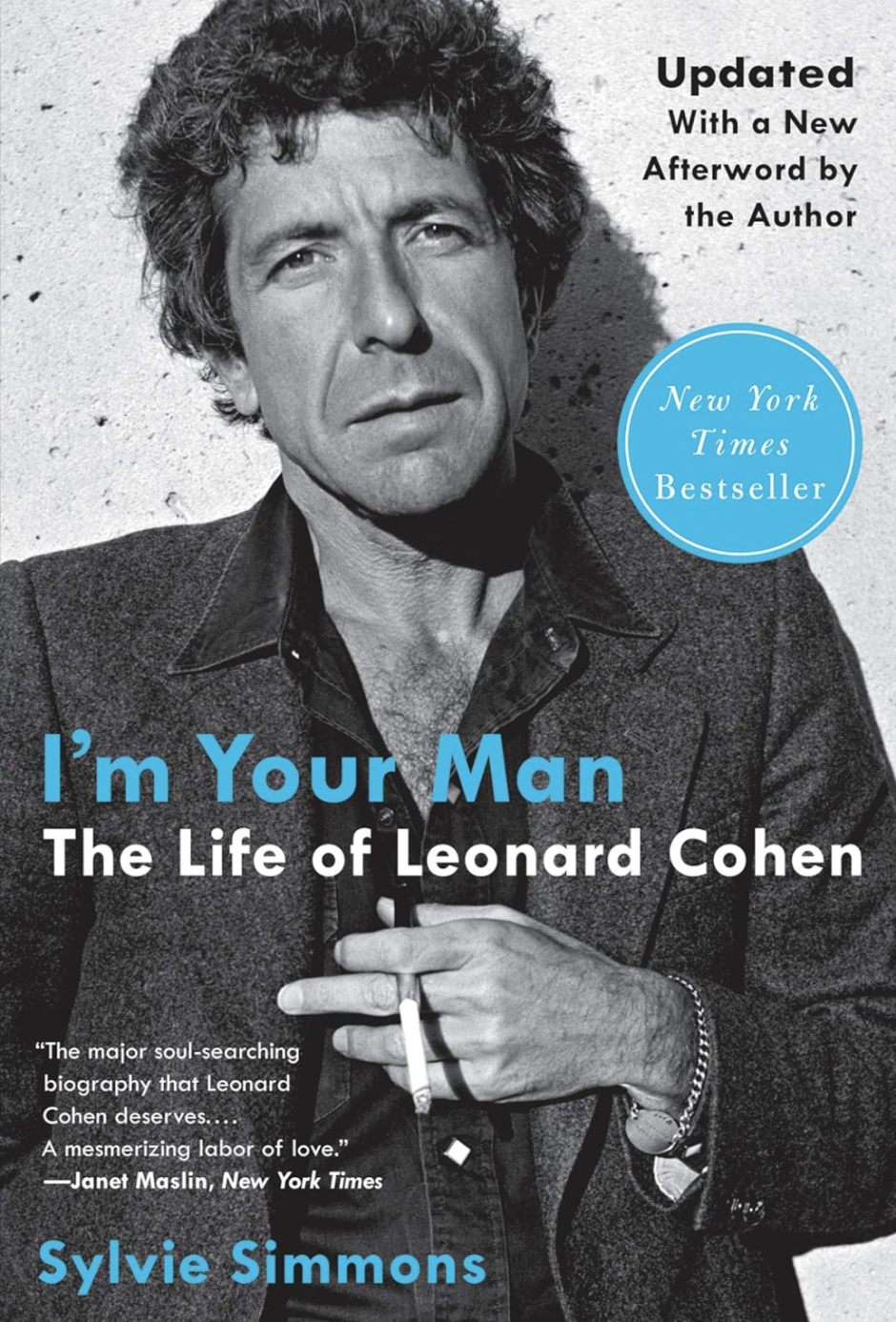
This book succeeds as a biography better than almost any I’ve ever read. All Leonard Cohen questions are answered. All questions about the times in which he lived are answered. “What Leonard Cohen means to me (the author)” is touched upon lightly and then put down. As far as I can tell no relevant musical or poetic detail is omitted, including my long running question of “Why did he shift from guitar in the 1980s?”
Highly recommended for anyone into Leonard Cohen – well written and very informative.
Things that surprised me
- He spent much more time in the Buddhist monastery than I originally thought
- Far more drug use, especially amphetamines than I would have thought, especially later in life (most people grow out of that sort of thing as they get older, Leonard grew into it)
- His work ethic and perfectionism were quite impressive
- The reason that he moved from guitar based folk was not due to some artistic “growth” but a musical writer’s block regarding guitar accompaniment. His synthesizer accompaniment was no blocked so he rolled with that.
- His youth and his old age lasted for long periods of time, his middle age was quite short
Highlights
Many years later Edgar H. Cohen would go on to write Mademoiselle Libertine: A Portrait of Ninon de Lanclos, a biography published in 1970 of a seventeenth-century courtesan, writer and muse whose lovers included Voltaire and Molière, and who, after a period in a convent, emerged to establish a school where young French noblemen could learn erotic technique.
Leonard did not cry at the death of his father; he wept more when his dog Tinkie died a few years later. “I didn’t feel a profound sense of loss,” he said in a 1991 interview, “maybe because he was very ill throughout my entire childhood. It seemed natural that he died. He was weak and he died. Maybe my heart is cold.”
Chapter Two of the hypnotism manual might have been written as career advice to the singer and performer Leonard would become. It cautioned against any appearance of levity and instructed, “Your features should be set, firm and stern. Be quiet in all your actions. Let your voice grow lower, lower, till just above a whisper. Pause a moment or two. You will fail if you try to hurry.”
Since the age of thirteen Leonard had taken to going out late at night, two or three nights a week, wandering alone through the seedier streets of Montreal. Before the Saint Lawrence Seaway was built the city was a major port, the place where all the cargo destined for central North America went to be offloaded from oceangoing freighters and put on canal boats and taken up to the Great Lakes or sent by rail to the West. At night the city swarmed with sailors, longshoremen and passengers from the cruise ships that docked in the harbor, and welcoming them were countless bars, which openly flouted the law requiring that they close at three A.M.
Lorca was a dramatist and a collector of old Spanish folk songs as well as a poet, and his poems were dark, melodious, elegiac and emotionally intense, honest and at the same time self-mythologizing. He wrote as if song and poetry were part of the same breath. Through his love for Gypsy culture and his depressive cast of mind he introduced Leonard to the sorrow, romance and dignity of flamenco. Through his political stance he introduced Leonard to the sorrow, romance and dignity of the Spanish Civil War. Leonard was very pleased to meet them both.
Over the subsequent years, whenever interviewers would ask him what drew him to poetry, Leonard offered an earthier reason: getting women. Having someone confirm one’s beauty in verse was a big attraction for women, and, before rock ’n’ roll came along, poets had the monopoly. But in reality, for a boy of his age, generation and background, “everything was in my imagination,” Leonard said. “We were starved. It wasn’t like today, you didn’t sleep with your girlfriend. I just wanted to embrace someone.”
In the summer of 1950, when Leonard left once again for summer camp—Camp Sunshine in Sainte-Marguerite—he took the guitar with him. Here he would begin playing folk songs, and discover for the first time the instrument’s possibilities when it came to his social life. You were still going to summer camp at age fifteen? “I was a counselor.
There were a lot of the Wobbly songs—I don’t know if you know that movement? A Socialist international workers union. Wonderful songs. ‘There once was a union maid / Who never was afraid / Of goons and ginks and company finks / And deputy sheriffs that made the raid . . . No you can’t scare me I’m stickin’ with the union.’ Great song.”
Leonard was clearly enthused. Some fifty years after his stay at Camp Sunshine he could still sing the songbook by heart from beginning to end.* In
At the second lesson, the Spaniard started to teach Leonard the six-chord flamenco progression he had played the day before, and at the third lesson Leonard began learning the tremolo pattern. He practiced diligently, standing in front of a mirror, copying how the young man held the guitar when he played. His young teacher failed to arrive for their fourth lesson. When Leonard called the number of his boardinghouse, the landlady answered the phone. The guitar player was dead, she told him. He had committed suicide.
The streets around McGill University were named for august British men—Peel, Stanley, McTavish—its buildings constructed by solid, stony Scotsmen in solid Scottish stone.
Had someone told you the British Empire was run from McGill, you’d be forgiven for believing them; in September 1951, when Leonard started at McGill on his seventeenth birthday, it was the most perfect nineteenth-century city-within-a-city in North America.
The general attitude to bilingualism at that time was not a lot different, if less deity-specific, from that of the first female governor of Texas, Ma Ferguson: “If the English language was good enough for Jesus Christ, it’s good enough for everybody.”
Fraternities and presidencies might appear surprisingly pro-establishment for a youth who had shown himself to have Socialist tendencies and a poetic inclination, but Leonard, as Arnold Steinberg notes, “is not antiestablishment and never was, except that he has never done what the establishment does. But that doesn’t make him antiestablishment.
But in 1952, between his first and second years, Leonard formed his first band with two university friends, Mike Doddman and Terry Davis. The Buckskin Boys was a country and western trio (Mort had not yet taken up the banjo or it might have been a quartet), which set about cornering the Montreal square-dance market.
Mostly, though, he played guitar—alone, in the quadrangle, at the frat house, or anywhere there was a party. It wasn’t a performance; it was just something he did. Leonard with a guitar was as familiar a sight as Leonard with a notebook.
Leonard, even before he started to write his own stuff, was relentless. He would play a song, whether it was ‘Home on the Range’ or whatever, over and over and over all day, play it on his guitar and sing it. When he was learning a song he would play it thousands of times, all day, for days and days and weeks, the same song, over and over, fast and slow, faster, this and that. It would drive you crazy. It was the same when he started to write his own stuff. He still works that way. It still takes him four years to write a lyric because he’s written twenty thousand verses or something.”
That sense of a lost Eden, of something beautiful that did not work out or could not last, would be detectable in a good deal of Leonard’s work.
“I felt that what I wrote was beautiful and that beauty was the passport of all ideas,” Leonard would say in 1991.
Leonard liked the Beats. They did not return the sentiment. “I was writing very rhymed, polished verses and they were in open revolt against that kind of form, which they associated with the oppressive literary establishment. I felt close to those guys, and I later bumped into them here and there, although I can’t describe myself remotely as part of that circle.”10 Neither did he have any desire to join it. “I
or writing about himself, as he did when one professor, knowing when he was beaten, allowed Leonard to submit a term paper on Let Us Compare Mythologies.
He applied to the U.S. Department of the Interior Bureau of Indian Affairs in Washington, DC, for a teaching position on a reservation. The bureau, oddly, had little use for a Jewish poet from Montreal with electro-cycle turret lathe skills.
Recalls Aviva Layton, who went to Leonard’s first night with Irving to give moral support, “I don’t remember him reading poetry, I remember him singing and playing the guitar. He perched himself on a high, three-legged stool and he sang—his own songs. That magic that he had, whatever it was, you could see it there at these performances.”
Survival, in discussions of the mystery and motivations of Leonard Cohen, has tended to be left in the corner clutching an empty dance card while writers head for the more alluring sex, God and depression and haul them around the dance floor. There is no argument that between them these three have been a driving force in his life and work. But what served Leonard best was his survival instinct.
Leonard walked through the town, he noticed that there were no cars. Instead there were donkeys, with a basket hung on either side, lumbering up and down the steep cobblestone streets between the port and the Monastery of the Prophet Elijah. It might have been an illustration from a children’s Bible.
On a small island with few telephones and little electricity, therefore no television, the ferry provided their news and entertainment, and their contact with the outside world.
The ritual, routine and sparsity of this life satisfied him immensely. It felt monastic somehow, except this was a monk with benefits; the Hydra arts colony had beaten the hippies to free love by half a decade.
He and I both carry komboloi—Greek worry beads; only Greek men do that. The beads have nothing to do with religion at all—in fact one of the Ancient Greek meanings of the word is ‘wisdom beads,’ indicating that men once used them to meditate and contemplate.”
He quoted himself saying, in his familiar partly humorous, partly truthful fashion, “I shouldn’t be in Canada at all. I belong beside the Mediterranean. My ancestors made a terrible mistake. But I have to keep coming back to Montreal to renew my neurotic affiliations.”
In this drab, run-down part of the Lower East Side, it looked like somebody had bombed a rainbow.
Alighting in Aberdeen, Trocchi made his way to London, where he registered as a heroin addict with the National Health Service and obtained his drug legally.
Leonard had the assistance, or at least the companionship, of a variety of drugs. He had a particular liking for Maxiton, generically dexamphetamine, a stimulant known outside of pharmaceutical circles as speed. He also had a fondness for its sweet counterpoint Mandrax, a hypnotic sedative, part happy pill, part aphrodisiac, very popular in the UK. They were as handsome a pair of pharmaceuticals as a hardworking writer could wish to meet; better yet, in Europe they could still be bought over the counter. Providing backup was a three-part harmony of hashish, opium and acid (the last of these three still legal at that time in Europe and most of North America).
That same year, her former partner became the first black person to be imprisoned under Britain’s Race Relations Act—a statute originally passed to protect immigrants from racism—after calling for the shooting of any black woman seen with a white man; Bacal is white.
The end of De Freitas/X/Malik’s story came in 1975, when he was hanged for murder. The Trinidad government ignored pleas for clemency from people in the U.S., UK and Canada, many of them celebrities. They included Angela Davis, Dick Gregory, Judy Collins and Leonard Cohen.
Leonard also argued to keep the title. It would appeal, he wrote, to “the diseased adolescents who compose my public.”
He put the albums on, Nadel wrote, “to the chagrin of everyone” besides Leonard, who listened “intently, solemnly” and announced to the room “that he would become the Canadian Dylan.”
At his decree, their singer and songwriter Lou Reed, a short, young, Jewish New Yorker, shared the spotlight with a tall, blond German in her late twenties. Nico, said Lou Reed, “set some kind of standard for incredible-looking people.”
While Dylan was babysitting her son, Ari—the result of her brief affair with the French movie star Alain Delon—Dylan wrote the song “I’ll Keep It with Mine,” which he gave to Nico. When
“You’re Leonard Cohen, you wrote Beautiful Losers,” which nobody had read, it only sold a few copies in America. And it was Lou Reed.
Nico told Leonard she liked younger men and did not make an exception. Her young man du jour, her guitar player, was a fresh-faced singer-songwriter from Southern California, barely eighteen years old, named Jackson Browne. A surfer boy crossed with an angel, his natural good looks appeared unnatural alongside the cadaverous Warhol and his black-clad entourage.
bumped into Jim Morrison a couple of times but I did not know him well. And Hendrix—we actually jammed together one night in New York. I forget the name of the club, but I was there and he was there and he knew my song ‘Suzanne,’ so we kind of jammed on it.” You and Hendrix jammed on “Suzanne”? What did he do with it? “He was very gentle. He didn’t distort his guitar. It was just a lovely thing. I
With “Suzanne” being such a powerful song and Collins such an evangelical cheerleader for its writer, Leonard was getting attention too, including from John Hammond, the leading A & R man at America’s foremost record company, Columbia.
Leonard knew how he wanted to sound, or at least how he did not want to, but as an untrained musician he lacked the language to explain it. He could not play as well as the session musicians, so he found them intimidating.
In 1964 Joni quit art school to be a folksinger, moving to Toronto and the coffeehouses around which the folk scene revolved. In February 1965 she gave birth to a daughter, the result of an affair with a photographer. A few weeks later she married folksinger Chuck Mitchell and gave the baby up for adoption. The marriage did not last. Joni left, taking his name with her, and moved into Greenwich Village, where she was living alone in a small hotel room when she met Leonard.
Any close inspection of Mitchell’s songs pre- and post-Leonard would seem to indicate that he had some effect on her work. Over the decades, Leonard and Joni have remained friends.
“He was tentative and earnest, very unpolished,” says Montreal music critic Juan Rodriguez. Nancy Bacal concurs. “He was horrified, just frozen. He told me, looking out at these people, how could he just become this other person?
producer and music publisher named Jeff Chase whom Mary Martin thought might prove helpful was brought in, and somewhere in the process Leonard appeared to have somehow signed over the songs to him.
When Fields walked into the room, he found the two women “pasting sequins one at a time in a coloring book,” an activity pursued after the age of seven only if a person is on speed.
He was involved and yet not involved—which described his general dealings with the Warhol set. They were more to his taste than the hippie scene on the West Coast that had begun to infiltrate New York: “There seemed to be something flabby about the hippie movement. They pulled flowers out of public gardens. They put them in guns, but they also left their campsites in a mess. No self-discipline,” he said.
This time, when Leonard arrived at Studio B for the first session, there were no musicians waiting for him, just his young producer and the two union-mandated engineers. (“Producers could only talk,” says Simon. “Unless you were in the union, you were strictly forbidden from touching any equipment, mics, mixing board, etc.”)
Three weeks and four sessions later, Leonard nailed “So Long, Marianne,” a song he had recorded more than a dozen times with two producers and with two different titles. In total, since May 1967 Leonard had recorded twenty-five original compositions with John Hammond and John Simon. Ten of these songs made it onto Leonard’s debut album. Four would be revisited on his second and third albums, and two would appear as bonus tracks on the Songs of Leonard Cohen reissue in 2003 (“Store Room” and “Blessed Is the Memory”).
As my friend Leon Wieseltier said, ‘It has the delicious quality of doneness.’
one thing Leonard said he liked about Greece was that he could get Ritalin there—a stimulant widely used for both narcolepsy and hyperactivity—without a prescription. Crill told Leonard that he had stopped taking acid since some of the manufacturers starting cutting it with Ritalin. “Leonard said, ‘Oh, I really loved that.’ He said it was very good for focus.”
Said Leonard, “I always think of something Irving Layton said about the requirements for a young poet, and I think it goes for a young singer, too, or a beginning singer: ‘The two qualities most important for a young poet are arrogance and inexperience.’ It’s only some very strong self-image that can keep you going in a world that conspires to silence everyone.”
“Suzanne,” the opening song, appears to be a love song, but it is a most mysterious love song, in which the woman inspires a vision of Jesus, first walking on the water, then forsaken by his father, on the Cross. “So Long, Marianne,” likewise, begins as a romance, until we learn that the woman who protects him from loneliness also distracts him from his prayers, thereby robbing him of divine protection. The two women in “Sisters of Mercy,” since they are not his lovers, are portrayed as nuns. (Leonard wrote the song during a blizzard in Edmonton, Canada, after encountering two young girl backpackers in a doorway. He offered them his hotel bed and, when they fell straight to sleep, watched them from an armchair, writing, and played them the song the next morning when they woke.)
After his short promotional trip to London, Leonard returned to New York and the Chelsea. He checked into room 100 (which Sid Vicious and Nancy Spungen would later make notorious) and propped his guitar in the corner and put his typewriter on the desk.
Leonard thought Scientology, for all its snake oil, had “very good data.”9 He signed up for auditing.
Since Bob Johnston was, as always, busy in the studio, he sent Charlie Daniels to pick them up. In 1968 Daniels wasn’t the Opry-inducted, hard-core country star with the big beard and Stetson, but a songwriter and session musician—fiddle, guitar, bass and mandolin. Johnston
One night Daniels called Johnston and asked if he could get him out of jail—it was advance planning; Daniels was about to get into a fistfight with a club owner. Johnston hollered down the phone that he should “get the fuck out to Nashville,” and he did. Johnston had kept him busy ever since, playing on albums by Johnny Cash, Marty Robbins, Bob Dylan, and now Leonard Cohen.
Johnston taped Leonard singing ten songs. Five would appear on Songs from a Room; one would be put aside for the third album, Songs of Love and Hate; and four have never as yet been released: “Baby I’ve Seen You,” “Your Private Name,” “Breakdown” and “Just Two People”
Other singer-poets are obscure, but generally the feeling comes through that an attempt is being made to reach to a heart of meaning. But Cohen sings with such lack of energy that it’s pretty easy to conclude that if he’s not going to get worked up about it, why should we.”
In 1962, when Roshi was fifty-five, just a kid with a crazy dream, he left Japan for Los Angeles to establish the first Rinzai center in the U.S.
Then, “he locked himself in one of the suites for hours and listened to the music and read the books he had his chauffeur go out and buy of Leonard’s. He came out and said he at least felt I was leaving him for someone worthwhile.”
But Leonard no longer attended the Scientology Center. Disenchantment had set in, as well as anger that the organization had begun to exploit his name. Leonard had “gone clear”; he had a certificate confirming him as a “Senior Dianetic, Grade IV Release.”4 “I participated in all those investigations that engaged the imagination of my generation at that time,” said Leonard. “I even danced and sang with the Hare Krishnas—no robe, I didn’t join them, but I was trying everything.”
It was May 4, 1970, the day of the Kent State massacre in the U.S., and, as some kind of convoluted antiauthority peace gesture, Leonard decided to start the second half of the show by clicking his heels twice and giving the Nazi salute. He had come back onstage to lighted matches and a long standing ovation, but the mood changed instantly.
Leonard took Cornelius, Johnston and Donovan to meet a friend in London who—he told them—had the best acid anywhere. “It was called Desert Dust and it was like LSD-plus,” says Cornelius. “You had to take a needle—a pin was too big—and touch your tongue with this brown dust, and with as much as you could pick up on the end of that needle you were gone, sixteen hours, no reentry.” Ample supplies were purchased and consumed; it would get to where the tour manager made them all hold hands at the airport as they walked to the plane so that he would not lose anyone—“a big conga line,” Donovan says, “with everybody just singing along.”
A review of the show in Billboard described him as “nervous” and “lifeless.” Wrote Nancy Erlich, “He works hard to achieve that bloodless vocal, that dull, humorless quality of a voice speaking after death. And the voice does not offer comfort or wisdom; it expresses total defeat. His art is oppressive.”
“Leonard said, ‘I want to play mental asylums,’ ” says Johnston. And just like he’d done when Johnny Cash told him he wanted to play prisons, Johnston said, “Okay,” and “booked a bunch of them.” Despite appearances, the Henderson (closed now, due to funding cuts) was a pioneering hospital with an innovative approach to the treatment of personality disorders. It called itself a therapeutic community and the patients residents.
The artists who played that year included the Who, the Doors, Miles Davis, Donovan and Ten Years After. Leonard had the slot before last on the fifth and final day, after Jimi Hendrix and Joan Baez and before Richie Havens.
Tension had been rising at the festival for days. The promoters had expected a hundred and fifty thousand people but half a million more turned up, many with no intention of paying. Even
Thirty-nine years later the spellbinding performance was released, along with Lerner’s footage, on the CD/DVD Leonard Cohen: Live at the Isle of Wight 1970
Leonard’s depression begged to differ. Says Suzanne, “Of course, it can feel like a dark room with no doors. It’s a common experience of many people, especially with a creative nature, and the more spiritual the person, the closer to the tendency resembling what the church called acedia”—a sin that encompassed apathy in the practice of virtue and the loss of grace.
He was at the Chelsea, having what might have been a somber, one-man bachelor party.
Leonard tried to get in contact, but he says, “I was just too late.” She had killed herself three days before. Leonard was mentioned in her suicide note. He published her letter on the album sleeve, he said, because she had always wanted to be published and no one would do so.
Leonard said in 1974. “I am committed to the survival of the Jewish people”7), but also bravado, narcissism and, near the top of the list, desperation to get away. “Women,” he said, “only let you out of the house for two reasons: to make money or to fight a war,”8 and in his present state of mind dying for a noble cause—any cause—was better than this life he was living as an indentured artist and a caged man.
“Who by Fire” had been directly inspired by a Hebrew prayer sung on the Day of Atonement when the Book of Life was opened and the names read aloud of who will die and how. Leonard said he had first heard it in the synagogue when he was five years old, “standing beside my uncles in their black suits.”
“We were all kids. I was twenty-two and I had never played a concert before such a big audience, and I’ve never been on tour with a guy who’s revered like he was. In Europe Leonard was bigger than Dylan—all the shows were sold out—and he had the most sincere, devoted, almost nuts following.
Serious poetry lovers don’t get violent but, boy, there was some suicide watches going on, on occasion. There were people who Leonard meant life or death to. I’d see girls in the front row”—women outnumbered men three to one in the audiences, by Lissauer’s count—“openly weep for Leonard and they would send back letters and packages.
The only guy I’ve seen who drew better-looking women than Leonard Cohen was probably Charles Bukowski. These women were all dressed up in seventies style and hanging on Leonard’s every word, during the show and afterwards.”
Leonard was also hungry for hunger. This domestic life had caused him to put on weight and what he needed was to be empty. As he wrote in Beautiful Losers, “If I’m empty then I can receive, if I can receive it means it comes from somewhere outside of me, if it comes from outside of me I’m not alone. I cannot bear this loneliness . . .”—a loneliness deeper than anything that the ongoing presence of a woman and children could relieve.
John Miller replaced Lissauer as musical director, the rest of the band consisting of Sid McGinnis, Fred Thaylor and Luther Rix. Leonard’s new backing singers were Cheryl Barnes (who three years later would appear in the film of the musical Hair) and a nineteen-year-old Laura Branigan (who three years later would sign to Atlantic and become a successful solo pop artist).
“So,” says John Lissauer, “the famous missing album. I have the rough mixes but the master tapes just disappeared. Marty culled the two-inch tapes from both studios. He never returned my calls and Leonard didn’t return my calls. Maybe he was embarrassed. I didn’t find out what happened for twenty-five years. I heard this from a couple of different sources. Marty managed Phil Spector and Spector had not delivered on this big Warner Bros. deal; they got a huge advance, two million dollars, and Marty took his rather hefty percentage, but Phil didn’t produce any albums. So Warner Bros. go to Marty, ‘He comes up with an album or we get our money back.’ So Marty said, ‘I know what to do. Screw this Lissauer project, I’ll put Phil and Leonard together.’ ” Which is what he did.
His records were “Phil Spector” records, the artists and musicians merely bricks in his celebrated “Wall of Sound”—the name that was given to Spector’s epic production style. It required battalions of musicians all playing at the same time—horns bleeding into drums bleeding into strings bleeding into guitars—magnified through tape echo. With this technique Spector transformed pop ballads and R & B songs, like “Be My Baby,” “Da Doo Ron Ron” and “Unchained Melody” into dense, clamorous, delirious minisymphonies that captured in two and a half exquisite minutes the joy and pain of teenage love.
Leonard was dressed for work, wearing a suit and carrying a briefcase. He looked, Dan Kessel recalls, “like a suave, continental Dustin Hoffman.”
“In the final moment,” Leonard said, “Phil couldn’t resist annihilating me. I don’t think he can tolerate any other shadows in his darkness.”
after his initial misgivings about fatherhood he had taken to it seriously, and his friends say he was grief-stricken at being separated from
Once the book was completed, the public had come sharply back into focus. One big reason for this was that Leonard was running out of money. If Leonard lived like a celebrity, if he’d had a yacht or a cocaine habit, it might be easier to understand. But though he did not spend much money on himself, he still had expenses: Suzanne, the children, Roshi’s monastery and various friends whom he supported financially in one way or another. The majority of Leonard’s income came from his songs, not his books, and five years had passed since his last album.
Lissauer came to the conclusion that Leonard had reached a point in his songwriting where he had “run out of ideas as a guitar player. There were certain things he could do with his guitar playing, but this dopey Casio did things that he couldn’t on his guitar and made it possible for him to approach songwriting in a different way.”
Writing songs was certainly proving torturously difficult for Leonard again. But this cheesy little two-octave keyboard that Leonard seemed so fond of gave him a whole new set of rhythms to work with, and he found he was able to come up with things he could never have created with six strings and what he called his “one chop.”
The first song to feature Leonard playing his Casio was the new album’s opening track, “Dance Me to the End of Love.” The seed of the song was something Leonard had read about an orchestra of inmates in a concentration camp, who were forced by the Nazis to play as their fellow prisoners were marched off to the gas chambers. As a testimonial to Leonard’s way with words and a romantic melody, it would go on to become a popular song at weddings.
Love is there to help your loneliness, prayer is to end your sense of separation with the source of things.”
“Hallelujah” took Leonard five years to write. When Larry “Ratso” Sloman interviewed him in 1984, Leonard showed him a pile of notebooks, “book after book filled with verses for the song he then called ‘The Other Hallelujah.’ ” Leonard kept around eighty of them and discarded many more. Even
after the final edit, Leonard kept two different endings for “Hallelujah.” One of them was downbeat: It’s not somebody who’s seen the light It’s a cold and it’s a broken hallelujah The other had an almost “My Way” bravado: Even though it all went wrong I’ll stand before the Lord of Song With nothing on my tongue but Hallelujah Bob Dylan said he preferred the second version, which was the one Leonard finally used on the album, although he would return to the darker ending at various concerts.
Dylan showed Leonard his new song “I and I.” Leonard asked how long it took him to write, and Dylan said fifteen minutes. Leonard showed Dylan “Hallelujah.” Impressed, Dylan asked how long it took Leonard to write it. “A couple of years,” said Leonard, too embarrassed to give the true answer. Sloman,
It is an intensely moving song, intimate and fragile, and sung in a voice that had deepened with age. Lissauer noted that it had dropped four semitones since he and Leonard had last worked together.
Leonard remembers, “Walter Yetnikoff said, ‘Leonard, we know you’re great, we just don’t know if you’re any good.’
Zembaty’s Polish version of Leonard’s adaptation of “The Partisan” had become an unofficial anthem of the Solidarity movement.
Famous Blue Raincoat was released in 1987. It featured nine songs,* including a few that Judy Collins had previously covered (“Bird on the Wire,” “Joan of Arc,” “Famous Blue Raincoat”) and a few that Warnes—like Collins in the past—would release before Leonard had recorded his own versions.
You’re stuck with the consequences of your actions, but in your work you can go back.”1 He had left behind him, he said, a “shipwreck of ten or fifteen years of broken families and hotel rooms for some kind of shining idea that my voice was important, that I had a meaning in the cosmos. . . . Well, after enough lonely nights you don’t care whether you have a meaning in the cosmos or not.”
Another Cohen-Robinson cowrite made it onto this album. On a visit to her house, he had handed her a sheet of verses—a litany of world-weary wisdom and cynicism—and asked her if she could write a melody. She did, and it became the song “Everybody Knows.”
When Marty Machat died on March 19, 1988, aged sixty-seven, Lynch took various files on Leonard from the offices of Machat & Machat that the lawyers said could be taken legally, including documents relating to the publishing company that Marty Machat had set up for Leonard. Lynch took the files to L.A., where she set up shop and began making herself as indispensable to Leonard as Marty had once been. At one point Leonard and Kelley became lovers. Eventually she became his manager.
Prince Charles, whose charity the concert benefited, was also a Leonard Cohen fan.
I’m Your Man had outsold all of his earlier albums.
Leonard appears to have remained good friends with many of his former lovers, remarkably few of whom seem to bear him any ill will.
But as Roshi told him, “You can’t live in God’s world. There are no restaurants or toilets.”
An old Eastern European adage says that a man should pray once before going to sea, twice before going to war and three times before getting married, but when it came to the last of the three, Leonard never seemed to stop praying.
During the four months Adam spent in the hospital, Leonard stayed there, keeping vigil. He would sit in the room quietly, watching his son, who remained in a coma. Sometimes he would read aloud to him from the Bible. When Adam finally regained consciousness, his first words to his father were, “Dad, can you read something else?”
Early on in their relationship, Rebecca was “whining about the various pain I had, my childhood, and this and that. And Leonard is the best listener, but at a certain point he said, ‘I understand, it must have been really terrible for you, Rebecca, having had to grow up poor and black.’ ” Rebecca laughed.
In his acceptance speech at the 1992 Juno Awards ceremony, Leonard deadpanned, “It’s only in a country like this that I could win a best vocalist award.”
“The light,” Leonard explained, “is the capacity to reconcile your experience, your sorrow, with every day that dawns. It is that understanding, which is beyond significance or meaning, that allows you to live a life and embrace the disasters and sorrows and joys that are our common lot. But it’s only with the recognition that there is a crack in everything. I think all other visions are doomed to irretrievable gloom.”
He was returning to the place where he had moved quietly, with no announcement, a few months before, not long after the last date of the Future tour. A small, bare hut on a mountain, where he had chosen to live as the servant and companion of an old Japanese monk.
Leonard became expert at rustling up soups. At the age of sixty-one, he would earn a certificate from San Bernardino County that qualified him to take work as a chef, waiter or busboy.
Rinzai monks, Leonard liked to boast, were “the Marines of the spiritual world”4 with a regimen “designed to overthrow a twenty-year-old.”
By the midsummer of 1993, when the tour was finally over, Leonard and Rebecca’s engagement was too.
When I finished my tour in 1993 I was approaching the age of sixty; Roshi was approaching ninety. My old teacher was getting older and I hadn’t spent enough time with him, and my kids were grown and I thought it was an appropriate moment to intensify my friendship and my association with the community.”
The old man, now approaching his ninetieth birthday, instructed Leonard that he wanted a traditional, open-pyre cremation. If Leonard would like to, Roshi said, he could keep one of his bones.
Among the uninvited guests, in Kigen’s words, was “a beautiful young lady who came up one evening and was wearing rags and feathers, literally. ‘Where’s Leonard? I’m here for Leonard.’
Leonard particularly enjoyed creating art on a computer. He just liked computers.
His interest in Macs started early on, thanks in part to the Apple company giving away free computers to select Canadian writers—among them Leonard, Irving Layton and Margaret Atwood—and sending tutors to their homes to show them how to use them.
He thought he had read somewhere “that the brain cells associated with anxiety can die as you get older,”39 although the general intelligence is that depression worsens with age. Perhaps
Leonard had left the monastery with around two hundred and fifty songs and poems in various states of completion.
In Canada, meanwhile, where new ways of honoring Leonard were still, miraculously, being found,
Leonard returned in September, at the request of Trudeau’s children, to be a pallbearer at Trudeau’s funeral.
Kelley took care of Leonard’s business affairs—good, reliable Kelley, not simply his manager but a close friend, almost part of the family; he even employed Kelley’s parents. Leonard, who took little interest in such things, had given Lynch broad power of attorney over his finances. He trusted her enough to have named her in his living will as the person responsible in an extreme medical circumstance for giving the order as to whether he should live or die. Lynch had been there almost continuously during the making of Dear Heather and they had been in regular contact since the album was completed, just as they always were, and Kelley had said nothing about any financial problems.
He repeated the same understatement to the media once the lawsuits began and the story went public. And what a strange story it would turn out to be, one with a tangled plot whose cast of characters included a SWAT team, financiers, a tough-talking parrot, Tibetan Buddhists and Leonard’s lover Anjani’s ex-husband.
To have been redeemed from depression in his old age only to have to spend it in an eternity of legal and financial paperwork was a cosmic joke so black as to test even Leonard’s famous gallows humor.
Leonard had wanted to walk away from the whole thing, but the lawyers said he couldn’t. They told him that lot of the missing money had been in retirement accounts and charitable trust funds, which left Leonard liable for large tax bills on the sums withdrawn and no money with which to pay them. It was no good telling the IRS that he had not been the one who had made the withdrawals; they needed proof. Which was why Leonard was sitting at his desk with Anjani and Lorca, in the house he had been forced to mortgage in order to pay his legal bills, grimly going through stacks of financial statements and e-mails.
Kory and Rice explained to Leonard that a case could probably be made that between ten and thirteen million dollars had been improperly taken. “That stunned him,” says Kory. “It stunned me.”
In 2001, Kelley, Greenberg and Westin orchestrated the sale of Leonard’s future record royalties to Sony/ATV for $8 million. After various cuts, Leonard apparently netted $4.7 million, according to documents later filed in Los Angeles Superior Court.
At that meeting, Kory held out the possibility of a reasonable settlement if Kelley would disclose what had happened to all the money. The alternative, he said, would be serious litigation and ultimately the destruction of her life as she knew it. Her response, Kory said, was “Hell will freeze over before you find out what happened to the money. It was my money.”
By Lynch’s account, the police took her on a long drive, interrogating her en route about her friendship with Phil Spector (who had been freed on $1 million bail while awaiting trial for murder). The journey ended at a hospital across town, where Lynch was taken to the psychiatric ward. She claimed that she was involuntarily drugged and held in the hospital for twenty-four hours, and that during this time Steve Lindsey filed for and subsequently won custody of their son. Lynch believed that Leonard and Kory were behind the whole episode, as well as several other strange things she claimed had happened to her following the hostage incident, such as being rear-ended by a Mercedes and threatened by a mysterious man.
Lynch’s subsequent accounts, related in thousands upon thousands of words she posted on the Internet, involved long, elaborate conspiracies, in which Phil Spector’s murder trial seemed to feature frequently and in which Lynch claimed to be a scapegoat in a scheme devised to hide Leonard’s lavish spending and tax fraud. Rather than fight Leonard in court, Kelley did so in cyberspace. Wherever Leonard was mentioned online and there was a space for comments, she left them, and not in brief. She sent innumerable lengthy e-mails to Leonard and his friends, family, musicians, associates and former girlfriends, as well as to the police, the district attorney, the media, the Buddhist community and the IRS.
Lynch had ignored Leonard’s lawsuit, including requests for discovery, and he was frustrated by her ability to avoid any accountability, even in litigation. But once a court issues the writ, Rice explained, the person who filed it can take it to the sheriff’s office and ask for officers to go with him to where his property is being held and take it back.
On a rainy October morning at nine A.M., Rice and her paralegal showed up, unannounced, at Lynch’s house in Mandeville Canyon with two armed sheriffs in riot gear, to search the house and garage and take possession of Leonard’s documents per the court order. The sheriffs emerged with one box after another.
Lynch, who continued her ceaseless assault of blogs and e-mails full of accusations and invective, also began to make threatening phone calls—to Leonard, to Kory and to friends and associates from various places across the U.S.
She thanked the millions of her fellow countrymen who failed to buy his early poetry books and novels, “because without that he might not have turned to songwriting.”
“Who Do You Really Remember” catalogs various deaths—his dog, his uncles and aunts, his friends—that occurred between his father’s death, when Leonard was nine, and his mother’s, when he was forty-three.
describes a conversation with the ghost of a dead friend, conducted while Leonard was on the twenty-year-old speed he’d found in the pocket of an old suit.
In the abbreviated, six-line version of his poem “Not a Jew” he asserts that he remains unswervingly Jewish. In “One of My Letters” he signs off not with “L. Cohen” but with his Jewish and his Buddhist names, Jikan Eliezer.
Finley remembers that he had talked about marriage “as an opportunity to be of service to another human being, an opportunity for the deepest human transformation, because you’re so deep in the presence of another human being. Which takes work, it takes mindfulness, it takes commitment, it takes discipline.
In his first conversation with Leonard, the rabbi had asked him, “You’re a Buddhist priest, how does that square with Judaism?” It was the same question Leonard had been asked by the press when he was ordained a monk; he had answered it in his poem “Not a Jew.” Leonard answered Finley that it did not have to square; Buddhism was nontheistic and Roshi was a great man with a great mind. “Leonard made it very clear to me that it had nothing to do with his religion, nor his beliefs. As we got to know each other better, I was delighted to see that he is a very learned Jew. He’s deeply well-read, very committed to understanding Kabbalah and—in a very similar way that I do—is using the Kabbalah not so much as a theology but as spiritual psychology and a way to mythically represent the Divine. If you understand that human consciousness is basically symbolic, then one has to find some kind of symbol system that most closely articulates one’s understanding of all the levels of reality.”
He gets the inner ethos of brokenness and healing and the tragedy of the human condition, in that we’re not particularly well suited for this life but you still have to find your way through.”
Blue Alert, the album Leonard and Anjani had worked on together, was released, as was Book of Longing, in May 2006.
In a few weeks’ time Roshi would be one hundred years old, and yet here he still was, the constant in Leonard’s life, the good friend, the wise father figure who disciplined and indulged him and never left, not even when Leonard had left him.
When he quit smoking, Leonard had promised himself he could start again when he reached seventy-five. He blamed his abstinence from cigarettes for the loss of the two lowest notes in his vocal range, even if in truth they had only ever been audible to certain mammals and devoted female fans. His voice now was deeper than it had ever been.
He had to stop counting how many tribute albums there were—more than fifty by this point, from twenty different countries.
because it was recorded by his first and most stalwart champion, was Democracy: Judy Collins Sings Leonard Cohen—from 2004,
Major artists were increasingly making their money from touring, charging considerably higher ticket prices than under the old system, when concerts existed to promote album sales. Although
Rob Hallett was getting anxious. Leonard had been rehearsing for at least four months now and all he had was bills. “About a million dollars later, I started panicking. Then Leonard said, ‘Okay, come and see the rehearsals.’ ”
Leonard, the band and crew, and Kory and Hallett arrived several days early so that they could rehearse some more in the theater, five, six hours a day.
He took a deep breath; one lesson he had learned from his years at the monastery was to “stop whining.”
But here he stood in the spotlight in his sharp suit, fedora and shiny shoes, looking like a Rat Pack rabbi, God’s chosen mobster.
Leonard sang as if he had come to this place alone to tell all these people in the seats, individually, a secret.
That his choices leaned toward the more stirring, later songs than the naked early ones was perhaps in part an old man’s delicacy, but more likely because they worked better with a large band, and Leonard needed a large band to drown out the noise of doubt. Equally
They played for almost three hours that night, with a short intermission—and no one played three-hour shows, certainly not a man in his seventies who had not sung more than a handful of songs in succession on a stage in a decade and a half.
At another of the concerts, two young women rushed the stage, prompting Leonard to comment wryly, or wistfully, or both, as security gently led them off, “If only I were two years younger.”
This was quite a change from Leonard Cohen tours in the past, which had been fueled by cigarettes and alcohol or the drug du jour. (By the end of his last tour, with The Future, Leonard had been smoking two packs a day and drinking three bottles of Château Latour before every show.)
“As the Irish say, with the help of God and two policemen, [it] may last a year and a half, or two.”
Michael Eavis was. The dairy farmer who founded the UK’s biggest and best-loved rock festival had been trying to get Leonard to agree to play there, he said, “for almost forty years.”
Songs of Leonard Cohen came with two old songs released for the first time: “Store Room” and “Blessed Is the Memory,” which were recorded during the 1967 sessions and shelved.* The reissued Songs from a Room also had two additional songs, the previously unheard versions of “Bird on the Wire” (titled “Like a Bird”) and “You Know Who I Am” (titled “Nothing to One”) that Leonard recorded with David Crosby before making the album with Bob Johnston.
It was a reflection of Leonard’s growing confidence onstage that he premiered more new material on the 2009 U.S. tour, “Feels So Good” and “The Darkness.” The set list, remarkably, had continued to expand, now featuring more than thirty songs.
The new decade began with “Hallelujah” at the top of the iTunes download charts in 2010—the version Justin Timberlake and Matt Morris sang on the Hope for Haiti telethon—and the first of a new slew of awards.
Then, while doing a Pilates exercise, he threw out his back—a spinal compression injury, the doctors told him, that would take four to six months of physical therapy to fix. Leonard insisted he was fine. His friends say he was not, that he was in great pain and could barely move. The tour was postponed. Since he was stuck in one place, Leonard thought he might as well do something. He began recording a new album.
“A sublime experience,” said Leonard, staying just long enough to have his photograph taken with an arm around Taylor Swift and to tell Rolling Stone that his new album, “God willing, will be finished next spring.”
These past three years on the road, with their three-hour shows and two-hour sound checks, sometimes barely a day off in between, had been more than rigorous, but much as Leonard had said of Roshi’s monastery, “once you get the hang of it, you go into ninth gear and kind of float through it all.”
On April 1, as he donned his monk’s robes to visit Roshi, who was celebrating his 104th birthday, Leonard learned that he had won the prestigious Glenn Gould Prize.
After a long stretch of contentment with his synthesizer, Leonard found himself returning to the guitar, playing it on four of the tracks. His guitar on “Crazy to Love You” takes the listener back to his earliest albums, in particular to Songs from a Room.
Leonard had returned, at least part-time, to his old job of driving Roshi around, running errands and taking him food; Roshi had become quite fond of Leonard’s chicken soup. Roshi, weeks away from his 105th birthday, was still working;
He doesn’t think too much about the future, he says, other than looking forward to the promise he made himself to take up smoking again on his eightieth birthday.
While we sat drinking at the small kitchen table, which was pushed up against the wall, by an open window through which a cool breeze blew, he asked how things were going with the book—a book, I should add, that he did not ask me to write and did not ask to read, neither of which appeared to inhibit his support.
(Biographers always lament the ones who got away, and I was sad not to have added Joni Mitchell, Jennifer Warnes and Phil Spector to this list. I tried. )
Jarkko Arjatsalo, founder and overseer of LeonardCohenFiles.com—Leonard calls him “the General Secretary of the party”—to whose website Leonard contributes;
Most of all, thank you, Leonard Cohen, for being so considerate as to choose the second I hit puberty to release your first album, for continuing to move and enlighten me with your music and words ever since, for permitting me to out you as a ukulele player, and for living a remarkable life that has run me ragged these past few years.
It was only his duties to Roshi—which now regularly included driving him back and forth to doctors’ appointments—that kept him off the road. Roshi, by this point, was a hundred and five years old.
Once again it was completed at remarkable speed: nine months. Popular Problems, Leonard announced, would be released on his eightieth birthday.
Leonard dedicated Popular Problems to Roshi, who had died in a Los Angeles hospital on July 27, 2014, age one hundred and seven.
All the space that’s left when the passing of time takes away everything—friends, family, libido, his taste for alcohol, his health—there’s nothing left to fill it but work. So Leonard lit a cigarette and worked.
But though his mind was still sharp, Leonard’s body betrayed him. Time and touring had taken their toll. No more skipping onto a stage or falling to his knees; he had multiple compression fractures of the spine. He was also fighting cancer. Immobilized by pain, in the words of a man of soldierly habits, he was “confined to barracks.”
“There were hilarious, esoteric arguments fueled by medical marijuana,” Adam said, “episodes of blissful joy that sometimes lasted hours, where we’d listen to one song on repeat like teenagers.”
Leonard died at home in his sleep on November 7, 2016, following a fall in the middle of the night. He was buried three days later, according to his wishes, in a plain pine box next to his parents in the Shaar Hashomayim Cemetery in Montreal.
I’ve worked at my work I’ve slept at my sleep I’ve died at my death And now I can leave.
-
RIP Kinky Friedman
Farewell to the Kinkster – I saw him at a book signing once in Alpharetta in the mid 1990s and was never able to see him play live but for a time he was my favorite act.
He was similar in many ways to Tom Lehrer, but I would say that for Friedman the music was first and the comedy second, whereas Lehrer was the reverse. The originality was very, very high.
Obit here -
Random Thoughts on Leonard Cohen
Thought Organization Status – Ramble

After hearing a song from him on the show Your Honor I looked him up recently, and discovered that he had a great many albums (some live and compilations, but still) in his late period that I managed to miss during my bluegrass period. That led me to this article on his love lives, which I found quite interesting. I found the line “He had many adulthoods” quite gripping, though not quite accurate.
Upon reflection on his personal life and career in the back of my head while doing a lot of rote cut and paste work I had the thought, “Leonard Cohen was a machine who converted people into art” (not meant as a compliment)
The album cover is one of my favorite photographs
-
Quote of the day – Parenting
From Marleigh
I really like Kate Wolf – her songs are short, sad, and good.