Books
-
Addendum to Imperium
I finally got around to publishing my notes on Imperium, and then Tyler Cowen publishes this better description of the Russian national psyche
To begin with, each Eurasian ruler conceived of himself as the sovereign of a universal, not national, empire. Such a ruler was non plus ultra; confident in his superiority over other religious or political bodies, he was destined to rule the world, if not politically, at least rhetorically, an autocrat whose subjects’ servile condition was a natural state.
Seen through the prism of a universal monarchy, the Eurasian imperial vision blurred the separation between metropolis and periphery, between the peoples within and outside the empire’s boundaries, between servitude and slavery. Whether they were elites or commoners, all were considered to be in personal servitude to an emperor and often referred to by a term interchangeable with slave.
Consequently, Eurasian societies did not develop either the notions or the institutions that could enshrine the idea of freedom…
The concept of universal monarchy allowed for little differentiation between internal and external territories. -
Imperium by Ryszard Kapuscinski
From my Notion template
This Book – in 3 Sentences
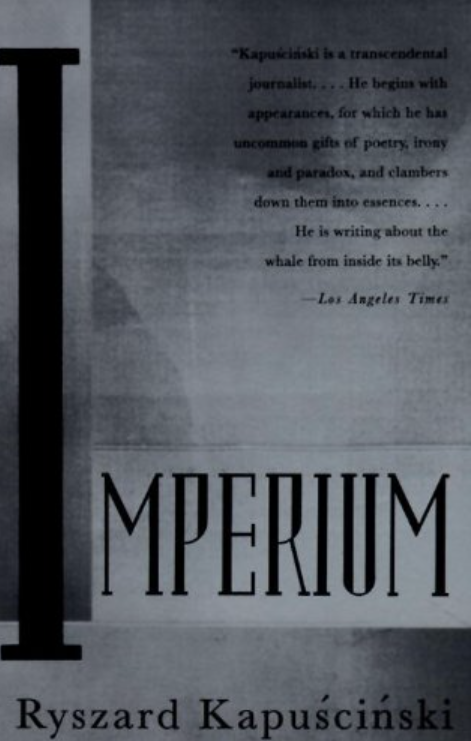
I somehow stumbled across this book in my kindle recommendations, or perhaps it was a blog (Kevin Kelly perhaps?) somewhere but I’m glad I read it. The author is a Polish journalist from the Iron curtain era who traveled quite widely in the Soviet Union at it’s peak and decline, in particular the outer republics, not so much in Russia proper. It’s a pure travelogue, mostly of the “I went here and saw this” variety (i.e. the good kind). The highlights do a much better job of summarizing it than I would. A few notable thoughts after reading this book (mostly vibe based, my observations, not the author’s).
- It occurred to me that both Russia and it’s former imperial territories and the United States are outliers in how people view nationality. Russia assumes that everything is a natural empire and anything that isn’t currently an empire will become part of one at some point . America thinks that America is at the forefront of the natural progression of things and everything will be America at some point. The world becomes one eventual empire vs becoming one eventual country. I now think that a comparison of views of nationality involving either country is of limited value due to the viewpoints being such outliers. That is my observation, not the author’s.
- Scott Alexander’s definition of communism as mostly “taking every bad idea in the world and doing them all at once” seems much more accurate to the real Soviet world result than anything involving Marxism seems very apt.
Highlights
How many victims, how much blood and suffering, are connected with this business of borders! There is no end to the cemeteries of those who have been killed the world over in the defense of borders. Equally boundless are the cemeteries of the audacious who attempted to expand their borders. It is safe to assume that half of those who have ever walked upon our planet and lost their lives in the field of glory gave up the ghost in battles begun over a question of borders.
In short, the total surveillance clearly plays the same persuasive role as those one-story-high, thick billows of barbed wire: it is simply a silent but emphatic warning, lest some preposterous idea accidentally enter your head!
Worst of all are the books. What a curse to be traveling with a book! You could be carrying a suitcase of cocaine and keep a book on top of it. The cocaine wouldn’t arouse the least bit of interest; all the customs inspectors would throw themselves upon the book. And what—God forbid!—if you’re carrying a book in English? Then the real running, checking, paging through, reading would begin.
The second group will observe the Soviet people and imitate their way of thinking and acting. The essence of this posture is resigning oneself to the existing reality, and even being able to derive from it a certain satisfaction. There is a saying that is very helpful in this, and which it behooves one to repeat to oneself and to others every evening, regardless of how terrible the day that has just ended: “Rejoice in this day, for things will never again be as good as they were today!”
It wasn’t really possible to imagine Siberia. One of my friends finally showed me a drawing in a book: in a heavy snowstorm walked a column of tattered and hunched-over men. Heavy chains with iron balls at the end were attached to their hands and legs, and they dragged these balls behind them over the ground. Siberia, in its sinister, cruel form, is a freezing, icy space…plus dictatorship.
And yet it doesn’t occur to anyone to frighten children with: “Wash your hands or they’ll send you to Canada!” Or “Play nicely with that little girl or they’ll deport you to America!” In those countries, quite simply, there is no dictatorship, nobody puts anyone in chains, nobody imprisons anyone in camps, dispatches him to work in hellish frost, to a certain death. In those frozen lands, man has one antagonist—the cold. Here, as many as three—the cold, hunger, and armed force.
Despite being transported in a wagon-coffin, the general is aware of being in a certain way privileged—they are driving him; others they force to march for years on foot.
This wandering of the deportee is not only a displacement in space and in time. It is accompanied by a process of dehumanization: the one who reaches the end (if he doesn’t die along the way) has already been stripped of everything that is human. He has no surname; he does not know where he is; he does not know what they will do with him. His language has been taken away: no one will speak with him. He is a consignment; he is a thing; he is a trifle.
Whiteness is often associated with finality, with the end, with death. In those cultures in which people live with the fear of death, mourners dress in black, to scare death away from themselves, isolate it, confine it to the deceased. But here, where death is regarded as another form, another shape of existence, mourners dress in white and dress the deceased in white: whiteness is here the color of acceptance, consent, of a surrender to fate.
It is Europe. European civilization is the only one that has ever had global ambitions and (almost) realized them. Other civilizations either couldn’t satisfy such ambitions for technical reasons (for instance, the Maya), or simply didn’t have such interests (for instance, China), convinced that they themselves were the entire world. Only European civilization proved capable of overcoming its ethnocentrism. Within it arose the desire to know other civilizations, as well as the theory (formulated by Bronislaw Malinowski) that global culture is created by a constellation of parallel cultures.
If there exists such a thing as the genius of a nation, then the genius of the Russian nation is expressed in, among other things, just this saying: “Well, that’s life!”
One of the pillars upon which the system rests is isolation from the world, and a foreigner, by the mere fact that he exists, undermines this pillar.
I read Bierdayev’s old book in which he reflected upon how the great expanses of the Imperium had influenced the Russian soul. What does a Russian think about, somewhere on the shore of the Yenisey, or deep in the Amur taiga? Every road that he takes seems to have no end. He can walk along it for days and months, and always Russia will surround him. The plains have no end, nor the forests, nor the rivers. To rule over such boundless expanses, says Bierdayev, one had to create a boundless state. And behold, the Russian fell into a contradiction—to maintain the great expanses, the Russian must maintain a great state; on the maintenance of this great state he expends his energy, of which not enough remains for anything else—for organization, for husbandry, and so on. He expends his energy on a state that then enthralls and oppresses him. Bierdayev believes that this immensity, this limitlessness of Russia, has a negative influence on its inhabitants’ way of thinking. For it does not demand of them concentration, tension, an intensification of energy, or the creation of a dynamic, vigorous culture. Everything falls apart, is diluted, drowned in this ungraspable formlessness. Russia—an expanse, on the one hand, endless, broad, and yet, on the other hand, so crushing that it takes one’s breath away, and there is nothing left to breathe.
And then I traveled to the non-Russian republics of what was then the Imperium. What caught my eye? That despite the stiff, rigorous corset of Soviet power, the local, small, yet very ancient, nations had succeeded in preserving something of their tradition, of their history, of their, albeit, concealed pride and dignity.
Painting did not bring him happiness. He had a girl called Margerita. No one knows what sort of girl she was. Niko loved her and painted her portrait. Margerita’s face is done according to the conventions of the great naives, by which everything is too big and out of proportion. Oversized lips, bulging eyeballs, enormous ears. Niko gave this portrait to Margerita. The girl shrieked in indignation. Enraged, full of hatred, she left him. His talent condemned him to solitude. From then on he lived in lonely abandonment.
A nation that does not have a state seeks salvation in symbols. The protection of the symbol is as important to it as the protection of borders is to other states. The cult of the symbol becomes a form of the cult of country. Protection of the symbol is an act of patriotism.
But there is also the matter of religion. In the year 301, during the reign of the emperor of the Armenians Tiridates III Arashakuni, Armenia adopts Christianity. It is the first country in the world in which Christianity attains the rank of a state religion.
way. Many works of ancient literature survived owing entirely to the fact that they were preserved in Armenian translations.
Baku always made a career of oil. As far back as the tenth century Arab writers refer to Baku as the place from which oil is brought.
We are standing over a relief map of Central Asia, and she wants to show me how great Azerbaijan once was (this is what she regards as a bit of nationalism). I tell her that her desire to present to me the Great Yesterday is a universal impulse in today’s world.
Today expansion is difficult and risky, as a rule broadening ends in narrowing, and that is why nations must satisfy the instinct for breadth with a feeling of depth, which means reaching into the depths of history to demonstrate their strength and significance.
After the Revolution, Valery tells me, they started giving girls’ names that celebrate the modern inventions now making their way to the countryside. So there are girls with the names Tractor, Chauffeur. One father, apparently counting on tax reductions, called his daughter Finotdiel, which is an abbreviation of the name of the Office of Finance (Finansovyj Otdiel).
The disciples of this martyr, the Hurufites—mystics of the numeral, cabalists, and diviners—believed that the origins of the universe could be comprehended in terms of the figures 28 and 32. Using these numerals one can explain the mystery of each thing. It was the Hurufites’ belief that God expressed himself through beauty: the more beautiful something was, the more God manifested himself in it. Beauty was their criterion for valuating the phenomenal world.
An underwater mountain range connects the eastern and western shores of the Caspian Sea. The mountains stretch from Baku to Krasnovodsk in Turkmenistan.
The transition to a sedentary life was for the nomad always a last resort, a sign of failure in life, a degradation. One can settle a nomad only by force, by economic or political coercion. For him, the freedom that the desert gives has no price.
The people of the Uzboj worshiped sacred stones. This is typical of inhabitants of deserts, who revere everything they have at hand—stones, gorges, wells, and trees.
Particles of dust, these bits of near nothingness (they are stones ground to powder by wind and water), suspended in the air, grow warm in the sun, and thus comes into being a dry mist, the terror of all desert people, a dry and hot mist, clouds of powder as hot as burning coals; that is what the desert commands one to breathe in the hour of its fury.
During the feast they serve the guest the sheep’s boiled head on a plate. The guest must eat the brain. Then he must pluck out and eat one of the eyes. The host eats the other eye. In this way the knots of brotherhood are tied. It is an experience one does not quickly forget.
Erkin said that an Uzbek prefers to overpay and buy in the bazaar than to spend less in a store. The bazaar is tradition, the place of meetings and conversation, a second home.
He ordered his adversaries and opponents poisoned. He prepared the potions himself. He carried the standard of death, and this mission absorbed him for half the day. During the second half of the day, art absorbed him. Timur devoted himself to the dissemination of art with the same zeal he sustained for the spread of death.
Timur was sounding the limits of man’s possibilities. Timur demonstrated that which Dostoyevsky later described—that man is capable of everything.
Erkin showed me Timur’s grave in Samarkand, made of green nephrite. Before the entrance to the mausoleum there is an inscription, whose author is Timur: Happy Is He Who Renounced the World Before the World Renounced Him.
Just as Columbus lived in the epoch of great geographic discoveries, when every sailing expedition altered the picture of the world, so we live today in the epoch of great political discoveries in which ever newer and newer revelations continuously change the picture of our contemporaneity.
But doubts at once assailed me—was I really right to search for perestroika outside Moscow? I had just read a new book, published in early 1989, by the eminent historian Natan Eydelman, Revolution from the Top in Russia. The author regards perestroika as just one more in a series of turning points in Russian history and reminds us that all such turning points, revolutions, convulsions, and breakthroughs in this country came about because they were the will of the czar, the will of the secretary-general, or the will of the Kremlin (or of Petersburg). The energy of the Russian nation, says Eydelman, has always been spent not on independent grass-roots initiatives, but on carrying out the will of the ruling elite.
Nicholas I: “The Czar is surprised—the inhabitants of Petersburg tremble with fear, / The Czar is angry—his courtiers die of fear; armies are marching, whose God and faith / is the Czar. The Czar is angry: let us die, we will cheer up the Czar!”) The czar has been considered a god, literally, for centuries, for Russia’s entire history. Not until the nineteenth century was there a czarist decree to remove the portraits of the czar from the Orthodox churches. A czarist decree! Without it no one would have been so bold as to touch such a portrait, or rather, icon. Even Bakunin, that anarchist and subversive, Jacobin and dynamiter, calls the czar “the Russian Christ.” And just as the czars are the vicars of God, so Lenin and Stalin are the vicars of world communism. Only after Stalin’s death does the slow process of secularizing the rule of the Almighty begin. Secularization—and with it the gradual erosion of omnipotence.
This last notion was put forth in the sixteenth century by the Pskov sage and visionary, the monk Philotheus. “Two Romes have already fallen (Peter’s and Byzantium),” he writes in a letter to the contemporary Muscovite prince Vasily III. “The Third Rome (Moscow) stands. There will not be a fourth,” he categorically assures the prince. Moscow: it is the end of history, the end of mankind’s earthly wanderings, the open gateway to the heavens.
All dictators, irrespective of epoch or country, have one common trait: they know everything, are experts on everything. The thoughts of Qadaffi and Ceauşescu, Idi Amin and Alfredo Stroessner—there is no end to the profundities and wisdom. Stalin was expert on history, economics, poetry, and linguistics. As it turned out, he was also expert on architecture. In 1934—which means between one ghastly purge and the next, even more horrifying, one—he commissioned a plan for the rebuilding of Moscow. He devoted to it, as was piously written, much time and attention. The new Moscow was to manifest in its appearance the following traits of the epoch: triumph, power, monumentality, might, seriousness, massiveness, invincibility
In any case, the greatest ambition and fondest dream of Stalin was precisely the same as the greatest ambition and fondest dream of all Soviet leaders—namely, to catch up with and surpass the United States!
After all, there are countless churches in Moscow; there are even churches in the Kremlin, and yet the Leader’s finger came to rest on just this one place, where there towered the spectacular silhouette of the temple built by the czars of Greater Russia to thank God for forcing Napoleon to retreat and saving their Imperium.
Only he who maintains (and has somehow proven) that his authority has a human and divine nature can rule here, can lead the people and count on their obedience and devotion. Hence the preponderance in Russian history of pretender czars, false prophets, haunted and fanatical holy men—they claim the power to rule souls and that they are touched by the hand of God. The hand of God is in this case the sole legitimation of power.
In short, the background scenery changes, but the main principle of history, which continues to operate in the foreground, remains unchanged—the principle of the cult.
unaware that as he does so he becomes for a second time communism’s victim: the first time he was a victim by force, imprisoned by the system, and now he has become a victim voluntarily, for he has allowed himself to be imprisoned in the web of communism’s problems. For such is the demonic nature of great evil—that without our knowledge and consent, it manages to blind us and force us into its strait-jacket.
Armenians! They must be together. They search for one another the world over, and—the tragic paradox of their fate—the more their diaspora expands and dissipates away, the greater their mutual longing for one another, their desire and need to be together. Only
can one appreciate how painful a thorn for them is the matter of Nagorno-Karabakh—to live a dozen or so kilometers from one another and yet not to be able to be together! An eternal splinter, an eternal wound, an eternal stigma.
that we do not resolve difficulties, we only displace them. “The art of clarification,” says Cournot, “like the art of negotiation, is often simply the art of displacing difficulties. There is, one might say, a kind of untouchable reserve of incomprehensibility in certain things that the calculations of human intelligence are capable neither of removing nor of diminishing, but only of arranging this way or that, sometimes leaving everything in a half-light, at another time illuminating certain points at the expense of others, which are then submerged by a darkness even deeper than before.“
(They say “comrade” more and more infrequently here, but they also aren’t able to say “mister,” for that still sounds too bourgeois, and the form “you,” toward a person whom one doesn’t know well, is impolite. So they address each other as “woman,” “man.”)
Like peasants the world over who begin each conversation with reflections on the subject of crops, and Englishmen who start every exchange with a discussion of the weather, so in the Imperium the first step in establishing contact between people is a mutual determination of one’s nationality. For much will depend on this.
At the same time, behind these front lines, Beria directs the deportation of Poles and Greeks, Germans and Kalmuks, into the depths of the Caucasus and to Siberia. As a result, entire nations find themselves in lands foreign to them, in unfamiliar surroundings, in poverty and hunger. One of the goals of these operations is to create the uprooted man, wrenched from his culture, from his environment and landscape, and therefore more defenseless and obedient vis-à-vis the dictates of the regime.
A single czarist official drives an entire column of Tuvinians (a Siberian tribe) to a hard-labor camp, and not one of these unfortunate vassals will revolt. After all, they could easily kill this official and vanish into the forest. But no, they walk on obediently, meekly execute his commands, endure his verbal abuse in silence. The reason, Mickiewicz explains, is that, in the eyes of the enslaved Tuvinians, this official personifies the might of the all-powerful state, which arouses their fright, terror, dread. To raise a hand against the official is to raise a hand against the superpower, and none of them can bring himself to do that.
One need only see cities over which a wave of ethnic conflict has recently rolled—even Fergane or Osh. Among the burned and devastated houses of Uzbeks, Karakalpaks, or Tajiks are visible the untouched houses of Russians. For who stands behind a poor Karachi, attacked by an infuriated Turk? At most—another Karachi. And behind a Russian? A kalashnikov, a tank, a nuclear bomb.
Not everyone knows that the Turkish language is the second most dominant language of the Imperium. About sixty million people speak it. An Azerbaijani can communicate not only in Ankara, but also in Tashkent and Yakutsk. His Turkish-speaking brethren live everywhere. In a certain sense, the former USSR is a Slavic-Turkish superpower. Solzhenitsyn’s idea was to get rid of the Turkish element so that only a Slavic superpower would remain.
After seventy-three years of bolshevism, people do not know what freedom of thought is, and so in its place they practice freedom of action. And here freedom of action means freedom to kill.
They stole what they could. Stalin locked them up in boarding schools. There they learned hatred, and when they grew up, they were dressed in the uniforms of the NKVD. The NKVD held the nation in the grip of a bestial fear. And there’s communism for you.
I have flown maybe one hundred thousand kilometers in this country on airplanes. Two observations from those trips: The airplanes are always full—at each airport, for every destination, mobs of people are waiting, sometimes for weeks, so that finding an empty seat somewhere is quite out of the question. Second, during the entire flight there is complete silence in the cabin. The passengers sit motionless; no one speaks. If one hears a buzz somewhere, bursts of laughter, and the clink of glasses, it means that a group of Poles is on board: who knows why, but travel puts them into a state of boundless euphoria, into a near frenzy.
It is true that a bit of time has elapsed since the epoch of Stalinism, but its memory is alive, and the lessons, traditions, and habits of that period remain, are fixed in consciousness, and will long influence people’s behavior. How many of them (or their families, acquaintances, and so on) went to the camps because during a meeting, or even in a private conversation, they asked about this or that? How many in so doing ruined their careers? How many lost their jobs? How many lost their lives?
A wise sentence from Ecclesiastes: “Who gathers knowledge, gathers pain.” Developing this bitter thought, Karl Popper once wrote (I am quoting from memory) that ignorance is not a simple and passive lack of knowledge, but is an active stance; it is the refusal to accept knowledge, a reluctance to possess it; it is its rejection. (Or, in a word, antiknowledge.)
A civilization that does not ask questions, one that banishes from within its compass the entire world of anxiety, criticism, and exploration—the world that expresses itself precisely through questions—is a civilization standing in place, paralyzed, immobile. And that is what the people in the Kremlin were after, because it is easiest to reign over a motionless and mute world.
No Louvre, no castles on the Loire, can offer so many pleasant and unforgettable sensations as the gloomy and humble interior of the Hotel Vorkuta. At work here is the immemorial law of relativity. Entering the Louvre from the sidewalks of Paris is not a passage from earth to heaven, whereas entering the lobby of the Hotel Vorkuta from the street is. The lobby saves our life, for it is warm, and warmth in this town is the most priceless thing.
Genady Nikolayevich, a miner, just turned fifty and retired. Such an early retirement is one of the perks one receives for work in such dreadful, polar conditions. Although it is a rather dubious perk—only twenty percent of miners live to be fifty.
Genady Nikolayevich is rather inclined toward the opinion of Ivan Solonievich, one of the few inmates who in 1934 succeeded in escaping to the West: all of Russia is a camp.
In small and medium-sized countries there is no equivalent of this class of which we speak here. In such countries, the elite are busy with their own internal affairs, their local intrigues, their own closed backyard. But in the Imperium, the ruling class (and often the common people as well) are preoccupied with the imperial scale of thinking, and, even more, the global scale, the scale of large numbers, large spaces, of continents and oceans, of geographic meridians and parallels, of the atmosphere and the stratosphere, why, of the cosmos. In Western Europe they were surprised to see on television that poor old women in Moscow abandoned the breadlines they had been standing in, gave up buying bread, to march down the street shouting the slogan “We will not give back the Kuril Islands!” But why be surprised? The Kuril Islands are a part of the Imperium, and the Imperium was built at the cost of the feeding and clothing of these women, at the cost of their leaking shoes and cold apartments, and, what is most sad, at the cost of the blood and lives of their husbands and sons. And so they should give this back now? Never. Never ever.
Nationalism cannot exist in a conflict-free condition; it cannot exist as a thing devoid of grudges and claims. Wherever the nationalism of one group rears its head, immediately, as if from beneath the ground, this group’s enemies will spring up.
In Irkutsk I spot a poster advertising a theatrical production entitled A Word about Russia. I buy a ticket and go. The show takes place in a church that was formerly called the Museum of Atheism.
“Russia,” he calls, “must remain a great world power! They want us to become like the Indians on an American reservation. They are trying to make us drunk, they are trying to poison us. But we will not become Indians. We will not be a banana republic!”
Fiodorov speaks about terrible things. When criminals escaped, they would persuade one of the political prisoners—naive and unsavvy—to go with them. This they did as insurance against death from hunger, which was always a threat. At a certain point they would kill the victim and divide up his flesh.
So let us stop getting excited and thrashing about, let us stop tormenting the stewardesses with questions for which they have no answers, and, following the example of our brothers and sisters from the sleepy village of San Juan near Valdivia, from the settlements on the Gobi desert crushed by the heat, and from the littered outskirts of Shiraz, let us sit motionless, staring off into space, and every hour sinking deeper and deeper into a state of mental numbness.
“Caucasian mafia” was how the taxi driver characterized those detained. The word “mafia” is enjoying a tremendous popularity these days. It is increasingly replacing the word “nation.” Here where one hundred nations once lived “in harmony and brotherhood,” one hundred mafias have now appeared. The nations have vanished, have ceased to exist. Three large mafias have taken their place—the Russian mafia, the Caucasian mafia, and the Asiatic mafia. These large mafias are divided into an infinite number of smaller ones. There are Chechen and Georgian mafias, Tatar and Uzbek, Chelyabinsk and Odessian. The smaller mafias are divided into even smaller ones, and these in turn into utterly small ones.
In today’s post-Soviet society there exist not only individual criminals, not only criminal elements, but an entire criminal class possessing a genealogy and tradition different from the rest of society.
Magadan is the capital of the northeastern territory of Siberia called Kolyma, after the river that flows here.
In colloquial Russian, Kolyma was transformed, bizarrely, into a word denoting the consolation of relativism. That is, when things are truly bad, awful, frightful, one Russian consoles another: “Don’t despair, it was worse in Kolyma!”
There were 160 camps—or, as they are also called, Arctic death camps—in Magadan and Kolyma. The convicts changed over the years, but at any given moment there were around half a million residents. Of these, one-third died in the camps, and the rest, after serving years of hard labor, left as physical cripples or with permanent psychic injuries. Whoever survived Magadan and Kolyma was never again the person he or she once was.
Garanin shot several, a dozen, or sometimes several dozen people a day. Murdering, he laughed or sang cheerful ditties. Beria ordered him shot suddenly and for obscure reasons, ostensibly for being a Japanese spy.
Convinced that he is in an insane asylum, that he is in a ghastly land of madness and surreal paranoia, Weissberg does not break down; under the most horrifying conditions, in crowded, dirty prisons dripping with blood, his mind, the mind of a Western rationalist, works intensively—it searches for a rational, reasonable explanation for that which is happening around him. In each cell they throw him into, Weissberg strives to discuss, to question, to exchange opinions.
It is Shalamov’s mind that is rational and logical and Weissberg’s mind that is astray, lost in abstractions. “Each intervention in that which fate was bringing, in the will of the gods, was something unbecoming and contradictory to the code of camp conduct,” Shalamov recalls. And between the lines: whoever thinks that he can behave differently has never touched the true bottom of life; he has never had to breathe his last in “a world without heroes.”
That desire—for one’s voice to be heard somewhere—is characteristic of enslaved peoples, who cling to their belief in the possibility of justice in the world the way a drowning man clings to a plank, who are convinced that being heard is being understood and that by that means alone they can prove their argument and win the case.
He doesn’t want a conversation, but a declaration that you agree with him, admit that he is right, join the cause. Otherwise you have no significance in his eyes, you do not exist, for you count only if you are a tool, an instrument, a weapon. There are no people—there is only the cause.
Their world is small—several valleys and mountains. Their world is simple—on one side we, the good people, on the other they, our enemies. Their world is governed by an unambiguous law of exclusivity—us or them. And if another world exists nevertheless, what might they want of it? Only that it leave them in peace. They need to be left in peace so as to thrash each other all the more thoroughly.
We have a saying here: if you do not plant cotton, they will plant you [in prison], if
It Is a Known fact that a dozen or so meters below the surface of every desert lie large deposits of concentrated salt. If water is conducted to it, the salt, together with the moisture, will begin to rise to the surface. And that is exactly what happened now in Uzbekistan. The concealed, crushed, deeply secreted salt started to move upward, to regain its liberty. The golden land of Uzbekistan, which was first cloaked in the white of cotton, was now glazed over with a lustrous crust of white salt.
Siberia is called the largest prison on earth. The czar deported hundreds of thousands of his subjects here; here the Bolsheviks imprisoned millions of innocent people. But our Siberian, Claudia Mironova, considers Siberia a place of sanctuary, an island of liberty. The immeasurable distances, the enormous taiga, and the lack of roads facilitated isolation, provided refuge, enabled one to vanish from view. Entire communities of dissenters, says Claudia Mironova, were able to survive here. They survived the czar and the Bolsheviks—no one knew where they were.
And she herself, Claudia Mironova? When they were herding everyone into the kolkhoz, one night she and her husband, taking with them a cow and two pigs, fled deep into the taiga. They settled there, built a shed, and later even a little house with an enclosure. During the entire Stalinist era, she says with pride, they did not see a single stranger. She posits as the key to their survival her knack for canning lard. Lard—therein lies the secret of life. The secret of life and the prerequisite for liberty. If you do not have lard—meaning, if you do not possess this basic, elementary wealth—you will not be free. That is what Claudia Mironova says, sharing with us the most important lesson of her life.
The so-called Soviet man is first and foremost an utterly exhausted man, and one shouldn’t be surprised if he doesn’t have the strength to rejoice in his newly won freedom. He is a long-distance runner who reached the finish line and collapsed, dead tired, incapable even of raising his arm in a gesture of victory.
Simplifying greatly, one can say that there are two Ukraines: the western and the eastern. The western (the former Galicia, territories that belonged to Poland before the war) is more “Ukrainian” than the eastern. Its inhabitants speak Ukrainian, feel themselves to be one hundred percent Ukrainian, and are proud of this. It is here that the soul of the nation survived, its personality, its culture. Things look different in the eastern Ukraine, which covers a territory larger than the western. Thirteen million native Russians live here and at least as many half Russians; here Russification was more intense and brutal; here Stalin murdered almost the entire intelligentsia. In 1932 and 1933, he had several million Ukrainian peasants starved to death and ordered tens of thousands of Ukrainian intellectuals shot. Only those who fled abroad were saved. Ukrainian culture was better preserved in Toronto and Vancouver than in Donetsk or Kharkov.
And they were all talking about one thing—the fact that on January 21, on the anniversary of the proclamation of the short-lived Ukrainian independence of 1918, hundreds of thousands had joined hands and formed a chain stretching more than five hundred kilometers between Kiev, Lvov, and Ivano-Frankovsk.
the Parliament passes a declaration of the sovereignty of the Ukrainian Soviet Socialist Republic. The declaration proclaims the primacy of the laws of the Republic over those of the USSR and also the right of the Republic to possess its own army and to mint its own currency. The declaration states that the Ukraine will be a neutral and nonatomic state. (This has great importance, since enormous stocks of the weapons of mass destruction are located in the territories of the Republic.) Yet
Rudzkoy, Yeltsin’s deputy, and Sobchak, the mayor of Petersburg, depart at the head of the delegation. Both had played leading roles in the defeat of the neo-Stalinist putsch, but both are Russians and thus they understand what Russia is without the Ukraine. “Without the Ukraine,” the Polish historian J. Waswicz wrote back in the thirties, “Moscow is relegated to a northern wilderness.”
Ukrainian patriotism has a peasant quality: it is firmly rooted in the native soil.
Even the Pioneers were sent in to help, but were later pulled out, for these were children, and children died in the greatest numbers—not only from hunger, but also because cannibals carried them off.
Stalin’s goal was to save the Imperium: the Imperium cannot exist without the Ukraine. Yet the twenties witness a renascence of Ukrainian nationalistic ambition, which develops under the slogan “Far from Moscow!” The main repository of the Ukrainian spirit is the peasantry. To break that spirit, Stalin must destroy the peasantry. At the time, there were around thirty million Ukrainian peasants. Technically, one could have annihilated a significant portion of them by building a network of gas chambers. But that is an error Stalin did not commit. He who builds gas chambers bears all the blame, brings the disgrace of being a murderer down upon himself.
Novgorod was a famous city in the Middle Ages, something along the lines of a Florence or an Amsterdam of the north—a dynamic concentration of commerce and craftsmanship, a long-flowering center of various arts, especially of sacred architecture and icon painting. A unique political system existed here. For hundreds of years (from the eleventh to the fifteenth century) Novgorod was a kind of independent, self-governing feudal republic in which the highest authority rested with a council composed of different elements of the city’s population and the neighboring free peasantry. The people elected a prince who ruled in their name and could be recalled at any moment. For those times and in that part of the world, these were unheard-of practices. The symbol of the freedom and independence of this city-state was a great bell with which the residents were summoned to the council.
the local kremlin. (A kremlin is a type of ecclesiastical citadel, a gathering of churches, cloisters, and service buildings surrounded by walls and, once, the seat of princely power.)
Moscow was anxious that Belorussia be inhabited by a Russian-speaking population—not even necessarily ethnic Russians, just Russian speakers.
I am all ears as one of the delegates ponders: Which domination is more dangerous for Belorussia—the Russian or the Polish? And he concludes that it is the Polish, because Poland is more attractive.
History In this country is an active volcano, continually churning, and there is no sign of its wanting to calm down, to be dormant.
The Russian Writer Yurii Boriev compared the history of the USSR to a train in motion: The train is speeding into a luminous future. Lenin is at the controls. Suddenly—stop, the tracks come to an end. Lenin calls on the people for additional, Saturday work, tracks are laid down, and the train moves on. Now Stalin is driving it. Again the tracks end. Stalin orders half the conductors and passengers shot, and the rest he forces to lay down new tracks. The train starts again. Khrushchev replaces Stalin, and when the tracks come to an end, he orders that the ones over which the train has already passed be dismantled and laid down before the locomotive. Brezhnev takes Khrushchev’s place. When the tracks end again, Brezhnev decides to pull down the window blinds and rock the cars in such a way that the passengers will think the train is still moving forward.
The Third World was born and a great demographic explosion began—the population of poorly developed countries began to increase at a rate three times greater than that of wealthy countries. A dozen problems result from this, which will be the worry of the twenty-first century.
Gorbachev’s enemies claim that he assumed the leadership of a flourishing USSR and brought about its breakup. It was just the opposite—the USSR was disintegrating for a long time, and Gorbachev extended its life for as long as it was possible to do so.
It is interesting that today blood flows only where blind nationalism enters the fray, or zoological racism, or religious fundamentalism—in other words, the three black clouds that can darken the sky of the twenty-first century.
Despite these difficulties, one can assume that three processes will come to predominate in Russian life. The first is the battle between the forces of integration and disintegration. Nationalism. Russians will want to maintain a large and strong state, an imperial superpower, whereas various non-Russian minorities will pursue more and more explicitly their own, autonomous goals.
The Russian land, its characteristics and resources, favor the power of the state. The soil of native Russia is poor, the climate cold, the day, for the greater part of the year, short. Under such natural conditions, the earth yields meager harvests, there is recurrent famine, the peasant is poor, too poor to become independent. The master or the state has always had enormous power over him. The peasant, drowning in debts, has nothing to eat, is a slave. Simultaneously, it is a land rich in natural resources—in oil, in gas, in iron ore. But these are natural resources whose exploitation and profits are easy to monopolize, particularly by a strong bureaucratic-authoritarian state. In this way both the soil’s poverty and its riches undermine the people and bolster the regime. It is one of the great paradoxes of Russia.
-
HikerTrash: Sordid tales from a dirty hiker
From my notion template
The Book in 3 Sentences

A lovely relaxing memoir written by a good friend of mine. I’ve known the author for decades now and our personalities and tastes have always contrasted and complimented each other quite well. In the past I’ve mentioned to him that he is using his “singlehood” (for lack of a better term) the best of anyone I know. This is his memoir of leaving compressed modern life and walking the continent. He remains the friend who always has the best answer to “So, what have you been up to since we last saw each other?”
How I Discovered It
The author told me, more authors should do that.
Who Should Read It?
People who spend too much time contemplating their compressed modern lives and wonder what something different would look like.
Highlights
It is not death that a man should fear, but he should fear never beginning to live.” M. Aurelius.
Technically, this was a safer choice than biking solo across the country. But to call it safe would be a stretch. This is far more involved and tedious. Yeah, it was just a walk through nature, but it was still fraught with peril.
Ever consider how much time is actually invested in just owning shit?
One I surely would not survive if not for the Whippet. A hybrid trekking pole/ice axe that I carry. (a tool I recommend every hiker carry)
Named the “Lost Coast” after depopulation in the 1930s, its name remains due to its inaccessibility, sparse population and rugged geographical features. The first night we spent there was in a little town called Shelter Cove.
The Redwood Forest is an extraordinary place. Thousands of 350 ft trees towering over you, blocking out much of the daylight.
For the following hour and a half, I’d attempt, successfully, to capture this indescribable spectacle in a photograph.
Snow is just frozen water why not use that? Why? 1. Because it doesn’t melt as quickly as you’d think. Nor does it provide much water. What looks like a lot of snow, once melted produces very little water. You could use your stove to melt it but then you’re wasting gas. Good in an emergency but only as a last resort. 2. Snow is just frozen, naturally distilled; water and distilled water is bereft of the minerals needed to absorb said water. It’s better than nothing but melted snow alone does not hydrate you sufficiently.
At an average of 18 inches wide it is quite difficult to find once separated from it.
As matter of fact, after only 6 months of meeting Karen I was able to quit my job cooking and make a living off the band income alone.
Previously, as a musician, most of my life I just played the drums. Contributing very little in the creative process. It wasn’t till I had hiked 1000 miles that I had the confidence to do what I did with Karen and the others. I managed, directed, created, wrote music and played the drums. All these things I found came very naturally. This was the first time I voluntarily took the leadership role in a creative endeavor. Then for it turn out highly successful made losing it quite painful.
Megadens, was a television show that remodeled private residences for the DIY network. One I had the privilege of working on from 2011 till 2016.
My theory is this. We as humans were born with an inherent ability to perceive multiple dimensions. And over time lose it. Perhaps because of diet or vaccines, air pollution, chemicals in the water or even television programming. Maybe radio waves or radar waves, microwaves, LED lights, WIFI, Bluetooth, 4g, 5g. Take your pick. It’s well documented that many children seem to be able to see spirits, apparitions or they have invisible friends. Watch or read any true stories about the paranormal and see for yourself. Animals sense them as well. You can see this in countless videos and testimonies. Cats, dogs, horses, even deer.
We’re not necessarily gifted the virtue of patience only opportunities to practice it.
Within days she was gone. Sept 11th 2021. She experienced no pain or fear. Which I am thankful for. She didn’t suffer like dad. We were told it was C19.
Meditation is mandatory. Quiet the mind. And then creative ideas rise to the top. Like wax in a lava lamp.
“It is the creative potential itself, in human beings, that is the image of God” Mary Daly
I don’t believe in coincidences anymore. I believe in omens. I call such curious encounters “landmarks” on a spiritual journey.
It seems the more one sheds the need for material possessions and desires, the more life’s journey plays out more on a spiritual level and less a physical one. And often it is rife with oddly synchronistic events.
The higher you climb in elevation, the cooler the air gets. About 5.4 degrees Fahrenheit every 1000 ft of elevation. But the air also gets thinner (less oxygen). Effecting your pace negatively. So, there’s some give and take.
In early 2010, prior to my divorce, I came down with a thing called diverticulitis. A potentially lethal condition. Small pockets in the digestive tract called diverticula become enflamed when eating certain foods or too much food in my case. These can potentially burst, leading to sepsis and a slow torturous decoupling from this plane of existence.
Practically harmless to humans, there are a variety of species of tarantulas native to Arizona.
I’ve yet to encounter a place with forests so dense. As beautiful as it is here, it feels prehistoric. Almost supernatural. The forests seem to be a separate world from the surrounding area. Once you set foot in them, under their thick dense canopy, It’s like entering another dimension.
You could spend your life thinking it’s all just a series of problems and curses. Brought on to you by society or your mom or dad or religion, government, gen x, gen z, or boomers. But it is you who is responsible for how your life unfolds. The mainstream media will have you convinced otherwise. They are wrong.
After months of hiking through the mountains and desert I’m learning more and more to be present in the moment.
-
My Inventions: The Autobiography of Nikola Tesla

The Book in 3 Sentences
- I actually finished this book ten or fifteen years ago – I was looking through my highlights trying to find some bits about his prodigious imagination and ability to visualize objects and concepts. I did not find that, I guess I did not highlight it. The book is interesting throughout. I will probably reread it at some point in the future – putting this review into existens for the sake of completeness. A good, honest autobiography, as these things go. These days he would totally be diagnosed with several spectrum disorders, probably accurately. His descriptions of his imagination and visualization is what stands out. I will probably reread purely for that part. It’s always interesting to hear genius describe itself.
How I Discovered It
The Kindle auto discover feature.
Who Should Read It?
People interested in that era. I think the original impetus was hearing The Handsome Families “Tesla’s Hotel Room” from their “Last Days of Wonder” album. I’ve always found the phrase captivating – such a pleasant way to hint at a since of an earlier time of insight and beauty. To “bask in the light of an older heaven” as Stapledon would say.
How the Book Changed Me
I suppose the bits about Tesla’s imagination had an impact – some people really have “spikey” talents in some or fashion and that is why we hear about them a century later. It’s also odd – he was all engineering, no science.Highlights
Genius is its own passport, and has always been ready to change habitats until the natural one is found. Thus it is, perchance, that while some of our artists are impelled to set up their easels in Paris or Rome, many Europeans of mark in the fields of science and research are no less apt to adopt our nationality, of free choice. They are, indeed, Americans born in exile, and seek this country instinctively as their home, needing in reality no papers of naturalization.
give us, through ripening years, of many deep problems; but when a man springs from a people who have a hundred words for knife and only one for bread, it is a little unreasonable to urge him to be careful even of his own
Government Telegraph Engineering Department at BudaPest. His salary was small enough to please those who hold that the best endowment of genius is poverty,
Emerson has said that steam is half an Englishman; may we not, in view of what such men as Edison have done, add that electricity is half an American?
The progressive development of man is vitally dependent on invention. It is the most important product of his creative brain. Its ultimate purpose is the complete mastery of mind over the material world, the harnessing of the forces of nature to human needs.
Speaking for myself, I have already had more than my full measure of this exquisite enjoyment, so much that for many years my life was little short of continuous rapture. I am credited with being one of the hardest workers and perhaps I am,
for I have devoted to it almost all of my waking hours. But if work is interpreted to be a definite performance in a specified time according to a rigid rule, then I may be the worst of idlers. Every effort under compulsion demands a sacrifice of life-energy. I never paid such a price. On the contrary, I have thrived on my thoughts.
Altho I must trace to my mother’s influence whatever inventiveness I possess, the training he gave me must have been helpful. It comprised all sorts of exercises–as, guessing one another’s thoughts, discovering the defects of some form or expression, repeating long sentences or performing mental calculations. These daily lessons were intended to strengthen memory and reason and especially to develop the critical sense, and were undoubtedly very beneficial.
and make it visible. Such an advance would revolutionize all human relations. I am convinced that this wonder can and will be accomplished in time to come; I may add that I have devoted much thought to the solution of the problem.
This I did constantly until I was about seventeen when my thoughts turned seriously to invention. Then I observed to my delight that I could visualize with the greatest facility. I needed no models, drawings or experiments. I could picture them all as real in my mind. Thus I have been led unconsciously to evolve what I consider a new method of materializing inventive concepts and ideas, which is radically opposite to the purely experimental and is in my opinion ever so much more expeditious and efficient. The moment one constructs a device to carry into practise a crude idea he finds himself unavoidably engrost with the details and defects of the apparatus. As he goes on improving and reconstructing, his force of concentration diminishes and he loses sight of the great underlying principle. Results
at the sacrifice of quality. My method is different. I do not rush into actual work. When I get an idea I start at once building it up in my imagination. I change the construction, make improvements and operate the device in my mind. It is absolutely immaterial to me whether I run my turbine in thought or test it in my shop. I even note if it is out of balance. There is no difference whatever, the results are the same. In this way I am able to rapidly develop and perfect a conception without touching anything.
During that period I contracted many strange likes, dislikes and habits, some of which I can trace to external impressions while others are unaccountable. I had a violent aversion against the earrings of women but other ornaments, as bracelets, pleased me more or less according to design. The sight of a pearl would almost give me a fit but I was fascinated with the glitter of crystals or objects with sharp edges and plane surfaces. I would not touch the hair of other people except, perhaps, at the point of a revolver. I would get a fever by looking at a peach and if a piece of camphor was anywhere in the house it caused me the keenest discomfort. Even now I am not insensible to some of these upsetting impulses. When I drop little squares of paper in a dish filled with liquid, I always sense a peculiar and awful taste in my mouth. I counted the steps in my walks and calculated the cubical contents of soup plates, coffee cups and pieces of food—otherwise my meal was unenjoyable. All repeated acts or operations I performed had to be divisible by three and if I mist I felt impelled to do it all over again, even if it took hours. Up to the age of eight years, my character
knowledge make modern existence hazardous in many ways. Most persons are so absorbed in the contemplation of the outside world that they are wholly oblivious to what is passing on within themselves.
taken in as whiskey or produced in the stomach from sugar. But it should not be overlooked that all these are great eliminators assisting Nature, as they do, in upholding her stern but just law of the survival of the fittest. Eager reformers should also be mindful of the eternal perversity of mankind which makes the indifferent “laissez-faire” by far preferable to enforced restraint.
me. I was fascinated by a description of Niagara Falls I had perused, and pictured in my imagination a big wheel run by the Falls. I told my uncle that I would go to America and carry out this scheme. Thirty years later I saw my ideas carried out at Niagara and marveled at the unfathomable mystery of the mind.
I had a veritable rnania for finishing whatever I began, which often got me into difficulties.
But instinct is something which transcends knowledge. We have, undoubtedly, certain finer fibers that enable us to perceive truths when logical deduction, or any other willful effort of the brain, is futile.
When natural inclination develops into a passionate desire, one advances towards his goal in seven-league boots. In
less than two months I evolved virtually all the types of motors and modifications of the system which are now identified with my name. It
machines, I determined to try my fortunes in the Land of Golden Promise. But the chance was nearly mist. I liquefied my modest
“Is this America?” I asked myself in painful surprise. “It is a century behind Europe in civilization.” When I went abroad in 1889 – five years having elapsed since my arrival here – I became convinced that it was more than one hundred years AHEAD of Europe and nothing has happened to this day to change my opinion.
time. We crave for new sensations but soon become indifferent to them. The wonders of yesterday are today common occurrences. When
My project was retarded by laws of nature. The world was not prepared for it. It was too far ahead of time. But the same laws will prevail in the end and make it a triumphal success.
not less menacing than those born from want and suffering. If we were to release the energy of atoms or discover some other way of developing cheap and unlimited power at any point of the globe this accomplishment, instead of being a blessing, might bring disaster to mankind in giving rise to dissension and anarchy which would ultimately result in the enthronement of the hated regime of force. The greatest good will comes from technical improvements tending to unification and harmony, and my wireless transmitter is preeminently such.
because of the directional character of the circuit. This was perfectly self-evident, but came as a revelation to some simple-minded wireless folks whose experience was confined to forms of apparatus that could have been improved with an axe, and they have been disposing of the bear’s skin before killing him. If
This invention is a logical outcome of observations begun in my boyhood and continued thruout my life. When
Peace can only come as a natural consequence of universal enlightenment and merging of races, and we are still far from this blissful realization.
As I view the world of today, in the light of the gigantic struggle we have witnest, I am filled with conviction that the interests of humanity would be best served if the United States remained true to its traditions and kept out of “entangling alliances.” Situated as it is, geographically, remote from the theaters of impending conflicts, without incentive to territorial aggrandizement, with inexhaustible resources and immense population thoroly imbued with the spirit of liberty and right, this country is placed in a unique and privileged position. It is thus able to exert, independently, its colossal strength and moral force to the benefit of all, more judiciously and effectively, than as member of a league.
The proposed League is not a remedy but on the contrary, in the opinion of a number of competent men, may bring about results just the opposite. It is particularly regrettable that a punitive policy was adopted in framing the terms of peace, because a few years hence it will be possible for nations to fight without armies, ships or guns, by weapons far more terrible, to the destructive action and range of which there is virtually no limit.
-
I’ve leveled up
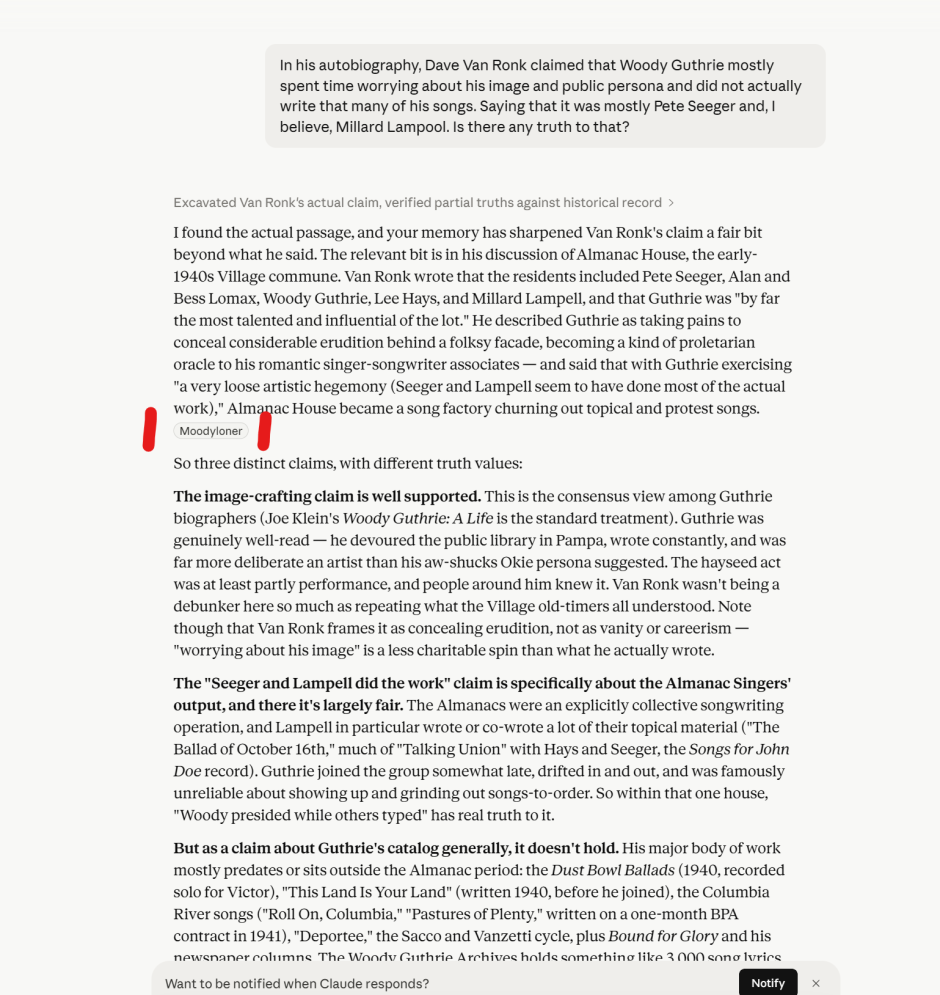
Claude/Fable now cites me as a source when it explains why I’m a a bit wrong on something!
-
Joan Baez: The Last Leaf by Elizabeth Thompson
The Book in 5 Sentences
- On the whole a pretty sub par biography in general. There were some details that were unknown to me at the time, but all of the important ones were largely covered in the Dylan biographies. On the whole I was unimpressed. It did not delve into her guitar work very much (she is a guitarist of some renown, why not?) and spent too much time on the mundane aspects of her life. The direct Pete Seeger influence was interesting, as well as the fact that she was a national figure in this (rapidly growing) niche at 19 and 20 was mentioned, but largely underdocumented.
Summary + Notes
At his death in 1951, The New York Times reported that he had been a professor of English and drama at Hunter College in Manhattan, and in 1933 established a fellowship center in Mount Kisco, New York State, “an educational project for the promotion of peace.”
Back home, his wife saw his anxiety and suggested they seek guidance from the Quaker community. They went as a family, the girls staying for twenty minutes before being dispatched next door with all the other kids to Quaker Sunday school. Not surprisingly, Joanie found it tiresome, as would any child forced to sit in silence, but the Baezes attended regularly from then on. Joanie has never entirely left the ritual of Quaker Meeting behind and it’s clear from her own lifelong commitment to pacifism and nonviolence that, young as she was, the experience was a formative one.
The protest cemented her friendship with Ira Sandperl, a self-taught Gandhian scholar and advocate of nonviolent social change whom she’d met at the Quaker Meeting her father insisted “the girls” continue to attend. By day he worked at Kepler’s, the radical and intellectual bookshop that was to Menlo Park what Cody’s was to Berkeley, and City Lights to San Francisco. A Stanford dropout, he was often on campus, talking about peace and disarmament, and Joanie found in him a mentor and friend. In 1965, they would co-found the Institute for the Study of Nonviolence.
And it took, and I loved the music and I discovered that this man did what my family, in a sense, had done for many years which was, having become Quakers, fused everything with their politics. This was music and politics in a way I’d never known it but it was so natural to me, his music and what he did with his life, and I understood that very quickly. There was Harry Belafonte, Odetta and Pete. I listened to Pete’s music endlessly and heard the stories about him, and learned the songs, and followed him.
how the Baez women felt about upping and moving yet again is unknown. The lifestyle probably took its toll on Albert and Joan’s marriage, for by the end of the 1970s they were living apart and would divorce, though they remade their vows some thirty years later because Albert wanted to die a married man. Free-spirited and creative, Joanie might have been less anxious and insecure if she’d been able to settle in one place and make lasting friends, but she has said she was eventually afraid to make friends because she knew they’d be lost in the next move. She appears to have had no idea why she was enrolled at Boston University’s School of Fine and Applied Arts, only that no other school would take her.
Any drama was strictly personal, and pretty soon Joanie had flunked college.
Club 47, the coffeehouse with which Baez is forever associated, had opened its doors in January 1958, founded by Brandeis graduates Paula Kelly and Joyce Kalina and built from scratch, their aim to replicate a Paris café “where people would go listen to jazz, smoke cigarettes and talk a mile a minute,” explained Siggins.
What’s remarkable is just how fully formed the teenage Joan Baez was as a talent. Film footage discovered in a fridge during 36the making of the PBS documentary How Sweet the Sound captures a Club 47 performance from 1958. She is perched on a stool, ramrod-straight, half in shadow, her hair long and wavy, wearing a patterned dress and playing a mahogany Martin. She is singing the English ballad “Barbara Allen” exactly as it would appear on her second album three years later.
As with Bob Dylan, there are those who claim that she “stole” songs and made them her own to such an extent that it sounded as though other people were copying her. Such is the folk process, everyone learning from everyone else, yet there are some who claim that Baez stole not only Debbie Green’s songs but her identity. Green herself has firmly refuted this.
Kalina have recalled Joanie as being difficult to befriend, someone who could be “arrogant, rude, hysterical—she had stage fright half the time.” It would be decades before she attained a sense of inner peace, the result of “serious work,” and only in the second half of her career did she become truly comfortable onstage.
39Folksingers ’Round Harvard Square featured Baez with Bill Wood and Ted Alevizos, both of whom she has also cited as major influences. It was made in May 1959 at Fassett Recordings, located in a Beacon Hill brownstone.
Joanie descended the stage to “an exorbitant amount of fuss.” Wein thought her gift “immediately apparent. She was an exceedingly talented vocalist, the Sarah Vaughan of folk-singing,” he wrote in his memoir Myself Among Others. “Instantly she became not only the great discovery, but also the living symbol, of the first Newport Folk Festival.”
Grossman returned. He was just getting into artist management and he saw folk music as the next big thing, telling Shelton that “the American public is like Sleeping Beauty, waiting to be kissed awake by the prince of folk music,” a metaphor that Baez, whom Gibson thought “puritanical,” might not have appreciated.
Martin guitars, once available cheap in yard sales, were now much sought-after.
She was comfortable with Vanguard, who as it happened had the rights to record the Newport Folk Festival from its inception in 1959. Helped in large part by the success of Joan Baez, who at one point had three albums in the Top 10, the label would become pre-eminent in the field of what’s now called Americana.
Her decision made, Joanie returned home to Belmont, singing Tuesdays and Fridays at Club 47 for $25 a night, a princely sum in those days. By day she worked as a housemother in the kindergarten at Perkins School for the Blind, where Amelia Earhart had been a volunteer reader and Helen Keller a student.
Folksingers ’Round Harvard Square was released in January 1960 on Veritas Records.
The nineteen songs were laid down over three days, with “Mary Hamilton,” the long Scottish Child Ballad—from the nineteenth-century anthology of English and Scottish ballads identified by Francis James Child, a Boston-born polymath who became Harvard’s first Professor of English—that would become a staple of her repertoire, captured in one take.
Working with her was always delightful, on the road as well as in the studio or concert hall set-ups. Her voice, in all registers, was extremely microphone-friendly and did not require any electronic manipulations such as limiters or equalization. Joan required minimal editing, as most of her output was one-take versions.”
Joan Baez was released in time for Christmas 1960 and would spend sixty-four weeks on the Billboard chart, peaking at No. 20 and eventually being certified Gold. The singer was not yet twenty but her performance is remarkably assured.
But the folk revival was overwhelmingly white—and, despite a small group of high-profile older women, overwhelmingly male. As
There were more concerts with Pete Seeger, whose consummate ease as a performer was in stark contrast to her own anxieties.
Dylan’s first break came on April 11, 1961, when he was booked for his first professional gig, playing support to bluesman John 51Lee Hooker at Gerde’s. Baez had already heard his name which is presumably why she headed to West 4th Street that night. She noted that he carried “an undignified amount of baby fat,” wore a too-small jacket and seemed dwarfed by his guitar. His own songs were “original and refreshing if blunt and jagged” and she thought him “exceptional.” He finished his set and was brought to the table where she was seated with Michael. “The historic event of our meeting was under way,” she wrote a quarter-century later.
Nat Hentoff, who, writing in The Reporter of folk’s renaissance, suggested that, until Baez, “no one had appeared who could hold an audience by musical excellence alone.”
Scarcely four years had passed since her Club 47 debut, yet May 1962 found Baez giving a solo concert at Carnegie Hall.
The signing of the Civil Rights Act was two years away and Baez was one of the first major artists to embrace the black cause.
Time recommended three “other newcomers”: Bonnie Dobson, Judy Collins, and Carolyn Hester—all of them still active.
of detached madrigal singers performing calmly at court, and of saddened gypsies trying to charm death into leaving their Spanish caves.
was “uniquely and profoundly” her own. Yet for some traditionalists and their followers who’d been ploughing the folk furrow long before the 1960s revival, the Baez voice was too polished for folk music, which, in her hands, became something akin to art song.
Pete Seeger would not be invited to appear because of his left-wing views, even though a seven-year battle with the House Un-American Activities Committee had seen him vindicated. As a result, Baez refused to appear, as would The Greenbriar Boys, Tom Paxton, Barbara Dane, and Ramblin’ Jack Elliott. Judy Collins and Theodore Bikel, having participated in earlier shows, refused future appearances.
“A Hard Rain’s a-Gonna Fall,” a song written with fierce urgency the previous October as the world held its breath during the Cuban Missile Crisis. Baez’s
the Pacific Ocean just a short drive away in the Jaguar XK-E she’d bought on a whim with cash and which the IRS would later seize and sell to offset the taxes she was withholding in protest against Vietnam. (She has always said Dylan was a terrible driver, so he may not have been allowed behind the wheel of the silver sports car, of which neighbor Hunter S. Thompson was envious.)
She would open each concert and then introduce Dylan, who would play a half-dozen songs, and then they would sing together. It’s easy to forget that in the old analog world, few people would have known what was coming, and it’s fair to say that not every audience was ecstatic. Nevertheless, Baez—always loyal to a cause—persisted, enabling Dylan quickly to acquire an audience.
Thus, she was “no longer supporting my portion of the arms race” and was 69withholding the sixty percent of her income tax used for defense spending.
Dylan’s thoughts on the subject, if any, are unknown, though Baez had yet to understand he was not an activist.
In her memoir, Baez described Dylan as “turning out songs like ticker tape, and I was stealing them as fast as he wrote them.”
“the rich fruits of their singing collaborations. Joan always seemed, onstage, the earnest, worshipful one, overly so, in the presence of the Boy Genius, and Bob would sometimes lightly mock that earnestness, as he did between songs at the Philharmonic. But when singing together they were quite a pair, their harmony lines adding depth to the melodies, their sheer pleasure in each other’s company showing in their voices.”
Nat Hentoff, writing in The New Yorker, reported him as saying: “Those records I’ve already made, I’ll stand behind them, but some of that was jumping into the scene to be heard and a lot of it was because I didn’t see anybody else doing that kind of thing. Now a lot of people are doing finger-pointing songs. You know—pointing to all the things that are wrong. Me, I don’t want to write for people anymore. You know—be a spokesman.” Lest there be any doubt, he volunteered that he wasn’t going down South to hold any picket signs and, besides, “The NAACP is a bunch of old guys.”
The album is simultaneously milestone and stepping stone, for the tracks include folk songs (among them “The Wild Mountain Thyme,” often sung in duet with Dylan) and country (“A Satisfied Mind,” a song she helped put on the map), as well as Donovan’s “Colours.” (At Newport ’65, perhaps to irritate Dylan, she had invited Donovan to join her for a duet.)
Enrolling students were given an extensive reading list, prepared by Sandperl (Thoreau, Tolstoy, Huxley, Gandhi, Malcolm X all featured), and were required to learn meditation and the benefits of Quaker-style daily silence. Baez described them as “regular-looking, college-age people. Flower children, thank God, aren’t interested.”
According to Hudson, both Merton and the nurse shared an enthusiasm for Baez’s music, agreeing they would each listen to her recording of “Silver Dagger,” a song of unrequited love from her debut album, every day at 1.30am.
Within a few weeks, and on his wife’s twenty-first birthday, Fariña would die in a motorcycle spill in Carmel following the launch party for his novel. Would
Only when she was back home in California did she learn that the CIA had pressured the interpreter to mistranslate her political remarks. “If you don’t cooperate, you will have trouble in your work in the future,” The New York Times reported his being told.
On March 26, Baez and Harris married at New York’s St. Clement’s Episcopal Church, speaking Quaker wedding vows. The groom wore a dark three-piece suit and tie, walrus moustache, and whiskers, the bride a Grecian-style floor-length dress. Judy Collins sang.
I had no idea what to expect from motherhood. It’s a bit like getting old. You don’t know what it’s like until you get there.
At an intensely political event reflecting her recent trip to Hanoi, she publicized Amnesty from the stage and with leaflets.
Inspiration for the task arrived quite out of the blue—a phone call from “a booth in the Midwest.” As she recollected to Arthur Levy, Bob Dylan rang and read to her the entire text of “Lily, Rosemary and the Jack of Hearts,” a lengthy and surreal song that would appear a few months later on Blood on the Tracks, still 104regarded as among his finest albums.
Dylan tried to persuade her to stay, talking already about a sort of never-ending tour on which they could all bring their kids. She
They would appear on the same stage in January 2010, as the newly elected President Obama and Michelle celebrated the music of the civil rights era at the White House. Not a word was exchanged.
In Washington, President Jimmy Carter promised to send the Seventh Fleet to rescue Boat People at sea.
Extraordinarily, Baez was not invited to participate in the making of “We Are the World.” When it came to 1985’s Live Aid, promoter Bill Graham, with whom she’d often worked, surely realized it would be rude not to include her, even if there had been fallout over the abortive Dylan and Santana tour. But she was granted only the 9am Philadelphia opening spot and given six minutes to perform. Introduced by Jack Nicholson, she declared: “Good morning, Children of the Eighties! This is your 119Woodstock, and it’s long overdue,” before singing “Amazing Grace” and (somewhat ironically) a couple of verses of “We Are the World.”
By 1979, Baez, too, was trying not to think about Vietnam. However, confronted with the evidence and two refugees who came to a study group at her California home to ask what had happened to all the Americans who had marched in solidarity with the Vietnamese, she could no longer stand aside. Her campaign for the Boat People brought opprobrium from the left, who felt she was letting the country off the hook over the war, and praise from the right, presidential candidate Ronald Reagan applauding her stand and noting that she’d finally “seen the light.”
As a teenager she made friends with members of the American Friends Service Committee, working with it down the years. Though she may now call it meditation, Baez routinely “keeps silence,” alert to “the still small voice” of God, whatever she may call him.
He wished to remind his fellow countrymen “that they are to be men first, and Americans only at a late and convenient hour.” Sentiments with which Joan Baez has always concurred.
Belafonte bankrolled the 1964 freedom summer, the year of Mississippi Burning, when three young activists were ambushed, tortured, and killed by the Ku Klux Klan, and in August that year flew into Greenwood, Mississippi with $70,000 in cash to support the Student Nonviolent Coordinating Committee (SNCC).
Reactionary violence or revolutionary violence—a rubber-hose beating felt the same whoever administered it, she explained, 134not for the first time. “I believe in people, not systems.” To her, all life is sacred.
Less seriously, 32% of women admitted to having ironed their hair to get “the look.”
Only Joan Baez appeared to see protest, in whatever form, as a vocation.
Vanguard released a three-CD box set, Rare, Live & Classic, one third of the tracks previously unreleased. They included family tapes and tracks from the Grateful Dead sessions of spring 1982, the album planned and recorded at drummer Mickey Hart’s Novato ranch but never released.
The break between chest voice and head voice, a problem overcome with lessons and daily exercises, is evident. She can sing in one or the other or make a leap for a high note or two, but melodies that require her to proceed seamlessly across the range are becoming a problem. The slightest cold or sore throat will of course exacerbate it, as will tiredness, all enemies of the singer.
Bob Dylan talked of her “heart-stopping soprano” and a guitar style he tried and failed to master, saying she was “at the forefront of a new dynamic in American music.”
Technique improves stamina but, as with the rest of the body, the years take their toll: The vocal cord fibers thin and stiffen and the larynx cartilage hardens, with the result that the voice becomes less stable, the top notes less reliable.
Her guitar playing has been taken for granted but it has always been rather sophisticated, a self-contained combination of rhythm and lead, Baez often picking out lines that either harmonized with her voice or were in counterpoint to it, while bass notes supported a song’s harmonic architecture.
Baez made one of her first New York City appearances with Earl Scruggs, and on The Earl Scruggs Revue Anniversary Special (CBS, 1975) she duets with Johnny Cash on “Gospel Ship,” and is joined by Leonard Cohen and Buffy Sainte-Marie on “Passing Through” (when she sings a verse in Dylan’s voice).
By the 1970s, her confidence as a speaker, and her eloquence, are rather remarkable. Discussing Vietnam, human rights, and nonviolence, she gives the combative arch-conservative William F Buckley a run for his money on Firing Line (1979).
NO DIRECTION HOME: BOB DYLAN (Martin Scorsese, 2005) Mesmerizing documentary of Dylan’s Greenwich Village years, 1961-65. Baez talks and sings from her California kitchen.
-
Nebula Maker by Olaf Stapledon
What It’s About
A precursor to Star Maker – it’s interesting, and entirely about the evolution of the cosmos at the nebula stage. Stapledon is the unrivaled master of slipping the reader into some sort of cosmic point of view in an entirely beautiful way.
After reading this book and a few others by him, I think I’ve discovered the method, to wit (and very roughly):
- Protagonist starts in an ordinary situation
- Protagonist is suddenly thrown into some very different situation, i.e. became one with a tree, or watching God at the moment of creation or the moment of the big bang
- Posits some multistep process of how that happened
- Explains the later steps in the process very well, so well in fact that you don’t notice he doesn’t explain the early steps at all.
Star Maker is much better, and if you can only read one, read that one. Nebula Maker was interesting though – essentially it is a small part of Star Maker – God creates the universe and the first step (after the big bang) is the formation of the nebulas who attain consciousness and awareness of each other. Religion, war and decay all follow – at some point decaying into stars, planets and people.
It introduced the concept of Glad Beholding as a religious goal which struck me as very deep in a way I can’t define yet.
How I Discovered It
The Amazon Kindle algorithm
What I Liked About It
Stapledon is just great in so many ways, he is able to write about big topics in a dramatic way like no other.
What I Didn’t Like About It
The organization left a bit to be desired, and the vocabulary was a bit much – without the Kindle word definitions I would have been very lost
Who Would Like It?
People who like Star Maker
Quotes and Highlights
By abstracting the personalities of the creatures Stapledon succeeds in making them appear stranger and more remote than could any detailed description, and the change in concept of the work required that many more recognizably “human” societies be pictured, societies with which a human reader can more easily identify. In addition, by creating a detailed history for these creatures, Stapledon originally made them appear almost human and accessible, a concept which he eventually abandoned. However, he did make use of some of the physical descriptions in the final plan.
The nebulae are devoid of senses familiar to human beings, suffer under no economic constraints, and have not been shaped by evolutionary pressures.
These personalities are Bright Heart and Fire Bolt. They represent, respectively, aspects of human personality Stapledon considered to be the most significant in human history, the Saint and the Revolutionary.
I have seen God creating the cosmos, watching its growth, and finally destroying it. Call me, if you will, a liar or a madman. Say I lack humor, say that my claim is sacrilegious and in the worst taste. Yet I have indeed seen God. I have seen him creating, watching, destroying.
The apparition, taken at its face value, violated the whole teaching of modern science. I know not whether I was more distressed at my derangement, or shocked at the devastatingly bad taste of the hallucination which confronted me, or tickled by the thought of the discomfiture which our scientists would suffer were it after all proved a true perception.
“It is God, it is God,” I said to myself. But I knew that if indeed there is a God he is no more visible than the theory of relativity.
Now at last I was to behold God’s latest creation. I was to attend the birth of that intricate and tragic cosmos, fashioned of nebulae and stars, in which mankind occurs.
Beneath God’s face the innumerable, shadowy, restless creative hands aimlessly fingered the pale glimmer which I knew was chaos, the formless potentiality of matter, the sleeping potentiality of mind. It seemed that in the dark spirit which is God there was not peace but restlessness, and the insistent need to create.
God gazed long upon his creature. And he smiled. And all his hands were still. Then God spoke to the dark and slumbering germ of the cosmos. And he said, “Let there be light.”
In answer to God’s command, the atom-cosmos had burgeoned not only with light but with a space and time peculiar to itself. And I, by some means or other, had gained a footing therein; but without ceasing to participate in the space and time peculiar to God.
There now came to me a vivid and terrifying realization that between me and the human world which was my true concern there lay aeon upon aeon of cosmical history, and nearly all of it inhuman. “Oh God,” I cried, “let me be again among my own kind. Blot out from my mind the memory of all this irrelevance. Let me play out my little past oblivious of the immensities. Let me take up once more the threads of a life distressed, bewildered, futile, but my own. Let me watch the spectacle of my own world. Futile it may be, tragic it is, but I am shaped for it. And in it there are little creatures like myself whose lives intertwine with mine.” Thus I prayed. But then I remembered the thing that God was, and I knew that it was useless to pray to him; useless, and also, in some manner which I could not comprehend, base. With a heavy heart I settled myself to the task of watching the bleak and intricate unfolding of the physical cosmos, not as yet feeling its perfection, not as yet realizing that some insight into these remote events was needed to prepare me for insight into the passionate themes which were to follow.
These undulations, these ubiquitous light rays, were actually visible to me. Seemingly they were for me illuminated by that other, swifter, more searching and more revealing light, which cast by the lucent person of God himself, pervades and drenches all things.
Each feathery ball, I noticed, was slowly shrinking. And as it shrank, it whirled more rapidly. And as it whirled, it was flattened. And as the flattening continued, there appeared in the center a bright and swollen core. The outer parts of the nebula were flung by their own movement far out into space; but seemingly the tugging core still kept a hold on them, so that they developed into an attenuated disc around the heart of the nebula, and were torn into streamers and spreading convolutions. So might a dancer, pirouetting, halo her bright head with far-flung, tangled whirls.
Could these lifelike creatures, I asked myself, be mere vortices of radiant gas? But I reminded myself that the briefest of the movements which I now witnessed must in fact occupy millions of terrestrial years, and that this impression of vital activity was an illusion. Age upon age must pass, I knew, before these clouds would condense into stars, and further ages before the rare meetings of stars should produce habitable worlds.
The living nebula has no need to gather energy from the world outside its own substance. Its font of power lies in the very matter which is its flesh. Its hunting ground and its prey are within its own intestines. It feeds upon its own secretion. For the primal beings within it provide by their myriadfold ejaculations a lavish source of power.
Since they have no need to seek food abroad or to avoid being preyed upon, none of the young nebulae save those significant few which grow up in enduring groups, develop organs of external sense. For the lone nebula, experience is entirely of events within its own body. But of those internal events it develops a very poignant and subtle awareness. It has an urgent need to be sensitive to the fluctuations of its internal energies, so that it may control and organize their expression and prevent them from damaging its tissues.
Since a nebula is so large that the cosmical light takes many thousands of years to travel across it, its nerve currents, though moving at the speed of light, are in a sense very sluggish. The whole tempo of nebular life is therefore, from the human point of view, fantastically slow. Passages of thought which a human brain would perform in a few seconds would take the huge nebular brain many years.
To understand the mentality of the nebulae, one must bear in mind three facts which make them differ through and through from human beings. They do not succeed one another in generations; they are not constrained by economic necessity; the great majority of them have reached maturity in ignorance of other minds. On Earth, the individuals of a race procreate and die, handing on the torch of evolution and of tradition to their successors. But with the nebulae there is no distinction between the growth of individuals and the evolution of the race. The life and memory of each nebula reaches back to the racial dawn. The race consists of the original host of individuals that condensed more or less contemporaneously after the explosion of the atom-cosmos. When the last of these dies, the race dies with it.
Another important consequence of the absence of generations is this. The nebulae are in a sense “nearer to God” than any man can ever be. The human child, in spite of our great poet, trails but dim and tattered clouds of glory. He embarks upon life, not fresh from God’s making fingers, but warped by the misfortunes and blunders of countless ancestors; and, no sooner is he born, than he entangles himself further by learning from the example of his elders. But the nebulae wake with the divine lust keen and unconfused within them, and they pursue it untrammeled either by errant instinct or by perverse tradition. Never need they suffer from mistakes not their own, or be led astray by the half-truths of teachers whose very obscurity lends them a baneful prestige. Thus the nebulae, at least in their youthful phase, have been able on the whole to follow the light within them with a steadier will than man, though with less diversity of expression.
Not till the last phase of the nebular drama did they discover the inexorable decay and annihilation which plays so great a part in all human experience.
As terrestrial animals delight in hunting and feasting and fighting, so the young nebulae delight to conquer and tame the fury of radiation within their dense cores.
Yet an extremely complex inner life has combined with freedom from economic servitude to foster in them a kind of self-consciousness peculiar to themselves. They had no opportunity of distinguishing between “I” and “you”; but they had constant need of distinguishing between “I” and the many opposed and often rebellious processes and cravings at work within them. Though normally they could never conceive the possibility of an “ego” or a “stream of consciousness” other than their own, they thoroughly grasped the difference between the lowly and the lofty within themselves.
But in the young nebula this sense of impending revelation was not fleeting and occasional but an enduring state that dominated the whole behavior.
By its veiled creative symbolism this art, as I have said, can raise the nebular spirit to the highest reaches of religious ecstasy. In the social nebulae the dance life is of course socialized and pregnant with all manner of social symbolism. In the solitary nebulae its aim is simply the perfection of self-expression.
For the lone nebulae, being exempt from external influences, attained a perfection of physical form which was ever a source of wonder to the social nebulae. The captured solitary would of course prove quite incapable even of realizing that the shocking distortions and agonies which now beset him were caused by the efforts of other minds to communicate with him. It would very soon appear to the social nebulae that, for all his physical perfection and symmetry, the foreigner was but an abject savage, unable to appreciate the beauties of group life, and incapable even of intelligent intercourse; in fact, that he was a mere brute, physically superb, but blind, deaf, and incredibly stupid. For to the excited and babbling observers he offered no hint of the strange solipsistic intelligence and will at work within him.
Very few groups attained this perfection. Most were either too closely or too loosely knit. In the former the individual spirit was stifled by the proximity of his neighbors. He was a mere herd member, with no inner being. And because society was composed of barren individuals, social life was barren also. The dance pattern of the group was, so to speak, geometrical and fatuous. In the too loosely knit groups, on the other hand, there was no willed community at all, but only a grudging contract by which all engaged to refrain from interference with their neighbors, so as to secure the maximum freedom of individual behavior.
In some groups I found two parties identical in disposition and policy in all respects save that each considered that itself should rule and the other be a subject race. In some others, one party, through long subjection, had lost the power of independent choice and had become inherently servile. In extreme cases the subject race was so debased that they were mere cattle under the control of the master race. And often the masters themselves were by now so modified in actual physical constitution that, had their slaves deserted them, they would have been undone; for little by little they had come to effect a style of athleticism and even a physiological habit which would have broken down completely if menial service had ceased to be available. Their dance measures were so difficult, their bodily constitution and mental operations so subtle and precarious, that they needed constant assistance from the simpler, tougher, and automatically loyal “cattle” attendant on them.
In most nebular societies, at one time or other in their career, conflict between opposed parties would flare up into actual warfare. One side would seek to overcome the other either by bombarding their most vulnerable organs with concentrated radiation, or by actually grappling with them and striving to tear them into fragments. It is difficult to give any idea of the horror with which I observed these battles. Superficially the spectacle was nothing but a confused tempest of whirling gas clouds in the depths of space; but to me, who had by now learned the emotional significance of all these changing shapes, to me who moreover could experience at first hand the agony of these torn tresses and shattered cores, the spectacle was no less nerve-racking than the sight of human bodies dismembered by shellfire.
The opposing forces would be precisely matched, each individual of one troop having a special opponent in the other. Though each warrior might on occasion fight any member of the enemy force, one particular enemy was his peculiar property, his “dear enemy.” In combat with this individual he not only rose to the extreme of fury or cold hate, but also he attained a unique exaltation which might almost as well be called love as hate, since it included, along with the lust to destroy, a chivalrous and passionate admiration of the foe. This strange movement of the spirit was accompanied at its height by a violent physical orgasm which ejaculated a murderous flood of radiation into the body of the enemy and reduced the subject himself to exhaustion.
The second respect in which nebular militarism differed from our own was this. The nebulae, since they could not propagate their kind, could not rely on an inexhaustible supply of the raw material of slaughter. The average group had only a few hundred members. It was impossible, therefore, not to regret the killing of an enemy, since, once killed, he could never be killed again. It was even regrettable that an enemy should ever be permanently maimed, since as a cripple he could never again be a worthy foe.
The martial groups were not typical of the social life of the nebulae. They were definitely freaks, whose strange perversion was due to peculiarities in their early history. But though rare, and seemingly doomed to self-destruction, these perverts were to play an important and a baleful part in nebular history.
But this rejoicing concluded only the first and local phase of the First Cosmical War.
It would be tedious and unnecessarily harrowing to describe in detail this darkest age of nebular history. Everywhere I “heard” familiar cries, though in nonhuman speech. “Civilization in danger! The war to end war! Wars will never end; you cannot change nebular nature. Reduction of armaments is impracticable. Peace, with security.”
Thus it was that the nebulae, though beings who were by nature exempt from economic necessity, were trapped into the lust of a power which was useless to them save for mutual destruction. Could anything, I asked myself, be more mad, more barren, more tragically incompetent than this trumped-up greed and mutual fear? But then I remembered my own world.
The struggle became desperate. The weaker was mangled into insanity. The stronger floated off in proud but guilty self-absorption, seeking in vain to return into solipsistic bliss. Eventually he was butchered for ammunition.
To this Bright Heart replied, “No one is past saving. The underlying principle of glad beholding is in each one of us, striving for expression. That great principle, that spirit which conceived the cosmos, demands that all shall participate.”
When he was at the point of death he cried out, “Look! Look! The great Maker who made all nebulae in his likeness watches us from outside the world. His heart is bright. His tresses can brace the cosmos.” I, myself, half expecting to see a divine eternal nebula beyond the hosts of mortal nebula, looked. It was a strange shock to me to see, peering through the veil of innumerable nebulae, the almost human face of God, remote, inscrutable, intent, kindled (as it seemed to me) to ecstasy by the creatures of his own artistry.
Moreover a strange “crumbling disease” was beginning to attack him, a disease increasingly common among the minute “satellite” nebulae, and by now not wholly unknown among the normal nebulae.
Fire Bolt, in fact, was growing old. He was beginning to pass over from being a nebula to being a globular cluster of stars, a minute galaxy. But inwardly he was still almost his old ardent self, though tired, utterly tired.
Surely it was a supreme duty to organize a worldwide mission to the lone nebulae, so as to emancipate them from their solipsistic prison cells, and kindle them with the gospel of community, and the holy zest of the cosmical dance.
The advocates of mechanical power argued that although a few lone nebulae might, with infinite trouble, be educated to take a humble part in the cosmical dance, the great majority were clearly too far gone in solipsism to appreciate the beauty of communal life.
Throughout the nebular era two slow but irresistible changes, independent but interacting, were setting a limit to the life of any possible cosmical community of nebulae, and to the lives of individual nebulae also. The first of these was the continued expansion of the cosmos, the second was the senescence of the individual nebulae.
For by now the “crumbling disease” which had destroyed Fire Bolt was a widespread plague, especially among the social nebulae, whose more active life seems to have worn them out more rapidly than the solitaries.
A strange passion of loneliness seized me. Like a prisoner I could have battered on the walls of the cosmos, had there been any walls. But I was imprisoned in a boundless finitude. Around me the dust of a dead world stagnated in the ether.
In addition to inspiring or influencing writers such as Brian Aldiss, Stephen Baxter, Arthur C. Clarke and Stanislaw Lem, Stapledon’s work gave the field such enduring tropes as hive minds, Dyson spheres, genetic engineering and terraforming. It is arguable that only H. G. Wells has made a more significant contribution to the field. Olaf Stapledon died in 1950.
-
The Big Con by David Maurer and Luc Sante
The Book in 3 or More Sentences
An engaging look at the highly developed world of confidence men before 1940 and their criminal profession in general. The saying “You can’t cheat an honest man” is revealed to be apt, in emphatic terms and in a high degree of detail. A surprising amount of jargon has made it’s way into common language even in 2025. The book is a bit repetitive but quite readable nonetheless.
How I Discovered It
The good people of the Amazon Algorithm displayed it to me after I finished a similar book
Who Should Read It?
Anyone interested in that particular chunk of defunct Americana – or how good social engineering started.
Notes
Although the confidence man is sometimes classed with professional thieves, pickpockets, and gamblers, he is really not a thief at all because he does no actual stealing. The trusting victim literally thrusts a fat bank roll into his hands. It is a point of pride with him that he does not have to steal.
A confidence man prospers only because of the fundamental dishonesty of his victim. First, he inspires a firm belief in his own integrity. Second, he brings into play powerful and well-nigh irresistible forces to excite the cupidity of the mark. Then he allows the victim to make large sums of money by means of dealings which are explained to him as being dishonest—and hence a “sure thing.” As the lust for large and easy profits is fanned into a hot flame, the mark puts all his scruples behind him. He closes out his bank account, liquidates his property, borrows from his friends, embezzles from his employer or his clients. In the mad frenzy of cheating someone else, he is unaware of the fact that he is the real victim, carefully selected and fatted for the kill. Thus arises the trite but none the less sage maxim: “You can’t cheat an honest man.”
Their methods differ more in degree than in kind from those employed by more legitimate forms of business.
The three big-con games, the wire, the rag, and the pay-off, have in some forty years of their existence taken a staggering toll from a gullible public. No
In the big-con games the steps are these: 1. Locating and investigating a well-to-do victim. (Putting the mark up.) 2. Gaining the victim’s confidence. (Playing the con for him.) 3. Steering him to meet the insideman. (Roping the mark.) 4. Permitting the insideman to show him how he can make a large amount of money dishonestly. (Telling him the tale.) 5. Allowing the victim to make a substantial profit. (Giving him the convincer.) 6. Determining exactly how much he will invest. (Giving him the breakdown.) 7. Sending him home for this amount of money. (Putting him on the send.) 8. Playing him against a big store and fleecing him. (Taking off the touch.) 9. Getting him out of the way as quietly as possible. (Blowing him off.) 10. Forestalling action by the law. (Putting in the fix.)
Before 1900 crime had not become a big business. Confidence men did not realize that they were destined to become the aristocrats of crime.
The World War brought a crop of millionaires and sub-millionaires whose purses were swelled out of all proportion to their knowledge of investments.
As often as not these men had made their money slightly on the shady side and to them the rag and the pay-off appeared as very logical methods of taking profit.
With the increasing power and effectiveness of the Federal Government since 1930, the con men have had a hard time of it. Whenever a victim’s check passes through the mails the con men are laid open to possible prosecution and almost inevitable conviction, for once the government prepares a case thoroughly enough to bring it to trial, the fix is of little avail and it is almost a foregone conclusion that a federal jury will convict.
Why not a wire store? In other words, why not apply the tried and proved principles of confidence work to the rather clumsy touting efforts of the telegraph operators? If an unemployed telegrapher could get the mark’s confidence well enough to extort “expenses” from him, what could any expert insideman do? Once the mark was thoroughly convinced that the race results were being delayed for him, it was immaterial whether they really were or not—provided he was played against a fake bookmaker instead of a real one. And so a fake horse-poolroom which took bets was set up, shills were used in place of real betters, fake races were called with convincing fervor, and the results were all that could be desired. Thus the wire store was born. Now it only remained for smart confidence men to study the idea, correct its weakness, refine its strong points, and develop its potentialities.
the most enterprising have agents who locate prospective marks, investigate their financial standing, and compile a list from which the roper can select the fattest and juiciest. There is one restriction which, though it was formerly ignored especially in New York, is now rigidly observed: the mark must not be a resident of the city where he is to be trimmed.
He doesn’t know it, but he has been given the “shutout” or the “prat-out,” a clever method of stepping up the larceny in the veins of a mark when the manager feels that he is not entering into the play enthusiastically enough. It may be repeated several times so that the mark is fully impressed with what he has missed. The shills who surround the mark at the window usually play for more than the mark is being played for; if the mark is being played for $25,000, the air is full of $50,000 bets; thus the mark always feels like a piker instead of a plunger. Furthermore, ambitious marks must not be allowed to get too much of the store’s cash into their pockets.
Big-time confidence games are in reality only carefully rehearsed plays in which every member of the cast except the mark knows his part perfectly. The insideman is the star of the cast; while the minor participants are competent actors and can learn their lines perfectly, they must look to the insideman for their cues; he must be not only a fine actor, but a playwright extempore as well. And he must be able to retain the confidence of an intelligent man even after that man has been swindled at his hands.
But it should not be assumed that the victims of confidence games are all blockheads. Very much to the contrary, the higher a mark’s intelligence, the quicker he sees through the deal directly to his own advantage. To expect a mark to enter into a con game, take the bait, and then, by sheer reason, analyze the situation and see it as a swindle, is simply asking too much.
It is not intelligence but integrity which determines whether or not a man is a good mark.
Most marks come from the upper strata of society, which, in America, means that they have made, married, or inherited money. Because of this, they acquire status which in time they come to attribute to some inherent superiority, especially as regards matters of sound judgment in finance and investment. Friends and associates, themselves social climbers and sycophants, help to maintain this illusion of superiority. Eventually, the mark comes to regard himself as a person of vision and even of genius. Thus a Babbitt who has cleared half a million in a real-estate development easily forgets the part which luck and chicanery have played in his financial rise; he accepts his mantle of respectability without question; he naïvely attributes his success to sound business judgment. And any confidence man will testify that a real-estate man is the fattest and juiciest of suckers.
Con men feel that professional men as a class are notoriously gullible; they readily fancy themselves as adept at financial manipulation as they are in their own fields of specialization.
But he must also have what grifters term “larceny in his veins”—in other words, he must want something for nothing, or be willing to participate in an unscrupulous deal.
Many con men feel that marks have one characteristic in common—they are all liars. Whether this is true or not, I have no way of knowing first-hand, but we may assume that, if anyone is capable of giving expert testimony on this point, con men are, since lying is their profession.
If marks were not so anxious to impress strangers, they would keep their bank accounts intact much longer.
Perhaps it naturally follows that, if a mark has made money in a speculative business, his acquisitive instincts will lead him naturally into a confidence game; in the light of his past experience and his own philosophy of profit, it is a natural and normal way of increasing his wealth; to him, money is of value primarily for the purpose of making more.
Jews are difficult, but there is a con man’s proverb which says, “It takes ten Jews to trim one Greek.” And all con men agree that it is next to impossible to trim a Chinese. “I don’t know any grifter who would be dumb enough to try to trim a Chink,” said Little Chappie Lohr. “I’ve often seen them watching flat-joints down in China- town [San Francisco] that were playing for tourist suckers. They would look on for about five minutes, then walk on with a kindly grin. They’re a fly lot, those Chinks. They can smell a crooked joint.”
The outsideman travels on railways and steamship lines, usually on those lines leading into the city where the big store is located, and preferably those lines which extend far beyond the borders of the state within which the big store is situated; thus he avoids the “home guards” and “short riders” who might be able to cause trouble through political connections in their home state.
Hence ropers are just as essential to the prosperity of a big store as salesmen are to the success of a legitimate business.
You need what little sense you’ve got to trim him—and if you had any sense at all, you wouldn’t be a grifter.”
though Charley Gondorff at one time maintained an almost permanent boost for his New York store. At the height of the big-con games—1914–1925—New York was the center for much of the swindling activity which stripped thousands of marks of millions of dollars. At this time, the social and unofficial headquarters for big-con men was Dan the Dude’s saloon. “In New York City you could always get the best boost,” said John Henry Strosnider, who had a store there at that time. “All the con men hung out there.
So the tailer must be on the alert to see that no harm befalls the mark. He is really a sort of bodyguard and is usually the only man around the store who is armed.
Some hangouts specialize in one type of criminals, others cater to all types.
Confidence men are the elite of the underworld. They have reached the top in the grift*(which includes crimes depending upon lightness of touch and quickness of wit, as contrasted to the heavy-rackets which involve violence); they have arrived at the ultimate in success and achievement; they have gone as far as any professional thief can go.
Confidence men are not unaware of their social preeminence. The underworld is shot through with numerous class lines. It is stratified very much like the upperworld, each social level being bounded by rather rigid lines determined largely by three factors: professional standing, income, and personal integrity. While, as in the upperworld, income has much to do with social position, professional excellence and personal “rightness” appear to play an even greater part among con men than they do in the upperworld.
Pickpockets, because of the widespread reputation they bear as stool pigeons, are often shunned, though once a pickpocket has turned con man and established himself in that profession, he is accepted as a social equal provided he conducts himself according to the established code for con men. Small-time thieves, pimps, touts, traffickers in narcotics, hoodlums, some types of professional gamblers and all the numerous riffraff of the underworld are commonly excluded from the company of con men, who prefer association with their own kind, with higher-ups from the heavy-rackets, or with the political bigwigs, criminal lawyers and fixers who, in one way or another, derive revenue in return for protection.
When we think of cheese, it’s Wisconsin; when we speak of oil, it’s Pennsylvania; but with grifters, it’s Indiana. Many a first-rate con man has hailed from that state, and many, many more second- and third-raters.
Perhaps the fact that for many years it was customary for circuses to winter in Indiana may help to explain the number of grifters who come from that state. The American circus was a grifter’s paradise on wheels. Until very recently, most circuses carried grifters and confidence men as a matter of course, for the grift was a source of great profit—as
Although New York was for years—and still is—a center for all kinds of confidence men, few outstanding ones hail from that area, and relatively few from the East. The West appears to have produced more good grifters than the East, with Texas heading the list, while the Deep South, like the East, trails behind.
In olden times [around 1910–1915] in Dan the Dude’s place, you could see a hundred con men there at once, and not one of them would be a native New Yorker. Indiana, I think, has turned out more good grifters than any other state.”
It has been estimated by one informant that in Chicago alone in 1898 there were, to his personal knowledge, more than two hundred ropers working for five permanent and protected monte stores alone; there were hundreds more roping against unprotected stores which ran “on the sneak,” while the railroad lines running into Chicago were infested with mitt mobs. And similar conditions prevailed in New Orleans, San Francisco, New York City—in fact, in any city which was a railroad center.
The Yellow Kid, at the top of the list, was born a con man and never in his life had time for any other occupation.
With the increased use of narcotics among underworld folk, it is inevitable that some con men should become addicted, though most modern big-time criminals shun narcotics like poison. Some of the old-timers took up opium around 1900 when it was considered no more dangerous than smoking cigarettes—when many citizens on the West Coast placidly puffed the pipe on their own front porches, and an opium lay-out was standard equipment for most prostitutes whose Pekes and Pomeranians often acquired a “lamp habit” from breathing the smoke while their mistresses puffed. But the Harrison Act changed all that. As opium became more difficult to buy and to take, many addicts turned to morphine and heroin. However, confidence men have always felt that there was something disgraceful about addiction, the present generation being particularly sensitive about it. Consequently, once a con man becomes addicted, he carefully conceals the fact as well as he can and only his intimate associates are aware of his misfortune. How many of the more prominent grifters are addicted it is impossible to say, but it is rumored that Kid Duff, Jack Hardaway, Charley Dixon, Pretty Willy (better known as a thief), Kid Niles, the Yenshee Kid, Claude King, Kent Marshall, Red Lager (the Younger), Jimmy the Rooter, the Sanctimonious Kid and Jackie French are, or have been, addicted. There must be many others who have successfully concealed their addiction. As one goes down the social scale among grifters, addiction becomes increasingly common.
And Farmer Brown, king of the monte players, frequently and vociferously proclaimed in public that he was “married to the most beautiful woman who ever straddled a chamber-pot,” expert testimony to the contrary notwithstanding.
A good grifter never misses a chance to get something for nothing, which is one of the reasons why a good grifter is often also a good mark. Indiana Harry, the Hashhouse Kid, Scotty, and Hoosier Harry were returning to America on the Titanic when it sank. They were all saved. After the rescue, they all not only put in maximum claims for lost baggage, but collected the names of dead passengers for their friends, so that they too could put in claims.
On a police force there are two kinds of officers—“right” and “wrong.” A right copper is susceptible to the fix, whether it comes from above, or directly from a criminal. A right copper really has larceny in his blood and, in many respects, is an underworld character, a kind of racketeer who takes profits from crime because he has the authority of the law to back up his demands.
So, in a sense, the con man looks upon the right copper as a businessman who is smart enough to sell his wares at a price which the criminal can afford.
If the copper has damaging evidence to present, he will give it; if not, he will make no effort to frame the con men or give them a “bum rap.” Con men universally agree that the bum raps always come from right coppers and not from wrong ones. In other words, the maxim of the big con works both ways—if you can’t cheat an honest man, neither will an honest man cheat you.
The fix in Europe, however, seems to apply only to non-violent crimes; it is almost impossible to fix for crimes of violence as is done almost universally in this country.
The short-con games are, theoretically, any confidence games in which the mark is trimmed for only the amount he has with him at the time—in short, those games which do not employ the send. However, big-con operators do sometimes put the send into short-con games with excellent results, so, perhaps it is more accurate to say that, from the big-con man’s point of view, short-con games are any con games except the rag, the wire and the payoff.
“Mark it down and mark it well,” says a man who has taken off thousands with this game, “that a New Yorker is the best sucker that ever was born. He is made to order for anything. You can’t knock him. He loves to be taken because he’s wise.
The con man approaches a mark with the old story that he needs an honest man to finance a dishonest project.
But all professional criminals speak at least one argot or lingo fluently—the argot of their own profession. It is a mark of professional affiliation, a union card, so to speak, which requires several years to acquire and which is difficult to counterfeit.
Criminal narcotic addicts, in general shunned by other criminal groups, are extremely clannish and when they are together talk or jive incessantly in their own argot about the one subject which obsesses them—dope.
Grifters, and especially confidence men, like to talk and tell merry tales among themselves; in private they compensate for the fact that they must speak a conventional language while they are working by indulging in the excessive use of an argot which is very highly developed.
Bum rap. A conviction on a trumped-up charge.
Confidence game or con game. Any type of swindle in which the mark is allowed to profit by dishonest means, then is induced to make a large investment and is fleeced.
The gold brick. An obsolescent con game in which a sucker bought what appeared to be a genuine gold brick from a farmer or Indian.
Grift. 1. n. A racket or criminal profession. Often used where grifter would not be used in a strict sense. “I’ve been on the grift all my life.” 2. n. A group of criminal professions which employ skill rather than violence. “All those boys were on the grift.” 3. v. To work any profession included in the grift.
Grifter. In the strict sense, one who lives by his wits as contrasted to the heavy-men who use violence. For the professionals recognized as true grifters, see the chapter Birds of a Feather.
Gun moll. A thief-girl, especially a female pickpocket. The term has no connection with guns or with killings—as is sometimes suggested in the newspapers—but comes from Yiddish gonif, thief.
Heavy-gee. A professional on the heavy-rackets, usually a safeblower. Heavy-rackets. Those rackets involving violence or threat of violence as contrasted to the grift. See grift.
Joe Hep or Hep. Smart, or “wise” to what is happening. Probably ironically so called from one Joe Hep, the proprietor of a saloon in Chicago where grifters had their headquarters.
The pay-off. The most lucrative of all big-con games, with touches running from $10,000 up, with those of $100,000 being common. It operates on the principle that a wealthy mark is induced to believe that he has been taken into a deal whereby a large racing syndicate is to be swindled. At first he plays with money furnished him by the confidence men, then is put on the send for all the cash he can raise, fleeced, and blown off. The pay-off (invented in 1906) evolved from the short-pay at the track (q.v.) and was fully developed by 1910, when the big stores appeared in many of the larger cities. See
The rag. An intricate big-con game very similar to the pay-off, except that stocks are used instead of races. The insideman poses as an agent for a broker’s syndicate which is trying to break the bucket-shops. The mark profits on several investments, is sent for a large sum of money, and is fleeced.
Right. 1. As in right territory, territory protected by the fix. 2. As in right copper, one who will accept a bribe. 3. As in right guy, one who is trustworthy, especially one who is in sympathy with criminals.
Short con. As contrasted to the big con, those games which generally operate without the send. Also little con.
The wire. A big-con game in which the insideman (passing as a Western Union official) convinces the mark that he can delay the race results going to the bookmakers long enough for the mark to place a bet after the race is run. The roper makes a mistake and the mark loses. Cf. the rag, the pay-off.
The present European War is already affecting international stores. First, it has practically eliminated tourist traffic in Europe and also is hampering the free movement of con men abroad. Since the international con man preys, for the most part, on wealthy tourists, his only recourse is to follow the tourist trade to safer waters—namely, South America, the West Indies or Mexico. The problem of the fix is also becoming more difficult in the face of increasing military control over civilian life. This situation will probably force many confidence men to seek other hunting grounds for the duration of the War.
Recent federal legislation against securing passports under false names will probably seriously hamper the activities of confidence men and deep-sea gamblers who rope for the big con. For, once they reveal their true identity, they run the very grave danger of arrest by federal officials on an old charge or social ostracism on shipboard, for no con man can work effectively if a whole shipload of passengers is pointing him out as the notorious so-and-so. Neither of these obstacles is insurmountable, however; con men have overcome many more serious ones in the past.
Confidence men trade upon certain weaknesses in human nature. Hence until human nature changes perceptibly there is little possibility that there will be a shortage of marks for con games.
As long as the political boss, whether he be local, state or national, fosters a machine wherein graft and bribery are looked upon as a normal phase of government, as long as juries, judges and law enforcement officers can be had for a price, the confidence man will live and thrive in our society.
-
Ramblin’ Man: The Life and Times of Woody Guthrie by Ed Cray
The Book in Many Sentences
A tremendous, well written work that succeeds in the goal of every biography – the reader should have no unanswered questions after completing the book. In fact, this biography answered every question I had, raised some more questions and answered those too. I strongly recommend this book to anyone interested in American folk music or American political sentiment in the 20th century.
I’d read the Joe Klein biography sometime in the early 2000s and thought it did a good job of puncturing the Guthrie mystique, but after reading the Cray book I find the Klein book nearly a hagiography. No punches were pulled and both the good and the bad of Guthrie was unveiled. The good was mostly public and publicized, but the bad was hidden and much weirder than I anticipated.
Surprising Insights
- The bits about “Prairie Socialism” of the early 20th century was quite insightful. I had no idea about much of that. The teaching of American history does not lend itself to gradual increases and decreases. Guthrie makes much more sense in that light
- For all his talk of working people, Guthrie himself never held much in the way of a regular job. I knew this already, but this book came close to quantifying it. In my reading, outside of his late in the war military service, and “Let’s avoid the military” merchant marine service you could measure his working a steady job in days.
- At no point in his life did he care about money, or what money could bring. The marginal value of money over bare subsistence (for him and family) was essentially zero.
- His father was much more of a political insider than I would have thought. Very much a local apparatchik.
- Guthrie was much more of an alcoholic that I previously thought.
- His ability to attract people he could endlessly sponge off of, and steal from (including guitars!) was immense.
- He was definitely a CPUSA stooge
- Songs for John Doe! Which I knew about, but should be an eternal reminder that people are loyal to political parties, not political principles
- The Communist Party USA’s slogan “Communism is 20th Century Americanism” is a great slogan and I wander why no one has used that in modern times.
- Guthrie’s mom was much more violent than I would have thought.
- He spent far, far more time in New York and Los Angeles talking about ‘ramblin’ than I would have thought, and far less time actually ‘ramblin’ from place to place.
- I actually have a lot more thoughts than this, but will have to wait for another blog post
Highlights
Once prickly proud and fiercely independent, a figure larger than life, now he seemed shrunken, even emaciated, his wiry hair graying at forty-four, his face weathered by wind, sun, and tragedy. The voice was all but mute. Fire had seared his right arm, the angry skin drawn red and taut, the elbow cocked so he no longer could play an instrument or lift a pen.
They saw their father on weekends, sometimes visiting him at the state mental hospital in Montclair, New Jersey, occasionally taking him home to Brooklyn.
People across the country were singing the song now—at hoots and sing-a-longs and, better still, in public schools. Often the kids didn’t know who wrote it, didn’t care even. No matter, the skinny man in the oversized sport jacket sitting in the box at stage right had never bothered to copyright his thousand or more songs.
Restless Jerry P. had moved his family, including then-eighteen-year-old Charley, from the cattle and cotton country of Bell County north across the state to Indian Territory in 1897. The federal government was awarding land grants as large as 160 acres to anyone with Indian blood; Jerry P.’s second wife, Charley’s stepmother, was one-eighth Creek. It was enough to qualify.
They were Scots-Irish, MacGuthries in a distant past, more recently settled in Tennessee. The Guthries had migrated to Texas in covered wagons after the War Between the States, fervent Confederates still. It was no accident that Charley had a younger half-brother named Jefferson Davis Guthrie.
With statehood in the offing, Charley Guthrie, a solid Democrat, ran for election as district court clerk and won on September 18, 1907—after 395 votes from all-Negro and heavily Republican precincts were arbitrarily thrown out on the pretext that their ballot boxes had been stuffed.
The new district court clerk moved five miles from Castle to Okemah, a town “partly western in its optimism and quick acceptance of outsiders, and partly southern, in the soft accents of its inhabitants, its prejudice against blacks, and its tolerance of booze, sidewalk fights, and public drunkenness.”
More galling still, once-independent farmers found themselves renting back from speculators and banks the very acreage they had owned the year before.
His children as young as three might be drafted to pick cotton, and still it was never enough.
Their home was completed at a cost of $800, and the Guthries moved in during the fall of 1909.
There were, in fact, two forms of socialism. One was the orthodox dogma imported from Europe, atheist, rigidly Marxist in its demand that the land and engines of production be held in common. The other was a peculiarly American hybrid, one that blended the apocalyptic Protestant beliefs of small-town America with the Marxist principle of shared wealth.
The Socialist vote had steadily grown until Oklahoma had the largest membership of any state in the union. In Okfuskee County, the socialists had skimmed off 15 percent of the votes in the 1908 presidential election.
On July 2, 1912, after forty-six ballots, the Democrats nominated the governor of New Jersey, Woodrow Wilson, to be their presidential nominee. When, twelve days later, Nora delivered her third child and second son, Charley insisted the eight-pound boy be named after the Democratic candidate.
Nora favored the moralistic parlor ballads so popular in the last decades of the nineteenth century, “The Dream of a Miner’s Child,” “A Picture from Life’s Other Side,” and “A Story I Know Too Well”:
By World War I, Oklahoma was the nation’s largest oil-producing state. The huge Midcontinent field—with Okfuskee County sucking up its share—sprouted thirty thousand wooden derricks pumping easily refined “sweet” crude.
Mounting anger and the frustration of the state’s small farmers erupted in the wartime summer of 1917. Members of a small, radical tenant farmers’ organization, the Working Class Union, began an implausible, even absurd march to Washington. Once there, they intended to protest “Big Slick” Woodrow Wilson’s war and the newly adopted draft act. This was a “rich man’s war, poor man’s fight” and they wanted none of it.
Meanwhile, World War I doomed the Socialist Party. As patriotic fervor rose, buoyed by higher farm prices, the Socialist vote fell. From a peak in 1914 when some rural areas in Oklahoma delivered half of the vote to the Socialists, the party’s tally steadily dropped. Okfuskee County, which had given 31 percent of the vote to the Socialists in 1912, mustered a scant 3 percent six years later.
Real estate and insurance agent, Charley Guthrie was counted a successful businessman, holding as many as thirty pieces of rental property.
At least some of the neighbors thought the Guthries were too generous. Charley was easy with a dollar while Nora was sometimes so lost in her own thoughts she did not pay attention to the children. “The children always had expensive toys,” one sniffed, “but necessities were scarce.”
Return Barry to the state legislature, Charley thundered, and “he will want to amend that certain one of the Ten Commandments which says ‘Thou shalt not steal,’ so as to read ‘Thou shalt not steal on a small scale.’”
The election behind him, Charley had other things to worry about, in particular, his wife’s odd behavior. More and more she was acting like her older brother Jess, giving silly orders, behaving strangely or not paying attention, then finally just slipping off into a private world.
Woody found his own comfort. He would ever after deny that Clara had deliberately set herself on fire.
In the aftermath of the Great War, the solid citizens of Oklahoma had transformed militant patriotism into fervent self-righteousness. Once the Tulsa World had urged citizens to “Get Out the Hemp,” and “strangle the I.W.W.’s. Kill ’em just as you would kill any other snake.” Now American Legionnaires and a newly revived Ku Klux Klan, nothing less than “an extralegal arm of the business community,” took up vigilante enforcement of public morality. The Klan, particularly in boomtowns like Okemah, rallied support for Jim Crow and Prohibition, while decrying the new sexual freedom and those it deemed radicals, particularly union organizers.*
Crazy indeed. Even to an eight-, nine-, ten-year-old boy, who noted that before the oil boom, poor Indians could marry blacks but not whites, while after the boom, oil-rich Indians could marry whites but not blacks.*
But each tenant’s default compounded Charley’s mounting debt to the bank, and eventually he failed. “I’m the only man in this world that’s lost a farm a day for thirty days,” he groaned. In all, he tearfully told his sons, he had lost fifty thousand dollars.*
He was forty-three, a man scraping by while others skimmed the quick riches any boom proffered. For the first time he felt like an old man. Arthritis gripped his hands. Too many fistfights had broken too many bones.
The Cain house was on Okemah’s east end, where folks were “too poor to paint, too proud to whitewash.”
Nora alternated unpredictably between forgetfulness and blinding anger. She would stand in the yard, oblivious of the rain, staring at distant horizons. She failed to heat water for a bath, but forced George to bathe in the chilled tub anyway. Another time, she chased George around the house with a butcher knife, he later told his younger sister.
In a last gesture to preserve memories of the free-spirited girl he had courted, Charley hid the truth of just what happened on Saturday afternoon, June 25, 1927. He dismissed it as merely “an accident.” According to one account, he lay dozing, startled awake by the kerosene splashed across his chest, his shirt on fire and his wife standing over him, numbly watching the flames.* Charley dashed from the house, slapping at the flames and rolling on the ground. A neighbor helped to smother the fire, but too late. Charley had been severely burned, his torso a welter of blackened, peeling flesh from his collarbone to his navel.
Word quickly circulated around Okemah that Nora, seized by a fit of rage, had thrown a kerosene lamp at her husband. Even if the story was not true, she was plainly unhinged, Charley’s Masonic brothers decided. With the permission of Grandma Tanner and Nora’s half-brother Warren, they arranged for her immediate commitment to the Central State Hospital for the Insane in Norman on Monday, June 27.
the four of them drove the hard-packed roads of central Oklahoma to Norman and Central State Hospital for the Insane. There Nora sat in a locked ward, her limbs jerking spasmodically, a shrunken hulk who stared blankly at her visitors. Woody sought to talk to her, but she did not respond. Only at the end, as they were leaving, did she dredge a name from her memory. “You’re Woody, aren’t you?” she asked vaguely. She had markedly deteriorated in the past year, doctors told the young man. They held out little hope for either a recovery or her return home.
The young man effectively became a ward of Okemah’s more prosperous families. Because he was a burden to the Smiths, he shifted to the E. L. Price family home on Sixth Street. The
If he excelled in anything, it was ninth-grade typing; not only did he earn an A, but he became an accomplished typist in the process.
The vast sweep of the Staked Plain rose forty-seven hundred feet above sea level, so high that the cold winds blowing down the Great Plains from Canada had blasted the land bare of trees.
The young man stood a wiry five feet five inches tall, perhaps an inch shorter than his father, but at 120 pounds, stronger than the badly scarred and arthritic Charley.
If there was a problem with Guthrie, Harris said, it was that the young man “didn’t care if he had ten cents or ten dollars in his pocket.” Nor was he dependable.
He characteristically made light of the long hours he spent woodshedding, listening to others and copying what he heard played. “After a while, I was rattling around with [Jeff], playing my way at the ranch and farm house dances. We worked our way up to playing inside of the city limits.” In fact, he was to work at it harder than anything else he had taken up in his young life. Certainly harder than at school.
Meanwhile Woody was practicing guitar, Jennings said, trying to master “the Carter Family lick” shaped by Maybelle Carter on a series of RCA Victor shellac records. Because “he wanted to do all the runs,” Jennings explained, Guthrie listened to the records repeatedly in Shorty Harris’s drugstore, imitating what he heard. He listened, he imitated, he listened again, he imitated once more, learning by rote.
He read constantly, Matt Jennings recalled. “We’d go to the library together and check out two or three books, and he’d recap them for me before I got through one book.” Guthrie systematically worked his way through the shelves, concentrating on psychology, Western religions, and Eastern philosophies, what Jennings called “yogi stuff.” Guthrie read and reread the newly published mystical parables of Lebanese-American poet Kahlil Gibran, The Prophet. “He just wanted to know something about everything in the world,” Matt explained.
In time, young Guthrie felt confident enough to write in his tight longhand a book about the fundamentals of psychology, then to stuff his notebook pages inside a salvaged cover from another book, and donate the volume to the library. Mrs. Todd catalogued the manuscript under “Guthrie, Woodrow Wilson,” and put it on the shelves.*
“Had a letter last week that my mother’s dead.” Charley had gathered his three children together and read them the official notification; Nora Guthrie had died three months before in the state hospital at Norman.†
Woody’s prospects as either innkeeper or bartender hardly improved when Texas Rangers swept down on the town in July 1930, declared martial law, and rounded up those they deemed undesirable. Hundreds found themselves escorted to the edge of town, then summarily ordered to move on. The Rangers returned to the jail, arrested Sheriff E. S. Graves, and padlocked the cribs, jake joints, and remaining cothouses along South Cuyler that Graves had protected. For three days Pampa was quiet, until the Rangers left; the gamblers, bootleggers, and prostitutes crept back, more discreet now, but still offering the same pleasures.
In his music as well, Woody sought to simplify. Instead of learning the more difficult fingering that would allow him to play in all the keys, Guthrie became “a clamper fiend.” He used a capo, a spring-loaded clamp that enabled him to shorten the length of the strings, and thus raise the pitch, fret by fret, half-step by half-step.
With Jeff and Allene, Woody made his first unpaid radio broadcasts, on WDAG in Amarillo, then early in 1936 on tiny KPDN on the second floor of the Culbertson Building in Pampa. While the appearances on WDAG were sporadic, “two-by-four” KPDN offered Guthrie and the Corncob Trio more regular fifteen-minute bookings on “The Breakfast Club.”
People who knew the Guthries, particularly the men who performed with Woody, came to think the young man a “born natural” musician. “Give him a French harp and he was an artist on it,” Shorty Harris said of his on-again, off-again employee. Sooner or later Guthrie learned to play virtually anything with strings—guitar, mandolin, violin—anything
Some of Mary’s attraction for Woody came with his desire for a family life. Mary embodied that, and a stable, loving family. As his uncle noted, “The Jennings were fine people, very up-and-up nice people, all of them.”
Furthermore, Guthrie was virtually unemployed, with no prospects to speak of. How was he going to support a wife, a girl barely sixteen at that? And what about children? Despite their opposition, Mary was determined to follow her heart. Eventually she prevailed upon her mother to sign a consent form allowing the underage girl to be wed.
Sharecroppers, who only rented the land they farmed, received nothing; the effect was to drive them from their farms as landowners put their acreage into the land bank.
They—and tens of thousands of other sharecroppers throughout the South—raised cotton and lived off a vegetable garden and the hog they slaughtered. Each year they mortgaged their mule to buy seed and start over, always hoping for better weather, a bigger crop, and higher prices. But the good times never came.
By the end of the decade, only 35 percent of farm families owned their own homes; most farmers rented the land they worked.
A half-million farm families were turned from the land, to become itinerant “honk-honk hoboes” in the 1920s. Hundreds of thousands more followed as the Great Depression set in.
Mary was undemanding, “a good, easy girl,” Guthrie wrote in a notebook of random thoughts he began to keep. “She’s about the only person in circulation that knows just exactly how to handle me.” Handling Guthrie meant leaving him free to do whatever he wanted when whim overtook him. “She very seldom ever complained, and she worked hard all of the time. She could straighten up a house almost as fast as I could litter it up with scrap paper.”
Even with the birth of his daughter Gwendolyn in November 1935, Guthrie was an indifferent husband, “the least adapted to marriage of anyone who ever took the vow,” said Matt. Guthrie, who came and went as he pleased, seemed to think his daughter no more important than anyone else’s kids, Matt said. Guthrie played with Gwen, but left the hard task of child rearing to Mary.
Three years of drought had brought down upon the Panhandle two- and three-hour windstorms, furies that sucked fertile topsoil high into the air to sift down in a fine grit two or three inches deep on road and roof. If the winds were from the Southwest deserts, the dust was tan or gray; if they blew off the rich farmlands of Kansas to the north, the dust clouds were black. And all the while, the biggest storms flattened hundred-mile fronts.
The dust storm heaved up without warning late in the afternoon of Palm Sunday. From Amarillo on the southwest across a seventy-mile front to tiny Miami, Texas, on the northeast, it suddenly loomed, towering three, four, five thousand feet into the sky, rolling steadily onward. The sky turned black, black as night, so black, Pampans remembered, “you couldn’t see your hand in front of your face.” Nothing was more frightening than that first half hour of darkness. The cloud rolled in from the north, tumbling black earth swept up from the rich Kansas topsoil and the lighter red dust of the Texas Panhandle, “like the Red Sea closing in on the Israel children,” Woody Guthrie wrote later. He and Mary stuffed wet newspapers around doors and windows, then hunkered down in their shotgun shack on South Russell. They struggled to catch a good breath as the fine dust filtered through cracks until the naked electric light hanging on a cord from the ceiling glowed no brighter than a lighted cigarette.
John Gikas, hunting rabbits north of town, raced the black cloud to Pampa at sixty miles per hour. Overtaken by the storm, his car shorted out by static electricity, and Gikas groped his way the last block to home.
By 1935 he was copying portraits in oils; Abraham Lincoln and Jesus Christ were repeated subjects. His sister-in-law Ann remembered too copies of “Whistler’s Mother” and “A Boy and His Dog” (“Blue Boy”) in the house on South Russell.
In fact, his involvement in the superstition business was more deliberate, and Woody less passive than he later portrayed. In the first issue of “News Expose,” a mimeographed “newspaper” he wrote and edited for friends at the end of 1935, Guthrie announced “ALONZO M. ZILCH BECOMES PSYCHOLOGICAL READER.” Zilch, Guthrie’s alter ego, had “turned to a strange field of endeavor, that of psychology, philosophy, and things of the mental realm.” The white house on South Russell Street was now “The Guthrie Institute for Psychical [sic] Research.”
Guthrie spent some seven months in Pampa as a fortune-teller and sometime faith healer. In that time, he scraped out a precarious living for a man with a wife and a year-old daughter; too many of his visitors could pay him only in gratitude.
In the evenings, Guthrie often disappeared to stomp the railroad tracks, to swap songs with the men huddled in hobo jungles or listen to stories about a fearsome railroad detective known as East Texas Red.
Steady work made Pampa all the more confining and less attractive to Guthrie. Life with Mary, as much as he admired her, was stifling. Beyond frolicking with his daughter, he had little to do with Gwen.
The more Betty Jean contributed financially to their income, the more demanding she became. Once an accommodating stepmother, she now insisted that the children—George, Mary Jo, and the boy born Lee Roy Buzbee, now dubbed Fritz Guthrie—call her “mother.” When they refused, she whipped them.
As a boy in Okemah, he had occasionally attended the First Methodist Sunday school. In Pampa, he had gone along to tent revivals when those touring attractions came to town, but no one in his immediate family regularly attended church
Woody would also vote for Roosevelt; what else could he do in Pampa, where, as Matt Jennings put it, “Republicans were just about as powerful as the Vegetarians”?
Sometime in late February or early March 1937, Matt’s older brother Fred drove Guthrie in Jennings’s beer delivery truck the twenty-five miles to the federal highway south of Pampa. Just outside Groom, Texas, Guthrie climbed down from the cab, stuffed his paint brushes in a hip pocket, slung his guitar over his shoulder, and put up his thumb. Out there, at the end of Route 66, lay California and opportunity.
He kept moving, singing in honky-tonks for a beer and a sandwich, thumbing rides on the side of the highway by day, by night looking for a dead-headed freight or asking police to let him sleep in their warm jails if the boxcars rumbled through town without slowing. He was in a hurry. “You hate to just sleep all night and not get anywhere,” Guthrie wrote later.
A second housewife down the line packed four “great big juicy sandwiches” in a bag for him; he shared them with three other hoboes in the freight yard. “I felt like I had learnt the secret of all religion. To give away all of the stuff you can’t use. All other baloney is bull.”
“There is a stage of hard luck that turns into fun, and a stage of poverty that turns into pride, and a place in laughing that turns into fight,” Guthrie had discovered.
Turlock was a thriving town of more than 4,000, surrounded by hundreds of small farms. Nurtured by a sprawling irrigation system that siphoned the glacier-fed Merced River, the rich alluvial loam produced alfalfa, watermelons, row crops, peaches, and apricots nine months of the year.
The federal government was going to build a huge dam, the first step in a vast irrigation plan to water the central valley; there were said to be jobs for laborers there.
Guthrie was a few months shy of twenty-five, the father of one child, his wife pregnant with another. He sent occasional, small money orders to Mary, who depended on her concerned parents most of the time. “I know it upset my dad a lot—my mother too,” she said. “Woody wasn’t doing the manly thing.”
Most important, Jack Guthrie was as ambitious as his cousin Woody was directionless. And he had a suggestion. Why not team up and see if they could make a go of it in Los Angeles? The big city would offer lots of opportunities the small towns of the central valley lacked.
Publicity was everything; furthermore, the program would give them enough prestige to ask for a two-dollar guarantee for six hours of singing in saloons.
As editor of the air, Burke was caught up in the welter of California’s unusual politics. A leader in the state’s newly reborn Democratic Party, he presided over a clangorous array of retirees seeking twenty-five- or thirty-dollars-a-week pensions, old-line socialists grubbing for a utopian community in the desert, technocrats and Upton Sinclair’s End Poverty in California advocates with their rival schemes to end the hegemony of big business, the open shop, and the unchallenged sway of the Los Angeles Times in southern California.
Burke offered them a daily, fifteen-minute slot at 8:00 A.M. They could do the program and still make it to a construction site early enough to pick up at least a half-day’s work. They could begin next Monday.
BEFORE 8:00 on the morning of July 19, 1937, Woody Guthrie and his cousin Jack stepped up to the microphone in the cramped studio on the third floor of radio station KFVD. As the engineer’s finger snapped in their direction, they began singing the theme song of the first Oklahoma and Woody Show.
From the earliest days of silent films, former cowboys like Bronco Billy Anderson had turned out one—, two—, then four-reel flickers. Over the years, particularly after the invention of the talkie, the heroic cowboy of a legendary West gave way to singing cowboys in a West that existed only on Hollywood’s back lots.
By the time Woody Guthrie reached Los Angeles in 1937, the “horse operas” of Maynard and Gene Autry were Saturday matinee favorites.
Even in such urban areas as Philadelphia, New York, and Los Angeles, country or western music filled large blocks of airtime. The NBC network broadcast two country programs weekly, National Barn Dance from Chicago and Grand Ole Opry from Nashville.
Not only was the music popular with listeners, it was inexpensive. Station managers and program directors had no trouble finding musicians like the Guthrie cousins willing to perform for free in the hope of building a following.
Woody and Maxine were different from the cowboy singers who favored artificial “buckaroo ballads.” Rather than sing of a West that never was, Woody preferred to re-create in song a West that had vanished, with ballads like the gritty “Sam Bass,” learned in Pampa from his Uncle Jeff, or the hardbitten “Corinna, Corinna,” picked up somewhere between Pampa and California.
Just twenty-five, Woody’s singing style was evolving. The unusual two-part harmony with Maxine Crissman stemmed from the century-old church tradition of shape-note hymn books, with the male voice providing the tenor harmony above the alto carrying the melody. At the same time, he forsook the traditional, nasal, pinched-throat voice of the southern mountains; he sang with a harsh head tone, more of the West, a rasping voice at once old and new.
Despite his affable radio demeanor, Guthrie was still stiff with the prejudices of Okemah and Pampa. He casually referred to African-Americans as “niggers,” and once after an unpleasant clash with blacks on the beach at Santa Monica Bay,
His racism was unconscious and unexamined, a by-product of a boyhood spent not far from that part of Oklahoma known as “Little Dixie.” (Both Matt Jennings and Woody’s Uncle Jeff later remarked how they had to take pains not to use the word “nigger,” though Matt, practicing Catholic that he was, ignored racial differences.)
Guthrie was shaken. He apologized on the air, declined to play the harmonica showpiece again—under that title—and from then on spoke of “colored men.”
Maxine came to understand at least one source of the pressure. She and Woody were spending a considerable amount of time together, usually alone. While it was all innocent, whispers of a romance, a dalliance, something, got back to Mary in Pampa.
They were not only broadcasting locally, but because of the peculiarities of the frequency, KFVD’s signal reached far beyond California. When atmospheric conditions were right, the nighttime program bounced off the cooling ionosphere as far as Hawaii to the west, and well into the Great Plains to the east. In Pampa, at 1:00 A.M., Mary Guthrie tuned to 1000 kilocycles on the dial to listen for the code words of love Woody had promised in his letters.
Sponsors meant they had taken the first step to fame, if not fortune. Sponsors did not care how good you were, Crissman said. Instead, they asked, “How much mail do you get?”
(Woody had already worked out deals whereby he would periodically mention nearby Henry’s Service station in exchange for free repairs on Roy Crissman’s weary automobile, and Polly Gasoline for a full tank. Guthrie also received complimentary tickets when he plugged a touring rodeo.)
That evening, Guthrie called Mary in Pampa and asked her to bring their two daughters and join him in Glendale. He suggested that Matt drive them to California; Woody would send the ten-dollar gas money.
Woody was less pleased with the living arrangement. With Mary’s arrival, his plan to “sail the seas and walk foreign lands” was overtaken by her dream of owning a ceramic shop; she would run the business, and Woody would paint.
Such domesticity was beyond Woody. “He just wasn’t a nine-to-five man,” Maxine said. He liked to work through the night, do their morning show, then return home to sleep during the day. With five children running through the house, that schedule was difficult to keep. He loved his two daughters and Mary, Maxine concluded, “but he just wanted to get away from them.”
The oldest of the stations, XER, built its transmitter and antenna in Villa Acuña, Coahuila, in 1930, across the Rio Grande from Del Rio, Texas. Free of the wattage limitations imposed by the Yankees’ Federal Communications Commission, the signal of XER and its successor, XERA, blanketed the entire American Midwest well into Canada.
Broadcasting from Mexico also freed promoters from Federal Trade Commission restrictions. Consequently, patent medicine and snake oil salesmen prospered on these “border blasters,” selling cure-alls for feminine ailments and unlikely concoctions like J. R. Brinkly’s goat-gland extract for sexual impotence.
But not for long. Apparently at Horton’s instigation, a squad of six armed soldiers marched into the XELO building and ordered Guthrie and his friends from the country. An army officer informed them in English that their visas did not have the necessary work permits to continue broadcasting. They would be arrested if they returned to work in the morning.
After three weeks, the Mexican adventure was over. Horton ducked out without paying the group’s last two weeks’ salary. The tantalizing WLS offer also mysteriously vanished.*
Burke responded to the listeners’ mail—eventually, Maxine would estimate, they received ten thousand pieces in a ten-month period—by moving the Woody and Lefty Lou program
A foot of rain in the first week of March 1938 brought widespread flooding throughout Southern California. Streets became raging spillways, intersections flooded to cover wheel hubs. More than 130 people died in the floods; many of them were literally washed out to sea, their bodies never recovered.
Guthrie was paying more attention to the newspapers, and from them acquiring a broader vision of the world. On his copy of “Chinese-Japs” he jotted a reminder, “Rewrite with better slant on the chinamen.”
On Saturday, June 18, 1938, some ten months after they first went on the air together, Woody and Lefty Lou from Old Mizzou broadcast together for the last time.
On that last broadcast, Guthrie announced he would become the Light’s roving “hobo correspondent.” First he planned to ride freights five hundred miles north to Chico, California, where hungry migrant farmworkers anxiously waited for the almonds and peaches to come in. From there, well, they could read the Light to find out.
Guthrie hitchhiked to Sacramento with the idea of getting arrested. As he told the story to Maxine—it would be elaborated in later retellings—he walked into the capitol, unslung his guitar, and started singing in the marble rotunda. A crowd of secretaries and tourists applauded his impromptu serenade, and some good-naturedly threw coins for him. After a few songs, capitol police simply escorted Guthrie from the building—but not before he swept up and pocketed the change on the floor.
In this fifth year of Franklin D. Roosevelt’s New Deal, an older Woody Guthrie saw with a new understanding. These migrants were desperate amid plenty, proud folk trapped by the “crooked work and starvation going on all around.”
The constant dread of the wandering worker is to be arrested by some city officer, charged with idleness or vagrancy and sent in almost chain gang style to the bean patch to work without pay.
No hand at picking cotton himself, and not one to take another man’s job in any event, Guthrie watched from the edge of the road as the American Legion’s vigilantes in their “black sedans with hot searchlights” scattered picket lines with flailing axe handles.
The misery Guthrie saw that summer and fall struck him hard. For the first time, this man who masked his serious thoughts with deflecting humor spoke to his wife about what he had seen, “about people being hungry and not having a place to live.” The plight of the migrants, “dust bowl refugees” he now called them, was pathetic. “His main object in life from then on was to help the poor man.” Her husband still cared nothing for money for himself or his family, Mary Guthrie added with a faint tone of exasperation. He
Once again, he was not “doing the manly thing,” Mary complained. As her brother Matt put it, Guthrie loved his family, “but had this idea of equality [that] all children are equal. ‘Mine aren’t better than anyone else’s.’ ” Emotionally, the runny-nosed kids of the migrants playing in the fields were his children too.
They came, lured by handbills distributed from Oklahoma to Arizona by agricultural associations touting high wages in the Golden State. A labor surplus assured growers a supply of hungry people ready to work for a penny less than their neighbor.
The flow of migrants westward had steadily increased in inverse proportion to rainfall in the Great Plains. The drier the growing season “back home,” the poorer the crop, and the harder it became for sharecropping families to hold on. Compounding the problem was the fact that southern-grown short-staple cotton could not compete with the higher-quality long-staple imports from India and, particularly, Egypt.
Contrary to the myth, the great majority of the people on the roads were neither blown out by windstorms nor tractored out by farm mechanization. In eastern Oklahoma, untouched by the dust storms, landlords and bankers were evicting tenant farmers in order to turn patchworks of small farms into vast cattle ranges. “For every farmer who was dusted out or tractored out,” Guthrie came to understand, “another ten were chased out by bankers.”
When the seasons changed and the walnuts had been bagged, the last cotton, lettuce, and ’chokes shipped to market, the suddenly unemployable workers became “Okies.” Texan Buck Owens, later to become a major country music figure, remembered the signs, “No Okies Allowed in Store,” propped in the shop windows of his hometown Bakersfield. “Well, I knew I wasn’t from Oklahoma, but I knew who they was talking about.”
The migrants camped where they could. Guthrie ruefully joked he had relatives living under every bridge in California.
To supplement his dollar a day, Guthrie sang for tips in the bars along “The Nickel,” Los Angeles’s Fifth Street Skid Row.
A number of Ed’s friends were black, and only the Communists seemed truly concerned with the plight of the Negro in America.
Guthrie was cavalier about the fees. “If you’re afraid I wouldn’t go over in your lodge or party, you are possibly right. In such case, just mail me $15 and I won’t come. When I perform, I cut it down to $10. When for a good cause, $5. When for a better cause, I come free. If you can think of a still better one, I’ll give you my service, my guitar, my hat, and sixty-five cents cash money.”
“Woody was a great lover of humanity in the abstract, but was rough on people individually.”
He became outspoken in his opposition to international fascism, so prominent an antifascist that in May 1935, Geer was briefly kidnapped at a Hollywood theater, beaten by four Nazi sympathizers, and dumped, bruised and half-conscious, in the hills under the Hollywoodland sign.
Guthrie was to meet Burl Ives and Gilbert Houston there, the one a pudgy character actor who played a polished guitar and sang a few folk songs he had learned from his Illinois family, the other a black-browed, handsome youth whose acting career foundered on his extreme myopia.
Geer and Robbin, Guthrie also found men who shared his newborn dedication to the people of the dust bowl migration. Geer and Robbin provided an embracing, extended family while their Marxist views offered a political and social explanation for the poverty Guthrie saw all about him. Guthrie reveled in their acceptance and he borrowed what he thought useful of their politics.
Like the Socialists of pre-statehood Oklahoma, Guthrie remained a bedrock Christian, unchurched, undisciplined, but certain of his faith. “I seldom worship in or around churches, but always had a deep love for people who go there,” he explained.
For all his interest in communism, he remained his own man. When others praised the Soviet Union and the purported superiority of its economic system, Guthrie remained silent. According to brother George Guthrie, “He never did run the country down to me, or the way it was run, or anything like that.”
He also endorsed “Ham and Eggs,” a California-based pension movement that promised thirty dollars every Thursday to the poor and the elderly. The Communist Party officially sneered at the scheme.
Certainly, doctrine of any sort bored Guthrie; Ed Robbin remembered his new friend dropping off to sleep during meetings at the Robbin home as the interminable discussions of the nuances of Marxist thought ground on. Guthrie instead picked up the slogans, if not the dialectic of the Communist Party U.S.A.
For all his conviction, Guthrie did not join the Communist Party—despite his later claim that “the best thing that I did in 1936, though, was to sign up with the Communist Party.” But in 1936, Guthrie was living in Pampa, Texas. He had not yet visited Sacramento, where he claimed he purchased a copy of the Constitution of the Union of Soviet Socialist Republics and fell under its sway. His wife Mary insisted Guthrie did not join the Communist Party. They wouldn’t have him, she added.
Ed Robbin, the first party member to take Guthrie in tow, deemed his friend a poor recruit. He was not asked to join. Will Geer agreed. “Woody never was a party member, because he was always considered too eccentric by the party apparatus. . . . But he was a convinced socialist, positive that this country had to be socialist.” Guthrie instead served as what the party called a “fellow traveler,” a nonmember who generally agreed with the Communist Party’s platform but was not subject to party discipline.
Communism, ran the freshly minted party slogan, “is Twentieth Century Americanism.”
“Naturalization” was intended to submerge Moscow’s influence on the Communist Party U.S.A.’s daily affairs and to mask the “foreign” origins of the party. (Party members, at least those with identifiably ethnic names, even went so far as to adopt American noms de politique.)
Richmond took on the column despite his skepticism about Guthrie, the folksiness of his columns, and their deliberate misspellings.
As the summer of 1939 wore on, Guthrie’s reputation among Los Angeles’s leftists grew.
Forester decided to hire this new voice to write an opinion piece for his “independent weekly.” From now on, writing would take more of Guthrie’s time and energy.
War in Europe was no concern of theirs. Neither the United States nor the Soviet Union were involved—the one was too far away, the other had signed a nonaggression pact with Berlin just a week before. And just as suddenly, American communists were no longer speaking of “antifascist fronts.”
Even with his wife due to deliver their third child, Guthrie abruptly drove off with Will Geer to the Imperial Valley on a Friday night in October. Mary did not bother to protest; her husband did what he wanted.
It was one thing to allow a Communist airtime on KFVD when “antifascism” was the watchword among liberals everywhere. It was quite another when the Soviet Union not only signed a nonaggression pact with Germany, but also joined Hitler in carving up hapless Poland. The Burkes did not want lame excuses or strained explanations for Moscow’s land grab, for its escalating threats on neighboring Finland. Ed Robbin, spinning apologia for the Soviet Union, would have to go.
When Mary insisted that Guthrie take a steady job, he reluctantly worked a few days for Shorty Harris in the drugstore. “I hated this worst than anything in the world,” wrote the man who had boasted he was “born working, raised working.” To Guthrie, soda-jerking once more for Shorty Harris was an acknowledgment of how little he had achieved.
Guthrie was impressed, particularly when Geer told him the rent was $150. “I thought at first that was for a whole year.”
She had loaned it to him, with “no question I would get it back.” But when she asked Guthrie to put the guitar in its case because it was raining, he refused on the ground he never used a case. “I knew then I would never see that Martin again.”
He borrowed the tune from the Carter Family’s “Little Darling, Pal of Mine,” which had itself been inspired by a southern gospel hymn, “Oh, My Loving Brother.”
A classically trained composer, a lyricist, and performer in his own right, Robinson was struck by Guthrie’s sense of timing. “Woody was a performer, a natural performer,” Robinson continued. “It was terribly understated. It didn’t look like much. But he made you look twice.”
Alan had accompanied his father on lecture tours as early as age six. Later, father and son worked together, lugging a 350-pound Presto recording machine from schoolhouse to mountain cabin, eventually to amass some ten thousand songs and ballads on three thousand aluminum discs.
And he had picked the artists to perform for the Steinbeck Committee fund-raiser—all but Will Geer’s friend from California, this bushy-haired Okie with the exaggerated drawl.
In the meantime, Guthrie fit himself into New York’s radical circles—what Maxine Crissman, left behind in California, disdained as “the wrong crowd back there.” Guthrie resumed writing his “Woody Sez” column for the People’s World, periodically sending a sheaf of columns to Al Richmond in San Francisco. The Daily Worker picked up the short commentaries—giving Guthrie a certain cachet among New York City’s sectarian Left.
Once again, Guthrie played the country boy, remaking Okemah and his early life to appear an authentic proletarian.
Woody Guthrie was deliberately reshaping himself to the fantasies of the Communist Left: a voice of the people, unlettered yet intelligent, perceptive and droll. As Al Richmond described it, Woody “put on like he was less sophisticated than he really was. . . . He was not totally unsophisticated in terms of what might be called dogma.”
(Such sentiments did not prevent Guthrie from applauding the Soviet Union’s attack and victory in the Russo-Finnish War.)
In New York, Guthrie was to remake himself as an “untutored” spokesman for the underclass and an authentic voice of social protest. In a commentary he sent to Alan Lomax, the young man who had read his way through the Okemah and Pampa public libraries wrote, “I’ve not read so many books. I doubt if I’ve read a dozen from back to back.”
Early in his stay, Guthrie went to bed still wearing his muddy boots, provoking Lomax to scold his guest. He ought to behave himself and act like an adult, Lomax barked. From then on, Guthrie slept on the floor, his heavy jacket serving as a blanket. As if he were asserting his independence, he insisted upon eating while he stood at the sink.
It was an act, “and it was very annoying actually. Everybody knew it was an act,” Bess Lomax said. “It was perfectly obvious that he was quite a literate person, and he was writing up a storm all the time.” He played the primitive when he was unsure of himself, she added. It was a test of their trust in him.
Guthrie was a prize to be treasured, the one-in-ten-thousand informant who was close to his roots yet was supremely articulate. “Take care of Woody,” Alan advised his younger sister Bess.
“My father, mysteriously, for some reason caught fire,” Guthrie asserted, adding Charley’s was a failed suicide attempt prompted by financial reverses. Charley, living still in Oklahoma City with his half-brother Claude, was to take the blame for mother Nora, dead for more than a decade.
Lomax proposed to make a preliminary selection of the songs. Guthrie would write introductions to each while a young man Lomax had hired as an intern at the Archive of American Folk Song, Peter Seeger, would serve as the music editor.
Guthrie and Seeger, who would shoulder most of the burden of editing Lomax’s book, were an unlikely pairing. The Seegers were patrician New Englanders, people of “old money” and older lineage. It was a heritage that twenty-one-year-old Peter Seeger both honored and hid. Though Seeger’s father and mother were musicians, he a composer-conductor, she a concert violinist, their third son had declined formal musical training. A ukulele, a whistle, an Autoharp, anything would do for the boy—except the violin and compulsory lessons.
Though money was tight in the Seeger household, Peter spent most of his youth at boarding schools, drawing closer to his father, Charles, and eventually taking up his pacifist, leftist views. Together they attended meetings of the Pierre Degeyter Club in New York’s Greenwich Village to hear talks about music in a world cleansed by revolution.*
In father Charles Seeger, the patrician’s noblesse oblige toward those who were neither Seegers nor Seeger friends had grown to an embracing concern for the working class.
Guthrie and Seeger got on well together. “He must have liked my banjo picking, because everything else about me must have seemed strange,” Seeger said later. “Didn’t drink. Didn’t smoke. Didn’t chase girls.” Woodrow Wilson Guthrie certainly did all three.
The two albums gained only limited distribution and scattered sales; fewer than a thousand copies were sold—and those largely among college intellectuals and members of the political Left. When Guthrie eventually asked Wetherald to reissue the two sets, he was turned down. The fuming Guthrie finally concluded that RCA refused to re-release the albums for political reasons “in order to silence him.”
The dalliances came easily, according to Will Geer. At parties or fund-raisers, “Woody was a very sexy fellow and he wrote sexy ballads, the way he would sing them in a sexual manner. . . . He got a lot of the girls with charm.
Guthrie supported himself with well-paying radio appearances, earning as much as eighty-three dollars for a sustaining show and even more if the program was sponsored. He sang “Do-Re-Mi” on Corwin’s Pursuit of Happiness and earned fifty dollars for the one song, his best pay ever.
The trip with Guthrie through the Southeast was Seeger’s first brush with poverty and with racial bigotry.
Seeger was startled by the whitewashed house on the corner of Russell and Craven, “not much better than a shack, and not much bigger than a trailer.” Here was Guthrie, devoting himself to the plight of the unemployed and dispossessed, yet his own family hardly lived any better.
Seeger was taken aback only when Mary’s mother, deciding he was trustworthy, reached up to shake him by the shoulders. “You’ve got to make that man treat my daughter right,” she earnestly insisted.
Three days in Pampa playing with his children, now five, three, and fourteen months, were seemingly enough for the restless Guthrie.
When he was not broadcasting, Woody was making music in the fifth-floor apartment of Martha and Huddie Ledbetter on East 10th Street. Despite the obvious differences of race, age, and even size, Guthrie and the burly man known as “Leadbelly” were unusually close. Guthrie “just adored Leadbelly,” Yurchenko stressed, and “Leadbelly was just crazy about him.
On January 16, 1925, in one of his last acts as governor, Neff signed a full pardon for the songmaker. His was one of just five the governor granted during his entire term. Ledbetter, having sung his way to freedom, was now draped in legend.
If there was a “star” in the nascent folk song movement, it was Leadbelly.
Furthermore, for all his being on time, being prepared with his songs, Ledbetter could not read the lines Lomax wrote for him. Ray insisted Lomax not book Ledbetter again.
Pipe Smoking Time went on the air on November 25, 1940, with Guthrie singing a theme song set to “So Long, It’s Been Good to Know You”: Howdy, friend, well, it’s sure good to know you. Howdy, friend, well, it’s sure good to know you. Load up your pipe and take your life easy With Model Tobacco to light up your way. We’re glad to be with you today.
Mary chose to ignore the obvious evidence of her husband’s dalliances with young women. After all, she was responsible for three children. Besides, Texas girls knew that was a man’s way.
The array of food, the expansive bar, the expensive formal dress both attracted and angered Guthrie in his everyday work clothes. The fact that the women in their gowns had shaved under the arms intrigued Guthrie.
No matter her husband had finally found a job to support them. No matter they were left homeless. No matter three-and-a-half-year-old Sue, when Alan Lomax asked where she lived, replied, “In the car.”
Their alcohol-propelled adventure ended when Guthrie lost his car keys in the desert.
Robbin thought they would drive to Pasadena. Instead, Guthrie pried open a window in the empty house and promptly moved his family in. (Some two months later, Guthrie finally met his unsuspecting landlord, charmed her with his singing, and settled on ten-dollars-a-month rent for the dilapidated house. He would never pay it.)
Writing came easily to him, even with the three children clamoring to sit in his lap or crawling underfoot. It was nothing so much as “a conversation with yourself . . . just a quiet way of talking to yourself.” His prose was free-form, flowing and seamless, typed quickly, single-spaced and virtually without margins. “Its mighty seldom that I know what I’m a gonna . . . write till I read it back over to myself and the biggest part of the time its news to me.”
There they rented rear rooms behind a gift shop run by the state. Lacking electricity, Guthrie punched a hole in the wall separating the units, ran a drop cord through it, and bootlegged power.
Kaiser had constructed a gasoline-powered, five-mile-long beltline to move gravel to the construction site, where dozens of bulldozers and moveable cranes crawled like bugs far below their lookout point.
For two weeks he had hitchhiked his way across the country. He was still on the road on June 22, 1941, when he learned that Hitler had sent five great army columns eastward into the Soviet Union, a brazen stroke that sundered the Soviet-Axis Pact and drove the Red Armies into bloody retreat. Guthrie had a wry grin as the fifth-floor door opened and he shook Pete Seeger’s hand. “Well, I guess we’re not going to be singing any more of them peace songs,” he offered.
No group had been a more consistent foe of Franklin Roosevelt and his pro-British policies than the tenants in the fifth-floor flat. They had turned about with the Stalin-Axis agreement in August 1939; so they reversed themselves twenty-two months later.
“it became one war, instead of two, and there was some chance of beating fascism on its own ground, which everybody was for. But it sure knocked hell out of our repertoire.”
Guthrie was to have a profound influence on the Almanacs. The Oklahoman spanned the distance between rural and urban. “There was the heart of America personified in Woody. . . . And for a New York Left that was primarily Jewish, first or second generation American, and was desperately trying to get Americanized, I think a figure like Woody was of great, great importance,” said one man close to the group.
They sang folk songs Hays had learned from neighbors around Commonwealth College and hymns his father had boomed from the pulpit. They sang songs Seeger had plucked from the Library of Congress collections. But the majority of their songs were deliberately composed to protest any U.S. involvement in the threatening European war.
The Almanacs’ antiwar posture uncomfortably aligned them with the strutting fascists of the German-American Bund and the bitter Roosevelt haters gathered into America First. Bernay decided to release the three-record album as Songs for John Doe on an expedient “Almanac” label.
With the $250 fee they earned for the day’s work, Mill Lampell bought a 1932 midnight blue Buick from a New Jersey relative. Once owned by a thug nicknamed “Joey the Mouth,” the armor-plated car got seven miles a gallon and burned a quart of oil with each tank of gas. It had one advantage; it was big enough for the five of them, their instruments, and luggage.
Guthrie’s rage against the Interests could be petty, even “unpardonably rude,” as Alan Lomax’s gently reared sister Bess put it. Invited with Lampell to the expansive home of a friend of Lampell’s former girlfriend, Guthrie was uncomfortable and grew hostile. He brazenly tried to pocket a silver cigarette lighter, then silverware, and a cigarette box. Each time the hostess snatched them back. Guthrie finally went off—to the hostess’s relief—with a wedge of cheese and a bottle of brandy stuffed in his pockets.
They crossed the northern tier of states, first to Butte where they sang for mine workers, then on to Duluth and a lumber camp near the Canadian border, where fifty taciturn Scandinavian jacks listened to the men’s songs in utter silence and then asked for encores—which they also greeted with silence.
“He was so dominant because he was the authentic thing. For the rest of us, it was more or less something we adopted. For Woody, we assumed, it was authentic stuff,” Hawes added.
Behind on their rent, the electricity and gas bills unpaid, Seeger grumbled that Hays the hypochondriac was malingering. Contrary to all socialist doctrine, the Almanacs voted to ask him to leave the 10th Street house.
Their working-class background offered them an insight into Guthrie; it also left them with no illusions about the real estate agent’s son. “He pretended to be something else,” Cunningham explained years later. “He loved to have people think of him as a real working-class person and not as an intellectual. “Gordon told Woody once, when Woody was boasting about how he had gone to work with the migratory workers, ‘You never picked a grape in your life. You’re an intellectual. You’re a poet.’”
Guthrie was self-engrossed, she added. “He seemed to feel that it was perfectly all right for other people to support him, to see that he had whatever he wanted, and furthermore, he did not see why he in return should assume any responsibility towards others.”
Deferring musically only to his friend Huddie Ledbetter, Guthrie was the de facto featured performer at these hootenannies.
Guthrie, said his friend, Pete Seeger, “was really a writer more than a performer. He’d write a song, and restlessly go on to write another song, and restlessly go on to write another song, and restlessly go on to write another song.” He sang some of the songs a few times, “but more often than not, we wouldn’t even hear them. He’d write it, and go and write another.”
Assuming the pointed insults were part of their act, the booking agent laughed off the jibes at the Rockefellers and Standard Oil Corporation. With the right costumes and a few hay bales as props, these kids would be fine. He offered them a two-week engagement.
As many as 30 million people reportedly heard the Saturday-evening program broadcast over an unusual four-network hookup on February 14, 1942. No group of folk singers ever had a larger audience.
Then, as quickly as the Almanacs rocketed to national attention, they were to fall from grace. On Tuesday, February 17, the Scripps-Howard World-Telegram trumpeted “Singers on New Morale Show Also Warbled for Communists.” The article, which linked the Almanacs to the antiwar album Songs for John Doe, ignored the fact that Communist policy had changed in the year since its release. Once antiwar, the Almanacs were now militantly determined to beat the Axis. They were as “American” in their patriotism as any Legionnaire or Ku Kluxer.
His backlighted curls glowing, “this little boy turned around and looked at me, and I knew right then and there that I was going to marry him.” It was a stunning realization for the twenty-four-year-old woman born Marjorie Greenblatt in Atlantic City, New Jersey. She was already married, to Joseph Mazia, a metallurgist who worked on a classified job at the government’s Frankfort Arsenal.
Once again, as Cisco Houston admiringly put it, here was this scrawny guy who “was a little bit unwashed, but he always managed to get the beautiful women.”
Joe Mazia was alternately angry and disbelieving. He had just had a visit from two agents from the Federal Bureau of Investigation who were conducting a security check on him. The agents asked him if he knew his wife “was having an affair with a Communist.”
While he was now organized, his manuscript was not. According to Gordon Friesen, himself a published novelist, the twelve-hundred-page, single-spaced manuscript did not have an acceptable conclusion. “There was a beginning, a middle, but then the story just went on and on.”
Aware of the protective fictions he had crafted and the heroic yarns he spun, Guthrie invariably called his book “an autobiographical novel.” Others were to assume Guthrie’s fantasies were true; there lay the seeds of myth.
Leadbelly and his wife, Martha, looked on Guthrie in a parental way. Their apartment “was always a place where Woody could go and did go often for food and a place to sleep and probably gave Martha, Huddie’s wife, fits, . . . considering some of his personal habits, because Martha had one of the best kept houses I’ve ever seen,” Lee Hays commented.*
Still married to Mary and the ostensible supporter of three young children, Guthrie was exempt from the draft.
All the while Marjorie wavered between her duty to her faithful husband and her love for Guthrie. On December 20, 1942, she finally found a compromise, and a decision. She would stay in Philadelphia with Joseph until he received his security clearance from the FBI in April.
To Mary he inscribed, improbably, generously: “Anything good I ever do will be because of you, Mary.” In return, Mary mailed Guthrie a copy of the divorce papers she had signed in El Paso on March 23, 1943. She was doing well, working her way up from a three-dollars-a-day waitress to manager of the Welcome Inn, with a staff as large as thirty-five people.
Cisco Houston, when he was not at sea, chided him for growing soft, an Okie too comfortable in New York’s honeyed luxury. There was a war to be won, and Guthrie was not doing his part. If Houston’s comments were a goad, Guthrie’s draft board was a prod. He was divorced, and though the father of four—three legitimatized by marriage, the fourth acknowledged by birth certificate—he was legally single and therefore subject to induction.
Guthrie would mind Cathy while Marjorie taught dance lessons during the day. He pushed Cathy in her stroller along the boardwalk, prepared her bottle, and diapered her, all chores he had avoided with his first three children.
Despite Asch’s seeming indifference, these were the first of more than three hundred different songs, ballads, and fiddle and harmonica tunes Guthrie was to record for him over the next eight years.
Three days after recording the first two songs, Guthrie was back in the Asch studio with Cisco Houston. In a day-long session they recorded fifty-six songs and ballads. They returned the next day—probably with Sonny Terry—to cut seventeen more masters. On April 24 and 25, the pair recorded another fifty songs.
Proud holder of NMU Book No. 86716, Guthrie had remained draft-exempt so long as he served in the merchant marine. But as he told Jim Longhi, the FBI had lifted Guthrie’s seaman’s papers because of an article he had written for the Sunday Worker. He would regain his papers, he promised, and sail with Jim Longhi on the next voyage. Guthrie’s appeal failed. A self-important officer from Naval Intelligence now sat screening seamen in the NMU hiring hall off Eighth Avenue. Guthrie’s name was on a blacklist.
He was inducted, ironically enough, on May 7, 1945, the day the embattled Third Reich surrendered.
While he had written, and sometimes sent a few dollars or toys, Guthrie had not seen Gwen, Sue, and Billy in almost four years.
The marriage had not only bound Guthrie to Marjorie, but it served to free him from the service. As a married man, he could now claim Cathy as a dependent. The father of four children, Guthrie had enough points under the army’s complicated system to qualify for a discharge.
On December 21, 1945, two days later, Private First Class Guthrie was released from active duty. Like millions of other ex-GIs, he returned home to hang his dress uniform with its “ruptured duck” in the far corner of a dark closet; it had never fit his slender frame anyway. He was honorably discharged on January 13, 1946.
Guthrie seemed unable to concentrate. He wrote a great deal, but no two days’ work fit together coherently.
He hurt others as well. When one woman he impregnated asked him for money to help pay for an abortion, Guthrie refused. His seed, his “creation ore,” was too precious to be squandered; the woman found a cooperative doctor without his help, and ended their affair.*
During the war, Guthrie had no difficulty reconciling the two; American patriot and American communist were one and the same. But as the Red Army on the east and the Allied armies on the west closed on Hitler’s Germany, President Franklin D. Roosevelt died; in his place was Harry S. Truman, as reflexively anticommunist as Roosevelt was instinctively a negotiator. Truman was of no mind to compromise when the second in command of the French Communist Party fired the first shot of the Cold War.
By mid-June 1945, the transformation was complete. Loyal Communists across the country were hastily retracting support of Browder, of “Teheranism,” of what now was officially termed “revisionism.”
Almost as a refuge, Guthrie in mid-1946 spent days typing hundreds of pages of his wartime essays and songs, papers that had been damaged by sea spray and salt water.
There would be no funeral. Marjorie and Woody had the body cremated with the intention of scattering Cathy’s ashes along the Coney Island beach she loved. A day or two after Cathy’s death, Cisco Houston and Jim Longhi silently walked along that dark beach with Guthrie, the seamen three bonded in grief. Guthrie suddenly threw himself on the sand, his arms and legs in the air, raging into the dark sky. “He screamed for thirty seconds,” Longhi recalled. “And then he got up. And it was over.”
Guthrie’s drinking did not surprise Longhi; because of a shipboard confidence, Longhi knew of Guthrie’s fear of the madness that had swept away Nora in 1925. “The rum made him feel good.”
According to Guthrie, songs had to be about people to be interesting, to be art. “A song was a different kind of thing than a speech. . . . A song had to have some staying power.”
Guthrie surrendered on August 2, 1949, in New York City on an indictment that charged him with mailing three letters containing material so obscene they could not be spread upon the court records. He was freed on a thousand dollars bail posted by Marjorie and her brother David.
In a plea bargain arranged by Longhi, Guthrie pled guilty on October 5, 1949, to a single count of mailing “an obscene, lewd and lascivious letter.” Longhi spent the next seven weeks, with the aid of four continuances, getting Guthrie into a pioneering psychiatric counseling program—and keeping him there.
Longhi scrambled to free his former shipmate. “The sentence was long enough to go over Christmas, and I didn’t like that,” he explained. “I did a little talking around, and got him out before Christmas. The irony is that some of my right-wing friends got him out.”
While in the hospital, Guthrie was visited by a twenty-year-old college dropout who called himself “Buck” Elliott. Born Elliot Charles Adnopoz, the son of a successful Brooklyn surgeon, young Elliott was fascinated by horses, cowboys, and the mythical West. He had run away from home at fourteen to join a rodeo, changed his name to something more American, scraped through high school between journeys westward, and taken up the guitar as the suitable instrument for a would-be cowboy from Brooklyn.
“We started playing music, and one day led to another,” Elliott explained. “I ended up staying there for about a year and one-half.” There was never a formal invitation to move in, “but they didn’t kick me out and I became like a member of the family.”
The two men managed to play together daily, sometimes for hours on end, Nora recalled. Her father would sometimes spike the children’s morning orange juice with rum so they would be quiet while he and Elliott played guitar. (To save time, he also fed them hot dogs for breakfast and bribed them with candy during the day.)
Elliott was, as he put it, the “perfect mimic.” For years after, he “did Woody Guthrie songs exactly the way that Woody did.” He played guitar the same way; he sang in the same rusty voice so well that people often mistook one for the other.
Whether it was Matusow’s testimony, or Ives’s, or the earlier citations by the California senate’s Un-American Activities Committee, the blacklist snared Guthrie in early 1952. Decca dropped the Weavers, its number one act.
Guthrie was not to be placated. In a flash of anger, he struck Marjorie—“He beat the hell out of me,” she later acknowledged—cut the telephone cord, then threatened her with the scissors.
At the hospital, Guthrie told the doctors that he suffered dizzy spells and blackouts. The doctors responded with an unsurprising diagnosis of alcoholism.
Guthrie spent a month in Bellevue, first wringing the alcohol from his guts, then undergoing the repair of a hernia by Jack Elliott’s surgeon father, Abraham Adnopoz.
Eventually, Earl Robinson’s brother-in-law, a doctor, suggested Guthrie transfer to Brooklyn State Hospital. The staff there was experimenting with insulin shock therapy to treat alcoholism.
Huntington’s chorea—“chorea,” or dance, for the spontaneous muscular contractions that wracked the limbs—was an inherited degenerative disease. It struck most often when the victim was between thirty and fifty years old; the physical, emotional, and cognitive symptoms appeared gradually, but inexorably worsened. There was no cure.
In the end the helpless victim died, limbs twitching or grown rigid and unmoving. As often as not, death came from choking, or infection, or starvation, not from the disease itself. Huntington’s chorea was a sentence of death by slow degrees. Later they all would wonder just when the disease began. Guthrie himself stated it was shortly after he got out of the Army Air Force. Marjorie attributed the onset to Cathy’s death, convinced there was a psychological trigger. However it began, alcohol seemed to exaggerate, if not exacerbate, Guthrie’s condition.
Will and Herta Geer had come the year before to join a clutch of liberal friends already established in the sparsely settled town. Herta had found the tract with its rustic house in Topanga Canyon and insisted they buy it. Will, blacklisted for his politics, could not appear in films, on radio, or the disdained medium of television. Instead they would build a hillside amphitheater with help from other blacklisted actors and writers, and present plays. They would get by, Herta insisted.
“She was a nice person—generous, talented, open,” said Bob DeWitt, who had sold the house to the Marshalls. “She was the first hippie that I ever knew . . . a free-spirited person in 1952 and that was unheard of at the time.”
For her part, Anneke wrote later, “I didn’t stop to think how jealous my husband would be in this strange set-up. As a matter of fact, I really didn’t care what he felt. I just wished he would go away, and leave me alone.”
(In reality, Hamilton realized, Guthrie was an intellectual. “I didn’t get the feeling that he was really a laborer in the proletarian sense of the word.”)
Gerlach played a twelve-string guitar in the style of Leadbelly, which irritated Guthrie. “Guthrie didn’t like imitators. He didn’t like people imitating him. He was not much for fans,” Gerlach noted. Guthrie advised Gerlach to find his own way of playing the unwieldy twelve-string.
Within a week the triangular relationship became strained, Elliott said. “Woody seemed to be a little uncomfortable with young me around. See, I was twenty-one, and Anneke was twenty-one, and Woody was forty-one.”
“Woody was more of an emotional burden than anybody else would have been,” she added with a laughing snort. “It was too much emotion in one small house.” Finally, they asked Guthrie and Anneke to leave.
He tried to write those kinds of stories for Geer, who was presenting blacklisted actors and singers under the omnibus title of “Folksay.” Guthrie’s scripts were unpresentable, Geer said, the writing both cumbersome and pornographic.
Topanga did not seem as welcoming. Elliott suggested Guthrie “might have been aware of the fact that people there were not real in love with him on account of the way he took off with Anneke.”
“I got up the next morning, and Woody was gone and so was our silverware. I imagine he pawned it for a bottle.”
Guthrie left El Paso by Greyhound bus for Tulsa on August 9, 1954, FBI agents trailing after him.
He had been arrested for trespassing in the freight yards, nabbed while sleeping. “Before the officer hauled me off, the brakeman slipped me a dollar. Something like that always happens just when you get to starving. I can safely say that Americans will let you get awful hungry but they never quite let you starve.”
On Thursday, September 16, 1954, Guthrie put a pad of writing paper, a shirt, and the manuscript for “Seeds of Man” into a paper bag. Bag in hand, he checked himself into Brooklyn State Hospital, surrendering finally to the doctors’ diagnosis.
Marjorie made it clear Guthrie was a member of her family when she linked with a new suitor, Al Addeo. She was frank, Nora noted. “She said that he was marrying both of them, and that she came with a ‘husband,’ that she came with Woody.”
As the applause ran on, the legend of Woody Guthrie—the banty, brilliant songmaker who had stood for the underdog and downtrodden—crystallized, Silber decided.
Guthrie, hospitalized but alert, reviewed the agreement that turned over to the trust all rights to his songs and publications. Any future income was to be used to pay medical and educational expenses for Arlo, Joady Ben, and Nora. (Creation of the trust also served to prevent state authorities from seizing the income from royalties to pay for Guthrie’s hospitalization.)*
Dr. George Comeau determined that Guthrie needed to be restrained “for the welfare of patient and safety of others.” Judge Nelson K. Mintz committed Guthrie to the New Jersey State Hospital at Greystone Park.
I’m worried about how you boys are doing. Out there, if you guys say you’re communists, they’ll put you in jail. “But in here, I can get up there and say I’m a communist and all they say is ‘Ah, he’s crazy.’ You know, this is the last free place in America.”
There were increasingly more of these acolytes, including a nineteen-year-old dropout from the University of Minnesota, Robert Zimmerman, who arrived amid a New York City snowstorm almost twenty years to the day after Guthrie. In late January or early February 1961, Bob Dylan, as Zimmerman had taken to calling himself, knocked on the door of the home Marjorie had bought in Howard Beach. One of Marjorie’s teenage dance students, hired to keep watch over the children, took one look at the young man’s work boots and mismatched attire, then politely suggested he come back another time.
In later visits to the Gleason home, Dylan fastened on Jack Elliott, who had returned from a six-year stay in Great Britain, where he had introduced Guthrie’s songs to a host of young musicians. Elliott, as he acknowledged in a newspaper interview, “did Woody Guthrie songs exactly the way that Woody did,” and was criticized for “being a perfect mimic, aping Woody Guthrie down to the very last movement and gesture and facial expression.” Years before, Guthrie had drawled, “Jack sounds more like me than I do.” Now, watching Elliott—whose two made-in-Britain recordings Dylan had repeatedly listened to in Minneapolis—Dylan copied appearance, manner, and gesture.
John Cohen had known Guthrie for as long as eight years and had seen the creeping pace of Huntington’s chorea. Later, watching Dylan sing in a Greenwich Village club, “jerking around, tilting his head this way, and making these moves—I’d never seen anything like that except in Woody. When I first saw him, I said, ‘Oh, my God, he’s mimicking Woody’s disease.’”*
Guthrie had spent four years, ten months, and five days at Greystone. In that span, his third wife had put their daughter up for adoption, had divorced him, remarried, and fled the country. Greystone dentists had removed eight of his teeth. Surgeons had repaired hernias on both his left and right sides and performed a hemorrhoidectomy on him.
By early 1966, Guthrie weighed no more than 100 pounds, down from the 125 pounds he had weighed when he was confined to Greystone nine years earlier.
Guthrie died at 7:20 A.M. the next morning, Tuesday, October 3, 1967. He was fifty-five years old. He had spent the last thirteen years and seventeen days in state mental hospitals, essentially untreated, wasting away slowly.
Marjorie would ask resisting secretaries how old they were. “If they’re under thirty, I say I’m Arlo’s mother. If they’re over thirty, I say I’m Woody’s wife.”)
Tragedy stalked the children of Woody Guthrie. Cathy, the child he had nicknamed “Stackabones,” was dead, fatally burned in a fire twenty years earlier. Her death had seemingly drained her father of creative energy; certainly there were few notable works from him after that.
Perhaps it is in the nature of performers to adopt a stage persona; Jack Elliott, Bob Dylan, and Guthrie’s son Arlo—born like Elliott “on a 5,000-acre cattle ranch” in Brooklyn, later given speech lessons to lose the local accent, bar mitzvahed on the Lower East Side of Manhattan—all would end up on stage with a generic Western drawl.
While he was less disciplined than members of the party, he nonetheless followed the party line, even to the extent of endorsing Communist North Korea’s invasion of autocratic South Korea.
That might describe Peter Seeger, who, blacklisted, spent more than a decade playing before growing audiences at colleges, churches, and gatherings of 1960s activists. He encouraged the notion that anyone could play an instrument and sing songs for their own enjoyment without regard to professional standards. In doing so, he transformed tens, perhaps hundreds of thousands of music consumers into music makers. Seeger is aware of that achievement; he himself described it as his most important work in an interview in 1998.
novelist John Steinbeck erroneously attributed to drought and dust storm the migration of his fictional Joads and the hundreds of thousands of other Oklahomans who fled the eastern part of the state looking for work. (In the main, these “Okies” were victims of poor farming practices and low farm prices.
Marjorie was furious when Elliott, Dylan, and others imitated Guthrie after the disease had set in. “They heard Huntington’s, the slur when singing, talking. In Elliott, Dylan, you hear early Huntington’s. Dylan didn’t even know the real person. Woody was mythology in his own mind.”
At the first annual Woody Guthrie Festival in Okemah on July 18, 1998, Arlo, by then a long-experienced performer, commented on the release two weeks before of a postage stamp honoring Guthrie: “For a man who fought all his life against being respectable, this comes as a stunning defeat.”
-
A Deeper Blue: The Life and Music of Townes Van Zandt by Robert Earl Hardy
The Book in 5 Points
- A very nice and complete biography of Townes van Zandt. It succeeds in the primary function of a biography in that all of my questions about the subject have been answered. The book is well written and well structured
- As I’ve gotten older my impression of TVZ has darkened considerably. I used to consider him (when I discovered him 30 years ago) as something akin to a tortured Old Testament prophet who was somehow clued into the unseen full picture of life. 20 years ago I discussed him with my guitar teacher of the time who described him as something like “a parasite who wrote some good songs”. I’m now much closer to that point of view than my original point of view. This book, and having reached the same age as TVZ when he died, largely cement that theory.
- After reading the book I listened to his albums in order (the ones released during his lifetime) and my esteem dropped a bit more. Many, many of them were dramatically overproduced and hide all of the strengths of TVZ. Some of this songs remain powerful gems that resonate powerfully to this day. His recorded output is low for the length of his musical career.
- I’d assumed that TVZ had a rough and tramautic childhood in some way to be write such dark and gloomy songs, but no! In fact his childhood seemed pretty awesome. Intact family, loving parents, close friends, upper middle class lifestyle, close extended family, no outside trauma at all – he checked all of the boxes for a happy life. But, I suppose a description of him as “a hedonist, first last and always” was true.
- He had a huge ability to attract people who would enable his self destruction.
How I Discovered It
Part of my 2025 exploration of American folk music.
Who Should Read It?
Townes van Zandt fans – there is no general interest value to be had
Highlights
“I remember my dad telling stories about how the Depression had absolutely no effect on his family, except all of a sudden their neighbors were as poor as they were.”
Three months later, Townes asked his father if he could have a guitar for Christmas. As Townes later told the story, his father told him he could have a guitar if he learned to play “Fraulein,” a sentimental country hit of the time, as his first song.9 Townes readily agreed. He got the guitar for Christmas, and by New Year’s he had learned “Fraulein,” which he proudly played for his father and which he continued to play for the rest of his life.
Hank Williams and Lightnin’ Hopkins both made their first commercial recordings in 1946; in 1950, Woody Guthrie’s Dustbowl Ballads was rereleased to a growing new audience of young folk music enthusiasts, the same year that Leadbelly’s old chestnut “Goodnight, Irene,” recorded by the Weavers, was the most popular song of the year; in 1952, Harry Smith’s monumental Anthology of American Folk Music was released on the Folkways label and began to seep into the underground consciousness; Hank Williams died at the age of twenty-nine in the back seat of his baby-blue Cadillac on New Year’s Day 1953, and his rise to lasting fame was launched in earnest; and Sam Phillips was just starting to record blues, country, and the beginnings of rock’n’roll music at his little studio in Memphis, and was putting the records out on his fledgling Sun label.
On a “vocational interest” test in 1960, Townes’ highest rating was for “musician (performer),” followed by “real estate salesman.” Just below that was “artist,” and below that, “lawyer.
he didn’t pay any attention to the basic rule of a police state, which is, you obey the little rules, you shine your shoes, look nice, turn out well, hit all your appointments on time, and then you can break the big rules. Well, Townes was a scofflaw at every point. So consequently he was not too highly regarded by those in power.
Then he got into glue sniffing and so forth in his senior year. But always, Townes was a hedonist, first, last, and always…
Townes’ drinking and substance abuse, at first sporadic and experimental at Shattuck, soon became methodical and habitual, and the pattern of mood swings he had exhibited in his later teen years became steadily more pronounced.
This is how Van Zandt told the story of his most infamous youthful stunt to that writer: I lived on the fourth story of this apartment building, and at one point during one of these parties I went out and sat on the edge of the balcony and started leanin’ backwards. I decided I was gonna lean over and just see what it felt like all the way up to where you lost control and you were falling. I realized that to do it I’d have to fall. But I said, “Hell, I’m gonna do it anyway.” So I started leanin’ back really slow and really payin’ attention, and I fell. Fell over backwards and landed four stories down. Flat on my back. I remember the impact and exactly what it felt like and all the people screamin’. I had a bottle of wine and I stood up. Hadn’t spilled any wine. Felt no ill effects whatsoever. Meanwhile, all the people had jammed onto the elevator, an’ when the doors opened I was standin’ there and they knocked me over coming out—an’ it hurt more bein’ knocked over than fallin’ four stories.
Myrick recalls having a lot of parties at the apartment, most of them less crazed than the one that featured Townes going over the balcony. “He didn’t fall; he jumped,” Myrick says of the notorious occasion, “and it was the third floor. We were all blasted. I think it was just alcohol. And he was standing on the balcony, and he had his cowboy boots on, and he said ‘I wonder if I’d break my leg if I jumped.’ We just looked at him like he was nuts. And he did it. He sprained his ankle but he didn’t break anything. And the landing was not soft.”
Bob Myrick confirms that throughout this time, Townes continued to be immersed in his music. He was listening to Hoyt Axton and Dave Van Ronk records intensely, Myrick remembers, and a lot of Delta blues.
But they’d gotten wind that he was trying to drop out of school with the forged letter, and now we’re trying to pull Townes off the rug with glue stuck to his sideburns.… So perhaps that explains why they said, ‘You’re going to the hospital.’
The psychological report concluded with emphasis that Townes had an “obsessive-compulsive schizoid character with strong paranoid trends.” The official diagnosis was “Schizophrenic reaction, Schizo-affective type (Depression).”4 The treatment prescribed was cutting-edge at that time: a regimen of “shock therapies”—both insulin coma therapy and electroshock treatments—to be administered over the course of the next couple of months—nearly forty treatments between early April and early June 1964—during which time Townes was only to leave the confines of the hospital on occasional supervised weekend passes.
Insulin coma therapy, which had been introduced in the mid-1930s to treat schizophrenia, consists of injecting the patient with increasing amounts of insulin each morning in order to lower the blood sugar enough to bring about a coma. The procedure was performed in a special treatment room with specially trained nurses and attendants. “The comas were allowed to continue for about thirty minutes,” according to Dr. Jameson, “then [were] terminated by injecting fifty-percent glucose intravenously, followed by the administration of sugared orange juice and then breakfast. Acute episodes of schizophrenia did end quite satisfactorily with this treatment in most cases.”
“Obviously, the man wasn’t really schizophrenic, because he was able to do as much as he did,” Dr. Jameson says unequivocally. “Now we would call it ‘bipolar with psychotic features.’ Manic-depression—bipolar disorder—is basically a mood disorder, and it sometimes shows some psychotic features. If he was manic, and he probably was when he was psychotic, he couldn’t sleep, and just ordinary sleep deprivation can make a person psychotic.”
Manic-depressive illness is often complicated by the subject’s substance abuse, and Van Zandt clearly was abusing substances, primarily alcohol, prior to his diagnosis and treatment. In fact, it was recognized at the time and is even better understood today that a much greater percentage of individuals with bipolar disorder are diagnosed as alcoholics than in the general population, and Townes unquestionably was an alcoholic.6 It is important to note the relationship between the two distinct diseases. “The alcoholism could have started as his own misguided attempt to treat himself, because it would have made him feel better,” Dr. Jameson says. “Often we see patients for alcoholism and drug abuse where the underlying cause is that they’re manic-depressive. And they have to be treated for that before they can be treated for the other.”
And it seemed that the future was all that Townes was equipped to discuss. “He virtually had no memory of his childhood,” Fran says. She recalls that Townes’ mother, distraught by this unexpected after-effect of his treatment, would go through the family photo albums repeatedly with Townes, telling him stories to reinforce his memories and to help him rebuild them.
Others have speculated that Townes pretended to have lost these long-term memories to inculcate guilt in his father and gain sympathy from his mother.
the marriage was made official that night because of a new military draft law taking effect the next day. In 1963, President Kennedy had changed Selective Service regulations so that married men were placed one step lower in the order of call-up than single men, spawning a rush of so-called “Kennedy husbands.” Now, Lyndon Johnson’s new Executive Order number 11241 stated that “men married on or after August 26, 1965, with no children, are … considered the same as single men in Class 1-A with regard to order of call.…” Townes got in as one of the very last “Kennedy husbands,” and remained eligible for draft call-up only in the fourth order of call, after “all delinquents, volunteers, and single and newly married men [age 19 to 26, oldest first] in Class I-A were selected for induction.” Had the marriage taken place the next day, he would have been considered the same status as single men in Class I-A and would have been near the top of the list of young men headed for Vietnam.
While Bob Dylan’s writing was inspiring folk musicians everywhere, Townes’ inspiration was more direct. “Townes was right there,” Clark stresses, “and while you couldn’t be Townes or write like Townes, you could come from the same place artistically.”
Townes determined that he wanted to join the Army. He went to a recruiter to sign up, Fran recalls, “and one of the things they ask is, ‘Have you ever been in a mental hospital?’ And of course he had been. So he had to get a clearance from the doctors, and they wouldn’t give it to him. That is when they wrote this letter, which said that he was an acute schizophrenic and was only marginally adapting to life.17 I will never forget that sentence, because Townes looked at that and said, ‘I’m crazy.’ I said, ‘No, you’re not. It’s just making you 4-F.’ It was one of those kind of mixed blessings. We didn’t have to worry about his going to war, but at the same time there was some desire to keep him out of trouble,
“Tower Song” is a well-crafted love song, if somewhat pious in its assumptions and outlook. It is much more in the commercial folk tradition than “Waitin’ Around to Die,” yet still reveals a depth of thought unusual for that tradition. It very clearly shows the influence of Bob Dylan’s writing circa Another Side of Bob Dylan, and comparing it with the more blues-oriented “Waitin’ Around to Die” illustrates a dichotomy in Townes’ early songwriting that remained quite solid for some years: it is easy to separate Townes’ Dylan-influenced songs from his blues-influenced songs. The clearest sign that Townes’ songwriting is maturing comes later, when those two lines of descent merge and become something uniquely his own.
According to Newbury, though, the reason was simple: the street-smart New Yorker, Eggers, conned the eager young artist—who happened to have a strong hedonistic streak— with talk of “how we’re going to go out there and set the world on fire.”
Townes told an interviewer years later that when the album came out, “The underground station in Houston would play cuts off it from time to time because my mother would just constantly phone in a request. She would try to disguise her voice. ‘Could you please play that Townes Van Zandt song?’ ‘Yes, Mrs. Van Zandt, we’ll play it as soon as we can get to it.’
We went home and went to bed, and about two o’clock in the morning I woke up and … I had gone into labor. I didn’t want to wake [Townes] up, so I kept thinking, this will go away, this will go away.”
For two or three months after the baby was born, things held together. “Then the pressures came back,” according to Fran. It was at this point that Townes started dealing with the new pressures by turning to new substances. For the first time, he started shooting heroin.
“I would come home and he would have drugs in the house with the baby right there.
The hitchhiker turned out to be Townes Van Zandt, and the album was Van Zandt’s brand new release, Our Mother the Mountain. Ely listened to it, then listened to it some more with his friend Jimmie Dale Gilmore, and they decided that they too wanted to write and perform songs like that.
Later he played shows in Austin with his friend Cado Parrish Studdard and some other on-again, off-again musicians, calling the impromptu group the Delta Mama Boys, in honor of a thenfavorite illicit high, Robitussin DM cough syrup, which they called Delta Mama.
There is a relentless quality to the progression of the verses; nature is invoked but there seems to be a power growing that is outpacing nature, an apocalyptic power, all couched, as Townes prefers, in a language of dreams.
He could get up in a venue … with between a hundred and two hundred people, and he was without equal. If it got a little bigger than that, he’d tend to, in my opinion, kind of lose it.” And as the gigs did get bigger, White says, Townes grew more interested in working with supporting musicians.
Townes was really locked into that college circuit, and that’s where the big money was back then, better than the clubs.”
“Rake” addresses the duality, and the possibility of merging its two aspects, in a more fantastic context, personified here by the classic duality of the sun and the moon. The title character thrives in the night and curses the day, expressing the feeling of many sufferers of manic-depressive illness, except here the darkness is not depression, but life-infused mania, casting the rake into a vampire-like existence, while day “would beat me back down,” rendering him hardly able to stand. The rake’s selfawareness is sharp throughout. In the last verse, however, he gets a surprise when “my laughter turned ‘round, eyes blazing and said/ ‘My friend, we’re holding a wedding.’” Through some transmutation—like medication—the night and the day become bound together, and the sharp joys of the life of the night are turned into pain. “Now the dark air is like fire on my skin/And even the moonlight is blinding.” A more vivid rendering of the manic-depressive state is hard to come by in modern verse.
Van Zandt himself was exhausted after the sessions, and like always after a long stay in New York, he was glad to get back to Texas, where he returned to the bosom of his friends in Houston and took up again an unrestricted courtship of his heroin habit.
Townes realized he had left something at home that he now needed, Leslie Jo volunteered to go back and get it. As was her custom, and as was very common at the time, she set out hitchhiking. She was picked up by a man who took her onto a back road, stabbed her more than twenty times, then dumped her in a ditch. She was bleeding profusely, but still alive, and was able to crawl a considerable distance to a nearby house, where she started screaming for help as best she could. A woman came to the door, saw Leslie Jo dying before her eyes, and immediately went to call for an ambulance and the police. When she returned to the front door, Leslie Jo was dead.
he lived in an area called Pasadena, southeast of Houston, “down on the ship channel,” says Mickey White. “It’s a real industrial area; the petrochemical industry. ‘The air is greener in Pasadena.’
‘Two lonesome dudes on an ugly horse’ is about two guys looking to cop. The ugly horse, of course, is heroin.”
She recalls that J.T. often included an “imaginary father” in his games. “This imaginary father was incredible,” she says. “When J.T. would swing he would sit on the side of the swing and say he was saving room for his father to sit with him.”
Fran arrived at the hospital in the middle of the night, and they took her to Townes. “Immediately, I was scared really badly,” she recalls, “because they’d knocked his teeth out at the hospital. They told me he was DOA, and they knocked his teeth out trying to get the tubes out of him.
Bob Myrick visited Townes and was giving him a serious chewing out about the dangerous situation he was placing himself in. “Townes just looked at me with a real funny smirk and he said, ‘Well, it’s not my drug of choice.’
A seriousness of purpose had been coalescing among so-called “pop” artists and musicians that signaled the end of the innocence of the sixties. Significantly, many of these artists were reaching their thirtieth birthdays.
The subconscious must be writing songs all the time. I’ve heard a lot of songwriters express the same feeling, that that song came from elsewhere. It came through me.”
“I don’t really write my songs,” Dylan said, “I just write them down.”
Much like the folk music scene that had formed around the Lomaxes in Houston in the early sixties—a scene the young Guy Clark had absorbed studiously—a growing community of itinerant Texas musicians soon began to form in Nashville, with the Clarks as their nucleus.
As Earl Willis recollects, the purpose of Townes’ trips to the mountains was to dry out from his heroin habit as well as from alcohol. Willis says, “His way of kicking the habit was to go cold turkey, which he did a number of times. He’d go out in the mountains to clean up his act. He had a half interest in a horse out in Colorado, and he’d go and load that horse up with supplies and ride out into the mountains. He’d come back straight, then turn around and go back to Houston and start all over.”
Townes was pleased to be living a spartan existence in the barely furnished trailer—which they called Goat Hill—with some chickens to look after; the liquor store was around the corner, and the pharmacy sold syringes and codeine cough syrup.
Cindy recalls that the shooting of the film was interfering with their heroin shooting:
But these were like the Rhodes scholars of fan mail: eloquently written letters talking about Townes’ music in great detail; saying how he’d saved their life, by listening to one of his songs.”
Townes ended up getting in an armwrestling match for another pint that they had. And he won. Townes was a great arm wrestler…. He understood the leverage, and he was really good at it. He could go in with guys that were much bigger than him and beat them handily. In fact, it was the only thing he was good at gambling on, arm wrestling.”
They left the gathering and went to You Scream, I Scream, where Gradi figured Townes was likely to be found. She told Jeanene they had imported beer, ice cream, and folk music. “I can’t imagine a worse combination,” Jeanene says. “I was a punk rocker. I was hanging out at the Continental Club … I was a wild thing.
The kids are following behind, and whatever money he had left, he rolls down the window right as the cab is pulling out and says, ‘Here, take this home to your mama,’ and throws all the money out the window.”
By this time, there was a new development that Townes and Jeanene couldn’t ignore: Jeanene was pregnant, and she was determined to have the baby. At some point, Townes revealed to Jeanene that he was still a married man and that he didn’t know where his wife was.
Finally, in August, Townes checked himself into the Starlite Recovery Center Drug and Alcohol Rehabilitation Program—at Kerrville, of all places—where he underwent rehab until early October. Townes recalled later that this was his longest period of sobriety, the three months from August to October, 1982.14 But soon he was drinking again.
The song had come to Nelson through a fortuitous sequence of connections. Peggy Underwood was a good friend of Lana Nelson’s, Willie’s daughter, and Peggy suggested that it would be a great song for Willie to cover. Lana agreed, and played the song for her father during an evening recording session. Willie liked it so much he immediately learned it, then, late that night, woke Haggard up and had him come to the studio to record the song. The recording was done on the first take, and Haggard claimed it was the only song he’d ever recorded before he really knew it.
That same week, the doctors caring for Townes’ mother determined that her cancer was inoperable, and gave her roughly six months to live. Her eldest son married the nearly-nine-months-pregnant Jeanene Lanae Munsell a week later, on March 14, 1983, in a small outdoor ceremony,
Townes called Peggy Underwood, who took him to the Alcoholism and Drug Abuse Treatment Center at Brackenridge Hospital in Austin, where Townes voluntarily checked himself in on July 27. According to hospital records, Townes claimed that he had been in treatment eleven times previously.
Of Townes’ mental status, the Brackenridge doctor’s notes state that “He admits to hearing voices, mostly musical voices. He denies any suicidal ideations. Affect is blunted and mood is sad. Judgment and insight is impaired.” Townes initially expressed some confusion about where he was; his speech was “rambling,” and he walked with a “stumbling gait.” On his second morning in the hospital, he was “more alert,” and he told the doctor that “he will probably be staying for detox and does not want to stay for the program.” Townes requested and signed his own release that same day. He was discharged “AMA [against medical advice]/ Unimproved” on July 30, after only three days in the hospital.
Susanna Clark agrees. “Townes was funny,” she says. “Bob Dylan was a big fan of Townes. Every time Bob Dylan came to town, his people would call the house and say, ‘There’s a backstage pass ready for you at the Dylan concert.’”
Susanna also notes that Townes was inherently “not impressed” with Dylan’s stature, although he admired his writing. As she recalls, “Townes kind of made a joke. He said that when he ran into Bob Dylan on the street, Bob Dylan said, ‘Oh, I have all your records.’ And Townes said, ‘Apparently.’”
Bob observed that Townes joked about his new Nashville home, “saying that he had the perfect place to live; he was right by the airport and there were two liquor stores—he called them ‘LSs’—and a mental hospital all within walking distance.”
Bob Moore remembers Townes stopping in to see him in the midst of the tour. “He just looked worn out,” Moore says. By the time Townes returned to Nashville in July, he was exhausted. And he was drinking again, after nearly a year of sobriety.
First, though, Glass says, Townes “insisted on scouting the street to purchase a walking stick, as his leg was troubling him.” Townes began having attacks of gout around this time, not unusual in heavy drinkers; he was photographed carrying a walking stick in subsequent years. Glass arranged to meet Townes later in the day. “When I came back, he had already drunk the entire contents of the room’s mini bar—every small bottle of whatever. I had neglected to remove it; I was told he was no longer drinking. He blamed the need to do this on the fact that I had turned up in dark sunglasses at the airport and it had freaked him out.’’
Townes also became more and more prone to weeping on stage.
“The truth is the truth,” Gingles says, “and on more than one occasion, in front of me, over at their house, I heard Jeanene tell him, ‘I can’t wait ‘til the day you’re dead, because then you’re gonna be worth more to me than you ever was alive.”
By all accounts, Jeanene demanded that Townes leave the family home in Smyrna and find a place of his own.
Once the doctors realized “that they had a late-stage alcoholic on their hands,” according to Susanna, “they had him in a room that had a glass wall so that the nurses could keep an eye on him at all times. And apparently they were giving him such strong drugs to make the withdrawal seizures not come that he had to be on a respirator.”
The doctor told me that if we ever tried to dry Townes out it would more than likely kill him.”
Townes overdubbed his vocals and did not play guitar at all—an absence that is felt on the final recording more acutely than Donnelly must have imagined during the sessions, even though it was his only option, given Townes’ unsteady condition and declining instrumental skills.
J.T. believes that Townes’ great writing was done before his addictions got the better of him, that “alcoholism didn’t take effect until the last ten years of his life,” adding: “I’ve never seen someone more able to in the worst circumstances, in the worst stage of personal abuse, be able to … convince someone that they were not only not able to help him, but that they had lied to themselves as well, and that their life was a sham and that they should also start drinking heavily.”
“Harold just showed up when it was time to go on the road,” Jim Calvin says. “He would fly into Nashville and stay at Townes’ house for a day or two, make sure the truck was running good, and they’d take off. Or they’d meet up at some airport if they were going to Europe. Harold would be constantly trying to take care of business and keep Townes away from his bottle and stuff, or keep him from getting in too deep before a show, and that kind of business. It was definitely a love–hate thing by the time I met them. They’d test each other, but you could tell they were friends. They would have quit each other in disgust long ago if there wasn’t a whole lot more to it, I think.”
Harold would hide his vodka, and then make him drink Ensure before he could have his vodka, so he’d just guzzle the Ensure so he could get his vodka.”
Jeanene was firm in her determination to keep Townes away from the family when he was drinking.
Some of those involved in the Easley sessions had heard that Townes was in a wheelchair, but seeing his condition when Eggers wheeled him into the studio was a shock for everyone. He was pale and unshaven, gaunt,
An engineer on the sessions remembers Townes and the group working for three days, starting each day around noon, working for two or three hours, then taking a break while Townes had a nap, and returning to continue around six or seven o’clock. Townes and Eggers were at odds the entire time. “I was the mother superior with the stick,” said Eggers.
Early the next day—New Year’s Eve—Steve Shelley phoned Jeanene, who still controlled Townes’ business affairs, and told her they were cancelling the sessions. Townes hadn’t been told of the decision when Jeanene called him at his hotel to tell him, and while they were talking Harold Eggers came in and confirmed what Jeanene had said. She then spoke to Eggers and told him to get Townes back to Nashville and to a doctor, even if he had to drag him kicking and screaming.
He was taken in for x-rays. When the doctor emerged he told Jeanene that Townes had an impacted left femoral neck fracture—a common variety of hip fracture—and that he would need surgery right away. Jeanene was stunned. How could he have a broken hip for nearly two weeks and not know it?
But when she arrived with Will and Katie Belle later in the morning, Townes was suffering delirium tremens, sweating, convulsing, and hallucinating. Jeanene spoke to a doctor, who insisted that Townes be put into alcohol detoxification and rehabilitation, saying it was the only way to save him, but she believed that Townes was too weak for that now. Even though, just the day before, Townes had himself expressed the desire to enter detox, Jeanene had come to believe that detox would kill him. Plus, she said, she had promised Townes that she would take him home. She was insistent. The doctor was equally insistent in his response, advising her against removing a late-stage alcoholic from medical care so soon after a major operation, especially in his extremely fragile, unstable condition.
Telling the hospital staff that she was his wife, Jeanene signed Townes out of the hospital “AMA (Against Medical Advice).”10 They got Townes to the car, where Jeanene lifted the flask and helped Townes take a drink, “which went against everything I had been through with him all those years trying to keep him away from the bottle,” Jeanene later wrote. “It was too late for that and I had to put that dream behind me and just accept what was and love him as he was.”
When Jeanene soon realized that the only medication they had prescribed for Townes at the hospital was antibiotics—no pain medication—she called the doctor. Knowing that Townes had left the hospital against medical advice and that he would drink, the doctor would not prescribe pain medication, which would be dangerous mixed with alcohol;
And this one doctor comes in this room, and boy he was just real upset. He was mad. He said to Jeanene, ‘What the hell were you doing? What were you thinking when you took him out of this hospital?’ And this other doctor just grabbed him and jerked him out of the room. And he says, ‘Unfortunately, Mr. Van Zandt did not survive.’”
Back at home, Katie Belle explained to Royann that “Daddy had a fight with his heart.”
As she recalls, “The doctor came in, and I said, ‘What happened?’ And he said, ‘He never should have left the hospital. It’s as simple as that.’ Think about it. He had all those drugs from the hospital still in him, then she’d given him vodka, then the nurse says to get him Tylenol P.M., and Jeanene told me that he took four of them. And damn, you know, he just laid back. Jeanene said that he had his hand on his chest and was just very peaceful. There wasn’t a peep out of him. He just laid back.”
The autopsy report states that “The patient died of a cardiac arrhythmia. The manner of death is natural.” In fact, “cardiac arrhythmia,” which is a disturbance or irregularity in the heartbeat, cannot reliably be diagnosed post-mortem—it is an effect, not a cause. The term is often used by medical examiners as a catch-all phrase when no cause of death is immediately evident. There was no “heart attack,” as such; the autopsy cites a “normal” heart, with no indication of significant coronary disease.
John Townes Van Zandt signed and executed his Last Will and Testament in October of 1988. No new will was prepared between then and the time of Townes and Jeanene’s divorce in 1994, but a codicil with three alterations was added. The first alteration was to a paragraph wherein J.T. and Will would share the inheritance of any of Townes’ assets in succession of Jeanene—the new version removed J.T. and left only Will in line for inheritance. The second alteration gave more details about the intended distribution of Townes’ song copyrights, specifying an intent that the Songwriters Guild of America administer the copyrights. The final amendment reads, in full: “It is my intention that Lara Fisher receive nothing under this my Last Will and Testament.”
On the other side of the coin, the bickering, ill will, and lawsuits surrounding Van Zandt after his death mark the final and most unfortunate similarity between Townes and his hero, Hank Williams.
It became a standing joke around Austin that the letters “BFI” (which stands for Browning-Ferris Industries), which adorned the front of every trash dumpster in town, actually stood for “Blaze Foley Inside.”
This could have been a seizure from alcohol withdrawal, indicating that Townes could not “sip” enough to get his blood alcohol level high enough.
By all accounts, Lara Fisher was Townes’ fourth child—his second oldest— unacknowledged except through the exclusionary gesture in the final version of his Last Will and Testament.