The Barbary Coast by Herbert Asbury
The Book in 3 Sentences
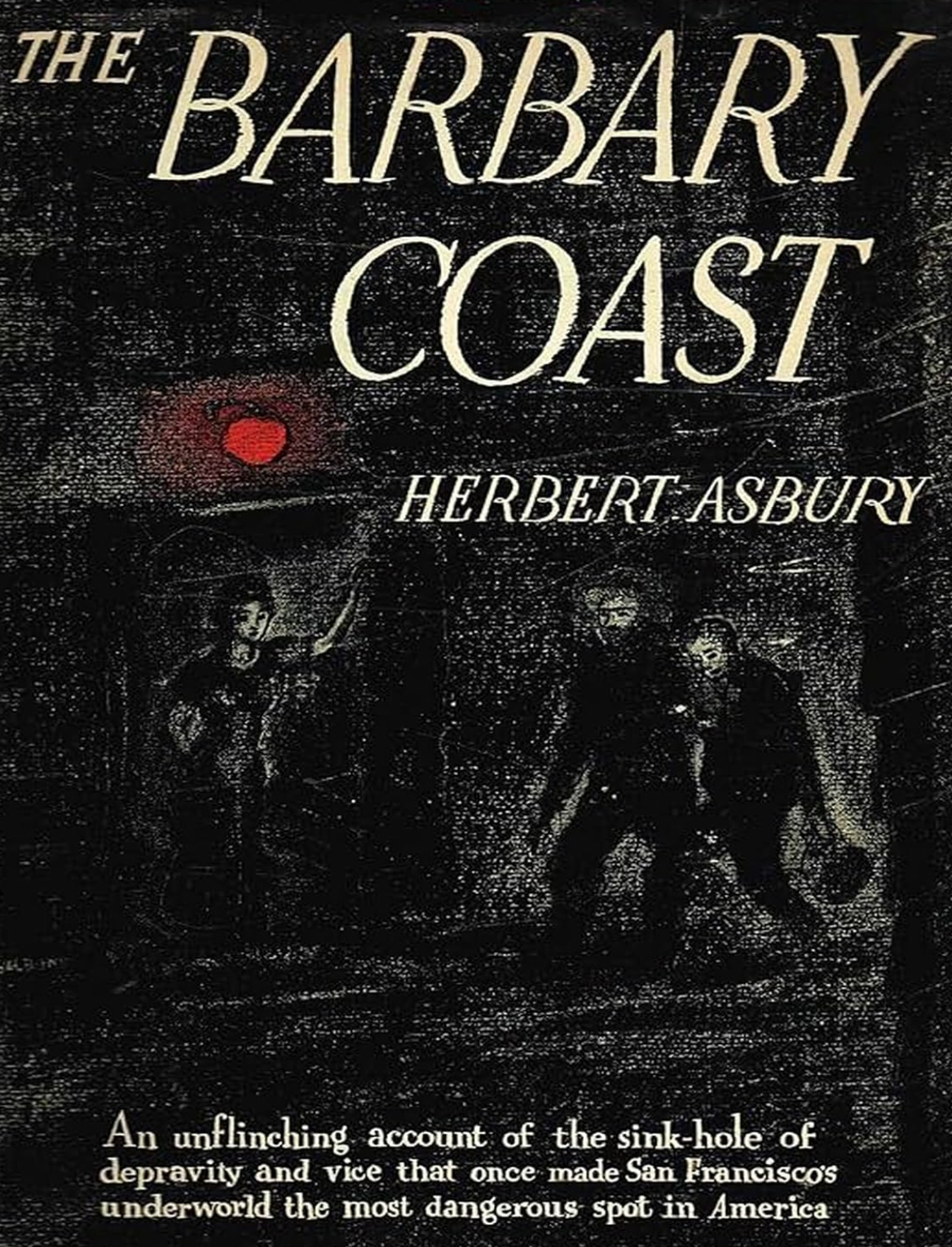
- A lovely history of the San Francisco underworld from approximately 1845-1910 or so. I’m a sucker for this time period. Asbury includes a bit too much detail but that has it’s own charm as well.
How I Discovered It
The lovely Amazon auto suggest feature. Also – I read Asbury’s “Gangs of New York” decades ago and knew what I was getting into.
Who Should Read It?
Fans of the city and the genre.
Highlights
Brannan hurried overland to meet Brigham Young. He tried unsuccessfully to induce the Mormon leader to abandon his plan of settling in the valley of the Great Salt Lake and urged him to lead the whole body of Mormons into California and build up a strong Mormon state in the territory surrounding the Bay of San Francisco, which he represented as possessing an incomparable climate and soil of extraordinary fertility.
None of this money was ever remitted to the Church at Salt Lake City, and when Brigham Young made formal demand for “the Lord’s share,” and also for a share of Brannan’s personal earnings, Brannan retorted that he would pay upon a written order signed by the Lord, and not otherwise.
Brigham Young several times dispatched his holy gunmen, better known as Destroying Angels, to San Francisco to deal with Brannan and collect the money by force. But the Angels were invariably met in the desert, and their wings clipped, by Brannan’s “exterminators,” fighting men whom he is said to have employed as a bodyguard for half a dozen years.[3]
During the height of the gold excitement, there were at least five hundred ships stranded in the harbor, some without even a watchman on board, and none with a crew sufficiently large to work her. Many of these vessels never sailed again.
By the beginning of 1850 the city had a permanent population of at least twenty-five thousand, most of whom were adult males under forty, and had become the foremost American port on the Pacific, a distinction which it retained until the phenomenal rise of Los Angeles. Several
Many of these repulsive rodents attained such size and ferocity that they were more than a match for a terrier, and they often attacked sleeping men, biting large chunks from ears, noses, and cheeks.
The exact number of gambling places in early San Francisco was never determined, but there were at least several hundred; perhaps as many as a thousand.
The most popular games were monte, faro, rondo, roulette, rouge et noir, and vingt-et-un. Poker was comparatively unknown, for the restive San Franciscans, and the miners who regularly risked the proceeds of their back-breaking toil, considered this prince of gambling games too slow. They
the amazingly high cost of living and the extraordinary opportunities for frittering away money, everyone in early San Francisco was supremely confident that he would soon be able to return home with an incalculable amount of gold. Everything was conceived on a vast scale, and there was always plenty of cash available for any scheme that might be proposed, no matter how impossible or bizarre it seemed. No one hesitated to borrow money, although for several years the prevailing rates of interest ranged from eight to fifteen per cent a month, payable in advance, and even higher unless gilt-edged security was provided.
Many, at a loss how else to exhibit their prosperity, employed dentists to put their own gold into their teeth. If they had no teeth that required attention, they had good ones dug out and gold ones substituted.
Together with male natives of these and other Central and South American countries, they were known in San Francisco by the generic name of Chilenos, or, contemptuously, “greasers.”[18]
Moreover, it was at least as cosmopolitan as the remainder of the population; it has been said that by the end of 1852 there was no country in the world that was not represented in San Francisco by at least one prostitute.
If anyone protested that he carried no weapon, the statement was considered so preposterous that he was promptly searched. Almost invariably a knife or a fire-arm was found secreted in some unusual part of his clothing.
When the mob seized her, there was a great roar of “Give her a fair trial and hang her!” which aptly expressed the sentiment that prevailed throughout California.
Particularly susceptible to this sort of jingoism were the fifty or sixty young thugs who comprised an organization known at first as the Hounds and later as the San Francisco Society of Regulators. Despite this highsounding title, they were never anything more than an aggregation of thieves and ruffians, whose principal occupation was maltreating the SpanishAmericans. Under pretense of a fervent and belligerent patriotism, the Hounds beat, stabbed, and shot the helpless Chilenos whenever opportunity offered; systematically extorted gold and jewelry from the few who had acquired wealth; burned and otherwise destroyed their tents and cabins; and made frequent forays against the colony of harlots at Clark’s Point and on the slopes of Telegraph Hill, where they raped the women, tore down their shelters, and carried off their meager belongings.
None of these penalties was actually inflicted, however, for the politicians did not fail the Hounds in their hour of peril. Within a few days all of the young thugs had been released. But they were so frightened that they made no effort to reorganize, and soon afterwards most of them left San Francisco.
No man dared touch him, for all knew that if he was molested, or even angered, he would return with his desperadoes and torture and kill every soul in the place.
Murieta threw down his rifle, raised his hands, and called to Captain Love: “Shoot no more. The work is done.”
The head of the outlaw chieftain, and the mutilated hand of Three-Fingered Jack, were severed from their bodies, placed in large bottles of spirits, and brought to San Francisco.
Because the hair on the head continued to grow, it attracted much attention for several years, particularly among the superstitious Mexicans. Eventually it found its way into Dr. Jordon’s Museum of Horrors, in Montgomery Street, on the outskirts of the Barbary Coast. It was destroyed in the earthquake and fire of 1906.
There, in particular, gathered the ruffianly larrikins from the frontier towns of Australia, and the escaped convicts and ticket-ofleave men from the British penal settlements at Sydney, in New South Wales, and on the island of Tasmania, then called Van Diemen’s Land. This wave of undesirable immigration, which to all intents and purposes was one hundred per cent criminal, began to wash against the shores of California about the middle of 1849, in direct and open violation of an old Mexican statute which forbade the entry into the territory of persons who had been convicted of crime in other countries.
Every grog shop is provided with a fiddle, from which some half-drunken creature tortures execrable sounds, called by way of compliment, music.
But too often this dignitary was of the type of an early Alcalde named Meade, who knew little law, but who had a violent antipathy toward Mexicans and cigarette-smokers. To admit being either or both was tantamount to conviction in his court.
During the half-dozen years that followed Alcalde Geary’s first attempt to form a reputable municipal government, an average of almost two murders a day were committed in San Francisco—and at no time in that period did the city have a population of more than forty thousand.
Three-fourths of San Francisco lay in ruins when the fire finally burned itself out, but the task of rebuilding was begun with characteristic energy and dispatch. Within ten days the wreckage had been cleared away and three hundred buildings erected, while hundreds more were under construction. By June 1 business and life in general were proceeding almost as usual.
This witness was heard, but, under questioning, at length admitted that he had not seen Jenkins for several days. He was, it appeared later, a professional alibi witness for a large group of Sydney Ducks.
By far the most powerful politician in early San Francisco was David C. Broderick, a New York saloon-keeper and Tammany henchman who became a United States Senator and was at length killed in a duel by Judge David S. Terry of the California Supreme Court.
From the middle of 1851 to his death, in 1859, Broderick was, for all practical purposes, in absolute control of San Francisco’s political machinery.
Under the protection of the politicians the dives, bagnios, and hide-aways of Sydney-Town began to reopen, and the Sydney Ducks and other criminals who had been deported or frightened away by the Vigilantes of 1851 gradually returned. By the middle of 1855 San Francisco was again a hell-roaring swirl of crime and debauchery; once more the city swarmed with murderers, thieves, burglars, gamblers, prostitutes, and swindlers of every degree. And within another six months conditions were at least as bad as they had ever been at any time during the early days of the gold rush. “Assassinations, murders, and hangings constitute the leading materials of the budget of news in San Francisco,” said a New York newspaper in January 1856.
while a considerable number of respectable citizens sincerely believed that such an illegal usurpation of authority was a greater source of danger than a continuation of the corruption under which San Francisco was laboring. Among the latter was William T. Sherman, then engaged in the banking business, who later became General in the United States Army.
The Governor’s proclamation had appointed William T. Sherman, who had gained considerable fame as a soldier during the Mexican War, as Major-General of militia and had commanded the members of all volunteer companies, and all other persons subject to military duty, to report to General Sherman and assist in subduing the insurgents. Fewer than a hundred men answered the summons.
King was born in Georgetown, Maryland, and was the son of William King. As a youth he worked in Washington, where he found thirteen other James Kings. To avoid confusion he called himself James King the son of William, which he soon shortened to James King of William.
In later times the Barbary Coast meant only the single block on Pacific Street between Kearney and Montgomery streets, a short stretch of dangerous and disreputable thoroughfare, which was also widely known, after the middle eighteen-nineties, as Terrific Street.
Every variety of vice and crime was almost constantly on display. For many years, and especially during the eighteensixties and eighteen-seventies, it is doubtful if a night passed in which the Barbary Coast was not the scene of at least one murder and of innumerable robberies.
Occasionally a girl earned as much as fifty dollars a week, practically all of which she gave to her pimp, who promptly spent it on another woman, as has been the custom of his kind from time immemorial.
The Morgue was also headquarters for the many drug addicts, better known in those days as hoppies, who lived in the alleys of Chinatown and the Barbary Coast.
Occasionally they earned a few pennies by showing the holes in their arms to tourists. Few of the hoppies could afford a hypodermic needle; instead, they used an ordinary medicine dropper, filling it with cocaine or morphine and forcing the point into their flesh. They obtained most of their supplies of narcotics at an all-night drug-store in Grant Avenue, where enough cocaine or morphine for an injection cost from ten to fifteen cents.
In that year the city granted the right to sell beer, whisky and other intoxicating beverages to 3,117 places, or one for every ninety-six inhabitants. And there were at least two thousand blind pigs, or blind tigers, as speakeasies were called in those days, which operated without licenses. The
when the United States census showed a total of 71,328 scattered throughout the state. More than half, however, were in San Francisco. The number began to decline immediately after the passage of the Ten-year Exclusion Act in the spring of 1882, and the influx from the Flowery Kingdom was definitely stopped by the Scott Exclusion Act of 1888, which specifically forbade the importation of Chinese laborers.[41]
The Chinese settlement has always been confined within a small sliver of territory some seven blocks long and three blocks wide, and although for almost thirty years thousands of Orientals arrived in San Francisco every year, nearly all of them managed to find both lodging and business opportunity in this restricted area.
Four years later, in 1889, another official investigation placed the number of Chinese in San Francisco at 45,000, of whom about one-third were women and children, including slaves.
Despite the activities of the steamship and railroad companies, the constitutional convention of 1878 was overwhelmingly antiChinese, and the state constitution as ratified by the voters of California in the spring of 1879 reflected the prevailing attitude. It forbade the employment of Chinese by corporations, debarred them from the suffrage, annulled all contracts for coolie labor, directed the Legislature to provide for the punishment of any company which imported Chinese, and imposed severe restrictions upon their residence in the state. The popularity of these stringent provisions was further attested in September 1879, when a secret ballot was taken at the regular election on the question of permitting the entry of the Chinese. Only 833 votes, out of a total of 155,471, were cast in favor of unlimited settlement by the Orientals.
Still another imposed a fine of from ten to fifty dollars upon “any person found sleeping in a room containing less than five hundred cubic feet of space for each person.” This law made the slumbers of practically every Chinaman in San Francisco illegal.
Its first appearance as a common noun was probably in 1872, when the Sacramento Weekly Union of February 24 asked editorially if the boys of that city were to be “trained as polite loafers, street hounds, hoodlums, or bummers?” Within five years the word was in general use throughout the United States and had taken its proper place in the American language as the peculiarly apt designation of a young rowdy of criminal tendencies. The exact derivation of “hoodlum” is unknown, and probably always will be, in common with many other words and phrases of journalistic parentage.
All of these hoodlums, of whatever age, possessed a violent antipathy to the Chinese and tormented them at every opportunity and in every conceivable way.
Such effective repartee by the police, however, was rare; usually the hoodlum was accorded comparatively gentle treatment. Not until about 1890 did the San Francisco police learn what the New York police had already known for more than fifty years—that the best cure for hoodlumism is the frequent application of locust or hickory to the hoodlum’s skull. Once the police had acquired this knowledge, the power of the rowdies rapidly declined.
some five years after his encounter with the carriage-painter he was caught committing a robbery. He was convicted and sent to San Quentin Prison for fifteen years, and the reign of this human billy-goat as King of the Hoodlums and pet of the prostitutes was ended.
By the latter part of 1854, when the yellow population of San Francisco numbered only a few thousand, the upper end of Sacramento Street and the eastern side of Grant Avenue were lined with gambling houses. They were crowded both day and night, for the Chinaman is probably the most persistent and reckless gamester on earth; he will, ordinarily, bet on either side of any proposition, no matter how fantastic. Most of the Celestial gambling resorts of the early days were small and poorly furnished; in few was there room for more than three to six tables.
most spectacular and at the same time the most powerful agencies in the underworld of Chinatown were the tongs, which were always deeply involved in every evil scheme concocted in the quarter. The complete history of these extraordinary associations probably never will be written. It is extremely doubtful if any white man has ever thoroughly understood the innumerable ramifications of tong influence or been privy to the intricacies of their organization and methods, despite the fact that they are as American as chop suey. Like that celebrated dish, they are unknown in China.[53]
The boo how doy, popularly known as hatchetmen or highbinders, received regular salaries, with extra pay for exceptional bravery in battle, and bonuses based on the number of men they killed.
But from the ranks of the boo how doy came many killers of great renown, whose exploits entitle them to rank beside the best of the gunmen produced by the white man’s gangland.
Many murder mysteries in early San Francisco were never solved because of this practice of shipping the corpus delicti to sea as a live sailor; many crimps did a flourishing business in so disposing of the victims of criminals who had found that the easiest way to rob a man was to kill him first.
All of Miss Piggott’s regular customers knew the exact location of the trapdoor and kept away from it, for it was an unwritten law of the establishment that any man who stood upon the fatal spot was fair game.
A frequent visitor to the Cobweb Palace was William Walker, the famous Central American filibuster who, with his long, black cloak and big, floppy hat, was a familiar figure in San Francisco for several years. Once when Walker poked with his cane at a cobweb, Warner remarked: “That cobweb will be growing long after you’ve been cut down from the gibbet.” It was only about three years later that Walker was shot by a firing squad in Honduras.
The origin of the custom of putting a dime in a pocket of the rifled raiment is unknown in present-day San Francisco, although the coin was obviously meant for car-fare home.
In common with most reformers, however, he was not long content to confine his activities to the special field in which the value of his work was unquestioned and in which he had the support of every right-thinking citizen; he was soon heavily engaged in what might best be described as a general denouncing business. Scarcely a week passed in which the newspapers did not contain at least one statement of violent protest signed by him, and scarcely a sermon did he deliver in which something or someone was not denounced in language which left no doubt as to his meaning. He inveighed against public dancing as vicious and immoral and against the nickelodeons as possessing the same undesirable attributes; he condemned most of San Francisco’s trolley cars, and especially those which traversed Kearny Street, as “dance halls on wheels . . . full of lewd women and beastly men”; and during his latter years he fell into the habit of fulminating against practically every public amusement and pastime which threatened to obtain a foothold in San Francisco.
After a Saturday-night inspection of the brothel, when he found the hallways swarming with drunken men and saw things which he had supposed went out of fashion with the destruction of Sodom and Gomorrah, Father Caraher immediately launched a vigorous offensive. He found the heads of the police department and other city officials in a somewhat sympathetic mood, for the blatant depravity on exhibition at the Nymphia had caused considerable talk even among the hardened debauchees of the Barbary Coast.
If there were no women on the trolleys, the conductors usually shouted: “All out for the whore house!”
For many years the reform element, particularly the clergy, successfully advanced the curious argument that since the brothels could not be abolished, fear of disease would keep men from frequenting them; they never seemed capable of realizing that vice regulated, even to a slight extent, is vice in retreat. They ignored the frequent warnings of reputable physicians and medical societies that venereal diseases were becoming alarmingly prevalent in all classes of San Francisco’s population.
Within a few minutes after the earth had ceased to rock, sixteen fires were throwing their menacing glare against the morning sky from as many sections of the city south of Market Street.
For two days the holocaust raged unchecked, while the trains and ferries, and the roads throughout the countryside, were crowded with frightened and unhappy refugees. The fire finally burned itself out, but not until it had destroyed 28,188 buildings in 522 blocks, covering an area of more than four square miles, or 2,593 acres, of which 1,088 acres were north of Market Street. The property loss was estimated at about four hundred million dollars, while 315 persons were known to have lost their lives, and 352 had been reported to the police as missing. Only a few were ever found.
periodic crusades against Judge Carroll Cook, revealed that they were two officers of Judge Cook’s branch of the Superior Court. Harrington and his associates changed the name of the resort to the Dash, and remodeled the interior, installing a row of curtained booths on either side of the dance-floor. They also discharged most of the dancing girls and in their places employed male degenerates who wore women’s clothing.
By the middle of October the Barbary Coast lay, as the San Francisco Bulletin said, “harmless as a serpent bereft of its fangs.”
The backbone of the Barbary Coast had been broken by the Examiner’s crusade and the action of the Police Commission in the autumn of 1913. In the language of the prize-ring, the Coast was punchdrunk; it could do nothing but wait hopelessly for the knock-out blow.